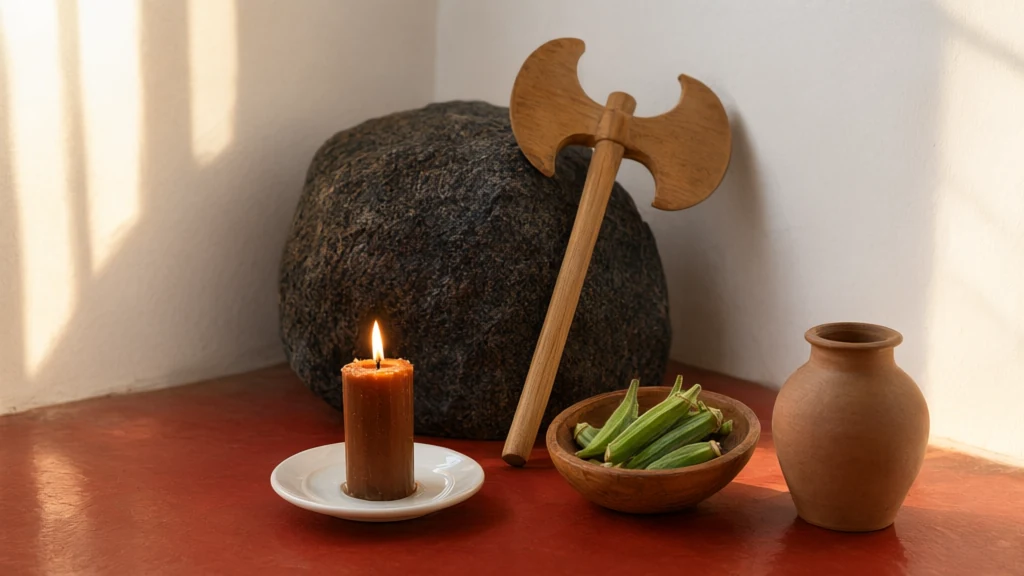
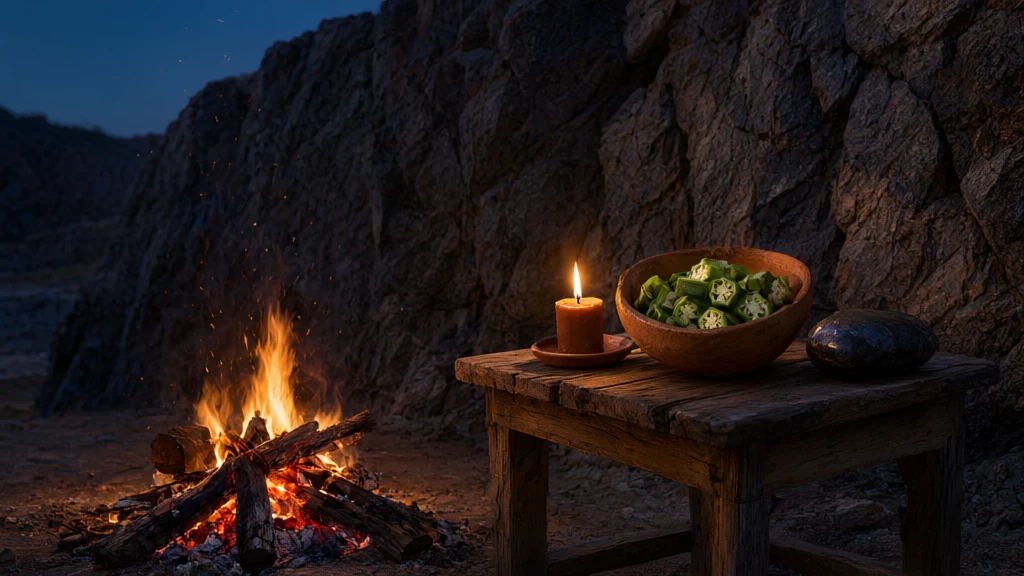
Xangô is the orixá of thunder, lightning, and justice, who Yoruba mythology tells was king of Oió before becoming an orixá. In Brazil, he is greeted with Kaô Kabecilê and has Wednesday as his day. Everything told about his life comes from myths: "There are no historical records of the life of Xangô on Earth," write Reginaldo Prandi and Armando Vallado.
| Candomblé ketu | Umbanda | Batuque (a gaúcha house) | Candomblé angola | |
|---|---|---|---|---|
| Name | Xangô | Xangô | Xangô | Nzazi, or Zázi |
| Colors | alternating red and white beads; red, brown, and white clothing | brown; in some houses, brown, red, and white | red and white | white, orange, red, and brown |
| Day | Wednesday | Wednesday | Tuesday | not listed in the source |
| Greeting | Kaô, kaô Kabiessi | Kaô Kabecilê or Caô Cabiecilê | Kao Kabecilê | not listed in the source |
| Food | okra amalá in dendê with dried shrimp | amalá | not listed in the source | dibangulango, sautéed okra in dendê |
| orixá | Saint Jerome and Saint John | Saint Jerome, Saint John the Baptist and Saint Peter | Saint Jerome and Saint Michael Archangel, in another house | not listed in the source |
Symbol: oxê, the two-blade axe | Stone: edun ará, the lightning stone | Wives in myths: Oiá (Iansã (Oya)), Oxum (Oshun) and Obá | Rhythms: alujá and tonibobé
The ketu comes from the tables of Prandi and Verger. The Umbanda comes from the federations and houses cited below. The batuque is that of Ilé Àsé Odé and Iemanjá (Yemoja), and the angola, that of Inzo Tumbansi. Each house may do things differently, and this is a fact of the worship. The short profile of the orixá is in Xangô on the orixás page.
Who is Xangô: the king of Oió who became an orixá
Obá means king in Yoruba. It is also "one of the epithets of the orixá Xangô," explain Prandi and Vallado in the chapter "Xangô, king of Oió" (Edusp, 2010). Prandi is a full professor of Sociology at USP; Vallado is a babalorixá of the Candomblé Casa das Águas.
The genealogy they reproduce from the myth begins with Odudua. Odudua had a son, Acambi; Acambi's seventh son was Oraniã, king of Oió; and Xangô is the son of Oraniã. Xangô is, therefore, the great-grandson of Odudua. The mother changes according to the version: the princess Iamassê, or Torossi, daughter of Elempê, king of the nupes.
Before reigning in Oió, Xangô was "the great warrior who governed Cossô," a neighboring city of the capital. He dethroned his older brother, Ajacá, called Dadá, who was sent to a small city with a crown of búzios. Pierre Verger, in Orixás, tells that Dadá stayed in Igboho during the seven years of Xangô's reign and returned to the throne later.
As king, Xangô also judged. Prandi and Vallado write: "As obá, Xangô was also the highest magistrate of his people, the supreme judge." From this comes the lord of justice. After death, he was divinized, and the cult grew "to the point that the king of Oió, from then on, was his first priest."
Verger reads Xangô in two coexisting planes: the "historical" and the "divine." In the divine plane, he "punishes liars, thieves, and wrongdoers." For the set of deities of which he is a part, see what the orixás are.
The myths of Xangô: the fire of Iansã and Obá Kossô
The most told itã is in Mythology of the orixás, by Prandi (2001), and Prandi and Vallado reproduce it in its entirety. Xangô sent his wife Iansã to the land of the baribas to seek a magic potion. On the path she tasted the liquid, spat, and "Iansã spat fire!". The rivalry and partnership of the couple are in Iansã and Xangô and in who is Iansã.
Xangô began to cast fire from the top of an elevation. "The people, terrified, called that lightning", and the crash became thunder. One day "the obá missed his aim and set fire to his own palace", and Oió turned to ashes. General Gbaca defeated him and expelled him. By ancient custom, the king guilty of a misfortune was forced to take his own life. The myth says that Xangô hanged himself in the forest.
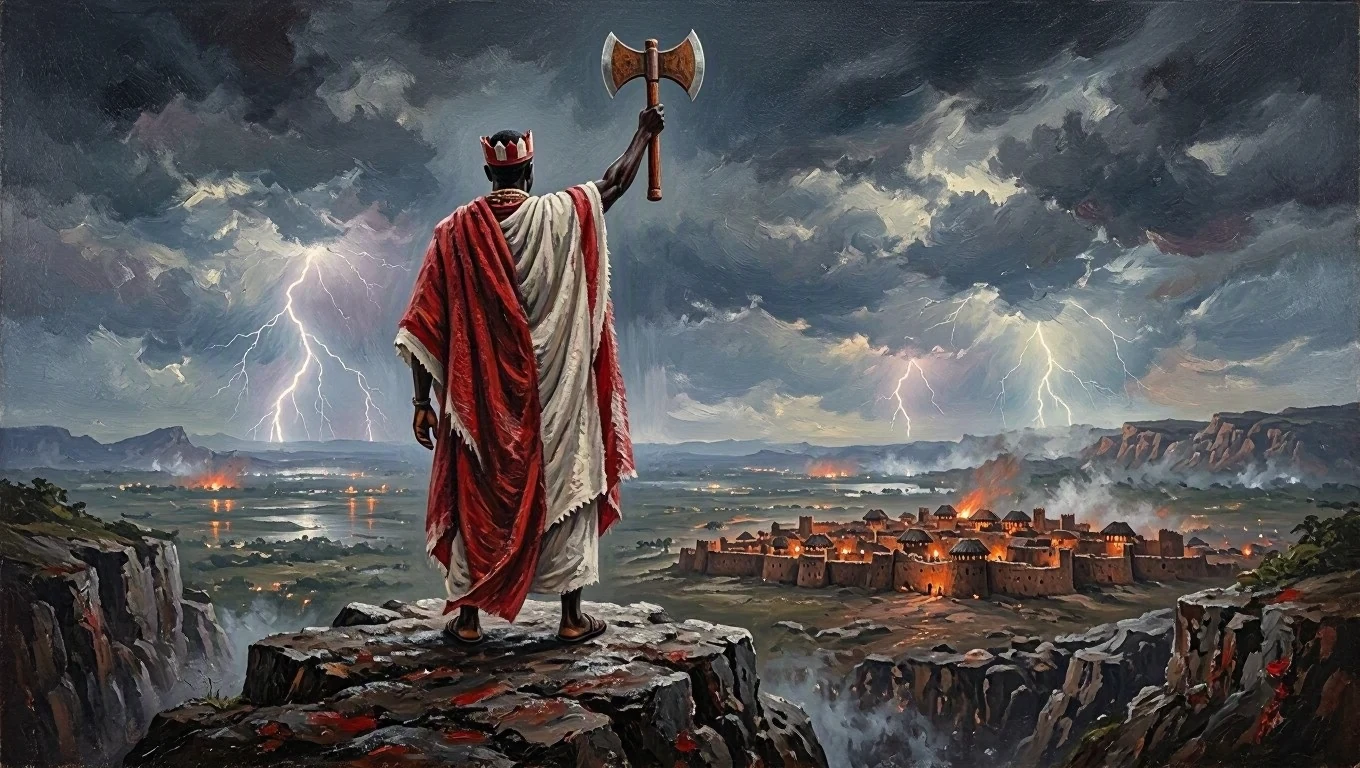
The body was not found, and the supporters shouted "Oba ko so!", "The king did not hang himself!". Prandi and Vallado warn that the expression "is evidently ambiguous": it could be "King of the city of Cossô" or "The king did not hang himself", which stands as "Long live the King". Verger gives the first reading: Xangô kept from Kossô the title of Oba Kòso. In the quality of Obacossô, who makes him an orixá is Iansã, who "asked Olodumare" for the transformation.
Verger gives Xangô three wives: "Oiá, Oxum and Oba". The other two have their own profiles in who is Oxum and who is Obá. In another itã by Prandi (p. 257 and 258), reproduced by Felipe Rosa and Waldmir Araújo Neto in Xangô: fire, matter and transformation, Iansã finds Xangô hidden under an acocô, "his sacred tree". The refrain says: "Oiá is the one who holds Xangô's back".
With Ogum (Ogun), the relationship is one of dispute. Andreas Hofbauer, in the review of Mythology of the orixás, summarizes: "The fight between Xangô and Ogum seems thus eternal." In the Afonjá myth, Xangô buried Ogum with stones. He won, but "on that day and only on that day." The other side is in who is Ogum.
Third or fourth king of Oió? What Verger and Prandi say
The sources do not match, and the most honest thing is to show both accounts.
- Third: Verger writes that, "as a historical figure, Xangô would have been the third Aláàfìn Òyó". Pedro Nogueira, in a dissertation at UFJF, writes "the third sovereign of this nation".
- Fourth: Prandi and Vallado tell that Ajacá "was crowned third Alafim of Oió" and that Xangô was "crowned the fourth Alafim." Hofbauer records the same in a myth of Mythology: "In a myth Xangô is cited as the fourth king of Oió".
The two versions agree on the order that matters: Oraniã, the father; Dadá-Ajacá, the older brother; then Xangô. Neither of the open sources explains why the count results in one king more or less. Prandi and Vallado's own summary says that Xangô "would have been one of the first rulers" of Oió.
The oxê, the lightning stone, and the justice of Xangô
The symbol of Xangô is the oxê, "double axe" in Prandi's table. Prandi and Vallado explain the two blades: "His double axe aims for justice for each of the two sides that oppose each other in the dispute." In the same table, the area he sponsors is "government, justice courts, bureaucratic occupations".
The stone is the edun ará, the lightning stone. Verger notes that these "edùn àrá (in reality, Neolithic axes)" stay over a wooden mortar, the odó. In the quality of Jacutá, Xangô is "the lord of the edun-ará, the lightning stone".
Lord of the sound of thunder / Lord of the mortar / Oiá disappears in the land of Irá / Xangô disappears in the land of Cossô. Oriki translated by Prandi and Vallado
There are things that Xangô does not accept. Verger says it is "formally forbidden to offer him white beans of the sèsé species". In the xangô of Recife, Rita Segato recorded that he "is the only orixá who cannot enter the 'balé room'", the room of the eguns (Anuário Antropológico).
The food is amalá. In Prandi's table, it is "okra cut into slices cooked in dendê with dried shrimp." Verger describes the Yoruba version, made of yam flour with okra sauce. What to take and where to deliver it is in offering for Xangô; the preparation, in amalá of Xangô.
Xangô in Brazil: Barroquinha, Recife, mina and Batuque
Xangô arrived with the Yoruba of the 19th century, when Brazil began to receive Yoruba enslaved people "in large quantities". Prandi and Vallado recount that "the first Yoruba temple in Bahia was, emblematically, dedicated to Xangô", born from a brotherhood of the Barroquinha church. At Casa Branca do Engenho Velho, "The terreiro is of Oxossi and the main Temple is of Xangô", according to the Geledés.
The Axé Opô Afonjá, by Mãe Aninha, “is also dedicated to Xangô”. There she created the obás of Xangô, twelve ministers, six on the right and six on the left, each with two substitutes. For Prandi and Vallado, Candomblé is “a kind of miniature memory of the African city that the black man lost.”
Outside of Bahia, the name changed function:
- Pernambuco: “the primacy of Xangô ended up giving its name to the entire religion of the orixás”, known as xangô there and in other states of the Northeast. Roberto Motta, from UFPE, separates xangô, jurema and umbanda as three distinct religions in Recife.
- Tambor de mina: Xangô is Badé, "the name by which Xangô is revered in the temples of tambor de mina". Prandi's table gives the voduns Badé and Quevioso. See tambor de mina.
- Batuque: in Rio Grande do Sul, "nação Oió" names terreiros of Yoruba origin. A house in Rio Grande do Sul, the Ilé Àsé Odé e Iemanjá, gives the types "Agodô, Aganjú and Aganjú ibedji". The Gaucho worship is in Xangô no batuque.
- Angola: the parallel is the inquice Nzazi, which Inzo Tumbansi calls "God of justice" for being the lightning. Parallel, not the same: see the inquices do candomblé de angola.
In Salvador, the Pedra de Xangô, in Cajazeiras, "is an Afro-Brazilian sacred natural site".
Qualities of Xangô, Airá and the children of the orixá
In Candomblé, each orixá is divided into qualities. In Bahia, Verger heard that "there are twelve Xangô", a list in which "a certain confusion reigns": Dadá is a brother, Oranian is a father and Aganju is a successor. Prandi and Vallado describe five, "in the liturgy of some terreiros": Agodô, Obacossô, Jacutá, Afonjá and Baru. Afonjá "is the Xangô of the royal house of Oió". Each one, with myth, color and dance, is in qualities of Xangô.
Airá is a separate case. For Prandi and Vallado, "the most common is to consider Airá as a white Xangô", although there are those who treat him as a different orixá. Verger says that the Airá wear white and use "blue beads (segi)" instead of red corals. Already Airá Intilé receives from Obatalá a "red and white" necklace. The Revista Philologus records that many houses see Xangô and Ayrá as a single deity. The detail is in Ayrá, o orixá. Prandi and Vallado close with the words of Pai Pércio de Xangô, babalorixá of the Ilê Alaketu Axé Airá: "It is all Xangô".
The quality of each son, write Prandi and Vallado, is determined by the pai or mãe de santo, in the jogo de búzios. In Prandi's table, a taboo of the sons of Xangô is "contact with the dead and cemeteries". The portrait and the quizilas are in filhos de Xangô. The teste do orixá serves to start the conversation, not to replace the house.
Xangô in Umbanda: the line of justice
In Umbanda, Xangô is a line of ritual work, and the lists vary from author to author. In 1933, Leal de Souza placed Xangô in the fourth of the seven lines, under Saint Jerome, with ritual offerings (despachos) "in the quarries". For him, the color of the line was purple. The Santuário Nacional da Umbanda calls it "Sixth Line".
“The line of Xangô practices charity under a criterion of relentless justice: who does not deserve, does not have; who does, pays.” Leal de Souza, 1933
In the list of Matta and Silva, reproduced by the researcher Sônia Lages (UFJF), the line has falanges such as Xangô Kaô, 7 Pedreiras and Pedra Preta, but "the classifications vary". The Núcleo Umbandista São Sebastião says that it gathers caboclos, pretos velhos and people who had functions linked to the law, "such as judges and lawyers".
In the houses cited here, the color that repeats is brown. FUCESP writes: "In Umbanda, brown; in Candomblé, red and white." TUCTVC uses brown, red and white bead necklaces and candles, and lists among the requests "Protection in legal matters". The offerings go "in the mountains and quarries". The single-color brown candle and the bead necklaces in the house colors are in our shop; to check what your terreiro requested, speak via WhatsApp.
Who descends, the color of the candle and what is requested are in Xangô na umbanda.
Day of Xangô and syncretism: Wednesday and the saints of each house
The day of the week is Wednesday in Candomblé and Umbanda. In the batuque of a house in Rio Grande do Sul, it is Tuesday. In June, "in most terreiros," the bonfire of Airá takes place. The festivals of the year change from place to place, and the day of Xangô has its own page with each date:
- June 24, Saint John: terreiros in Belém celebrate Xangô on the saint's day, according to O Liberal. In Rio, the priest Diego de Ogum brings the two together through fire and harvest, on CNN Brasil.
- June 29, Saint Peter: at Casa Branca do Engenho Velho, "one of the most important orixás of the community, Xangô Airá, is celebrated on this day" (Castillo and Parés). See day of Saint Peter, June 29.
- June 30: a Recife bill from 2022 proposes Xangô as "Guardian of the City" and the Day of Xangô on this date.
- September 30, Saint Jerome: is the date of TUCTVC, FUCESP, and the Sanctuary. In Capão do Leão (RS), the City Hall held the festival of the "Africanist Patron" on this day in 2017.
The saint also changes. Verger: "Xangô was syncretized with Saint Jerome in Brazil and with Saint Barbara in Cuba." Prandi's table gives Saint Jerome and Saint John. In Bahia, Saint Barbara was also linked to Xangô until the 1930s, according to an article from Revista Ingesta (USP). Nogueira explains Saint Jerome through the lion at the saint's feet, "one of the symbols of royalty among the Yoruba." According to TUCTVC, there are traditions that still bring him closer to Saint Joseph and Moses.
To approach is not to equate: syncretism, says the TUCTVC, "does not mean that the two figures are exactly the same deity". The history of the lion's saint is in Saint Jerome and Xangô; the entire month of June, in June saints and orixás; the year, in the calendar of the orixás.
Pontos and cantigas of Xangô
In Umbanda, Xangô is sung in pontos. The Livro de Pontos Cantados (Book of Sung Sacred Songs) of Tenda Espírita Nossa Senhora da Piedade, a house founded by Zélio de Moraes, brings 32 pontos of Xangô, without a composer. The first opens with "Pedra rolou Xangô / Lá na pedreira". The quarry returns in several, such as the one that asks "Rolai essa pedreira sobre mim" if faith is lacking. A cantiga with the same idea opens the report from Belém.
What is sung, when, and which pontos have an owner is in ponto of Xangô; the general rule, in pontos cantados (sacred songs) in Umbanda.
In Candomblé, Verger says that the rhythms of Xangô are "tonibobé and alujá". The site has three Ketu cantigas of the orixá, with lyrics and translation: Oba Sá Rewa, Oba Ní Sà Rè and Ikitê Re O Lokê Odô. At the festival, as Prandi and Vallado tell, the faithful ask passage for the king: "Let pass, let pass His Majesty", "Kaô, kaô Kabiessi". Verger records another form, "Kawó-kabiyèsíle", and translates: "Come see the King descend upon the Earth". How to greet each orixá is in greeting of the orixás.
Herbs of Xangô
The lists diverge, and the divergence is the answer. In two Candomblé terreiros in southern Bahia, Bianca Purcino (dissertation, UFSB) registered acocô, baobá, and orobô as consecrated to Xangô. Acocô is the tree of the itã of Iansã.
In Umbanda, the Terreiro Pai Maneco from Curitiba lists "Lemon leaves, Erva Moura, Erva Lírio, Coffee leaves, Mango tree leaves, Xangô herb". In a terreiro in Teixeira de Freitas (BA), the stonebreaker is only from Xangô, due to the name that reminds one of a quarry (Research, Society and Development). In the batuque of that house in Rio Grande do Sul, the herbs are "Arruda, yam and gervão".
The comparison by tradition is in Xangô herbs. Two plants in the collection have their own articles: the bay leaf, herb of Oxalá and Xangô, and the cinnamon, herb of Oxum and Xangô.
Frequently asked questions
Who was Xangô in history?
There is no historical record. Prandi and Vallado write that "there are no historical records of the life of Xangô on Earth" and that what is known comes from myths. In them, Xangô was king of Oió, son of Oraniã, and became an orixá after losing the throne. Verger reads him on two levels: the historical and the divine.
What does Obá Kossô mean?
Prandi and Vallado say that the expression is ambiguous. It could be "King of the city of Cossô", the city that Xangô governed before Oió. Or it could be "The king did not hang himself", the cry of the supporters when the body was not found. This reading counts as "Long live the King", and that is how his name is glorified in the terreiros.
Who is Xangô's wife?
Verger gives three wives: Oiá (Iansã), Oxum and Obá. In the myths cited here, Iansã brings the potion of fire and, in the quality of Obacossô, asks Olodumare that Xangô become an orixá. A house of batuque in Rio Grande do Sul also gives the three as wives.
What is Xangô's day?
During the week, Wednesday, according to Verger, Prandi and the Umbanda federations; in a house of batuque in Rio Grande do Sul, Tuesday. In the year, it depends on the place: June 24 (Saint John) in Belém, June 29 (Xangô Airá) at Casa Branca in Salvador and September 30 (Saint Jerome) in Umbanda houses in São Paulo.
Which saint is Xangô in syncretism?
Verger gives Saint Jerome for Brazil, and Leal de Souza also, in the Umbanda of 1933. Prandi's table adds Saint John, and FUCESP also cites Saint Peter. In Cuba, the saint was Saint Barbara. Syncretism is historical proximity, not equality between orixá and saint.
References
- Reginaldo Prandi and Armando Vallado, "Xangô, king of Oió", in Dos yorùbá ao candomblé kétu, Edusp, 2010: PDF on the author's site
- Reginaldo Prandi, "African Gods in Contemporary Brazil", Horizontes Antropológicos (UFRGS), 1995: SciELO
- Reginaldo Prandi, Mythology of the orixás, Companhia das Letras, 2001: entry on Google Books
- Pierre Verger, Orixás: deuses iorubás na África e no Novo Mundo, Corrupio, 1981: entry on Google Books
- Andreas Hofbauer, review of Mitologia dos orixás, Revista de Antropologia (USP), 2001: SciELO
- Rita Laura Segato, "Inventing nature", Anuário Antropológico, 1986: PDF
- Lisa Earl Castillo and Luis Nicolau Parés, "José Pedro Autran and the return of Xangô", Religião & Sociedade, 2015: SciELO
- Viviane Alves Caldas and Leonardo Jovelino Almeida de Lima, Revista Philologus, 2022: PDF
- Vagner José Rocha Santos, "The acará of Iansã in the feast of Saint Barbara", Revista Ingesta (USP), 2019: PDF
- Roberto Motta, "Xangô, Jurema and Umbanda", Revista del CESLA, 2020: PDF
- Pedro Antonio Pires Nogueira, dissertation, UFJF, 2014: PDF
- Sônia Regina Corrêa Lages, Exu (Eshu): luz e sombras, UFJF, 2003: PDF
- Leal de Souza, Spiritism, magic and the seven lines of Umbanda, 1933: PDF
- Felipe Andrade Rosa and Waldmir Nascimento de Araújo Neto, Xangô: fire, matter and transformation, 2025: e-book on eduCAPES
- Bianca Cristina de Lima Conceição Purcino, dissertation, UFSB, 2022: PDF
- Joyce Almeida dos Santos and Jorge Luiz Fortuna, Research, Society and Development, 2023: PDF
- Tenda Espírita Nossa Senhora da Piedade: Book of Chanted Points
- FUCESP: Xangô page
- TUCTVC: Xangô page
- National Sanctuary of Umbanda: Xangô
- Núcleo Umbandista São Sebastião: Xangô Line
- Terreiro de Umbanda Pai Maneco: Xangô
- Ilé Àsé Odé e Iemanjá: Orixás
- Inzo Tumbansi: Bankisi worshipped
- Geledés: Casa Branca do Engenho Velho
- O Liberal: Day of Saint John the Baptist and Xangô in the terreiros
- CNN Brasil: Saint John the Baptist and Xangô
- Câmara Municipal do Recife: proposition 6630/2022
- Prefeitura de Capão do Leão: III Festa de Xangô