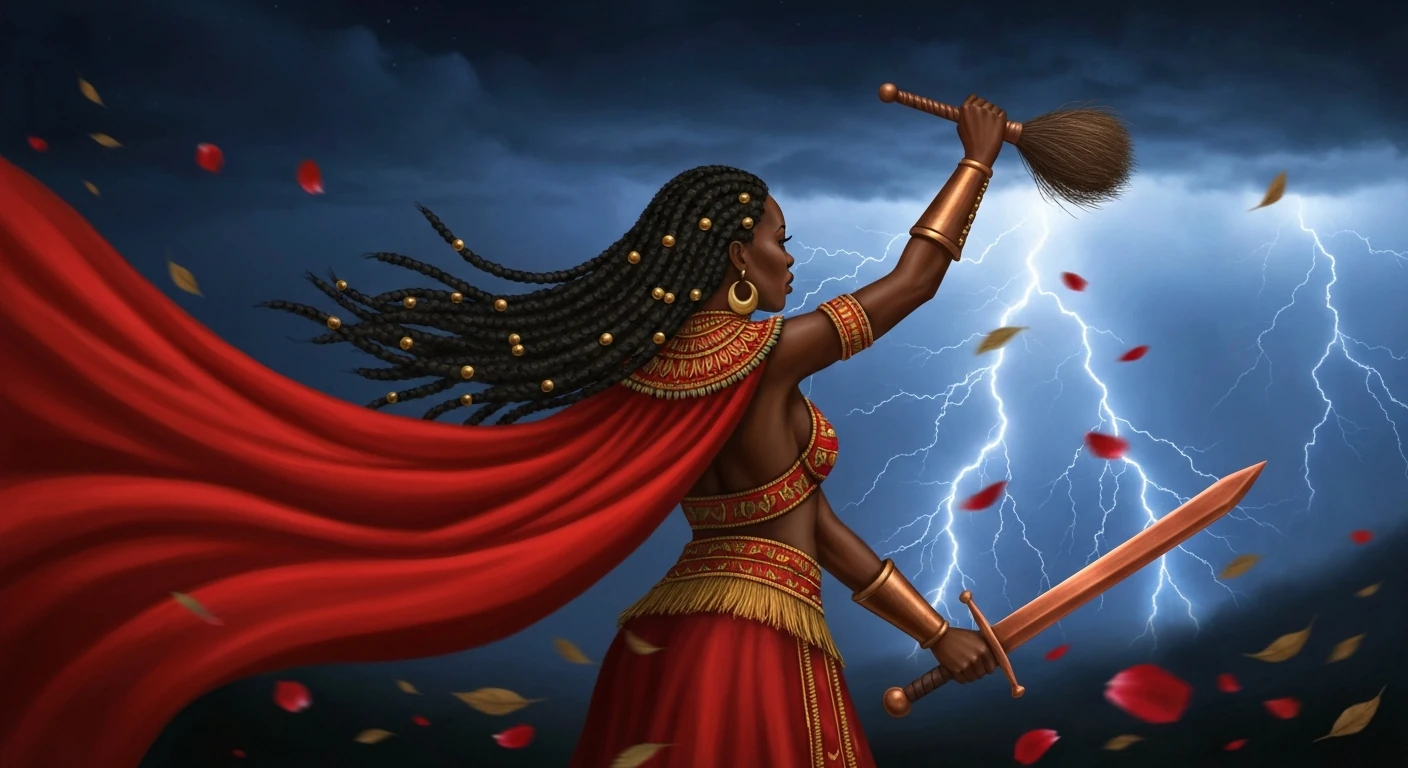
When the wind rises before the storm and the air begins to swirl without explanation, Afro-Brazilian tradition recognizes the passage of Iansã, the orixá of winds, lightning, and transformation. Mother of the nine heavens, lady of the Niger River, the only deity of the Yoruba pantheon who has power over the éguns, the spirits of the dead.
This guide gathers what practitioners, filhos-de-santo, and researchers need to know about Iansã: cosmology, technical profile, qualities, central myths, syncretism, and how to honor her with respect.
Who is Iansã in Yoruba cosmology
Iansã was born on the banks of the Niger River, in the region of present-day Nigeria, where she was called by the Yoruba people Oyá, a name that literally means "she who tears." The river carries the title to this day: Odò Oya, the river of Oyá.
The Brazilian name Iansã comes from the Yoruba title Ìyá Mésàn-Òrun, "mother of the nine spaces of Orum" of the nine heavens, of the nine children, of the nine storms. During the crossing of the Atlantic during the slave trade, Ìyá Mésàn was transformed, by the voices of the captives, into Iansã. The title became a name. The wind of the Niger became the wind of the Recôncavo.
More than the orixá of meteorological phenomena, Iansã is movement. The air that agitates. The breeze that turns into a gale. The calm that is broken. When something in your life needs to change direction quickly, it is Iansã who is invoked.
Technical profile of Iansã
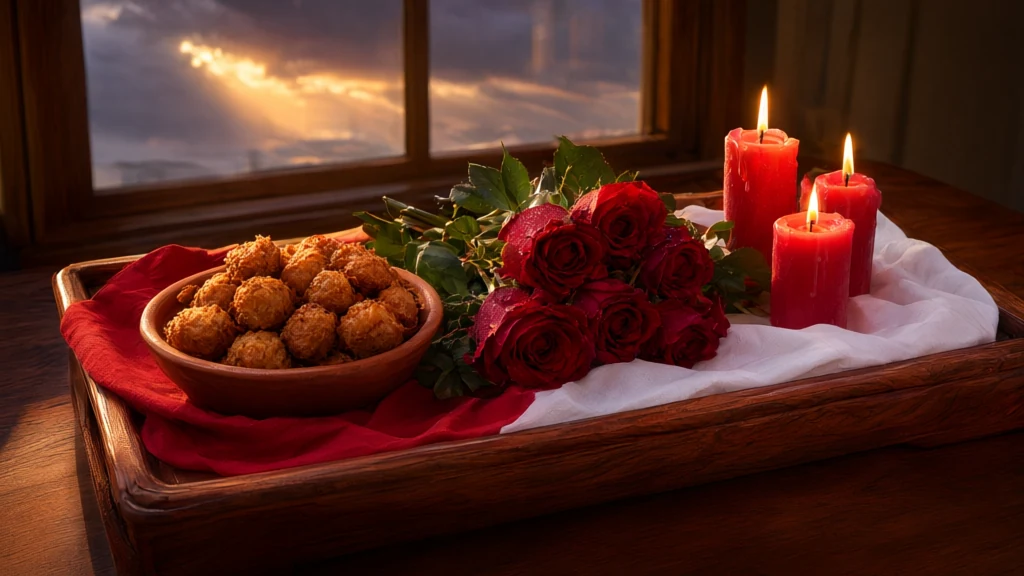
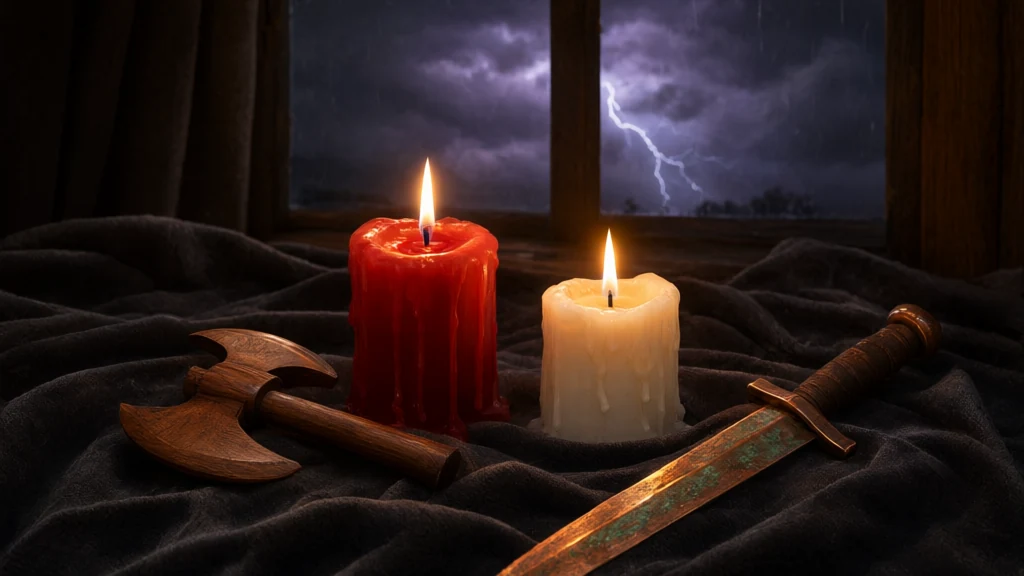
Names: Oyá, Oiá, Iansã, Iyá Mésàn-Òrun, Odò Oya Domains: Winds, lightning, storms, moving fire, Niger River, éguns (spirits of the dead) Colors: Red, brown/maroon and pink in Candomblé; gold-yellow in Umbanda, according to FUCESP (variations by nation and house) Day: Wednesday (see the day of Iansã in the week and in the year) Festive date: December 4 (syncretism with Saint Barbara) Element: Moving air; also fire, due to the association with lightning Symbols: Eruexim (ritual bundle of horsehair with a copper handle, to ward off éguns), copper sword, buffalo, lightning Greeting: “Eparrei, Oyá!” (also “Epa Hey”) Offerings: Acarajé, abará, black-eyed peas, fruits (silver banana, red apple, orange), red and yellow roses, white champagne, anise liqueur, white and red candles Bantu equivalent (Angola nation): Matamba (Bamburucema, Caiangô)
Iansã in Candomblé: ketu, jeje and angola
Candomblé is not monolithic. Iansã appears in each nation with its own foundation and language, and the experienced practitioner knows that these distinctions matter.
Candomblé ketu (nagô-yoruba)
It is in Candomblé ketu that the worship of Oyá arrives most preserved from Africa. Candomblé terreiros have been listed as heritage sites by IPHAN since Casa Branca do Engenho Velho, the first, with a decision in 1984 and registration in 1986. The list is in the text about the terreiros listed by IPHAN. The liturgical name is Oyá; “Iansã” is a title, used in prayers and chants. The qualities (paths or aspects of the orixá) are elaborated and transmitted orally. Academic sources such as Pierre Verger and Prandi list between 9 and 23 qualities, the most cited being:
- Oyá Igbalé "Oyá of the cemetery", who leads the éguns to the Orum. One of the most worshipped
- Oyá Messan / Mésàn "Oyá of the nine", referring to the nine heavens
- Oyá Onirá warrior quality, with a foundation that approaches Oxum (Oshun)
- Oyá Egunitá associated with fire and ancestry
- Oyá Tundê linked to rebirth and gratitude
- Oyá Timboá linked to wanderers and abandoned places
Important: the qualities vary between houses. The identification of the specific quality of each filho-de-santo is made by the pai or mãe de santo through the jogo de búzios never by reading an article or quiz. This list is introductory.
Candomblé jeje-ijexá
In the jeje tradition, of fon-ewe origin (Daomé), the name Iansã/Oiá is preserved, but there are proximities with Sobô, a female vodun associated with lightning. The worship has specific nuances, and the liturgical vocabulary draws from the fon languages.
Candomblé angola (bantu)
Here the change is greater. The energy equivalent to Iansã is called Matamba also known as Bamburucema or Caiangô. It is an inquice, not an orixá. Matamba governs winds, lightning, and the nvumbi (spirits of the dead, the angola equivalent to the éguns). Same symbolic field, distinct languages and foundations. Never treat as "the same thing with another name".
Iansã in umbanda
In Umbanda, Iansã is the orixá of movement, courage, and spiritual guidance. FUCESP records Wednesday, December 4, and the color gold-yellow. The greeting “Eparrei!” is universal, sung in classic pontos (sacred songs) such as “Eparrei, minha mãe, Eparrei, Oyá”.
Unlike Candomblé, Umbanda does not work on the elaboration of qualities with cowrie-shell divination. Iansã appears in the giras as the regency Orixá of the line and the spirits that work under her axé (caboclas, pretas-velhas linked to the line of Law) descend as spirit guides for disobsession, protectors in moments of transition. To deepen Bantu and Yoruba terminology, the Ancestralidades platform maintains a glossary curated by researchers in the field.
The central myths of Iansã
Yoruba oral literature and the books by Reginaldo Prandi and Pierre Verger hold the itans myths that explain who Iansã is beyond the technical sheet.
Iansã and Xangô (Shango)
Xangô is Oyá's definitive companion. She accompanies him in battles, learning from him the mastery of the lightning, the iná, the fire in motion in the air. According to Verger, when Xangô was dethroned and fled from Oyó, Iansã was the only wife who followed him. Where there is lightning, there is Xangô striking; where there is thunder and wind announcing, there is Iansã arriving first. The couple has its own article: Iansã and Xangô, the couple, the myths and the lightning.
Iansã and Ogum (Ogun)
Before Xangô, Oyá had a relationship with Ogum. A classic itan tells that she could transform into a buffalo and Ogum kept her animal skin, a condition for her to stay with him. Oyá accepted, under the promise that they would never mock this dual nature. From this cycle comes one of her symbols: the buffalo.
Iansã, the éguns and Obaluaê
This is the founding myth of Iansã's regency over the dead, narrated by Prandi in Mythology of the Orixás:
In a festival of the Orixás, Obaluaê arrived covered by his straw hood, marked by disease. The other Orixás refused to dance with him: they were afraid, they felt disgust. Only Oyá had courage. She spun with him, and the wind that rose in the spin lifted the straw, revealing Obaluaê in his healed beauty. In gratitude, Obaluaê shared with her his kingdom, the dominion of the éguns. Since then, Oyá Igbalé is the only Orixá to whom the spirits of the dead obey. With the eruexim, she leads the éguns away from the living and sends them to Orum.
Éguns are not demons. This is the most common misconception that persists. Éguns are ancestral spirits: people who lived, died, and are still in transit or already elevated. Iansã does not "control evil souls." She respects the éguns and is respected by them. The cemetery, in the Afro-Brazilian tradition, is a sacred space of axé and work with ancestry, not a place of horror.
Iyá Mésàn mother of the nine
In an itan cited by Verger, Oyá in her buffalo form spares the nine children. She leaves on each one's forehead the mark of the horns, saying: "If you need me, call through the horns." From this passage comes the title Ìyámésàn, mother of the nine heavens. It is the title that, through the voice of the diaspora, became Iansã.
Syncretism with Saint Barbara
On December 4, Brazil celebrates double: in popular Catholicism, it is the day of Saint Barbara, patroness of artillerymen, protector against lightning and storms; in the terreiros, it is the great festive day of Iansã.
This association is neither coincidence nor equivalence. It was a strategy of resistance. During enslavement, Africans and their descendants were forbidden from publicly worshipping their Orixás. For faith to survive, each Orixá was symbolically associated with a Catholic saint whose domain was similar. Iansã, Orixá of lightning, of the storm, of warrior courage, received the mantle of Saint Barbara, also a martyr, also linked to lightning.
Iansã is not Saint Barbara, and Saint Barbara is not Iansã. They are distinct figures, from distinct theologies, that history brought together out of necessity. Today, many devotees honor both on December 4, but each within its own tradition. Recognizing this syncretism as an act of cultural survival is recognizing the dignity of those who built it.
Children of Iansã
Tradition says that the children of Iansã carry a bit of their mother's wind. They are described as:
- Intense ones never go unnoticed in a room
- Courageous people enter confrontations that others avoid
- Impulsive ones decide quickly, change routes in seconds
- Temperamental ones feel in extremes, the good and the bad
- Just people cannot stand lies or hypocrisy
- Free ones do not tie themselves to places, routines, or people who limit them
- Natural leaders they lead when it is necessary to lead
Children of Iansã tend to live radical transformations throughout their lives: changes of city, of work, of bond, of spiritual path. The Orixá mother of the winds does not leave her child standing in the same place for very long.
How to honor Iansã
Honoring Iansã is less about complex rituals and more about connection with movement. Some traditional ways:
- Light a red or white candle on Wednesday, with the intention of courage, transformation, or guidance
- Place yellow or red roses in a vase at home, especially on days of important change
- Offer acarajé sacred food of the Orixá, also made as a symbolic offering on December 4
- Greet the strong wind when you feel it: "Eparrei, Oyá!"
- Cultivate courage is the daily exercise of her regency
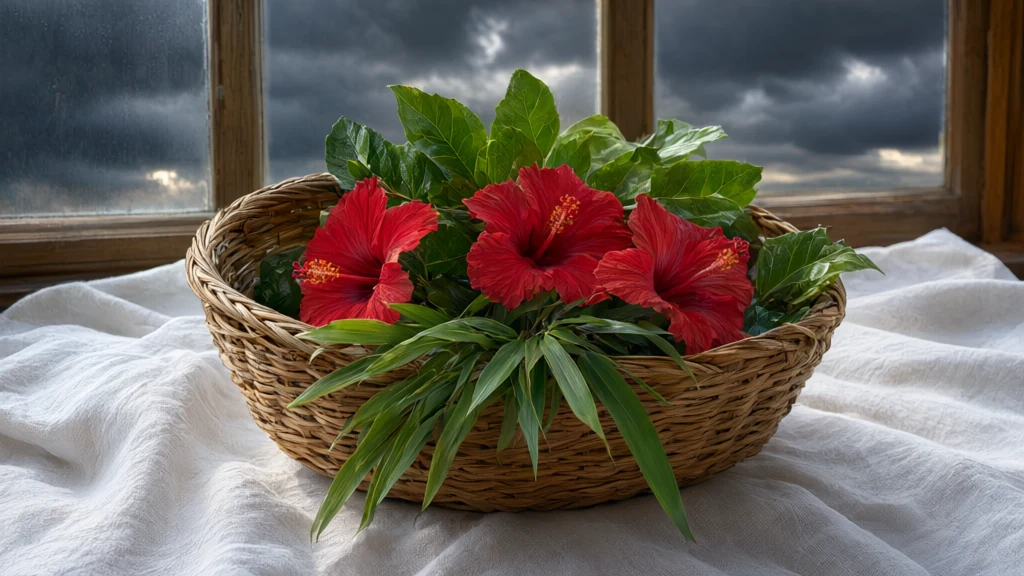
The herbs linked to Iansã vary from house to house, and some are toxic if ingested: see herbs of Iansã.
For deeper rituals or specific ritual work, seek a Pai or Mãe de santo from a traditional house. Feitura-de-santo and initiatory foundations are not blog readings, they are a lived path.
Frequently asked questions about Iansã
What does the name Iansã mean?
Iansã comes from the Yoruba title Ìyá Mésàn-Òrun, which means "mother of the nine spaces of Orum" or, in other words, mother of the nine heavens. It is also translated as "mother of the dusk" or "mother of the pink sky". The Brazilian name was consolidated by the voices of enslaved Africans, who transformed the Yoruba title into the spoken form in Portuguese.
What is Iansã's day?
Iansã is worshipped on Wednesday, the liturgical day of the week. The great festive date is December 4, in syncretism with Saint Barbara, when there are houses that celebrate with parties, offerings, and chants. The question of week or year, and whether it is a holiday, is in Iansã's day.
Is Iansã the same as Saint Barbara?
No. They are distinct spirits, from distinct traditions. The historical association between the two was born during the period of enslavement, and which researchers read as resistance and also as a complementation of beliefs. See Saint Barbara and Iansã. Honoring both on December 4 is recognizing this history without confusing the theologies.
Is Iansã the daughter of Iemanjá (Yemoja) and Oxalá (Obatala)?
This is a very repeated popular narrative, but not supported by the academic works of Reginaldo Prandi and Pierre Verger. The Yoruba tradition works with the relationships between the Orixás (Xangô's companion, Ogum's former companion, the one who received Obaluaê's éguns) rather than with family trees. It is better to speak of pantheon and bonds than of parents and children.
What is the personality of Iansã's children?
Intense, brave, impulsive, just, temperamental, frank in dialogue, thirsty for freedom, and natural leaders. Children of Iansã lived and will live profound transformations: she is the Orixá of movement, and those of her move.
Where to buy products to honor Iansã
At Joia Mística Laroyê, you find everything to celebrate and connect with Iansã:
- Red, white, and pink candles in the right sizes and colors for the Orixá
- Statues of Iansã in different materials and finishes
- Bead necklaces (guias) and other necklaces in Iansã's colors: red, brown, pink
- Dried roses and red crystals for dedicated altars
- Incenses and fumigants complementary in rituals of the Iansã line
- Ready-to-use baths prepared with intention and axé by Gleyzane
Visit our shop in Extrema, Minas Gerais or talk to us via WhatsApp and we ship nationwide. Every Wednesday is a day to light a candle for the mother of the winds.
Eparrei, Oyá!
References
- Decree-Law 25/1937, Presidency of the Republic: heritage listing
- Pierre Verger Foundation: the work of Pierre Fatumbi Verger on the orixás in Africa and the New World
- Ancestralities: glossary of terms and concepts about Iansã