Whoever arrives at the Batuque of Rio Grande do Sul quickly hears the religion being called Religião de Xangô. It is neither an exaggeration nor a casual nickname. The thunder of the orixá (orisha) runs through the Batuque from beginning to end, from the nations that have him as king to the drum that crowns the obrigações.
Next, why the Batuque carries the name of the king of thunder: its role as King of the nations, the alujá dance, and the Balance that judges the obrigações. In the end, there is still the Gaúcho syncretism with Saint Jerome, always with respect to the variation of each nation.
Why Batuque is called the Religion of Xangô
Three reasons combine for the Batuque to gain the name of the orixá of justice. They appear consistently in the sources about the religion:
- Xangô is the supreme King of two nations. In the Oió (Oyó) and Cabinda nations, he is the sovereign who organizes the pantheon.
- The greatest dance is his. The alujá, toque and dance dedicated to the orixá, is the crowning of the four-legged obrigações performed in the houses.
- He judges every obrigação. Even in the nations where he is not the king, it is in his chants that the Balance is made, the moment when the obrigação is confirmed.
Add these three things together and the result is clear: no orixá has such a central presence in the Gaúcho rite. Hence the nickname consecrated by use. It is worth saying that Religião de Xangô is a traditional name used by the povo de santo (the religious community), not a term coined by academics, but one that holds up on these foundations. To understand the religion as a whole, it is worth reading what is Batuque.
Xangô, the King of the Oió and Cabinda nations
Batuque is organized into nations, each with its own root, its chants, and its kings. In two of them, the orixá occupies the throne, as recorded in the Batuque entry on Wikipedia.
In the Oió nation, he forms the royal couple with Iansã (Oya) that concludes the order of prayers. The line moves from the oldest orixás to the newest and ends in Iansã, Xangô, and Oxalá (Obatala). In the Cabinda nation, the king is Xangô Camucá (or Kamucá), a path of the orixá linked to the ancestors, who brought the Cabinda cult to the South.
Even in the nations where another orixá is the sovereign, the thunder does not lose its importance: it continues as a reference of strength and order. To know all the roots of the religion, see the nations of Batuque and the order of the line of orixás.
Greeting: in Batuque, Xangô is greeted with “Káwó Kabiyesilé!”, which celebrates the arrival of the king. It is the same cry that echoes when the alujá begins.
The alujá: the greatest dance of Xangô
The alujá is the drum rhythm and the dance dedicated to the orixá, and it occupies a place of honor in the Batuque festival. It usually comes as the crowning of the four-legged obligations, the high point of the ritual work.
In the alujá circle, the chants narrate the king's deeds: his conquests, his power, and his dominion over thunder and justice. It is a moment of strength, in which the entire house reveres the sovereign. Being the dance that closes and celebrates the great obligations, the alujá helps explain why the king's name became attached to the religion.
A word of caution: we describe here what the alujá is as cultural information. The conduction of the rite belongs to the initiated and to the babalorixá or ialorixá of the house. Foundation is learned and practiced in the terreiro, with those who have axé for it.
The Balance: Xangô as the judge of obligations
Perhaps the most revealing point is this. When a four-legged obrigação is performed, the Balança (also called Cassum or Kasun) is done, a circle of pontos (sacred songs) that confirms the work. And it is done in the songs of the king, because he is the one who judges the obrigação.
The logic is powerful: regardless of the nation or the head orixá of the one performing the rite, the presence of Xangô is essential to validate the obrigação. He is the judge who gives harmony and firmeza to what was done, as described in portals about the Gaucho Batuque. That is why it is said that, in Batuque, every obrigação passes through the hands of the king.
Again, this is a cultural description, not a step by step. The Balança involves pontos (sacred songs) and fundamento (ritual foundations) led by the leadership of the house.
The qualities of Xangô in Batuque
Like every orixá, Xangô manifests in qualities (also called paths), and they vary from nation to nation and from house to house. The most cited in Batuque are:
- Xangô Agodô (Ogodô): oldest path, linked to authority.
- Xangô Aganju: young and severe quality, associated with firm land.
- Xangô Camucá (Kamucá): the King of the Cabinda nation, linked to the ancestors.
In some houses, other paths also appear. The golden rule is not to treat this list as closed: the number, spelling, and existence of each quality change according to tradition. For the general profile of the orixá, his weapons, and his myths, see the complete profile of Xangô.
The day of Xangô and the syncretism with Saint Jerome
In Afro-Gaúcho syncretism, Xangô is associated with Saint Jerome, celebrated on September 30. In Capão do Leão, the city hall holds the Xangô festival on this date. It is different from the June syncretism with Saint Peter and Saint John that appears in other regions and traditions. During the week, a house of Batuque, the Ilé Àsé Odé and Iemanjá (Yemoja), gives Xangô Tuesday, and not Wednesday. The dates of Xangô in the year are in Xangô day.
As in every Afro-Brazilian religion, syncretism here is a historical strategy of resistance, and not an equality between the Catholic saint and the orixá. Under the name of Saint Jerome, the worship of the orixá survived persecution and reached today's terreiros.
Xangô do Sul and Xangô do Recife: do not confuse
The name of Xangô baptized religion in more than one place in Brazil, and it is worth separating:
- In Rio Grande do Sul, "Religião de Xangô" is the nickname of Batuque, for the reasons we saw here.
- In Pernambuco and in other states of the Northeast, according to Reginaldo Prandi and Armando Vallado, "Xangô" names the very religion of the orixás of the region, the so-called Xangô do Recife or Xangô do Nordeste.
They are distinct traditions, each with its own history. What they have in common is the reverence to the same king of thunder.
Frequently asked questions
Why is Batuque called Religião de Xangô?
Because the orixá has a central role in the Gaúcho rite. He is the supreme King of the Oió and Cabinda nations, and his dance (the alujá) crowns the four-legged obrigações. Furthermore, it is in his chants that the Balança is performed, the moment when every obrigação is judged. This centrality gave the religion its nickname.
Who is Xangô in the Batuque of Rio Grande do Sul?
He is the orixá of justice and thunder, sovereign of the Oió and Cabinda nations. Together with Iansã, he forms the royal couple of Oió and, in the Cabinda nation, reigns as Xangô Camucá. Even where he is not the king, he acts as the judge of the obligations of the entire house.
What is the Balança in Batuque?
It is the circle of the ready ones that confirms a four-legged obrigação, performed in the chants of the king because he is the one who judges the ritual work. It is also called Cassum or Kasun. It is a foundation led by the leadership of the terreiro, not a practice to be done at home.
What is the alujá of Xangô?
The alujá is the toque and dance dedicated to the orixá, considered the greatest dance of Batuque. It usually crowns the four-legged obligations, with chants that celebrate the deeds and the power of the king. It is one of the most important moments of the religious festival.
Which saint is Xangô in Gaucho Batuque?
In the syncretism of the South, the orixá is associated with Saint Jerome, celebrated on September 30. It is a different association from Saint Peter and Saint John, the June festival saints of other regions, and it functions as a historical layer of resistance, not as equality between saint and orixá.
Where to find items to honor Xangô
At Joia Mística Laroyê, you find what you need to revere the king of thunder, with respect to tradition:
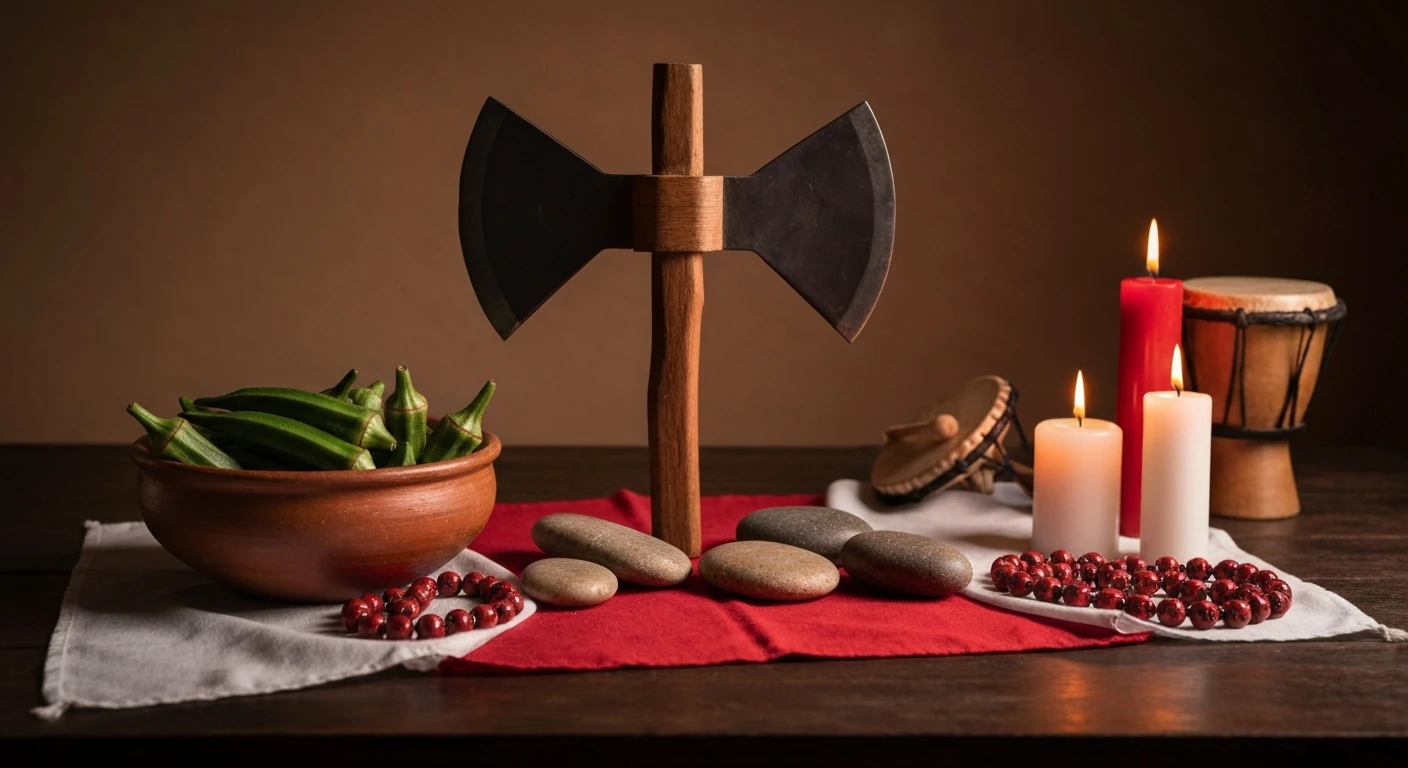
- Statues and tools of Xangô, such as the oxê (two-bladed axe)
- Red and white candles, the colors of the orixá
- Bead necklaces and firmas in the red and white colors of the orixá
- Ingredients for the amalá, the okra offering (see how to make Xangô's amalá)
- Alguidares and quartinhas made of clay
Visit our shop in Extrema-MG or talk to us via WhatsApp and we ship all over Brazil. In case of doubt about the use of each item, we offer spiritual guidance with responsibility.
References
- Wikipedia: entry about Batuque, an Afro-Brazilian religion from Rio Grande do Sul
- Candomblé: article about Batuque from Rio Grande do Sul as a religion of orixás
- Reginaldo Prandi and Armando Vallado (Edusp, 2010): Xangô, king of Oió
- Capão do Leão City Hall: III Xangô Festival, africanist patron of the municipality (2017)
- Ilé Àsé Odé and Iemanjá, casa de batuque: Orixás, characteristics and peculiarities