They say a child of Xangô enters the room and the room notices. The portrait of the children of Xangô is one of the most repeated when the subject is orixá. It is also one of the most misused, because it turns into a personality test in three clicks.
This article shows what tradition actually records about the child of the king of Oió, in light and in shadow, what the quality of the orixá changes in this profile and how the owner of the head truly discovers themselves.
The stereotype of Xangô, and what that word means
Before the characteristics, it is worth understanding where they come from. The sociologist Reginaldo Prandi, in Deuses africanos no Brasil, uses the word stereotype, not archetype. And he says where he got the material: field research in 60 São Paulo terreiros of Candomblé, with longer work in three houses.
This changes everything in the reading. It is not intuition from an astrology portal. It is a description gathered from the people of the religion (povo de santo), and Prandi records that the portraits largely match those gathered in Salvador, in Rio de Janeiro and in Africa itself.
In the case of Xangô, the portrait speaks of people who do well in justice, business and bureaucracy. People who feel they were born to be king or queen, stubborn, resolute and greedy, with an appetite for money, food and power. And who raise and protect the family beyond the usual, which makes them good friends and good parents.
The oldest formulation comes from Pierre Fatumbi Verger. He described the archetype as that of people who are willful and haughty, aware of their own importance, courteous in dealings, but incapable of tolerating contradiction. To know the divinity behind this, the text is who is Xangô.
The characteristics of the children of Xangô
Here is the point that almost no page says: the list of flaws of the child of Xangô is the same material as the list of virtues. It is the praise seen from the other side.
| In light | The same trait in shadow |
|---|---|
| Sense of justice, decides and upholds the decision | Judges quickly and does not review the verdict |
| Natural authority, occupies the environment | Authoritarianism, does not accept being contradicted |
| Generosity, likes a full table and sharing | Excess in food, in drink and in spending |
| Courage, faces conflict head-on | Anger that rises quickly, and passes quickly |
| Pride that upholds dignity | Prepotency and difficulty in apologizing |
| Charisma that attracts people | Vanity and scattered affective life |
| Protects the family with diligence | Overprotection and control |
No orixá is entirely good, nor entirely evil. The phrase is by Prandi, and he adds that Western notions of good and evil simply do not organize the religion of the orixás in Brazil.
No one gathers all these traits, and none of them is destiny. The theme of virtue and shadow in each orixá has its own page in what your orixá says about you.
It is also worth mentioning that these traits apply to both men and women. A daughter of Xangô is as just, as haughty, and as much in control of her own decisions as any son of the orixá.
Body and presence: what tradition describes
Field descriptions speak of a strong body, broad bone structure, open shoulders, medium stature, and a tendency to gain weight. They also speak of a haughty posture, a high chin, and a voice that imposes itself without effort.
And the same sources record the exception in the following phrase: there are also the thin and very elegant ones.
Keep this as a mythical portrait, and not as a diagnosis. Body does not determine orixá, and orixá does not determine body. Many people arrive at the terreiro expecting to find their own biotype on a list and leave frustrated, because that was never the function of the stereotype.
Quality changes the filho de santo
This is the point that separates a serious text from an internet test. Xangô is not just one. He runs in qualities, also called paths, and the quality rewrites the profile of the filho.
- Airá: the oldest Xangô, who walks with Oxalá. He wears white, and Airá Modé almost never takes dendê, only a drop, with segui beads instead of red coral. The son tends toward the serene, the moralist, the counselor. Some houses treat Airá almost as a separate orixá.
- Aganju: the young and warrior Xangô, of the firm land, of the volcano and the desert. He wears brown and red. The son leans toward the raw and the combative.
- Obá (Oba) Kossô: linked to the episode of Kossô and the affirmation that the king was not hanged, which reaffirms divine royalty. The son carries authority and a taste for prestige.
- Afonjá: the owner of the talisman received from Oiá, and the patron of Ilê Axé Opô Afonjá. The son is usually the most political of the Xangôs.
A son of Airá in white, without dendê, almost does not resemble a son of Aganju. And there are more names, including Dadá, the peaceful brother, who varies greatly from house to house. The complete list is in qualities of Xangô, and is not repeated here.
How the head orixá is confirmed
There is a single answer to this, and it is not on any website.
Prandi is direct: discovering someone's mythical origin is a religious prerogative of the pai or mãe de santo, through the jogo de búzios. This knowledge, he writes, is imperative in the initiation process. The houses add the bori as confirmation, and that is where the matter is settled.
Add to this the second orixá. Prandi records that each person has an associated divinity, the juntó, with an important role in defining behavior. Crossing the orixá de frente, the de junto, the quality of each one and the odu, he concludes that the variations serve as a model in an almost inexhaustible number. The subject is in orixá de frente and de junto.
That is: the strongest argument against reading horoscopes comes precisely from the researcher who cataloged the stereotypes. The right path is described in how to know which is my orixá.
What the son of Xangô cares for and uses
Whoever belongs to Xangô deals with a very well defined material set, and knowing it helps both the filho de santo and whoever wants to give a gift to someone from the house.
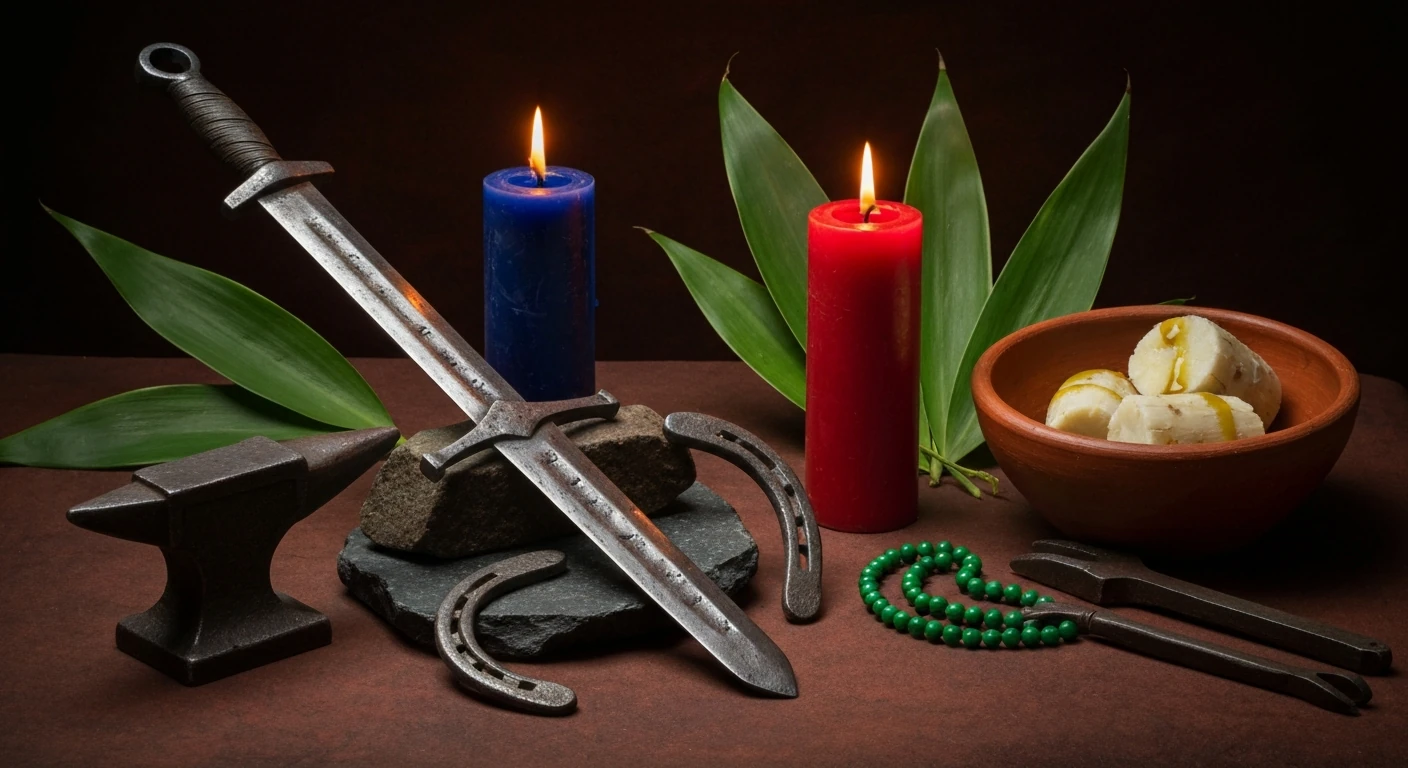
Xangô's Profile: red and white colors (brown or dark red in some paths, pure white in Airá) | day Wednesday | greeting Kaô Kabiesilé | tool oxê, the double-edged axe | lightning stone, the edun àrá | assentamento in a wooden gamela | syncretism with Saint Jerome, September 30.
His food is the amalá, the okra cut in dendê served over acaçá or yam, with the recipe in amalá de Xangô. And here it is time to debunk a rumor that circulates: okra is not a quizila of Xangô, it is his mark.
The most cited quizila is another, and it has an interesting twist. In the practice of the terreiro, Xangô does not deal with egum, the world of the dead, and this organizes a good part of the protection of those who belong to him. At the same time, the itans link Xangô himself to the origin of the cult of the eguns. Both things coexist in the tradition, and whoever explains the protection of your house is your leader. The domestic offering is detailed in offering for Xangô.
Frequently asked questions
What is the personality of the sons of Xangô like?
Tradition describes people with a strong sense of justice, natural authority and a generosity of a full table, who decide quickly and uphold the decision. The other side of these same traits appears as authoritarianism, pride difficult to bend and explosions of anger that rise and pass quickly.
How to know if I am a son of Xangô?
By a list of characteristics, one cannot know. The one who discovers the head orixá is the babalorixá or the ialorixá, through cowrie-shell divination, and the confirmation comes in the bori. Recognizing oneself in a portrait is a good starting point for looking for a serious house, nothing more than that.
What is the difference between a son of Airá and a son of Aganju?
Airá is the oldest Xangô, who walks with Oxalá, wears white and pulls the son toward the night air and the counselor. Aganju is the young and warrior Xangô, of the firm land and the volcano, who wears brown and red and pulls toward the combative.
Is a son of Xangô a brawler?
The portrait speaks of anger that rises quickly and passes quickly, not of a permanent brawler. Tradition associates this energy with indignation in the face of injustice, and not with a taste for conflict. Reducing someone to this trait is unfair, and the stereotype itself does not authorize the reading.
What is the day and the greeting of Xangô?
Wednesday in most Brazilian houses, and the greeting is Kaô Kabiesilé, also written as Kawó Kabiyesile, which translates as hail the king. The festive date changes with the house: at Casa Branca, in Salvador, June 29 is the feast of Xangô Airá; Umbanda houses use September 30, the day of Saint Jerome, and FUCESP adds June 24 and June 29. The dates are in Xangô day.
Where to buy Xangô material
At Joia Mística Laroyê, you find the material of the king of Oió with provenance:
- Bead necklaces (guias) in red and white: assembled or in loose beads for the house to consecrate
- Oxê of Xangô: the double-bladed axe, in metal and in wood
- Red and white candles: individual, seven-day, and in pairs
- Clay gamelas and alguidares: for the consecrated foundation (assentamento) and for the amalá
- Dendê, dried okra, shrimp and pemba: for the firmeza that your leader will instruct
Stop by the shop, at Rua Benedito Zingari, 460, Bela Vista, in Extrema-MG, or message on WhatsApp with delivery to all of Brazil.
One last word. The stereotype of Xangô served, in Prandi's research, as a model of identity for the people of santo to recognize themselves. It was never a report, never a sentence and never replaced the búzio of your house.
References
- Reginaldo Prandi: African gods in Brazil, with the stereotype of Xangô, the note of the 60 São Paulo terreiros and the definition of juntó, chapter I of Herdeiras do Axé (Hucitec, 1997), on the author's page at USP
- Augras and Correa: 1979 study that treats the identification of the owner of the head as a mythical equivalent of psychodiagnosis, with the authors' own caveat, Brazilian Archives of Psychology
- Wikipedia: entry about Xangô, with the paths of the orixá, the oxê, the amalá, Wednesday and the syncretism
- O Candomblé: terreiro text about the qualities of Xangô, with Airá Modé without dendê and the contas de segui
- Castillo e Parés, Religion & Society (2015): José Pedro Autran and the return of Xangô
- FUCESP: Xangô