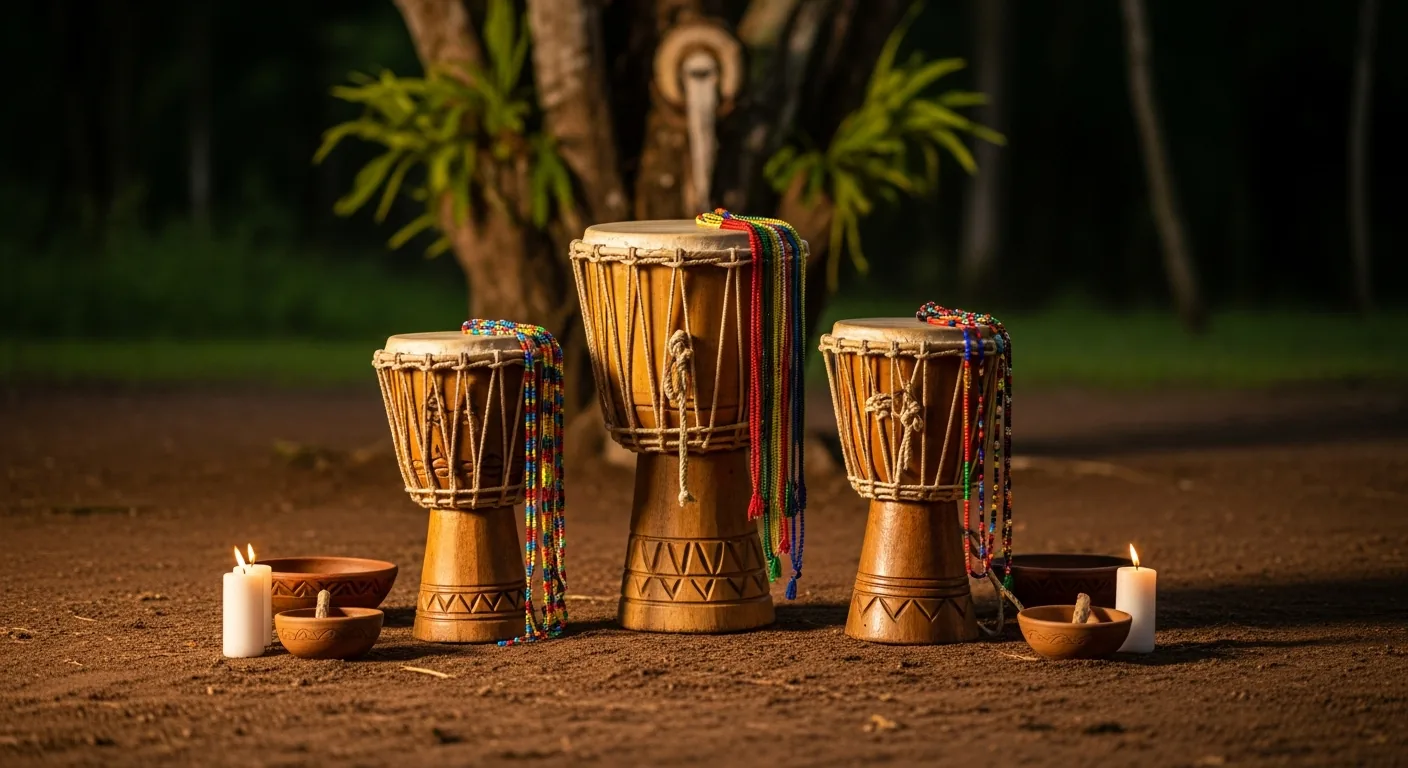
The inquices are the deities of Candomblé de Angola, the name the Bantu nation gives to the forces of nature that the Ketu nation calls orixás. Coming from the Kikongo word nkisi (receptacle of force), they guard the paths, the forests, the waters, the lightning, and the time, each with its own domain and a history brought from Kongo and Angola to the Brazilian terreiros.
This guide profiles the main inquices one by one: who each deity is, what their function is, and to which orixá they are approximated in the Yoruba pantheon. Before starting, it is worth the distinction that organizes everything that follows.
What are the inquices (and why are they not "orixás")
In Candomblé of the Congo-Angola rite, inquice (or nkisi, in the plural minkisi) is the deity worshipped. The word is Bantu and, in its African origin, designated a receptacle that concentrates spiritual force, and not just a "deity" in the sense that Brazil gave to the term. If you want to understand this journey of the word in detail, it is in the article what is a nkise.
Here, the practical consequence matters: inquice and orixá are not the same thing. They are distinct cosmologies, the Bantu world (Angola, Kongo) on one side and the Yoruba world (Ketu) on the other, with their own languages, myths, and rites. As Wikipedia summarizes, the inquices represent "the forces of nature themselves in essence," and not deified ancestors. The difference between the Ketu, Jeje, and Angola nations explains why each has its own sacred vocabulary.
Therefore, whenever this guide says an inquice "corresponds" to an orixá, read it as a historical approximation, never as a sign of equality. Nkosi recalls Ogum (Ogun) in the warrior function, but Nkosi is not Ogum. The correspondence helps those coming from Ketu to orient themselves, and nothing more. Above all the inquices is Nzambi (Zambiapongo), the creator God, who is not confused with any of these forces.
The correspondence with the orixá is a bridge for understanding, not an exact translation. Each house and each root keeps its own readings, and it is the zelador who confirms each case.
Inquices of the paths: Aluvaiá and the crossroads
Aluvaiá (also called Pambu Njila, Bombojira or, in the feminine form, Bombogira) is the guardian of the paths and the crossroads. He is the one who opens and closes the ritualistic paths, the messenger who links the material world to the world of the inquices. No obrigação begins without greeting him first.
In the Kikongo origin, its name comes from mpambu (bifurcation) and nzila (path): the crossroads itself, the point where roads meet and separate. Curiously, the Kongo tradition distinguishes two spirits that Brazil ended up merging into one: Mpambu Nzila, the guardian of the crossroads, and Mavambu, the director of all paths. This African granularity became a single figure in the Brazilian terreiro.
In the Yoruba pantheon, Aluvaiá is approximated to Exu (Eshu). The same warning applies: he is the lord of paths and communication, guardian of the house and the movement of life, and has nothing to do with the distorted image of a "demon" that prejudice attached to Afro-Brazilian religions.
Warrior and forge inquices: Nkosi and Mpanzu
Nkosi (Mukumbi, Roxi Mukumbe) is the warrior inquice, lord of the dirt roads and guardian of the terreiro. His name means "lion" in Kikongo, and the title Mukumbi comes from Ankosi Nkumbu, "Lord of Fame". He is the watchman who protects those who belong to the house and those who enter the sacred space. In parallel with Ketu, Nkosi is approximated to Ogum, the owner of iron and battles.
Beside him walks Mpanzu (Incoce), linked to the forge, to iron and to technology. Among the Bantu, the art of forging metal was sacred and fundamental for agriculture, hunting, and war, which makes Mpanzu a divinized ancestor of the lineages that dominated metallurgy. He also serves as a sentinel, and some houses read him within the same axis of Ogum.
Forest inquices: Mutalambô, Kabila and Katendê
The forest has its own owners. Mutalambô (Mutakalombo) is the hunter, ruler of the woods, master of land hunting and the waters, accompanied by the dog and the crocodile. He is the one who brings food and teaches the village to live off what nature offers. He corresponds to Oxóssi (Oshosi), the hunter of the Yoruba pantheon.
Kabila is the assistant hunter, the one who watches the entrance of the woods and shares the hunt equally among everyone. His philosophy is one of service to the community, and in Brazil he belongs to the same group (kanda) of Mutalambô's hunters. He is also read in the key of Oxóssi.
Katendê (Katendi) is the lord of the leaves and medicine, the owner of the science of herbs (jinsaba). Without him there is no axé, because every cure, every ritual bath, and every obrigação passes through the leaf. Katendê is approximated to Ossaim (Osanyin), the orixá of liturgical plants. In Africa, he was the guardian of fauna and flora, capable of transforming into an animal to punish those who invaded the woods with bad intentions. To know the universe of leaves that Joia Mística works with, see the herbs section.
Inquices of the earth, health, and ancestry: Kavungo and Nzumba
Kavungo (also Nsumbo, Tingongo, Impanzo, and Ntoto, according to the dissertation by Veridiana Silva Machado at USP; Cavungo and Cafunã in Reginaldo Prandi's table) is the inquice of the earth, health, and death. Machado summarizes the domain: "the force that acts on the earth, on the soil, as well as epidemic diseases, plagues, and healing." He is the parallel of Obaluaê and Omulu, not the same: FUCESP says "associated." His garments are made of raffia, and in Inzo Tumbansi, Kavungo's food is "Masangu (Pipoca)". An important quizila of his family is the pig, within the system of restrictions that you find in quizilas in Candomblé.
Nzumba (Nzumbarandá) is the deity of mud, decomposition, and ancestry, linked to what is oldest. It corresponds to Nanã (Nana Buruku). Here a divergence appears that is worth noting: researchers of the Kongo tradition consider the syncretism between Nzumba and Nanã an imperfect approximation, since Nanã belongs to the Jeje-Fon pantheon and Nzumba has Bantu roots, in the Balari. Brazil consolidated the reading, but the African origin is more specific.
Inquices of time, of lightning, and of the rainbow: Tempo, Zaze and Angorô
Tempo (Kitembo, Quitembo) is one of the most central inquices of the Angola nation, to the point of being called the "King of the Angola nation." He is the air, the wind, the seasons, and time itself passing. He is worshiped at the foot of a sacred tree, the white gameleira in Brazil, a heritage of the African worship of the Nsanda tree, with a mast and a flag that, when fluttering, announce his presence. Because he is an elemental force and not an ancestor, some houses approximate him to Irocô, the orixá of the sacred tree, as recorded in the Quitembo entry.
Zaze (Nzazi) is the lightning, the flash, and the fire, the divine justice that descends from the heavens. His colors are white and red, and the bonfire is one of his marks. It corresponds to Xangô (Shango), the lord of thunder and justice.
Angorô (Hongolo, in the feminine form Angoroméa) is the rainbow, represented by the serpent that collects water from the earth and takes it back to the sky. It is a force of renewal, movement, and communication between the high and the low. It corresponds to Oxumaré (Oshumare).
Inquices of the waters: Matamba, Dandalunda and Samba Kalunga
The waters guard three great ladies. Matamba (Bamburucema) is the queen of the winds, of the lightning and of the storms, linked to the aggressive waters of rivers in flood and to the guarding of the dead (vumbi). She is a warrior and feminine force, approached by Iansã (Oya) / Oyá.
Dandalunda (Ndandalunda, linked to Kisimbi) is the inquice of the fresh waters, of the springs, of the rivers and of the waterfalls, lady of fertility, of beauty and of wealth. In Brazil, she was strongly syncretized with Oxum (Oshun) around the 1940s and 1950s, although her original rites are distinct. Her ancient name, linked to the "guardians who guard the rain," carries the African memory of the Pleiades constellation announcing the rainy season.
Samba Kalunga (Kaitumba, Mikaia, Kaiala) is the force of the sea, the Great Kalunga. For the Bantu, Kalunga is at the same time the immense ocean and the world of the dead, the endless extension of Nzambi. Samba Kalunga is the mother who generates life, in the spiritual and material sense, and corresponds to Iemanjá (Yemoja).
Inquices of childhood and of peace: Vunji and Lemba
Vunji (Nvunji, Wunji) is the youngest of the inquices, the force of childhood, of innocence and of the protection of children and of the twins. It also responds for a justice of its own, linked to the character and the actions of each one. It corresponds to the Ibeji, the child orixás.
Lemba (Lembarenganga) is the inquice of creation, of peace and of serenity, treated by many as the "father of all inquices." It gathers masculine and feminine in the same force of balance, fertility and abundance, and in Africa it was linked to an ancient school of initiation. It corresponds to Oxalá (Obatala), the lord of peace and of creation.
There are still nkisi today that are little worshipped in Brazil, such as Ndundu, linked to the African Kimpasi worship and the figure of the great mother who multiplies the initiates. He appears mostly in chants and is remembered more as a memory than as a deity of common assentamento.
Zambi and the order of the pantheon
All these nkisi are organized under Nzambi (Zambiapongo), the supreme God and creator, who is above the forces of nature and is not settled like them. The nkisi are, in this sense, the paths through which the axé of Nzambi manifests in the world.
An observation on spellings: since Angola Candomblé is oral and has roots in kikongo and kimbundu, the names vary from house to house (Kavungo or Cafunjê, Nzazi or Zaze, Matamba or Bamburucema). No spelling is "wrong"; each root keeps its own. If you want to delve deeper into the vocabulary, the dialect of Angola Candomblé gathers dozens of translated words, and the Angola greetings bring how each deity is greeted.
The complete table of correspondence between each nkisi and its orixá, with the chants (muimbus) that praise them, is gathered in the article about the zuelas of Angola Candomblé.
Frequently asked questions
What are the nkisi in Candomblé?
Nkisi are the deities of Angola Candomblé, the bantu nation. The name comes from the kikongo nkisi and names the forces of nature (paths, forest, water, lightning, Tempo) that the ketu nation calls orixás. Each nkisi has its own domain and is worshipped with rites of Angolan and Congolese origin.
What is the difference between nkisi and orixá?
They are deities from different traditions. Inquice belongs to the Bantu world (Angola, Kongo) and orixá to the Yoruba world (Ketu), with distinct languages, myths, and cults. The correspondence between them (Nkosi and Ogum, for example) is a historical approximation that helps in understanding, not an exact equivalence.
How many inquices are there?
There is no fixed number. Brazilian catalogs usually work with about 16 to 19 main inquices, but the root and the house of each terreiro define which ones are worshipped. In Africa, the list of minkisi is even more extensive and granular than the consolidated version in Brazil.
How to know which is my inquice?
Who defines a person's inquice is the jogo de búzios, conducted by the zelador or the zeladora of the house. There is no online test or self-attribution that replaces this consultation. It is a ritual process, inside a house of the orixás (casa de santo), and not a curiosity that is resolved via the internet.
What is the most important inquice?
There is no single hierarchy, but Tempo (Kitembo) is treated as the "King of the Angola nation" and Lemba as the "father of all inquices". Above all is Nzambi, the creator God. Each house also has the inquice owner of its axé, who occupies a central place in that community.
Where to find items and statues of the inquices
At Joia Mística Laroyê, you find what you need to honor each inquice and its corresponding orixá:
- Statues and assentamentos: figures of the orixás linked to each inquice, from Ogum to Iemanjá.
- Ritual candles: in the colors of each force, from the white and red of Zaze to the white of Lemba.
- Herbs and leaves: the science of Katendê, for baths and fumigations.
- Bead necklaces and beads: in the color sequences of each divinity.
- Raffia and terreiro items: for the obligations of the Angola nation.
Visit our shop in Extrema, Minas Gerais or contact us on WhatsApp with delivery to all of Brazil.
References
- Veridiana Silva Machado, dissertation, USP, 2015: The staff of Lemba
- Reginaldo Prandi, Horizontes Antropológicos, 1995: African gods in contemporary Brazil
- FUCESP: Obaluaê page
- Inzo Tumbansi: Bankisi worshipped
- Wikipedia: entry on the inquice in the Bantu tradition
- Wikipedia: entry on the inquice Quitembo (Tempo)