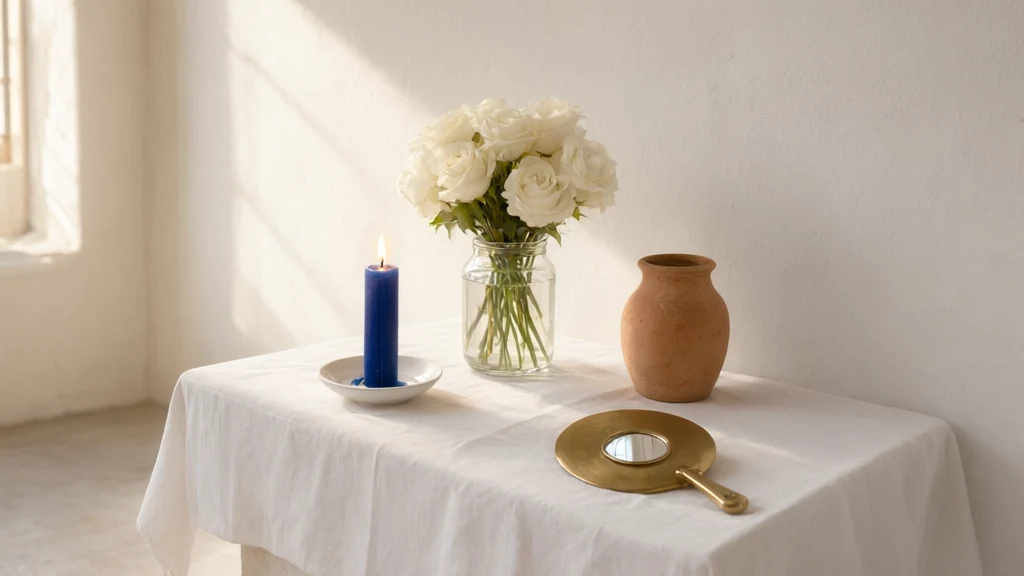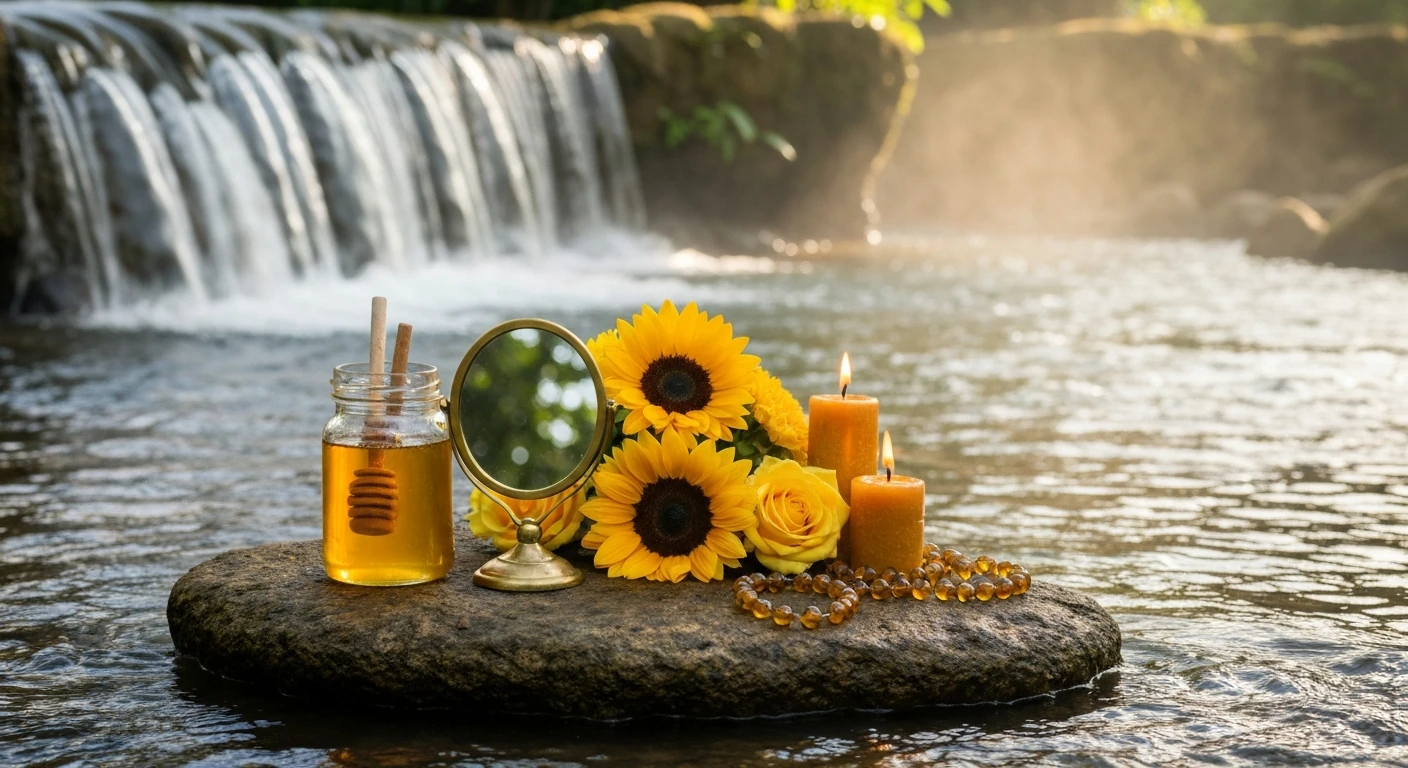
Oxum is the Yoruba orixá of the river of the same name in Nigeria: lady of fresh waters, gold, love, and fertility, greeted with Ora Yeye O and worshipped on Saturdays. To understand who Oxum is in Brazil, it is worth separating the traditions: in Ketu Candomblé she wears yellow and gold and dances with the abebê; in Umbanda, her color and place change from house to house.
The box below says where each piece of data comes from. What changes between nations and terreiros appears as a variation, because it does vary.
Who is Oxum: the orixá of the Osun river
Oxum is born from a river that truly exists. "Oxum is the divinity of the river of the same name that flows in Nigeria, in Ijexá and Ijebu," writes Pierre Verger in Orixás (1981), and "she is the queen of all rivers and exercises her power over fresh water." On the banks of this river, on the outskirts of Osogbo, is the Sacred Forest of Osun, considered the goddess's home and inscribed as a World Heritage site by UNESCO in 2005. Verger says that the city's name comes from Òsun gbo and that the annual festival of offerings to Oxum celebrates the arrival of Laro, the founder of the dynasty.
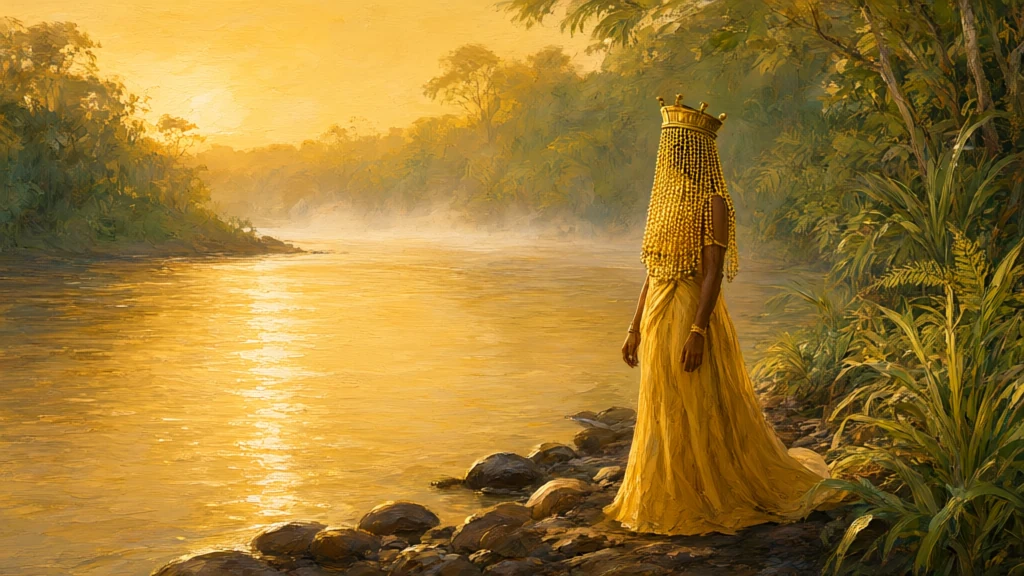
Among the titles of the Orixá, two say a lot about her place in the pantheon. Iyalodê (Ìyálóòde) is, in Verger's words, the "title conferred upon the person who occupies the most important place among all the women of the city." Yeyê means mother, the same word as the greeting Ora Yeye O.
Verger also records "Oxum's love for copper, the most precious metal of the Yoruba land in ancient times." From the wealth of copper to the wealth of Brazilian gold, the foundation remains: in Reginaldo Prandi's table for Ketu Candomblé, she is "orixá of fresh water and precious metals." For this reason, she is worshipped as the lady of prosperity: not wealth through accumulation, but the abundance that circulates and generates life.
And it is in life that her greatest dominion lies. Prandi places love, gold, fertility and gestation and vanity under Oxum's guard. The philosopher Aline Matos da Rocha, reading Oyèrónkẹ́ Oyěwùmí, recalls that in Yoruba cosmology Oxum is "primordial ìyá," mother of humanity: to reduce Iyalodê to love and vanity is to lose half of her.
Oxum technical sheet
Names and titles: Oxum, Òsun, Iyalodê, Yeyê Oxum Domains: fresh waters (rivers, lagoons and waterfalls), love, gold, fertility, pregnancy and vanity, according to Prandi (1995) Colors: in ketu candomblé, "yellow or gold with a little blue" (Prandi); in umbanda it varies by house: blue, almost always dark blue, in most houses, and yellow in others Day: Saturday Festive date: varies by region: December 8 in the South and in Sergipe, October 12 in umbanda houses in the Southeast, July 16 in Recife (all on Oxum day) Element: fresh water Symbol: abebê, yellow metal fan, almost always with a small mirror in the center; and the sword Metal: gold and copper Greeting: "Ora Yeye O!", which Verger translates as "Let us call upon the Mother's benevolence" Food (ketu candomblé): omolocum, black-eyed pea puree decorated with five boiled eggs (Prandi) In the angola nation: fresh water inquices, such as Samba and Quissambo (Prandi) or Ndanda-Nlunda (Inzo Tumbansi)
The Oxum card on the site, with the illustration, is in Oxum on the orixá page.
Oxum in candomblé: ketu and angola
In candomblé ketu, of Yoruba roots, the orixá is worshipped with the rites, chants and axé brought from Africa. In Prandi's table for Ketu rite terreiros, the emblem of Oxum is the "abebê: yellow metal fan; sword", and the food is omolocum. Verger describes the dance: it resembles a vain woman who bathes, shakes brass bracelets and "contemplates herself with satisfaction in a mirror", to the sound of the rhythm called ijexá. In the festivals, Oxum is called with chants in Yoruba, such as Adé Kojú Iyá, Yá Badé Lodô and Yeye Yeyê Ô.
Like the other orixás of ketu, she unfolds into qualities: paths or aspects of the same Orixá, with their own foundations. Verger explains that in the river of Oxum there are many deep places where she is worshiped with different names. Among them:
- Oxum Apará (or Opará): "the youngest of all, with a warrior spirit"
- Oxum Abalu: "the oldest of all"
- Oxum Ijumu: "queen of all the Oxuns"
- Oxum Ipondá: with Erinlé, mother of Logunedé (Logun Ede), according to Verger
The entire list and what each path holds are in qualities of Oxum.
Important: the qualities vary between houses and nations. There are others besides these, and each terreiro keeps its own foundations. The identification of the orixá and the quality of each filho-de-santo is done by the pai or mãe de santo through cowrie-shell divination (jogo de búzios), never by reading an article or an internet test.
In the angola nation, of bantu matrix, the divinity of fresh waters is not an orixá, but a inquice. Prandi's table gives Samba and Quissambo; Inzo Tumbansi worships Ndanda-Nlunda, "female divinity linked to the waters of the rivers". Even the same symbolic field, distinct tradition: treating the inquice as "the Oxum of angola" is a shortcut that erases the real diversity of candomblé. In the gaúcho batuque, Oxum has her own side and foundation, recounted in Oxum no batuque.
Oxum in umbanda
In Umbanda, the place of Oxum depends on the author and the house. In 1933, Leal de Souza, from the house of Zélio de Moraes, listed seven lines and none were of Oxum; she appeared as "Mãe Axum (Oxum)," one of the invocations of Maria. Matta and Silva, cited by Sônia Lages (UFJF), puts Cabocla Oxum as a falange of the Iemanjá (Yemoja) line. The National Sanctuary of Umbanda says that Oxum "composes the first part of the Third Line of Umbanda that ends in Iemanjá." And in Umbanda Sagrada, according to Cumino, the second line is that of the "Sense of Love," with Oxum and Oxumaré (Oshumare): it is from there that the expression "line of Love" comes. Each school and each house, a design; the complete picture is in Oxum in Umbanda.
In the gira, whoever descends in her name is the cabocla of the falange. Matta and Silva, in Lages' summary, writes that in Umbanda the orixás pass their attributes to the spirits and do not present themselves personally in the terreiro, as in Candomblé; there are houses that think differently. The pontos cantados (sacred songs) speak of waterfall, of river, of gold and of mother: the only ponto of Oxum in the book of the house of Zélio begins with "I saw mamãe Oxum of the Waterfall." Lyrics, versions and the pontos that have an author are in ponto of Oxum.
Regarding the color of Oxum in Umbanda, the houses with open pages say different things. FUCESP gives "dark blue (Umbanda), gold yellow (Candomblé)"; NUSS uses dark blue, and TUCTVC, dark blue and yellow; the Sanctuary says that the color and the candle "in Umbanda are blue, despite some temples using yellow." Terreiro Pai Maneco, from Curitiba, uses yellow, and at Tenda Espírita Mamãe Oxum, in Juiz de Fora, Pedro Nogueira (UFJF) recorded light blue. None are "wrong": the color follows the foundation of each house.
The central myths of Oxum
The itans, the sacred narratives, were compiled by researchers such as Reginaldo Prandi in Mitologia dos Orixás, which gathers 301 myths, according to the review by Andreas Hofbauer in Revista de Antropologia. Hofbauer notes that there are divergent versions of the same myth, and this applies to Oxum: each house tells it in its own way.
Oxum and the secret of cowrie-shell divination (jogo de búzios)
In the version published by FUCESP, Oxum wanted to learn to see the future in the búzios, and Exu (Eshu) refused to teach her. She asked the witches of the forest for a powder that left a person unable to see for some time, blew the powder into Exu's eyes and, pretending to help gather the scattered búzios, heard from him the name and meaning of each piece until the last odu. She kept the secret and returned to her kingdom. Other houses tell the story with different details.
Oxum, Xangô (Shango) and Iansã (Oya)
Verger writes that, according to what is said, Oxum was the second wife of Xangô, "having lived before with Ogum (Ogun), Orunmilá (Orunmila) and Oxossi"; for Prandi, she was "Xangô's favorite wife". In the myths, "Iansã and Oxum appear frequently as rivals", summarizes Hofbauer: Iansã is the other queen of the same king. Where Iansã is the wind that tears, Oxum is the water that flows around. The two dispute in the myths and dance side by side in the terreiros, sisters of the pantheon, opposite and complementary.
Syncretism with Nossa Senhora da Conceição
On December 8, Brazil celebrates Nossa Senhora da Conceição, and in the South and in Sergipe the terreiros celebrate Oxum. In Aracaju, the festival of Oxum on that day has been recorded in the press since the 1960s, according to historian Janaina Aguiar (UEM). In Recife and in São Paulo, the same date is usually for Iemanjá, as shown in Nossa Senhora da Conceição e Oxum.
The proximity with the saints was born during enslavement, when the worship of the orixás was persecuted, and the saint of Oxum moves from region to region. Reginaldo Prandi, to Folha de Pernambuco, lists Conceição in the South, Dores in Minas, Candeias and Prazeres in Bahia, Carmo in Pernambuco and Nazaré in the North; in Rio and in São Paulo, the strong bond is with Our Lady Aparecida. What links Oxum to the saints, for him, is the figure of a mother; the water of the river where Aparecida was found "is just a coincidence." This story is in Our Lady Aparecida and Oxum.
Oxum is not Our Lady, and Our Lady is not Oxum. They are distinct theological traditions that history forced together. Recognizing syncretism as a strategy of resistance, and not as equivalence, is honoring the intelligence of those who kept the axé alive under repression. In many congás of Umbanda, the piece that represents Oxum is an Our Lady; the forms and symbols are in the statue of Oxum. This memory is also heritage: in Porto Alegre, the monument with a statue of Oxum on Ipanema Beach, from 1999, was listed as a heritage site by the municipality in 2023, as recorded by the project Festas de Oxum by UFRGS.
The children of Oxum
Pierre Verger described a personality archetype for each orixá. That of Oxum, in his words, "is that of graceful and elegant women, with a passion for jewelry, perfumes, and expensive clothing." He adds that these people "avoid shocking public opinion, to which they give great importance," and that the seductive appearance "hides a very strong will and a great desire for social advancement."
Archetype is not a horoscope, and the portrait applies to children of any gender. Who is a child of Oxum is known in the house of the orixás (casa de santo), not by their way of being. What the houses and authors say about children of Oxum is in the specific article.
How to honor Oxum
Honoring the mother of fresh waters in daily life does not require the foundations of an initiate. It requires respect and consistency:
- Light a candle on Saturdays, in the color your house uses for Oxum: yellow or gold in Candomblé, blue in most Umbanda houses. The foundation is in ritual candles: colors and meanings
- Bring flowers and fruits: The National Sanctuary of Umbanda cites roses or yellow palms, yellow melon, gold banana, and peach. What to offer and how to arrange it is in offering for Oxum
- Prepare an Oxum herbal bath with basil, mint, or lemon balm. The step by step is in the guide for herbal bath for Oxum
- Respect the waterfall: for the NUSS, waterfalls are consecrated to Oxum; the Sanctuary asks that they serve only for the bath and be preserved
- Cultivate sweetness: deliberate kindness is practical devotion to the Orixá
Environmental respect is religious respect: if you are going to take an offering to the waterfall or the river, nothing of material that nature does not absorb. Flowers and fruits, yes; plastic, glass, and synthetic ribbons, never. The NUSS reminds that a lit candle in the waterfall only dirties the place. The house of Oxum is clean water.
For specific spiritual ritual work, foundations of offering, or confirmation of the ruling orixá, seek a pai or mãe de santo from a serious house. The blog teaches the public path; the foundation is lived in the terreiro.
Frequently asked questions about Oxum
What does Oxum represent?
She represents fresh waters, gold, love, fertility, and pregnancy. In Prandi's table for Ketu Candomblé, she is the "orixá of fresh water and precious metals," linked to rivers, lagoons, and waterfalls. In Yoruba cosmology, she is also a primordial mother.
What is the day of Oxum?
The day of the week consecrated to the Orixá is Saturday. The festive date varies: December 8 (Our Lady of the Conception) in the South and in Sergipe, October 12 (Aparecida) in Umbanda houses in the Southeast, July 16 (Our Lady of Mount Carmel) in Recife. In Salvador, Oxum's gift at Dique do Tororó has occurred since 1990, on the eve of the Iemanjá festival. All dates are on Oxum's day.
What is Oxum's color?
In Ketu Candomblé, she wears yellow or gold, "with a bit of blue," according to Prandi. In Umbanda, most houses with an open page use blue, almost always dark blue; some use yellow, and one house in Juiz de Fora registered light blue. The variation is legitimate and follows the foundation of each terreiro.
Who is Oxum in the Catholic Church?
Through the syncretism formed during enslavement, Oxum was approximated to various invocations of Our Lady: Conception in the South, Aparecida in Rio and in São Paulo, Candeias and Prazeres in Bahia, Carmo in Pernambuco. They are distinct figures: the association was a historical strategy of resistance, not theological equivalence.
What to offer to Oxum?
In Ketu Candomblé, the votive food is omolocum, a fradinho bean puree decorated with five boiled eggs, according to Prandi. In Umbanda, the National Sanctuary mentions yellow flowers and fruits. At waterfalls, only biodegradable items; the step by step is in offering for Oxum.
Where to buy products to honor Oxum
At Joia Mística Laroyê, you find everything to connect with the queen of the fresh waters:
- Yellow, gold, and blue candles, in the color your house uses for the Orixá
- Statues of Oxum in different sizes and finishes for your altar
- Bead necklaces (guias) and other necklaces in her colors: yellow and gold, or blue, according to the house
- Herbs for ritual bath: basil, mint, lemon balm, and cinnamon
Visit the physical store in Extrema-MG (R. Benedito Zingari, 460) or ask questions directly on WhatsApp.
Ora Yeye O!
References
- Pierre Verger: Orixás: deuses iorubás na África e no Novo Mundo (Corrupio, 1981)
- UNESCO: Osun-Osogbo Sacred Grove
- Reginaldo Prandi, Horizontes Antropológicos (1995): African gods in contemporary Brazil
- Reginaldo Prandi (USP): Mythology of the Orixás
- Andreas Hofbauer, Revista de Antropologia (2001): review of Mitologia dos orixás
- Aline Matos da Rocha, Revista da ABPN (2023): Oyèrónkẹ́ Oyěwùmí: em defesa do oxunismo
- João Augusto dos Reis Neto, Revista Calundu (2020): Pensar-viver-água em Oxum
- Inzo Tumbansi: Bankisi worshipped
- Leal de Souza, 1933 book: O Espiritismo, a Magia e as Sete Linhas de Umbanda
- Sônia Regina Corrêa Lages, UFJF (2003): Exu: luz e sombras
- Pedro Antonio Pires Nogueira, UFJF (2014): Intra-religious dialogue in Umbanda
- Luciane de Queiroz Silva, UFMS (2024): Templo de Umbanda Mamãe Oxum (with Cumino and Sacred Umbanda)
- Tenda Espírita Nossa Senhora da Piedade: Book of Chanted Points
- Umbanda houses: FUCESP, Santuário Nacional da Umbanda, NUSS, Oxum and As Cachoeiras, TUCTVC, Pai Maneco
- Juliano Muta, Folha de Pernambuco (2022): the relationship between Our Lady Aparecida and Oxum
- Janaina Aguiar, Diálogos (UEM, 2014): On the path of the waters there are gifts in the river
- UFRGS, NER: Festas de Oxum: Memory and Heritage
- Yasmin Oliveira, Correio (2024): the presence of Oxum in Dique do Tororó