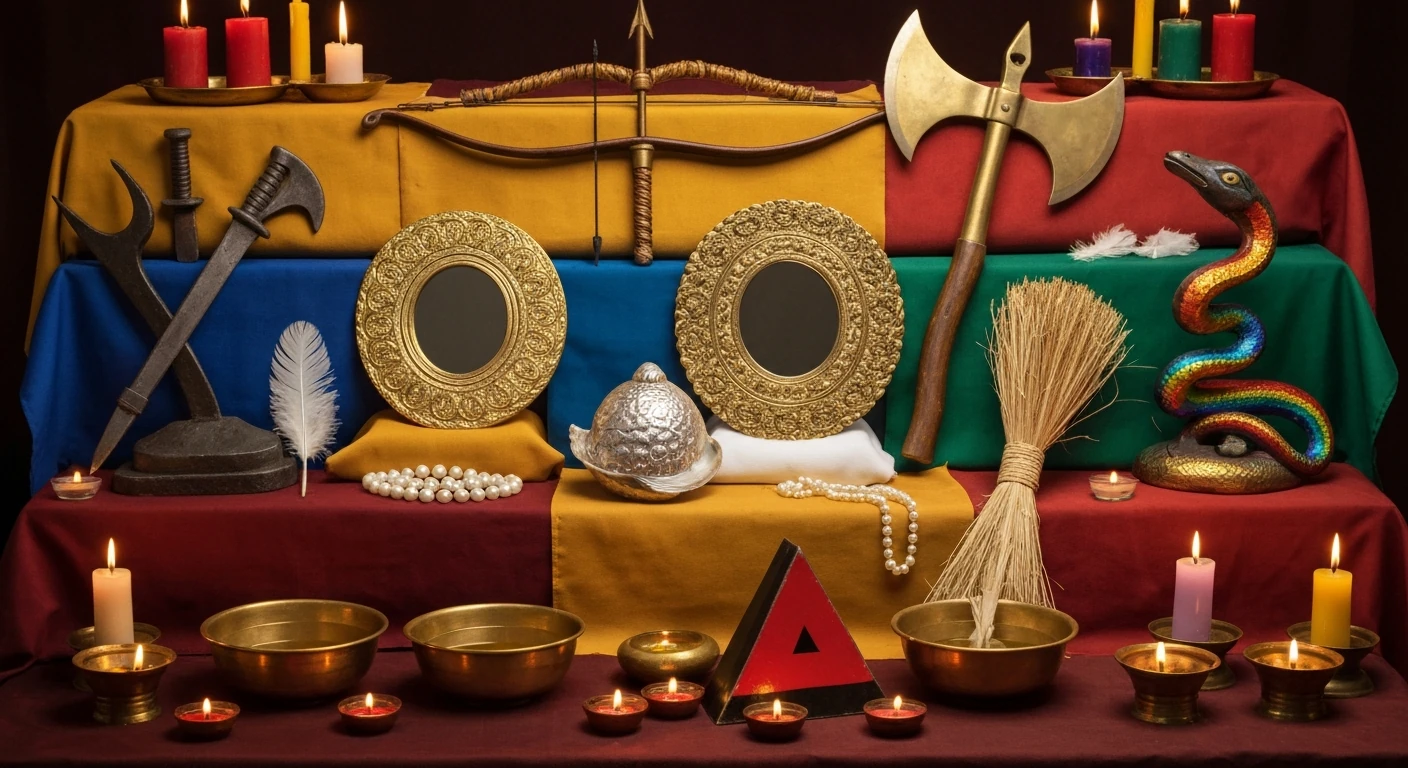
The calendar of the orixás has two times: the day of the week that each orixá rules and the annual date of the festival, inherited from the Catholic saint of syncretism. In Umbanda, the week goes from Exu on Monday to Oxalá on Sunday.
Monday is Exu, Tuesday is Ogum, Wednesday is Xangô and Iansã, Thursday is Oxóssi, Friday is Oxalá and Saturday is Iemanjá and Oxum, and Sunday varies from house to house (see the days of the week of the orixás). In the year, the most followed dates are Oxalá in January (the Washing of Bonfim, with a movable date), Iemanjá on February 2, Ogum on April 23, Exu on June 13, Obaluaê on August 16, Xangô on September 30, Iansã on December 4 and Oxum on December 8. The table below brings all the orixás month by month, and the dates change from nation to nation and from house to house.
Calendar of the orixás month by month
The table below brings together the main date of each Orixá throughout the year, with the corresponding Catholic saint. Right after, each Orixá has its detailed profile.
| Date | Orixá | Syncretized saint | How to honor |
|---|---|---|---|
| January (movable date) | Oxalá | Lord of Bonfim | Washing of Bonfim, white, food without salt, peace and silence |
| 20/01 | Oxóssi | Saint Sebastian | Fruits, leaves, reverence to the forests |
| 02/02 | Iemanjá | Our Lady of the Navigators | White flowers and perfume to the sea |
| 19/04 | Logun Edé | Saint Michael / Saint Expedito | Honey, fruits and symbolic hunt |
| 23/04 | Ogum | Saint George | Red, iron, opening of paths |
| 30/05 | Obá (Oba) | Saint Catherine | Warrior strength; offerings in water |
| 13/06 | Exu | Saint Anthony | Padê, dendê; opening of the ritual work |
| 26/07 | Nanã | Saint Anne | Still water and mud; no use of iron |
| 16/08 | Obaluaê / Omulu | Saint Roch | Pipoca (doburu) and ritual food |
| 24/08 | Oxumarê | Saint Bartholomew | Honey, sweet potato, cycles and renewal |
| 27/09 | Ibeji | Cosme and Damião | Caruru and sweets for the children |
| 30/09 | Xangô | Saint Jerome | Amalá (okra), lightning stone, fire |
| 05/10 | Ossaim (Osanyin) | Saint Benedict (Umbanda) | Sacred leaves and herbs |
| 04/12 | Iansã / Oyá | Saint Barbara | Red, acarajé, lightning and winds |
| 08/12 | Oxum (RS, Sergipe; Iemanjá in Recife and in SP) | Our Lady of the Conception | Honey, yellow flowers, fresh water |
| 13/12 | Ewá (Yewa) | Saint Lucia | Greeting and candle, according to the house |
Attention: some dates have more than one version (Iemanjá, Oxalá, Obaluaê) and three Orixás Obá, Ossaim and Ewá have less consolidated dates. All of this is explained in the cards and in the variations below.
First semester: from Oxalá to Exu
Oxalá in January (Senhor do Bonfim)
The spiritual year opens with Oxalá, the father of all Orixás, syncretized with the Senhor do Bonfim. In Salvador, the date merges with the famous Lavagem do Bonfim, which falls on the Thursday before the Bonfim Sunday, the second Sunday after January 6 (in 2027, by the rule, 1/14). January 15, which circulates as the "day of Oxalá," has no source: none of the consulted sources mention it. Oxalá is honored with white clothes, silence, peace, and food without salt, such as white canjica (ebô) and acaçá. December 25 appears as a date of Oxalá worship in a house of Umbanda and in a bill in Curitiba, still under consideration, without connection to Oxaguiã in either of the two. The rule of the Lavagem and the dates per house are in day of Oxalá. See the complete guide on who is Oxalá, the father of all orixás.
Oxóssi January 20 (Saint Sebastian)
Oxóssi, the hunter orixá, lord of the forests and abundance, is celebrated on January 20, together with Saint Sebastian in most of Brazil. In Bahia, however, Oxóssi syncretizes with Saint George in an important inversion, since in the Southeast Saint George is associated with Ogum (see the variations section). Oxóssi is honored with fruits, leaves, and reverence for the abundance of the forests. Know the guide on who is Oxóssi, the hunter orixá of the forests. Why January 20 is a holiday in Rio and when the festival of the houses in Salvador falls is in day of Oxóssi.
Iemanjá February 2 (Our Lady of the Navigators)
Few days of the year gather as many people by the seashore as Iemanjá day. The Queen of the sea, mother of almost all the Orixás, is celebrated on February 2 with offerings of white flowers, perfumes, mirrors, and letters delivered to the waves, a festival that gathers crowds by the seashore throughout Brazil. It is the main date, linked to Our Lady of the Navigators. In São Paulo and in Baixada Santista, however, many Umbandistas honor Iemanjá on December 8, and part of Umbanda still celebrates Iemanjá day on August 15, syncretized with Our Lady of Glory (see variations).
Logun Edé April 19 (Saint Michael / Saint Expeditus)
Son of Oxum and Oxóssi, Logun Edé carries the duality of his parents: six months he lives in fresh waters, six months in the forests. For this reason, he receives honey and fruits (from the Oxum side) and offerings of game (from the Oxóssi side). The syncretized saint varies between Saint Michael Archangel and Saint Expeditus, depending on the house.
Ogum April 23 (Saint George)
Ogum, the warrior Orixá, lord of iron, of the roads, and of battles, is one of the most popular in Brazil and his day, April 23, is also the day of Saint George. The holiday is only in Rio de Janeiro, and it is Saint George Day (State Law 5.198, of 2008). In São Paulo, Law 14.905, of 2012, put "Ogum Day" on the official State calendar, without a holiday. Ogum is honored with the color red, iron tools, and requests for protection and opening of paths; at the Terreiro de Umbanda Pai Maneco, in Curitiba, Ogum's amalá takes "white beer in coité". The laws, June 13 in Bahia, and the date in 2027 are on Ogum day.
Obá May 30 (Santa Catarina)
Obá is the warrior Orixá of the turbulent waters, a symbol of feminine strength and loyalty. In various terreiros, her day is celebrated on May 30, associated with Saint Catherine (in some houses, Joan of Arc). She is an Orixá less publicly celebrated, and her date is less uniform: it is worth confirming with the tradition of your house.
Exu June 13 (Saint Anthony)
Exu is the Orixá of paths and communication, the first to be greeted and the first to eat in any ritual: without him, nothing begins. Contrary to what prejudice insists on repeating, Exu has no relation to the devil: the association with Saint Anthony (June 13) was born as resistance, not as demonization. In the Gaucho Batuque, the same date is the day of Bará. This is the annual obrigação to Exus and Pombagiras. Learn more in the complete guide about the day of Exu, June 13 and about who is Exu.
Second semester: from Nanã to Ewá
Nanã July 26 (Saint Anne)
Nanã is the most ancient Orixá of the pantheon, lady of mud, clay, and the still waters to which she returns the bodies that return to the earth. Syncretized with Saint Anne (the grandmother of Jesus), she is honored on July 26. Due to her connection with the time before iron, her offerings traditionally do not use metal objects, but rather wood and bone. Learn in depth who is Nanã, the oldest Orixá of the pantheon.
Obaluaê / Omulu August 16 (Saint Roch)
August is known as the month of Obaluaê, the Orixá of healing and diseases, the doctor of the poor, syncretized with Saint Roch on August 16. His most characteristic offering is popcorn (doburu), popped in sand or in dendê. There is also the variation of December 17, associated with Saint Lazarus. Learn in depth who is Obaluaê (Omulu).
Oxumaré (Oshumare) August 24 (Saint Bartholomew)
Oxumaré, the orixá of the rainbow and the serpent, symbol of cycles, renewal, and wealth, is celebrated on August 24, syncretized with Saint Bartholomew in Bahia. It represents the movement between heaven and earth, the rain that rises and falls. It is honored with honey, sweet potato and offerings linked to abundance and the continuity of life. Learn more about who is Oxumaré, the orixá of the rainbow snake.
Ibeji September 27 (Saints Cosmas and Damian)
The Ibeji, twin orixás of childhood and joy, are syncretized with the twin saints Cosme and Damian. September 27 is one of the most beloved festivals of the people of santo: caruru, sweets, and treats are distributed to children, celebrating the purity, abundance, and renewal that the erês represent. See how Umbanda celebrates Cosme and Damian, the Erês, and the sweets table.
Xangô September 30 (Saint Jerome)
Xangô, the orixá of justice, fire, thunder, and quarries, is syncretized with Saint Jerome, celebrated on September 30. Warrior King, owner of the double-edged axe (oxé) and the lightning stone (edun ará), receives the amalá (okra) as the main offering. He is invoked in requests for justice and balance. In Umbanda, the FUCESP adds June 24 (Saint John) and June 29 (Saint Peter) to September 30; understand the orixá in who is Xangô.
Ossaim October 5 (in Umbanda, Saint Benedict)
Ossaim is the orixá of leaves and sacred herbs, the owner of the secret of green healing; without him, no ritual happens, for the saying goes: “kó si ewé, kó si òrìsà” (without leaf there is no orixá). In Umbanda, FUCESP and a tent in São José dos Campos record October 5, with Saint Benedict. In Ketu Candomblé, Prandi records Saint Onofre, and in Gaucho Batuque, Saint Roch appears, whose feast is August 16. No open source explains the connection of the orixá with October 5, so the date is less consolidated: confirm with your house. What is known and what is not known is in Ossaim day: October 5. Learn more about who is Ossaim, the owner of the leaves and green healing.
Iansã / Oyá December 4 (Saint Barbara)
Iansã (or Oyá), the orixá of winds, lightning, and storms, the only one who commands the eguns (the spirits of the dead), is syncretized with Saint Barbara on December 4. A warrior and transformer, she receives the acarajé as an offering and the color red as a mark. Discover who is Iansã in detail and the day of Iansã in the week and in the year.
Oxum December 8 (Our Lady of the Conception)
Oxum, the orixá of fresh waters, gold, love, and fertility, is syncretized with Our Lady of the Conception, celebrated on December 8. The date is of Oxum especially in Rio Grande do Sul, with Oxum Day by law in Porto Alegre, and in Sergipe; in Recife, in São Paulo, and in the ketu candomblé described by Prandi, the Conception belongs to Iemanjá, and Salvador has both readings. The complete map is in December 8, Oxum day. Lady of the waterfalls and rivers, she receives honey, yellow flowers, mirrors, and perfumes. In ketu candomblé her offerings include the honey ofá and okra; in the angola nation, the same energy appears as Kisimbi. See the guide on who is Oxum. It is also worth knowing that many houses in the Northeast also celebrate Oxum on July 16, in syncretism with Our Lady of Mount Carmel.
Ewá December 13 (Saint Lucy)
Ewá is the orixá of springs, the horizon, and clairvoyance, in some narratives the sister of Oyá. In some houses, her day is celebrated on December 13, associated with Saint Lucy (protector of the eyes and vision, which dialogues with her domain over clairvoyance). It is one of the less consolidated dates and varies greatly by tradition.
Why do the orixás have a date in the year
When the Yoruba peoples were brought by force to Brazil on slave ships, they could not bring their temples, but they brought the memory of their gods. So that the worship could survive colonial repression, each orixá was associated with a Catholic saint, and the saint's feast became, in secret, the orixá's feast.
Most people know the Orixás by the day of the week that each one rules. But there is a second layer of sacred time: the annual date, the festival that celebrates that Orixá once a year. This date almost always comes from syncretism, the historical association between each Orixá and a saint from the Catholic calendar.
It is worth remembering what researchers like Reginaldo Prandi and Pierre Verger teach: syncretism was a survival strategy, not theological equivalence. When we say that Oxum was associated with Our Lady of the Conception, we are not saying that "Oxum is Our Lady" (they are distinct spirits, in distinct traditions, that history placed side by side so that African faith would not be destroyed). Today, candomblé terreiros are among the heritage sites listed by IPHAN, as shown in the text about terreiros listed by IPHAN. To better understand this mechanism, it is worth reading the article about the syncretism of the June saints, and, if you are just starting now, the guide on what the Orixás are.
The civil dates of the orixás come from the Catholic liturgical calendar adopted by the terreiros, not from a closed academic table. Therefore, they vary: each nation and each house has its own tradition. Use this calendar as a respectful reference, not as the sole truth.
Day of the week is not the same thing as the annual date
This is the most common confusion for those who research the Orixás and it is worth clarifying once and for all. Each Orixá has two different sacred times:
- The ruling day of the week, which repeats every week (more commonly used in umbanda).
- The annual date, the festival that happens once a year (the one this calendar covers).
For example: Exu has Monday as his ruling day, but his annual feast is June 13. Oxum is ruled by Saturday, but her date is December 8. See the main days of the week:
| Orixá | Ruling day of the week |
|---|---|
| Exu (and Omulu) | Monday |
| Ogum | Tuesday |
| Xangô and Iansã | Wednesday |
| Oxóssi | Thursday |
| Oxalá | Friday |
| Iemanjá and Oxum | Saturday |
| Oxalá or the children, depending on the house | Sunday |
The days of the week also vary according to tradition and the house: Oxum is on Friday in many houses, and Iansã sometimes on Tuesday. For Oxalá, Prandi and the IPHAN give Friday in ketu Candomblé, FUCESP writes "Friday or Sunday" and the TUCTVC gives Sunday. In Umbanda, there are specific tables for each line of ritual work, and the article about the days of the week of the orixás shows each day. The important thing is to understand that "day of the week" and "date of the annual feast" are distinct things. The day of the week is also the calculation behind many guesses for the ruling orixá of the year, as shown by the ruling orixá of 2027.
Variations by nation, house, and region
The dates of the orixás are not a closed dogma: they change according to the Candomblé nation (ketu, jeje, angola), the house, and the region. The most important cases to know:
- Iemanjá (2/2, 15/8 or 8/12): February 2 is the national mother date; part of Umbanda celebrates on August 15 (Our Lady of Glory); in São Paulo and in Baixada Santista, umbandistas honor her on December 8.
- Oxalá (January and 12/25): in January, the Lavagem do Bonfim is the most cited mobile date; 1/15 has no source. December 25 is a date of worship in an Umbanda house (TUCTVC) and in a bill in Curitiba, without a connection to Oxaguiã in either. See Oxalá day.
- Saint George Ogum or Oxóssi: in the Southeast, Saint George is Ogum; in Bahia, he is Oxóssi. The same statue, two orixás, depending on the region.
- Xangô (09/30, 06/24 or 06/29): there is no single date. At Casa Branca de Salvador, June 29 is the feast of Xangô Airá (Castillo and Parés); in Umbanda, TUCTVC uses September 30, and FUCESP and the National Sanctuary of Umbanda also give June 24 and June 29. In São Paulo, Law 16.653 of 2017 put the third Sunday of June, Xangô Procession Day, on the city's events calendar, without a holiday. The dates and bill projects are in Xangô day.
- Obaluaê (08/16 or 12/17): Saint Roch in August, Saint Lazarus in December.
Therefore, when setting up your personal calendar, always confirm with your pai or mãe de santo as your house tradition is the final reference.
Frequently asked questions
What is the day of each orixá?
Each Orixá has an annual date linked to the saint with which it was syncretized. The main ones: Oxalá (Bonfim Washing, in January), Oxóssi (01/20), Iemanjá (02/02), Ogum (04/23), Exu (06/13), Obaluaê (08/16), Ibeji (09/27), Xangô (09/30), Iansã (12/04) and Oxum (12/08). The complete table is at the beginning of this article.
Today is which orixá's day?
It depends on the day of the week. In the most followed tradition in Umbanda: Monday is Exu's day; Tuesday, Ogum's; Wednesday, Xangô and Iansã's; Thursday, Oxóssi's; Friday, Oxalá's; Saturday, Iemanjá and Oxum's; and Sunday, Oxalá's or the children's, depending on the house (for Oxalá, Friday or Sunday: see Oxalá day). Oxum appears on Friday in many houses. These regent days vary according to the house and the line of ritual work, and are different from the annual date of each Orixá's feast.
Which orixá is celebrated in each month?
January is for Oxalá (the Bonfim Washing, on a movable date) and Oxóssi (1/20); February, for Iemanjá (2/2); April, for Ogum (4/23); May closes with Obá (5/30), and brings 5/13, day of preto velho, which is for spirit and not for orixá; June, for Exu (6/13); July is for Nanã (7/26), and many houses in the Northeast also celebrate Oxum on July 16; August gathers Obaluaê (8/16) and Oxumarê (8/24); September, Ibeji (9/27) and Xangô (9/30); October brings Ossaim (10/5); December gathers Iansã (12/4), Oxum (12/8) and Ewá (12/13). Some months concentrate more than one Orixá, others none.
Why is the day of Iemanjá on February 2 and also on December 8?
There are two traditions. The national date, February 2, comes from the syncretism with Our Lady of the Navigators, strong in the Northeast and in Candomblé. The one on December 8 (Our Lady of the Conception) is followed by umbandistas, especially in São Paulo and in Baixada Santista.
What is the difference between the day of the week and the date of the orixá?
The day of the week is the ruling day and repeats every week (Exu on Monday, Oxum on Saturday, for example). The annual date is the festival that happens once a year, linked to the syncretized saint. They are distinct concepts and should not be confused.
Which Catholic saint corresponds to each orixá?
Among the main ones: Oxalá / Senhor do Bonfim, Iemanjá / Our Lady of the Navigators, Ogum / Saint George, Oxóssi / Saint Sebastian, Exu / Saint Anthony, Xangô / Saint Jerome, Iansã / Saint Barbara and Oxum / Our Lady of the Conception. Remember: syncretism is a historical association, not an equivalence.
Where to honor your orixá
At Joia Mística Laroyê, you find everything to celebrate your Orixá's date with respect and tradition:
- Ritual candles by Orixá color white for Oxalá, yellow for Oxum, red for Ogum and Iansã, and much more
- Fresh or dry herbs and baths for baths and fumigations of each Orixá
- Statues of Orixás for your altar or congá
- Bead necklaces (guias) and offering elements honey, dendê, beads and ritual items
- Incense burners to prepare the environment on festival dates
Visit our shop in Extrema-MG and we ship to all of Brazil. For guidance on how to honor your Orixá's date, talk to us via WhatsApp.
References
- Decree-Law 25/1937, Presidency of the Republic: heritage listing
- Legislative Assembly of São Paulo: Law 14.905 of 2012, Day of Ogum
- Supreme Federal Court: Informativo 1105, ADI 4.092, holiday of the Day of Saint George
- Terreiro de Umbanda Pai Maneco: Ogum
- Agência Brasil: coverage of the Day of Iemanjá celebrated in Rio de Janeiro
- Castillo e Parés, Religion & Society (2015): José Pedro Autran and the return of Xangô
- Tenda de Umbanda Caboclo Tupinambá e Vó Catarina (TUCTVC): Xangô
- FUCESP: Xangô
- National Sanctuary of Umbanda: Xangô
- Municipal Chamber of São Paulo: Law 16.653 of 2017, Day of the Xangô Procession