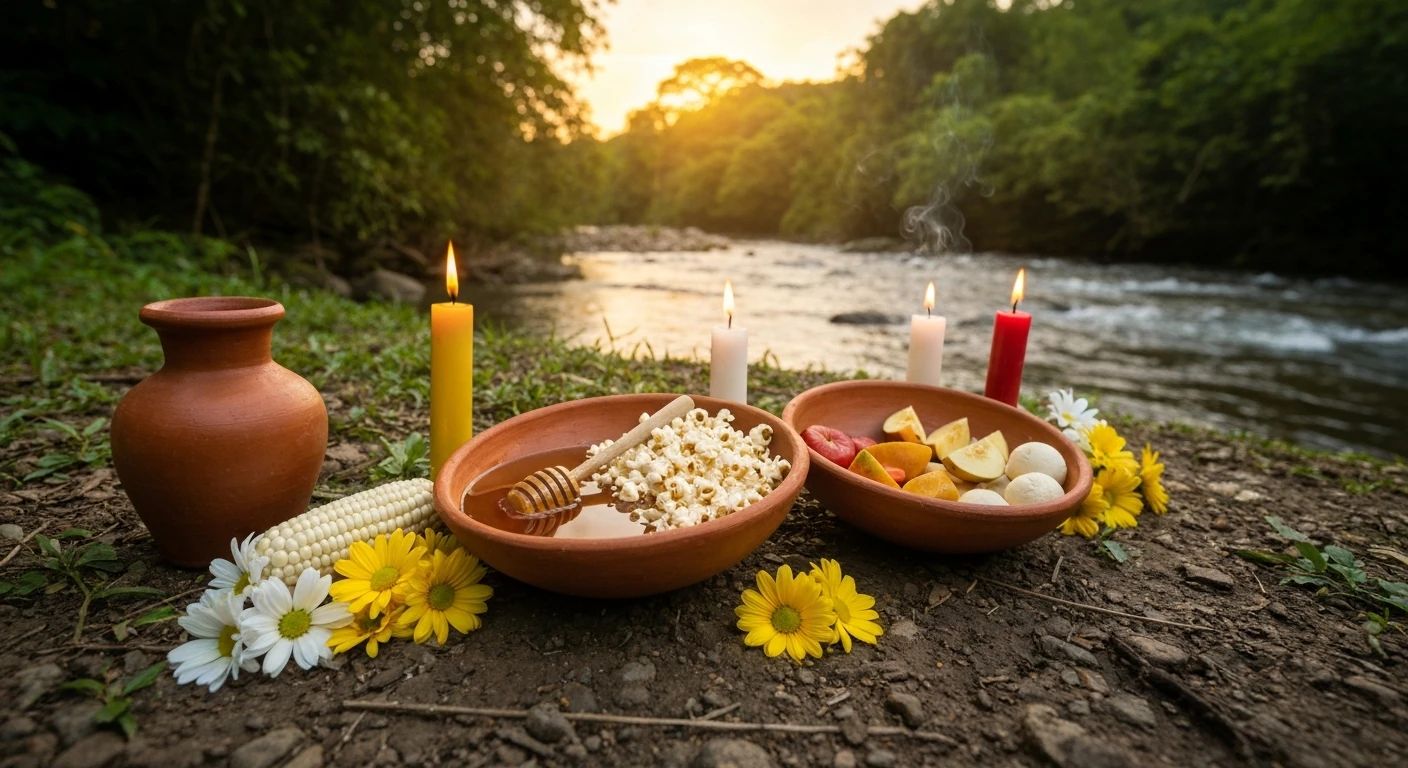
Setting up an offering for Xangô is a gesture of respect to the orixá of justice, and the secret lies in offering firm things, in the right place and with clean intention. No rushing and no bargaining, because an offering does not buy a sentence.
Next comes what to bring, how to set it up, where to deliver it and what never enters the plate of the king of Oió, with the domestic offering, which any devotee can do, separate from the food of the santo of Candomblé, which is terreiro liturgy. To know the orixá before setting up the offering, see who is Xangô.
What Xangô receives in an offering
The offering to the lord of justice is made of firm things and strong flavors, like the stone and the fire that are his matter. He is the owner of the thunder, and the offering accompanies this temperament.
- Firm fruits: the conde fruit, also called pinha or ata, is the most cited. Apple, banana and melon also please.
- Orobô: the bitter kola nut is his favorite fruit, used in almost every offering of Xangô. The obi is also well received.
- Candles: red and white, his colors in Umbanda. Light a pair or the number that your house usually sets.
- Carnations: red and white, the flowers most associated with the orixá.
- Cigar and black beer: the cigar and the dark beer accompany the offering in most houses.
- Acaçá: the white corn dough that every orixá receives, a neutral base that closes the offering.
Wednesday is the day of Xangô in most Brazilian houses, as shown by the list of days of the week of the orixás. His symbol is the oxê, the two-bladed axe that cuts both ways, an image of justice that weighs both sides before deciding.
Regarding cachaça and aguardente: they appear on some lists, but are firm elements of Exu (Eshu) and Ogum (Ogun) in most houses. For Xangô, stick to black beer or a dry red wine.
Amalá and Xangô's foods
The amalá is Xangô's signature food, and here lies the detail that almost no list explains correctly. According to the entry about amalá on Wikipedia, the dish takes cut okra, grated onion, shrimp powder, and salt, all in dendê, served in a gamela lined with acaçá. The okra is the center of everything.
And here is the most important correction. The idea circulates on the internet that okra would be a quizila of Xangô or Iansã (Oya). It is false. The okra is precisely the mark of Xangô, linked to the ideal of justice and abundance. The confusion arises from a myth involving Obá (Oba), the third wife of the orixá, and it does not hold as a rule.
The okra does not repel Xangô, it calls him. It is the food that seals the king's justice, and the amalá is the heart of the worship to him.
Other versions of the dish come from the same tradition. What the house calls caruru is usually the sautéed okra served on top of the amalá. In the Gaucho Batuque, the amalá gains a base of cassava flour with a sauce of oxtail, banana, and apple, a sign of how the same food changes form in each tradition. The complete recipe and the step by step of the preparation are in Xangô's amalá and are not repeated here.
Where to deliver the offering of Xangô
The stone is his house. Therefore, the delivery points for Xangô are always high, firm, and of living rock.
- Quarry: the most consensual location among the houses. The lightning stone, the edun ará, is the natural seat of the orixá.
- Hilltop or hill: where the terrain rises and the rock appears, the offering finds the orixá.
- Next to a large stone: a slab or a boulder in a clean place also works, when there is no quarry nearby.
If you do not have access to any of these places, set up the offering at home, on a red or brown cloth, in a clean and high corner, such as the top of a cabinet. Leave it for up to three days and discard it with respect, returning the fruits to the earth when you can.
A correction that avoids a serious error: crossroads is not a point of Xangô. The crossroads belongs to Exu and to Pombagira, the theme of offering for Exu. Taking an offering of Xangô to the corner is mixing territories that tradition keeps separate. The pillar of the series, with the general rules that apply to any orixá, is in how to make offering to the orixás.
How to set up the offering step by step
- Choose the day. Wednesday is his day, and the festival date changes with the house, as shown in the section about the festival day, further down. But gratitude has no closed calendar.
- Separate a clean gamela or alguidar. A clay vessel, wooden gamela, or white plate works well.
- Line it with banana leaf or cloth. The base avoids direct contact with the ground.
- Arrange the whole and washed fruits. The conde fruit and the apple stay in the center, with the orobô beside them.
- Add the drink in a quartinha or glass, next to the plate, with the cigar if you will use it.
- Light the candles red and white and firm the intention with your own words, out loud or thought.
- Hail the orixá. The greeting is Kaô Kabecilê, also recorded as Kawó Kabiyesilé, which means hail the king.
- Leave without looking back and take any plastic packaging with you.
Offering is a gesture of devotion and preparation of the field, not a negotiation. It does not buy a result nor force the orixá to do anything.
To choose the right color and size of the candles, it is worth reading how to use ritual candles.
What not to offer to Xangô
Here is the care that separates those who understood from those who just copied a list. The firmest quizila of Xangô has to do with death.
- Nothing linked to the dead: in Xangô do Recife, of the Nagô nation, anthropologist Rita Laura Segato recorded that "Xangô is the only orixá who cannot enter the 'ballet room' (room of the eguns or spirits of the dead) and has an aversion to death and the eguns". The territory of the eguns belongs to Iansã, according to Verger (sources diverge on the reason why Xangô stays away: see Iansã and Xangô), as the blog explains in offering for Iansã.
- Cemetery is not his place: never take an offering for Xangô to the cemetery grounds. The orixá's place is the quarry, the symbolic opposite of death.
- Spoiled or leftover food: the king of justice receives what is best and freshest, never the leftovers.
The concept behind these rules is in quizilas in Candomblé. Quizila is precept and respect for the foundation, not a threat of punishment. Each house establishes its own, and in case of doubt, the one who has the final word is their leader.
What is Xangô's feast day
Xangô's feast does not have a single date in Brazil. At Casa Branca do Engenho Velho, in Salvador, June 29 is the feast of Xangô Airá, "one of the most important orixás of the community", record Lisa Earl Castillo and Luis Nicolau Parés in the magazine Religião & Sociedade. In Umbanda, the Tenda de Umbanda Caboclo Tupinambá e Vó Catarina gives September 30 as the date of worship, and the Santuário Nacional da Umbanda says that the tributes happen "on September 30, the day of the death of Saint Jerome, or June 24" or June 29.
September 30 is the day of Saint Jerome in Catholicism. The Giras de Umbanda portal reminds us that enslaved Africans associated the saint who translated the Bible with their orixá of justice to keep the worship alive under repression. In Rio Grande do Sul, the City Hall of Capão do Leão held the "III Africanist Patron Festival of the Municipality" on September 30, 2017, with the Municipal Council of the Terreiro People, in honor of Xangô. The dates by house and by city, with the São Paulo law that placed the Xangô Procession on the calendar of events, are in Xangô day.
In Umbanda, some houses also link Xangô to Saint Peter and Saint John, in the cycle of the June festivals, a theme of June saints and orixás. Syncretism is plural and changes from region to region, and the complete calendar is in orixá calendar. None of this is an equivalence between saint and orixá, but rather a historical strategy for the survival of the worship.
A devotee's favor and a santo's food are not the same thing
This distinction separates those who understood from those who only memorized a recipe.
The domestic offering, more common in Umbanda, is the gift that the devotee prepares with their own hands. Fruits, orobô, black beer, cloves, and candles. There is no sacrifice, foundation chant, or consecrated foundation (assentamento).
The orixá food of the Candomblé ketu is something else. It is the house liturgy, prescribed by the babalorixá or by the ialorixá, often after the cowrie-shell divination that defines the appropriate ebó. Each nation has its own path, as shown in the article about the Candomblé nations. In the angola nation, the nearby energy appears as the inquice Nzazi, with its own liturgy and chants, and not as a translated Xangô.
To set a consecrated foundation (assentamento) or prepare ritual work food on your own is not an offering, it is an intrusion. The devotee who wants to go beyond a domestic offering seeks a house and a zelador. Respect begins by knowing where the home gesture ends and where the secret of the terreiro begins.
Frequently asked questions
What is Xangô's favorite food?
The amalá, okra cut in dendê served in a gamela of acaçá, is his signature food. Okra is the mark of Xangô, linked to justice, and is not a quizila, contrary to what many lists say. Fruta do conde, apple, and orobô complete the domestic offering.
What is Xangô's day?
Wednesday is his day in most Brazilian houses. The annual festival changes with the house: at Casa Branca in Salvador, June 29 is the festival of Xangô Airá; Umbanda houses use September 30, the day of Saint Jerome, and some also use June 24 and June 29. But a thank offering can be made on any day, with respect and preparation.
Where to leave the Xangô offering?
In a quarry, on top of a hill, or next to a large stone, because the rock is his home. Those who do not have access to these places can set the offering at home, in a high and clean corner, removing it in up to three days. Never at a crossroads, which is the territory of Exu.
What is Xangô's drink?
Black beer is the most associated with him, and some houses accept dry red wine. Cachaça and aguardente usually belong to Exu and Ogum, so avoid offering to Xangô without guidance from your terreiro. The drink goes in a quartinha or glass next to the plate.
Why does Xangô not deal with the dead?
In Xangô do Recife, of the Nagô nation, anthropologist Rita Laura Segato recorded that Xangô "has an aversion to death and to eguns" and that "avoids any proximity with the dead and never enters the quarto de balé", the room of the eguns. The territory of the dead belongs to Iansã. Therefore, cemeteries and egum things always stay out of his offering.
Where to buy items for the Xangô offering
At Joia Mística Laroyê, you find what you need to assemble the tribute to the orixá of justice:
- Candles in Xangô colors: red and white, in various sizes
- Clay gamelas and alguidares: for the amalá and for the offering plate
- Okra, dendê, and dried shrimp: for the amalá and the Xangô caruru
- Bead necklaces and beads in his colors: red and white
- Cigars, cloves, and incense burners: to complete the offering and cleanse the environment
Visit our shop in Extrema, Minas Gerais or buy via WhatsApp with delivery to all of Brazil.
To check the colors, symbols, and syncretism of the orixá, the Xangô entry on Wikipedia gathers the basics with sources.
References
- Wikipedia: Xangô entry, with colors, the oxê symbol, the edun ará, and the syncretism with Saint Jerome
- Wikipedia: Amalá entry, with the ingredients and the orixás who receive the dish
- Umbanda Giras: article about September 30 being the day of Xangô and Saint Jerome
- Castillo e Parés, Religion & Society (2015): José Pedro Autran and the return of Xangô
- Rita Laura Segato, Anuário Antropológico (1986): Inventing nature, Xangô do Recife
- Rita Laura Segato, Anuário Antropológico (1988): Iemanjá in the family, Xangô de Recife
- Tenda de Umbanda Caboclo Tupinambá e Vó Catarina (TUCTVC): Xangô
- National Sanctuary of Umbanda: Xangô
- Capão do Leão City Hall: III Xangô Festival, africanist patron of the municipality (2017)