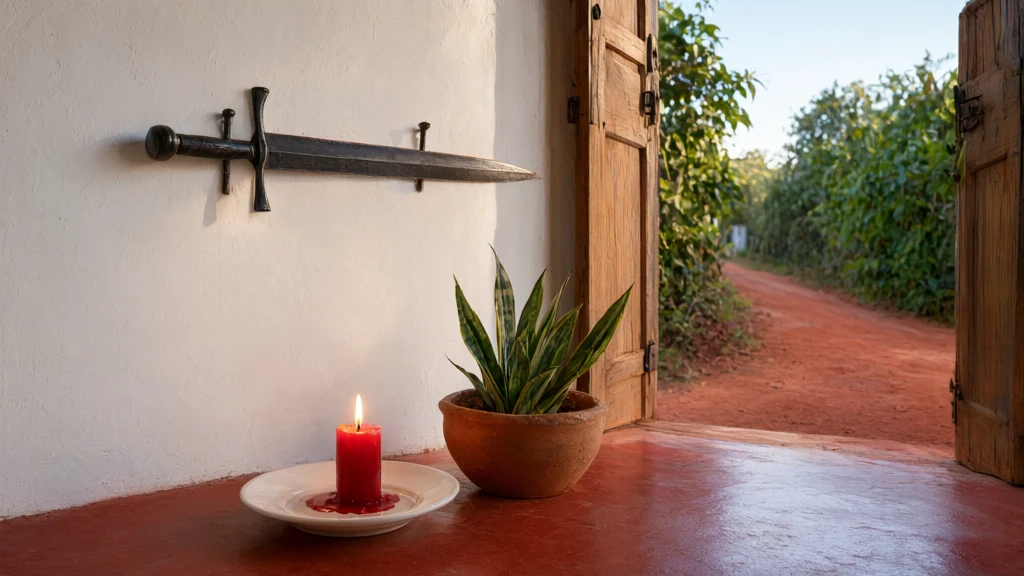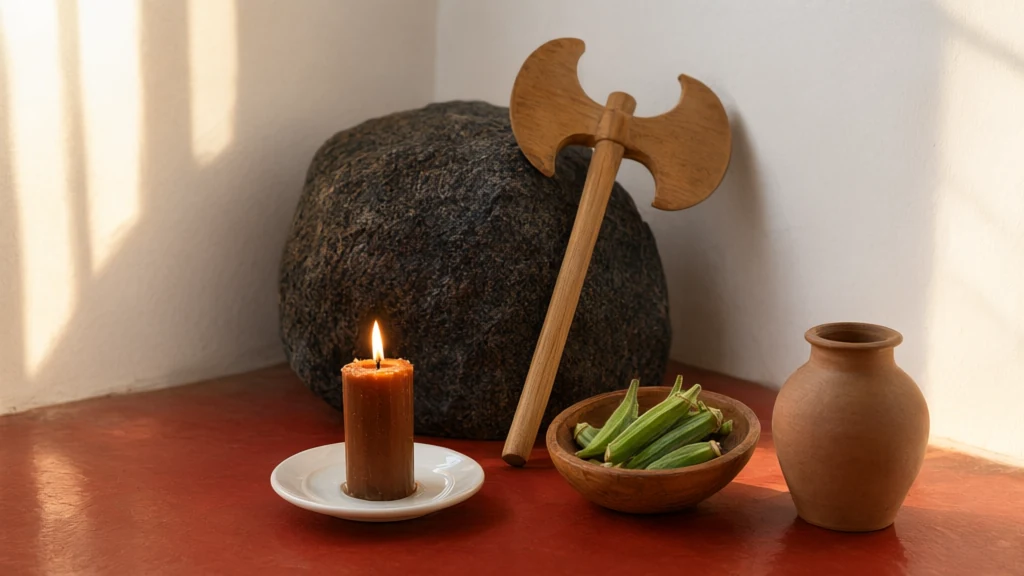
Xangô in Umbanda is the orixá of the line of justice and the quarries, celebrated on Wednesdays and, in many houses, on September 30. The candle is brown or red and white, depending on the terreiro. In the Matta and Silva coding, he works through phalanges such as Xangô Kaô, Sete Pedreiras, and Agodô. For most authors and houses, those who descend in the gira are caboclos and pretos velhos from his line.
Who is Xangô in Umbanda
Xangô is the same orixá of thunder and justice that Candomblé worships, lived in the Umbanda way. The history of Oió, the qualities, and the complete profile are in who is Xangô. An article from Religare magazine (UFPB) places Xangô among the nine most worshipped orixás in Umbanda terreiros.
In 1933, in Rio de Janeiro, the writer Leal de Souza registered the seven lines of Umbanda: "the first of Oxalá (Obatala); the second of Ogum (Ogun); the third, of Euxoce (Oxóssi (Oshosi)); the fourth, of Xangô". In the language of Umbanda, this fourth line was Saint Jerome, and Xangô's despachos were made "in the quarries". For him, the line "consecrates the reparation of what was destroyed".
“The line of Xangô practices charity under a criterion of relentless justice: who does not deserve, does not have; who does, pays.” Leal de Souza, 1933
Xangô's line changes number in each author
Xangô's place changes in each codification, and the researcher Sônia Lages (UFJF), who summarizes Matta and Silva, warns: "the classifications vary".
| Source | Place of Xangô |
|---|---|
| Leal de Souza, Rio de Janeiro, 1933 | fourth line, of Saint Jerome |
| Matta and Silva, by Nogueira (UFJF, 2014) | third line, after Oxalá and Iemanjá (Yemoja) |
| National Umbanda Sanctuary, Santo André (SP) | sixth line |
| Umbanda Sagrada, at TEUSP (Rio de Janeiro) | fourth irradiation, in pair with Mãe Oroiná |
| Casas de Fortaleza, by Silva (UFC, 2009) | Line of the Waterfalls, ruled by Xangô |
The number changes, and justice continues: Leal, the Sacred Umbanda, the houses of Fortaleza and the São Sebastião Umbandista Nucleus (NUSS), from São Paulo, link the line of Xangô to justice. The comparison is in the 7 lines of umbanda.
The legions (falanges) of Xangô according to Matta e Silva
In the esoteric umbanda of Matta and Silva, reproduced by Lages and by Nogueira, the line of Xangô is divided into seven lineages, each with a caboclo and an Exu (Eshu).
| spiritual legion (falange) | The Exu who accompanies her |
|---|---|
| Xangô Kaô | Exu Gira-Mundo |
| Xangô Sete Montanhas | Exu Corcunda |
| Xangô Sete Pedreiras | Exu Ventania |
| Xangô Pedra Preta | Exu Meia-Noite |
| Xangô Pedra Branca | Exu Mangueira |
| Xangô Sete Cachoeiras | Exu Calunga |
| Xangô Agodô | Exu Pedreira |
It is a school list, but some names also appear in the houses. The Tenda Espírita Nossa Senhora da Piedade (TENSP), a house founded by Zélio de Moraes, sings "Viva o meu Pai é Xangô Agodô". The Núcleo Mata Verde says that the Caboclo Pedra Branca is "of OXALÁ and XANGÔ". Who is the Exu of the first falange is in Exu Gira Mundo.
Does Xangô incorporate? Who comes down in the line
For most authors, no. Lages summarizes Matta and Silva: in umbanda, the orixás "pass their attributes to the spirits", without presenting themselves "personally in the terreiro, as occurs in Candomblé". Leal de Souza wrote in 1933 that "The Orixás do not always descend".
In the Terreiro de Umbanda Pai Maneco, in Curitiba, the Pai-de-Cabeça of the medium "is always a Caboclo of OGUM, OXÓSSI or XANGÔ". A leader heard by the house summarizes: "Pure Orixá does not incorporate".
For the NUSS, the line gathers caboclos, pretos velhos and spirits of those who worked with the law. According to the NUSS, a falange is the "falange of the pretos", headed by the preto velho Quenguelê.
How does the one who comes in the line arrive? In the houses of Fortaleza studied by Silva, the spirits of the Linha das Cachoeiras "became enchanted in the rocks or in the waters" and come to ask for justice for the persecuted children. In the ritual work, they bend the body of the medium and spin his head like a whirlwind, with firm feet. The same spirit can change lines: the Cabocla Braba comes in the Linha de Xangô "when she wants to ask for justice for the children".
In a terreiro in Passo Fundo (RS), the spirits of Xangô arrive with a strong shout, firm steps and voice. More about who descends in caboclos in umbanda and pretos-velhos in umbanda. If the doubt is about your gira, ask the leader.
Candle color, day and greeting of Xangô in umbanda
Color: brown | Day: Wednesday | Date: September 30 | Greeting: Kaô Kabecilê
| Source | Color of Xangô |
|---|---|
| Leal de Souza (1933) | purple |
| Federação de Umbanda e Candomblé do Estado de São Paulo (FUCESP) and Santuário Nacional da Umbanda | brown; red and white in some temples |
| Tenda de Umbanda Caboclo Tupinambá e Vó Catarina (TUCTVC), São José dos Campos (SP) | bead necklace and brown, red and white candle |
| Terreiro Pai Maneco, Curitiba | brown and white |
| Umbanda Esotérica, Belo Horizonte | green |
To light at home, the brown candle of a single color is the one that appears most in these houses. The orixá's card is in Xangô.
- Day. Wednesday is the day of Xangô at TUCTVC and at the Sanctuary.
- Date. The most cited is September 30, the day of Saint Jerome; FUCESP adds June 24 and 29. TUCTVC reminds that syncretism "does not mean that the two figures are exactly the same deity." The dates by location are in Xangô day, and the saint, in Saint Jerome and Xangô.
- Greeting. The Sanctuary records "Caô Cabiecilê" or "Kaô Kabecilê." The others are in greeting of the orixás.
Quarry, amalá and what is asked of Xangô
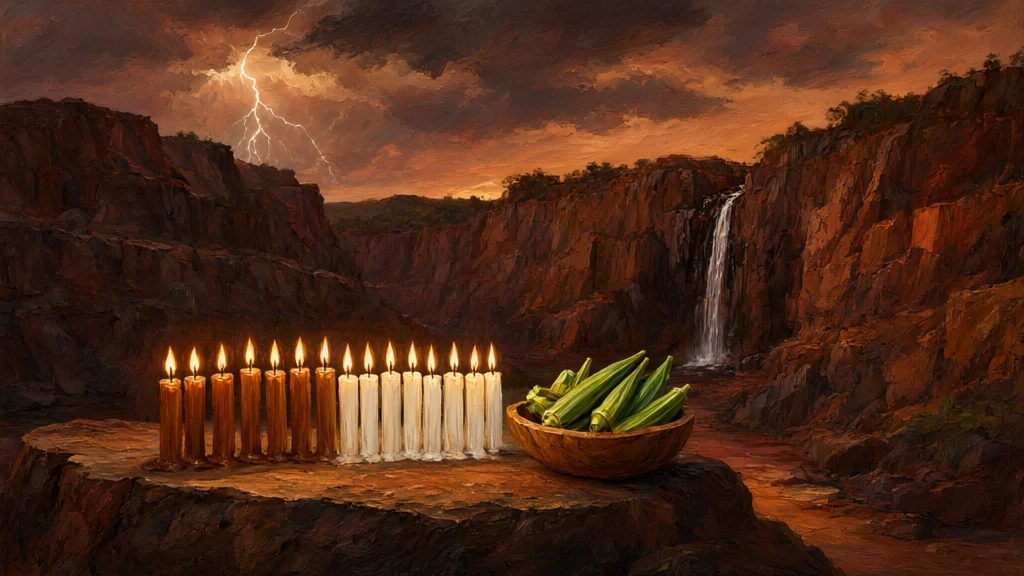
The quarry is the most cited point of strength. Leal already sent the Xangô ritual offerings "in the quarries," and FUCESP indicates "mountains and quarries." At Terreiro Pai Maneco, the amalá takes "7 brown candles and 7 white candles, black beer," shrimp and okra. The delivery is made "In the quarry or on a large and beautiful stone."
The first Xangô ponto (sacred song) of TENSP sings the same landscape: "Pedra rolou Xangô / Lá na pedreira / Segura a pedra meu Pai / Na cachoeira." The other pontos are in ponto de Xangô.
In Umbanda Sagrada, TEUSP teaches something else: "Xangô is the lord of fire and not of the stones!", and the stones belong to Oxum (Oshun). What your house teaches is what counts.
The foods are in Xangô amalá and offering for Xangô, and the leaves, in Xangô herbs. To check the candle or the okra that the house requested, Joia Mística Laroyê can be reached via WhatsApp.
What is asked of Xangô is justice. TUCTVC lists clarity in decisions and "Protection in legal matters." In Passo Fundo, those who seek the spirits of Xangô bring "legal problems." TEUSP reminds that his axe is not for punishment.
Xangô in Umbanda and in Candomblé: what changes
The big difference is the presence. In Candomblé, the orixá presents himself in the terreiro; in the Matta and Silva Umbanda, he passes the attributes to the spirits.
The color also changes. In the table by Reginaldo Prandi for the queto Candomblé, the beads of Xangô are "red and white (alternated)". FUCESP summarizes: "In Umbanda, brown; in Candomblé, red and white."
In Recife, "xangô" is also the name of a religion of the orixás, different from Umbanda and Jurema (Motta, UFPE). The qualities of Candomblé are in qualities of Xangô.
Frequently asked questions
What is the day of Xangô in Umbanda?
Wednesday, according to TUCTVC and the Santuário Nacional da Umbanda. In the year, the most cited date is September 30, the day of Saint Jerome, and there are houses that also celebrate in June. Check with your house.
What is the color of the Xangô candle in Umbanda?
Brown, in most of the houses cited here. TUCTVC uses brown, red and white, and Terreiro Pai Maneco, brown and white. In 1933, Leal de Souza gave the line the color purple. In case of doubt, follow the color that your house uses.
What is the Xangô prayer in Umbanda?
There is no single prayer: the prayers that circulate are from each house, such as the one TUCTVC publishes. Ask the leader for the prayer of your house. In front of the lit brown candle, your words also serve.
References
- Leal de Souza, 1933 book: O Espiritismo, a Magia e as Sete Linhas de Umbanda
- Lages, UFJF (2003): Exu: light and shadows
- Nogueira, UFJF (2014): lines of Umbanda
- Silva, UFC (2009): dissertation about a mãe de santo in the Umbanda of Fortaleza
- Bertocho, UFFS (2019): Terreiro de Umbanda Ogum Beira Mar
- Silva, UFMG (2017): Esoteric Umbanda in Belo Horizonte
- Esposito e Bastos, Religare (2022): mythology of the orixás
- Prandi, Anthropological Horizons (1995): African gods in Brazil
- Motta, Revista del CESLA (2020): Xangô, Jurema and Umbanda
- Houses: TUCTVC, NUSS, FUCESP, Santuário Nacional da Umbanda, Pai Maneco, Xangô and Oxalá in Umbanda, TEUSP, Xangô and Xangô, the Orixá of Fire
- TENSP: Book of Sung Chants (Pontos Cantados)