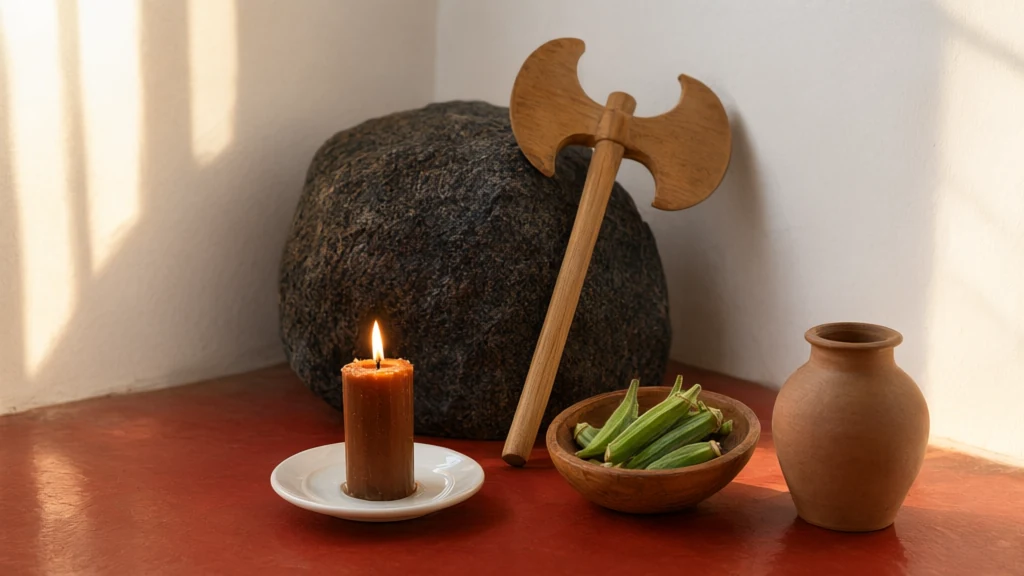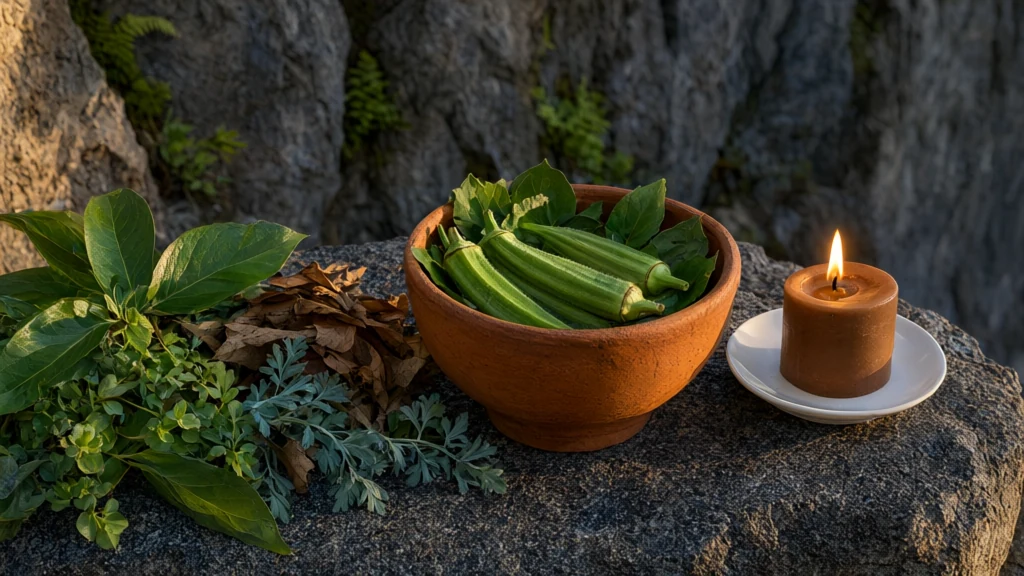
The herbs of Xangô most cited in terreiro research are acocô, baobá, and orobô in the Candomblé of Bahia and quebra-pedra in Umbanda. The list changes from house to house. Each plant below comes with the research or the terreiro that links it to the orixá.
What are the herbs of Xangô?
There is no single list: each tradition and each house records different plants. The table combines what the research and the houses say.
| Herb | Scientific name | Tradition and place | Who says |
|---|---|---|---|
| Acocô (akòkó) | Newbouldia laevis | Candomblé ketu and ijexá, Bahia | Purcino, UFSB |
| Baobá (osè) | Adansonia digitata | Candomblé ketu and ijexá, Bahia | Purcino |
| Orobô (orógbó) | Garcinia kola | Candomblé ketu and ijexá, Bahia | Purcino |
| Stonebreaker | Phyllanthus sp. | Umbanda, Teixeira de Freitas (BA) | Santos and Fortuna |
| vence-demanda | Justicia gendarussa | Umbanda, Viçosa (MG) | Tomaz, UFV |
| Okra leaf | Abelmoschus esculentus | Umbanda, Viçosa; Umbanda Nagô, RS | Tomaz; Torres |
| Aperta-ruão | Piper (three species) | Rio de Janeiro, 1985 | Rio Botanical Garden |
| Guiné | Petiveria sp. | Umbanda, with other orixás | Santos and Fortuna |
| Arruda | Ruta graveolens | Umbanda; batuque | Santos and Fortune; Ilé Àsé Odé |
The lists do not match because the same leaf serves several orixás. Researchers from USP interviewed Umbanda leaders in São Paulo. They say that "many times the same herb is circumscribed in the domain of more than one orixá". To find out whose plant it is, use which orixá is the herb of.
There is even an itã about this, in the version by Reginaldo Prandi cited by Bianca Purcino. Xangô orders Iansã (Oya) to blow the leaves of Ossaim (Osanyin) to his palace. Those that stay with him lose their axé, and in the end Ossaim gives a leaf to each orixá. The rest of the story is in who is Xangô.
In Candomblé: acocô, baobá and orobô
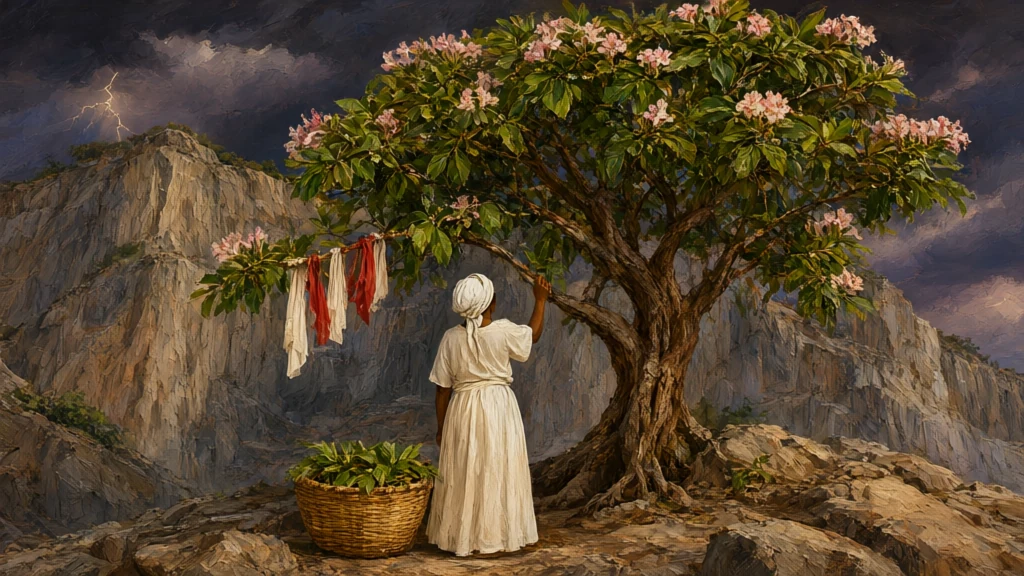
Purcino studied two terreiros in southern Bahia, one ketu and another ijexá. In both, three trees are consecrated to Xangô. The acocô is "a masculine plant", used in the protection of the terreiro and in baths for prosperity. The baobá and the orobô enter rituals that the house keeps. The orobô is a leaf "of hot characteristic".
Orixá: Xangô | Trees: acocô, baobá, flamboyant | Hot leaf: orobô | Nation: ketu and ijexá
The acocô is also in the myth. Felipe Rosa and Waldmir Araújo Neto reproduce an itã by Prandi. In it, Iansã finds Xangô hidden under an acocô, "his sacred tree". The couple has their own article in Iansã and Xangô. In ketu houses in Rio, Vitor Azevedo, from UERJ, puts the red-flowered flamboyant with Euá, Oyá and Xangô.
In Umbanda: every house has its own list
In Umbanda, the list depends on the house, and open sources provide at least four versions.
- Terreiro Pai Maneco (Curitiba): lime tree, erva-moura, erva-lírio, coffee leaves, mango tree and an unidentified "erva de Xangô".
- FUCESP (São Paulo): "some herbs", including tobacco leaf, cattail and jatobá.
- Terreiro de Teixeira de Freitas (BA): five of the 39 plants belong to Xangô. The stonebreaker is only his, due to the name that reminds one of a quarry. The guiné, the arruda, the pinhão-roxo and the alecrim are shared with other orixás, such as Ogum (Ogun) and Oxóssi (Oshosi).
- Viçosa (MG): the vence-demanda goes into a cleansing bath (banho de descarrego). The okra leaf goes into a ritual bath and in the food.
A 1985 survey in Rio de Janeiro, conducted by biologists from the Botanical Garden, does not separate Umbanda and Candomblé. It records the aperta-ruão as a "plant dedicated to Xangô" and the panaceia as a plant of Xangô and Obaluaiê (Babalu Aye).
In commerce, the quitoco is sold as erva-de-xangô. No open source confirms that Pai Maneco's plant is this one. The bay leaf and cinnamon have their own articles: bay leaf and cinnamon of Oxum and Xangô. How the orixá arrives in the gira is in Xangô in Umbanda, and the chants, in ponto of Xangô.
In the South: Umbanda Nagô and batuque
In Rio Grande do Sul, some of Xangô's plants go into the pot. Researcher Vladimir Torres studied eight Umbanda Nagô temples. He recorded okra in Xangô's "festive food" and mustard in the amalá. The yam, for him, is "liturgical food of Xangô". The dish is in amalá of Xangô.
In a house of batuque, the Ilé Àsé Odé and Iemanjá (Yemoja), the herbs of Xangô are rue, yam and gervão. It is the list of just one house. Other houses may give another list, as shown in Xangô in batuque.
Hot and cold herbs of Xangô
The sources that classify the leaves of Xangô put the majority on the hot side. Purcino records the orobô as a hot leaf. In Viçosa, a zeladora de umbanda cites three hot herbs: cambará, aroeira and mamona. They belong to the "orixás considered of fire", among them Xangô.
Àsé Dan Fè Èrò is a house of Candomblé. It gives the Yoruba name and the hot (gùn) or cold (èrò) class of each leaf. For the house, the abamodá is the "main leaf of Xangô". The igí mésàn is the lightning rod, of Oyá and Xangô. The cow tongue is of Xangô Barú and of Oxum (Oshun).
Cold leaf of Xangô, only one house records: the purple basil of Xangô Ayrá, which Àsé Dan Fè Èrò classifies as èrò, of water.
It is the list of one house, without a second source. Airá has an article in Ayrá orixá. The general rule is in hot and cold herbs and in the test hot or cold herb.
Caution: the herbs that do not go in the mouth
Some plants on the Xangô list are toxic and should not be consumed. The pinhão, purple and white, is the plant most cited in intoxications at the toxicology center of Belém, with 25.1% of cases. The two deaths in the series were from mamona and from cassava. Rue is one of the "plants most commonly used for induction of abortion" in Brazil, according to researchers from UFRGS. More about the pinhão in pinhão-roxo.
Ritual bath and amaci of Xangô: the recipe is from the house
No open source consulted provides a recipe for a Xangô ritual bath with function. In Viçosa, the use of plants depends on the indication of the mãe or the pai de santo. Amaci appears only as a record of use, in the aperta-ruão of Rio. What it is can be found in what is amaci.
For a ritual bath outside the terreiro, which ritual bath to take helps choose, without replacing the house. The same logic applies to herbs of Iansã and herbs of Oxóssi. The dates to bring the leaves are in Xangô day. If the house asked for a herb and you want to check the material, the Joia Mística team helps via WhatsApp.
Frequently asked questions
What are the herbs of Xangô in Umbanda?
Each house has its own list. Terreiro Pai Maneco cites lemon tree, erva-moura, erva-lírio, coffee, and mango tree, and FUCESP cites tobacco leaf, cattail, and jatobá. A baiano terreiro links stonebreaker only to Xangô, and two mineiro terreiros cite vence-demanda and okra leaf. The list of your house is what matters.
Is quitoco an herb of Xangô?
In commerce, quitoco is sold as an herb of Xangô, but no open source consulted confirms this. Terreiro Pai Maneco lists an "herb of Xangô" without saying which plant it is. The herbs of Xangô with published research are others, such as acocô, stonebreaker, and vence-demanda. Confirm with the leader of your house.
Can you take a Xangô ritual bath at home?
No open source provides a recipe for a Xangô ritual bath with function. Research says that use depends on the indication of the pai or mãe de santo. Head ritual bath and amaci are prepared by the house. Pinhão-roxo, mamona, and arruda are toxic if ingested, so no leaf goes in the mouth.
References
- Purcino, UFSB: Ethnobotanical profile in Candomblé terreiros
- Rosa and Araújo Neto, eduCAPES: Xangô: fire, matter, and transformation
- Azevedo, UERJ: Ewé Igbo
- Santos e Fortuna, RSD: Teixeira de Freitas terreiro
- Tomaz, UFV: Umbanda in Viçosa
- Guedes and others, Rodriguésia: Afro-Brazilian rituals in Rio
- Torres, UNISANTA Bioscience: Umbanda Nagô
- Colli Silva e Silva, Interagir: A grove of sacred leaves
- Revista Fitos: plant poisoning in Pará
- Infarma: plants and pregnancy
- Terreiro Pai Maneco: Xangô
- FUCESP: Xangô
- Ilé Àsé Odé: Orixás
- Àsé Dan Fè Èrò: Èwés