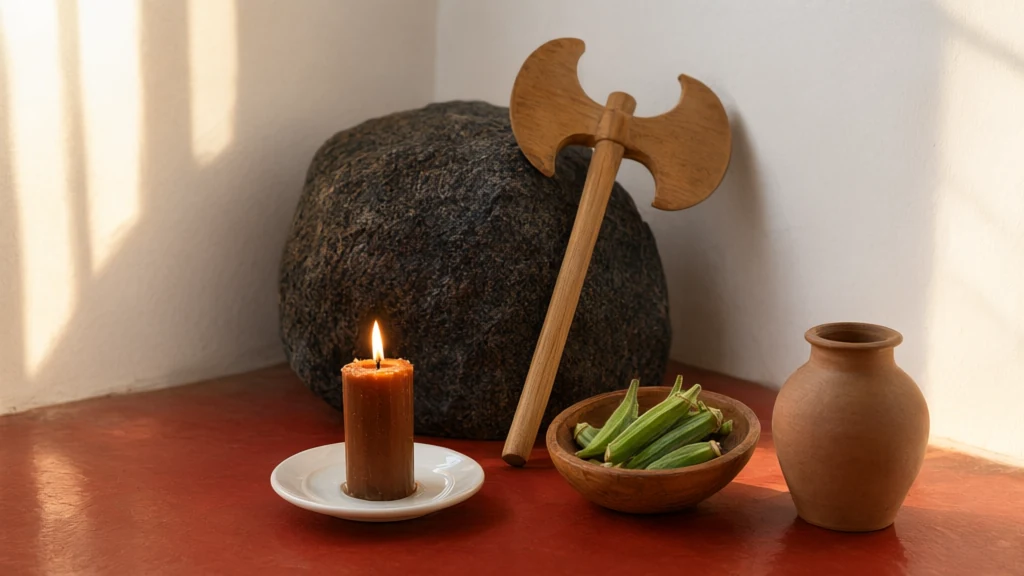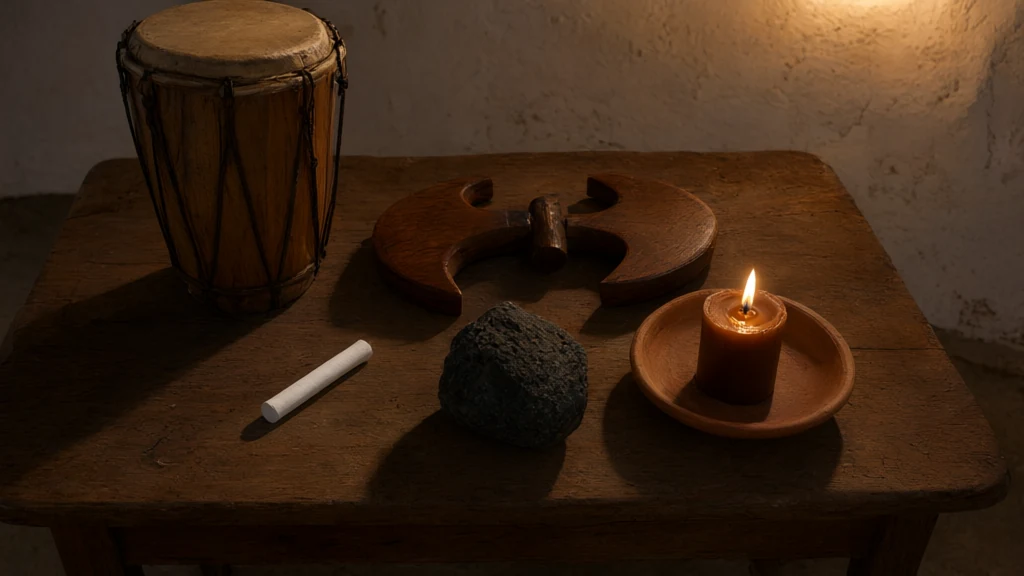
The ponto de Xangô is the sacred song of the Xangô line in the Umbanda gira: it calls, firms the arrival, thanks, and bids farewell to the orixá (orisha) and the caboclos of the quarry. The house of Zélio de Moraes publishes 32 pontos of Xangô, all without a credited author. The lyrics change from terreiro to terreiro. Sometimes, only one word changes.
What is the ponto of Xangô and when is it sung
The ponto de Xangô is the ponto cantado (sacred song) of the orixá and the caboclos of his line. Every moment of the gira has its own. In the books of two houses:
- Call: “Umbanda tá lhe chamando” (Umbanda is calling you), sings the Tenda Espírita Nossa Senhora da Piedade (TENSP). At Terreiro Pai Maneco, in Curitiba, the verse is “A Umbanda está lhe chamando” (Umbanda is calling you).
- Arrival and firmeza: the first ponto of TENSP ends with “Pai de cabeça chegou” (Father of the head has arrived). At Pai Maneco, “Arreia que Xangô chegou” (Get ready, Xangô has arrived).
- Thanksgiving: the last ponto de Xangô in the TENSP says “Meu Pai Xangô, muito obrigado” (My Father Xangô, thank you very much).
- Ascent: Pai Maneco has its own section, with “Ta na hora de subir” (It is time to go up). TENSP does not mark a ponto de subida for Xangô.
In a tenda in Dourados (MS), the researcher Haroldo Medeiros records pontos at all moments of the worship, from the smoke cleansing (defumação) to the arrival of the spirit guides. There, they serve as prayers. The ogã opens each one according to the moment of the ritual. In the houses that Pedro Nogueira studied, the pontos are “a kind of soundtrack” for the caboclos gira. In general, the ogãs are the ones who choose. The role of those who play is in curimba in Umbanda; the types of ponto are in pontos cantados in Umbanda.
In the tenda in Dourados, the orixás do not incorporate. Who descends are the spirit guides. Many pontos of Xangô are from the caboclos of his line: Pedra Roxa, Sete Pedreiras, Pedra Preta, Quebra Pedra. The line in the terreiro is in Xangô in Umbanda.
Where it is sung: call, arrival, affirmation (firmeza), gratitude, ascent | Zélio's house book: 32 pontos of Xangô | Sign on the ponto riscado: two-edged oxé
The pontos of Xangô in the house of Zélio de Moraes
The house founded by Zélio de Moraes publishes a Book of Pontos Cantados on the website. The "Pontos de XANGÔ" section has 32 numbered pontos, between Ogum and Oxóssi (Oshosi). None lists an author. The first opens with the stone and the quarry:
Stone rolled Xangô / There in the quarry
The others make of Xangô the "king of the quarry" and the "king of Umbanda". One greets Xangô Agodô. Another sings the "kingdom of Badé". Badé is the name of Xangô in the Tambor de Mina temples, according to Reginaldo Prandi and Armando Vallado. Who is the orixá behind these names is in who is Xangô.
The second house with an open book is the Terreiro de Umbanda Pai Maneco. The Xangô booklet has a greeting ponto, pontos for each caboclo of the line, and pontos for the line and the ascent. The house writes the author when there is one, as in "Composition: Pai Andir". In the ponto of Caboclo Quebra Pedra, the credit is different: "Composition: spirit".
Lily or book: the same Xangô ponto in different houses
The ponto of Xangô travels from terreiro to terreiro and changes along the way. In TENSP, up high "There is a lily that is Xangô's". In Pai Maneco, "There is a book that is Xangô's". Pedro Nogueira heard both versions in different houses.
| Ponto (sacred song) | In one house | In another |
|---|---|---|
| The quarry | ”There is a lily that belongs to Xangô” (TENSP) | “there is a book that belongs to Xangô” (UFJF and Pai Maneco) |
| Sitting on the stone | ”Waiting for my Pai Xangô” (TENSP) | “Talking with my Pai Xangô” (Dourados) |
| Who overcomes the demanda | ”With Ogum, the demanda was overcome” (TENSP) | “Saint Anthony overcame the demanda” (Dourados) |
| Seven quarries | ”That broke seven quarries” (TENSP) | “owner of the seven quarries” (UFJF) |
Nogueira reads the book as a mark of syncretism. The São Jerônimo of the congás that he visited holds a book. He writes that the syncretism “may be” there, without being definitive. The relationship of the saint with the orixá is in São Jerônimo and Xangô. The leaves of the line are in herbs of Xangô.
Other pontos also travel. Ponto 22 of the TENSP asks that the quarry roll over those who lose faith. In Belém, a report by O Liberal about the day of Saint John opened with the same idea. The dates in June and September are on Xangô's day.
Quarry, axe, and book: what the ponto of Xangô, the sacred song, sings
The ponto of Xangô returns to the same symbols.
- Quarry. In 1933, Leal de Souza already wrote that Xangô's ritual offerings are made in quarries. Medeiros summarizes: Xangô is the orixá "whose domain is the quarries and is associated with justice".
- Axe. The TENSP sings the "Xangô's little axe", which cuts mironga.
- Book and pen. Ponto 05 of the TENSP asks that Xangô take "the book and the pen" to set justice. Ponto 29 remembers that he wrote "with his golden pen". In Dourados, a ponto says that Xangô "wrote justice".
Prandi and Vallado tell that, as a king, Xangô was the supreme judge of his people:
His double axe aims at justice for each of the two sides that oppose each other in the dispute
Pontos (sacred songs) of Xangô that have an author: the Brado de Xangô and others
Not every famous ponto is a root ponto. Diamantino Trindade, cited by Lourival Andrade Júnior, calls pontos de raiz those "brought directly by the incorporated spirits". The others are by composers, "very common in curimba festivals".
- Brado de Xangô. It is the "He shouted in the village", which circulates on the internet with the name of Tião Casemiro. On the channel itself, the ogã says that the ponto (sacred song) is "authored" by Ivo de Carvalho and that he interprets it. In a show in Rio, in 2024, the credit returned to Ivo de Carvalho. The recording is on the Tião Casemiro channel.
- They are burning a candle. The recording by Ogan Helder, from 2024, credits Helder Dos Santos Santana as the author.
- “Xangô meu pai, amarra os inimigos”. The authorship was not verified in open sources. And the title promises an effect that a ponto does not guarantee. It stays out.
That is why only pontos that houses publish without an author or that research already cites are included here, and short ones, like in the ponto de Ogum.
Ponto riscado of Xangô: the double-edged oxé
In the ponto riscado, the sign of Xangô that research records is the oxé, the double-edged axe. Andrade Júnior, who studied pontos riscados of caboclos, shows that in the one of Caboclo Pedra Roxa the axe of Xangô appears “with two edges”, together with the arrows of Oxóssi. Other caboclos, such as Cobra Coral and Arranca Toco, draw the axe with a single blade. Pedra Roxa is also a caboclo of the Xangô line at Pai Maneco.
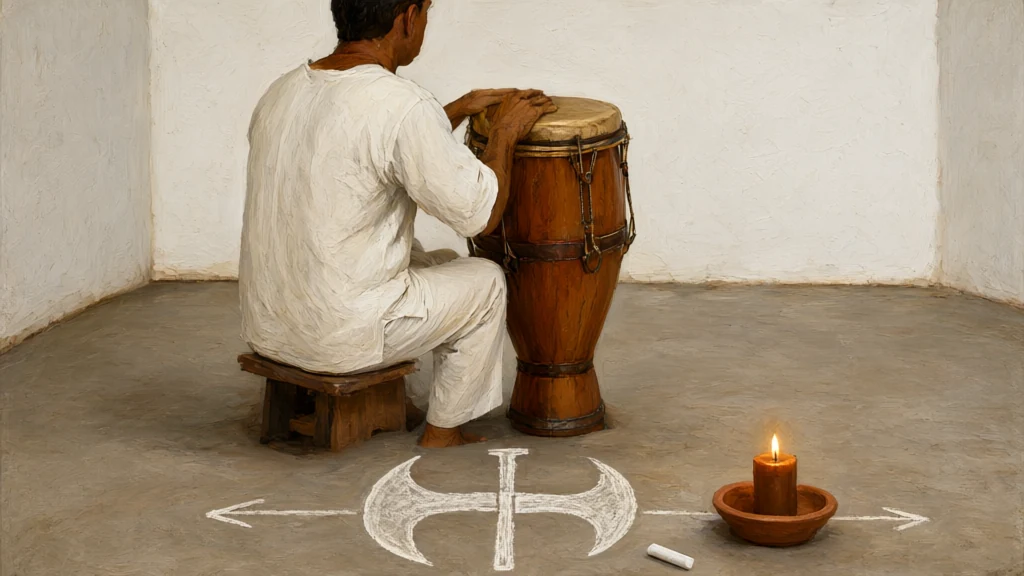
The riscado also says what the spirit is doing. In Dourados, a medium told Medeiros that each ponto riscado is “a request from that person”. Among the riscados, she cited “the riscado of Xangô”. The drawing belongs to the spirit and the house. A riscado copied from the internet is not the ponto of your terreiro. The foundation of drawing is in ponto riscado in umbanda.
Whoever is going to set the ponto with pemba and candle and wants to check the material that the house requested can speak with Joia Mística via WhatsApp.
Frequently asked questions
What is the best-known ponto (sacred song) of Xangô?
There is no measurement of which is the most sung. Among the pontos without an author, the one of the quarry with lily or book is in three records: TENSP, Pai Maneco and the UFJF research. Among the recorded ones, the Brado de Xangô circulates with the name of Tião Casemiro, who attributes it to Ivo de Carvalho.
What is maleme in the ponto of Xangô?
It is a word of request that appears in the pontos (sacred songs). In Pai Maneco, the ponto of Caboclo Pedra Roxa says "Me dê maleime" and immediately asks agô of Xangô. In the TENSP book, the same expression appears as "malembe" in one ponto and "Maleme" in another. The Dicio dictionary registers malembe as a petition chant to orixás in Candomblé.
Is there a ponto (sacred song) of Xangô in Yoruba?
In Yoruba, what is sung is the cantiga of Ketu Candomblé, not the Umbanda ponto. Pierre Verger records that, in Brazil, the rhythms of Xangô are tonibobé and alujá. Three cantigas are on the site: Oba Sá Rewa, Ikitê Re O Lokê Odô and Oba Ní Sà Rè.
References
- Tenda Espírita Nossa Senhora da Piedade: Book of Chanted Points
- Terreiro de Umbanda Pai Maneco: booklet of pontos de Xangô
- Pedro Antônio Pires Nogueira, UFJF: dissertação sobre caboclos e pontos em casas de umbanda
- Haroldo Paulo Camara Medeiros, UFGD: Quebra o coco e arrebenta a sapucaia
- Lourival Andrade Júnior, Mneme (UFRN): The caboclos in Afro-Brazilian religions
- Reginaldo Prandi and Armando Vallado: Xangô, king of Oió
- Pierre Verger: Orixás, Yoruba gods in Africa and the New World
- Leal de Souza: Spiritism, magic and the seven lines of Umbanda
- O Liberal: Day of Saint John the Baptist in the terreiros of Belém
- Dicio: malembe entry