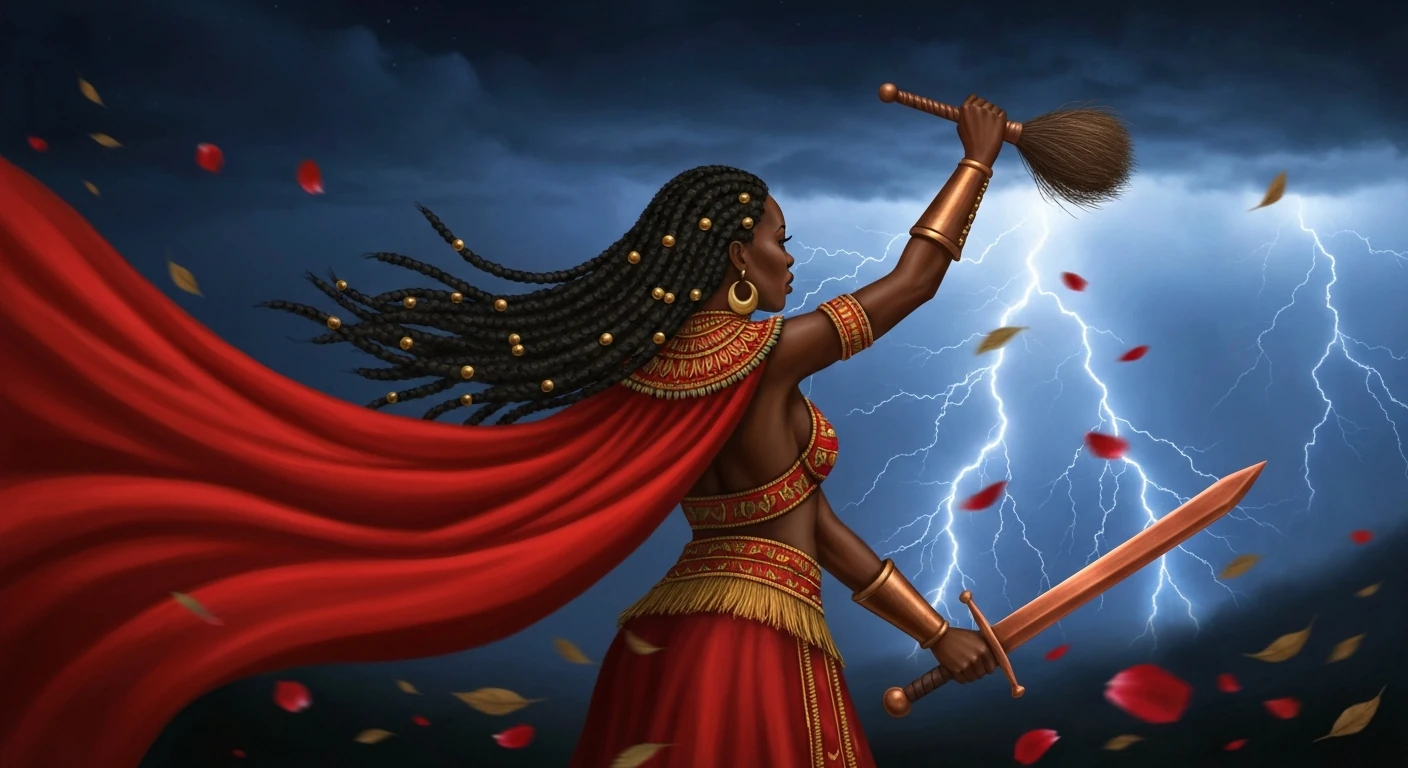
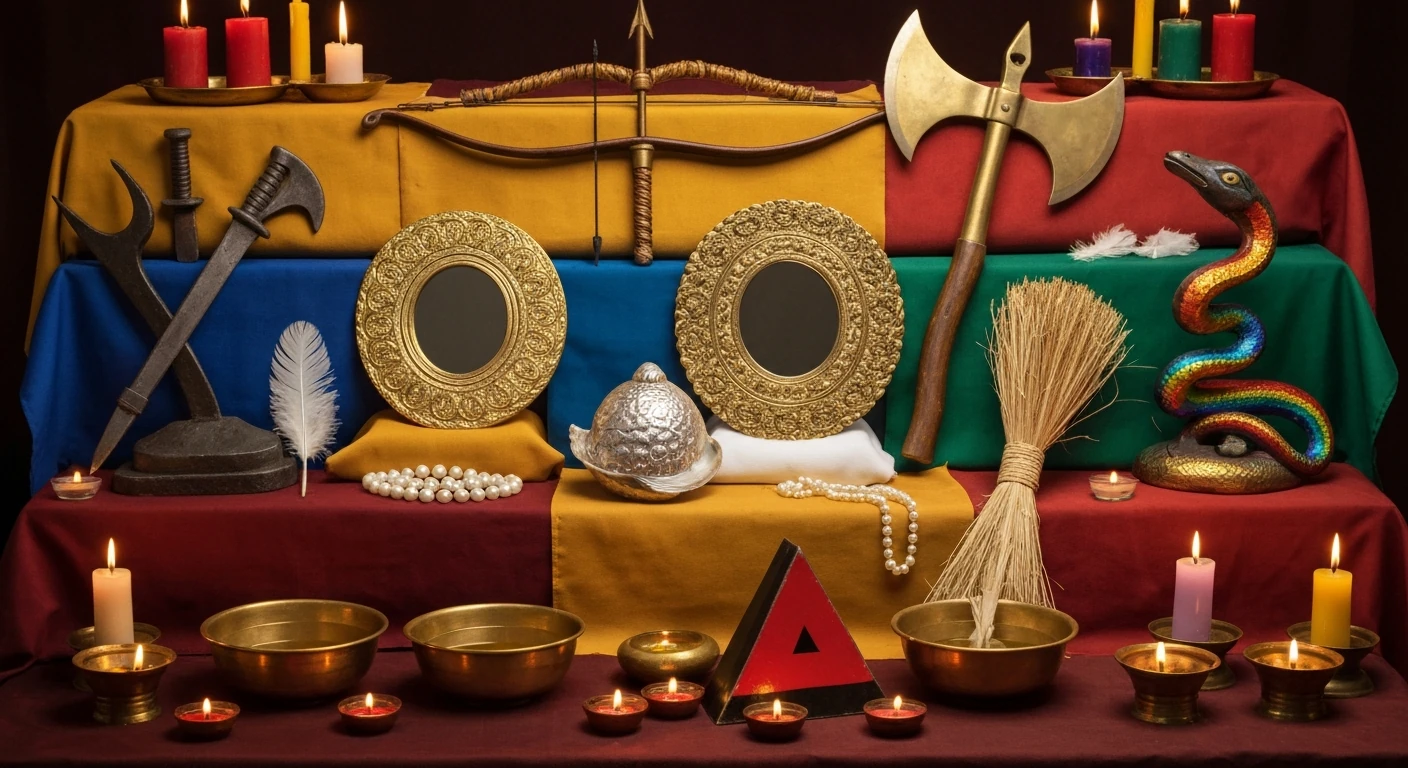
When the bonfires are lit and the poles are raised in June, there is more history burning there than the Catholic calendar tells. Behind each of the June saints Saint Anthony, Saint John, and Saint Peter walks an orixá that the African diaspora hid under the mantle of the saints so that faith could survive repression.
Next, how this syncretism was born, which orixá was associated with each saint of the month (with regional variations), and why so many houses call June the "month of Xangô". The dates of Xangô throughout the year, from June to September, are in Xangô day.
Why the June saints are linked to the orixás
The association between June saints and orixás is not poetic coincidence or friendly religious fusion. It is the heritage of a time when worshipping orixás was forbidden. During colonization and slavery, enslaved Africans were forced to venerate Catholic saints. To avoid losing what they carried in their memory, they made the saint a mask: they prayed before the Catholic statue while, inside, they kept the greeting to the orixá alive.
Syncretism, therefore, was a resistance strategy not an adherence of faith, not a theological equivalence. As explained by the Wikipedia entry on religious syncretism, each orixá was brought close to a saint whose domain resembled theirs: Ogum, lord of iron and war, gained Saint George in the Southeast; Iansã (Oya), of lightning, received the mantle of Saint Barbara. Today, some terreiros experience a movement of reafricanization, a return to the practices of Oyó and Benin, moving away from the Catholic varnish that once protected the tradition.
Important: saying "Saint Anthony is Ogum" is imprecise and disrespectful to both traditions. The correct way is: in syncretism, Saint Anthony was associated with Ogum as a form of cultural survival. They are distinct spirits, from distinct theologies, that history brought together out of necessity.
Saint Anthony: between Ogum and Exu (June 13)
The first saint of the June cycle is also the most regionalized. Saint Anthony, celebrated on June 13, does not have a single answer in the Afro-Brazilian field, and this is a richness, not an error.
In Bahia, Saint Anthony is usually associated with Ogum, the warrior orixá, lord of iron and of paths opened by force. The statue of the soldier saint, sword in hand, speaks with the orixá who opens the road with iron.
In Umbanda and in much of the Southeast and North (such as in Belém), Saint Anthony is brought close to Exu (Eshu), the orixá of communication, who opens and closes the paths, the first to receive offering in any ritual. The connection is explained by function: Saint Anthony is the "matchmaker" saint, the one who solves, the one who unlocks requests and unlocks paths is precisely the office of Exu.
Exu is not the demon. This is the oldest and most unjust misconception weighing on Afro-Brazilian religions, a legacy of colonial Christian reading. In Yoruba mythology, there is no figure of absolute evil: Exu is movement, exchange, word, crossroads. Reducing him to "devil" is erasing the orixá without whom, in the tradition, no ritual work begins.
Laroyê Exu! traditional greeting that recognizes the orixá of the paths as the messenger between the Orum and the Aiê.
Saint John the Baptist and Xangô: the heart of the month (June 24)
If June has an owner in the Afro-Brazilian imaginary, it is Saint John the Baptist, celebrated on June 24 and widely associated with Xangô, the orixá of justice, fire, lightning, and thunder. It is the most consensual correspondence of the entire June cycle, so widespread that the newspaper Brasil de Fato calls June 24 the "day of Saint John and Xangô".
The bridge between the two is fire. The Saint John festival is the festival of bonfires, balloons, and fireworks that tear the sky, and Xangô is the lord of the fire that falls from above, the lightning that delivers justice. King of Oyó in the Yoruba tradition, Xangô is the orixá who judges, who punishes injustice, and protects those who are right.
Colors: red and white (Umbanda); brown and white (Candomblé) | Day: Wednesday | Element: fire, lightning, stone (meteorite) | Symbol: oxê, the double-edged axe | Greeting: "Kaô Kabecilê!"
Kaô Kabecilê, Xangô! "come to contemplate the King," a traditional greeting to the orixá of justice.
In the language of terreiros, lighting a candle and greeting Xangô on the night of Saint John is honoring the judge of the pantheon at the height of his strength. For this reason, many describe the entire month of June as the time to ask for justice, balance, and strength (firmeza).
Saint Peter, the guardian of the keys (June 29)
Closing the cycle, Saint Peter, celebrated on June 29, is also mostly associated with Xangô, especially in Salvador and in Umbanda. The reading is symbolic and direct: Saint Peter is, in the Catholic tradition, the guardian of the keys of heaven, the one who decides who enters, an image of authority and judgment that echoes Xangô, the king-orixá who weighs justice.
In some popular festivities, Saint Peter also appears linked to Ogum or Oxóssi (Oshosi), in less consolidated and more local correspondences. It is worth recording them as a plurality, without establishing a national rule where tradition is diverse.
The important thing is to notice the design of the month: two of the three June saints, John and Peter, converge toward Xangô, and it is this convergence that gives June the fame of the month of the orixá of justice.
Why is June the "month of Xangô"?
June brings together three great Catholic festivities marked by the same element: fire. Bonfires, fireworks, balloons, everything burns. And the fire that falls from the sky, the lightning, is the domain of Xangô. Add to this the fact that Saint John and Saint Peter converge toward the same orixá, and it becomes clear why so many houses dedicate the month to the justice of Xangô.
There is, however, an important historical caveat. As pointed out by the Diálogos da Fé blog, from CartaCapital, the bonfire does not come from Africa: it is a Brazilian cultural adaptation, inherited from European winter solstice festivities. In traditional African worship, the fire of Xangô is a delicate matter that only the initiated in trance approach. The June bonfire, therefore, is a fruit of syncretism itself: the meeting between the Catholic festival, the European custom, and the orixá of lightning.
Recognizing this does not weaken devotion on the contrary. It shows that June, in Brazil, is a deeply mestiço month, where popular Catholicism and Afro-Brazilian religions have been intertwined for centuries.
Umbanda and Candomblé: syncretism is not the same in both
Here lies a common confusion that is worth clearing up. The June correspondences we described, Saint John and Saint Peter linked to Xangô, are stronger in umbanda and in popular Catholicism. In candomblé ketu, the history changes.
In the Ketu nation Candomblé (Nagô-Yoruba), Xangô is classically syncretized not with the June saints, but with Saint Jerome, Saint Barbara and Saint Michael the Archangel as confirmed by the entry about Xangô on Wikipedia. In other words: the June "month of Xangô" is, first and foremost, a phenomenon of Umbanda and popular faith, not a universal rule for all Afro-Brazilian traditions.
This distinction matters because Umbanda and Candomblé are distinct religions, with their own origins, liturgies, and calendars. Treating the two as synonyms erases the real diversity of the Afro-Brazilian field and signals superficiality to those who are practitioners. The Afrocentric portal Mundo Negro details how the June festivities vary from Salvador to Recife and Rio, reinforcing that there is no single syncretism, but many, depending on the house and the region.
Frequently asked questions about the June saints and the orixás
Who is Saint Anthony in Umbanda? Which orixá?
It depends on the region. In Bahia, Saint Anthony is usually associated with Ogum, the warrior orixá. In Umbanda and in much of the Southeast and North, he is approximated to Exu, the orixá of paths and communication. There is no single answer: tradition is plural and regionalized.
Is São João Xangô?
Not in the literal sense. In syncretism, Saint John the Baptist was associated with Xangô, the orixá of fire and justice, because the bonfire festival on June 24th dialogues with the domain of lightning. They are distinct figures, from distinct traditions, brought close by history, not the same figure.
Why is June the month of Xangô?
Because two of the three June saints, São João (June 24) and São Pedro (June 29), are associated with Xangô, and the element that unites the festivities is fire, the domain of the orixá of justice. Many Umbanda houses dedicate the month to celebrations and requests for justice and balance to Xangô.
Who is São Pedro in Umbanda?
São Pedro, celebrated on June 29, is mostly associated with Xangô, especially in Salvador and in Umbanda through the image of the guardian of the keys of heaven, who decides and judges. In some local festivities, he also appears linked to Ogum or Oxóssi, in less consolidated correspondences.
What is the relationship between the June saints and Candomblé?
In Reginaldo Prandi's table for the Ketu Candomblé of São Paulo terreiros, the saint of Xangô is Saint Jerome and Saint John. Saint Barbara was also linked to Xangô in Bahia only until the 1930s, according to Vagner Santos (USP). And in Casa Branca de Salvador, a Candomblé house, June 29 is the feast of Xangô Airá. The link of the June saints with Xangô is strong in Umbanda and in popular Catholicism, but not only in them. Each tradition has its own calendar of correspondences.
Where to honor the June saints and the orixás
At Joia Mística Laroyê, you find everything to celebrate June with respect to the two traditions it carries:
- Red and white candles for Xangô and candles in the colors of Ogum and Exu, to light on the nights of São João, Santo Antônio, and São Pedro
- Statues of Xangô, Ogum, and Exu in different materials and finishes
- Bead necklaces (guias) and strands in the colors of the June orixás: red and white, blue, black, and red
- Incense burners and herbs for cleansing and strengthening in the month of justice
- Offerings and seven-day candles for requests for balance and protection
Visit our shop in Extrema, Minas Gerais or talk to us via WhatsApp and we ship to all of Brazil. This June, light a candle and hail the justice of heaven.
Kaô Kabecilê, Xangô!
References
- Wikipedia: entry on religious syncretism
- Brasil de Fato: report on June 24 as the day of Saint John and Xangô
- CartaCapital: Diálogos da Fé blog about the origin of the June bonfire and Xangô
- Wikipedia: entry on Xangô
- Mundo Negro: report on saints, orixás and June festivities
- FUCESP: Xangô
- National Sanctuary of Umbanda: Xangô
- Reginaldo Prandi, Horizontes Antropológicos (1995): African gods in contemporary Brazil
- Vagner José Rocha Santos, Revista Ingesta (USP, 2019): The acará of Iansã in the festival of Saint Barbara
- Castillo e Parés, Religion & Society (2015): José Pedro Autran and the return of Xangô