On September 30, two festivals happen at the same time. In one of them, the Church celebrates the translator of the Bible. In the other, terreiros in Rio Grande do Sul greet the king of thunder. Saint Jerome and Xangô have shared the date for more than a century.
The question that brings the reader here is usually direct: which saint is Xangô? The honest answer is that there is not just one. There is a map, and it changes when you cross Brazil. This article tells who Jerome really was. It shows what in his statue the terreiros read as the signature of the Orixá, and why the correspondence is one in the South and another in Bahia.
Who was Saint Jerome
Jerome of Stridon was born around 347, in Dalmatia, the region of present-day Croatia and Slovenia. He went to the desert, studied Hebrew and Greek, and took on the task that would define his life: translating the entire Bible into Latin.
The result became known as the Vulgate, and served as the official biblical text of the West for more than a thousand years. Jerome died in Bethlehem on September 30, 420, and the date of his death became his liturgical day.
Here, an important distinction is worth noting regarding other saints of syncretism. Jerome is not a legendary figure. He left written work, correspondence, and a documented biography. He is among the four great doctors of the Latin Church, alongside Augustine, Ambrose, and Gregory the Great. In 2020, on the 1,600 years of his death, Pope Francis published the apostolic letter Scripturae Sacrae Affectus, which treats the Vulgate as a monument of the cultural history of the West.
In the iconography, he almost always appears with the same elements: a lion lying at his feet, a book, writing materials, and a skull. In the paintings of the penitent saint in the desert, a stone is also included in his hand, with which he beats his chest. Remember the lion, the book, and the stone, because it is in them that the story turns.
Xangô, the Orixá of justice
On the Afro-Brazilian side is Xangô, the Orixá of fire, lightning, thunder, and justice. He was a king before being an Orixá: the fourth alaafim of Oió, in the ancient Yoruba territory.
Only the essentials are here, because the blog already has his complete profile in who is Xangô.
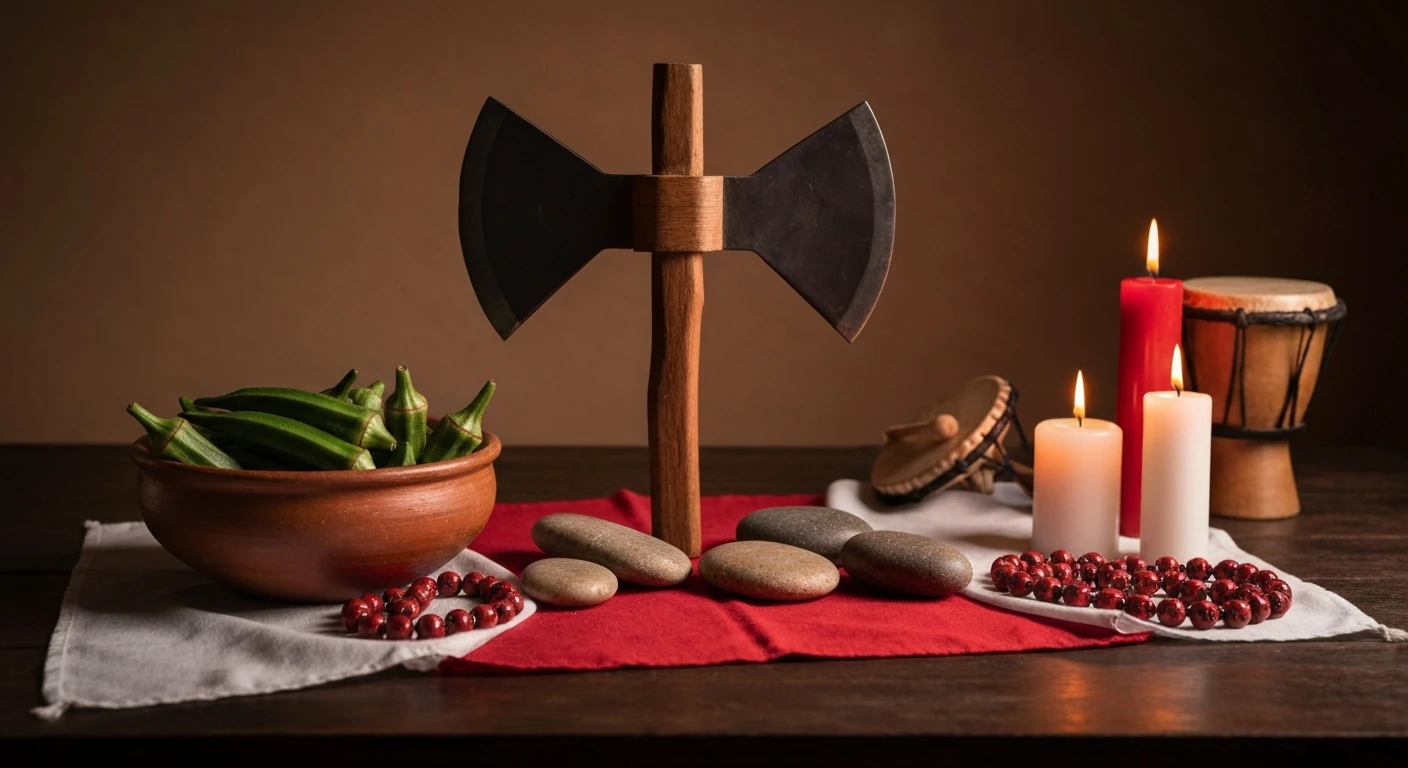
Symbol: oxê, the double-edged axe | Day: Wednesday | Element: fire | Offering: amalá, okra in dendê | Greeting: Káwó Kabiyesilé!
The two blades of the oxê say everything about him. Xangô's justice punishes the guilty and protects the innocent in the same movement. In Rio Grande do Sul, the greeting sounds like "Káwó Kabiyesilé!", and in the rest of the country, it circulates more as "Kaô Kabecilê!". They are spellings of the same Yoruba cry, which means greeting to the king.
The lion, the book, and the stone
Why specifically Jerônimo? The answer is in the image of the saint, and there are three elements that the terreiros read as Xangô's signature.
- The lion. In Yoruba culture, the lion is a symbol of royalty. A saint who tames such a beast is a saint of royal stature, and Xangô was indeed a king.
- The book. Jerônimo is the saint of the fixed word, of one who establishes the written norm. Xangô is the Orixá who judges. Written law speaks with pronounced justice.
- The stone. The stone in the penitent's hand finds Xangô's quarry and the edun ará, the lightning stone. In Umbanda, "Xangô das Pedreiras" is a common epithet.
A curious note about the lion: it comes from a medieval legend, in which the saint would have tamed the beast by healing a wound on its paw. Historians attribute the scene to a confusion with Saint Gerasim. The symbol that brought the saint closer to the orixá, therefore, is not even part of the real biography of Jerome.
Syncretism is not equivalence. Saint Jerome continues to be Saint Jerome for the Catholic, and Xangô continues to be Xangô for the people of santo. September 30th houses two devotions that respect each other.
Which saint is Xangô? It depends on where you are
Here is the point that almost no text on the subject covers. The correspondence of Xangô with Catholic saints changes by region, and treating it as a national rule is the most common mistake on the internet.
| Region and tradition | Saint associated with Xangô |
|---|---|
| Rio Grande do Sul, batuque and Umbanda do Sul | Saint Jerome, on September 30th. A house of batuque in Viamão also cites Saint Michael Archangel |
| Bahia, Candomblé Ketu | Saint Jerome, whom Verger records as the saint of Xangô in Brazil. Saint Barbara was also linked to Xangô until the 1930s, and after that, she remained only with Iansã (Oya) |
| São Paulo, Candomblé Ketu | Saint Jerome and Saint John, in the table by Reginaldo Prandi |
| Pernambuco and other states of the Northeast | The point there is not the saint, it is the name: the religion of Orixás itself is called Xangô |
| Southeast, Umbanda | Saint Jerome (30/9), Saint John the Baptist (24/6) and Saint Peter (29/6), according to FUCESP and the National Sanctuary of Umbanda |
Table sources: Pierre Verger, Orixás; Reginaldo Prandi (1995); Vagner Santos (Ingesta, USP, 2019); Prandi and Vallado (2010), for the Northeast; the African Society Kingdom of Xangô Aganjú, from Viamão; FUCESP and the National Sanctuary of Umbanda. The links are in the References.
There are houses that refine this even further, linking each quality of Xangô to a different saint. This reading exists and circulates among terreiros, but it is not a nation rule: it is a house foundation.
The contrast with the Southeast deserves a note. In São Paulo Umbanda, the dates coexist: TUCTVC gives September 30 as the date of worship, and FUCESP and the National Sanctuary of Umbanda add June 24 and June 29, of the June saints. As the priest Diego de Ogum (Ogun) summarized in an interview with CNN Brazil, there is no single and universal association between saints and Orixás.
It is still worth separating two energies that the public confuses. The lightning of Iansã is not the thunder of Xangô, and each has its own syncretism.
September 30 in the South: public festival and bill project
In Rio Grande do Sul, September 30 is not a discreet date. There is a festival held by the city hall and there is a bill project, but we did not find a law in force. In Porto Alegre, the PLL 411 of 2023 seeks to include the "Day of Xangô's Amalá" in the city's calendar, on September 30; the last processing is from October 2023, without a vote.
The city of Capão do Leão holds the Festival of Xangô, the Africanist patron of the municipality, organized with the Municipal Council of the Terreiro People. In 2017, the city hall held the third edition there on September 30. The news calls Xangô the Africanist patron of the municipality; we did not find a municipal law establishing the title. The other dates for Xangô in the country, with the São Paulo law, are on Xangô day.
This rooting has a history. Batuque is the quintessential Afro-Gaúcho tradition, structured throughout the 19th century, especially in the port regions of Rio Grande and Pelotas. As anthropologist Ari Pedro Oro describes in research published in Estudos Afro-Asiáticos, batuque is organized into "sides" or nations: Oió, Jeje, Ijexá, Cabinda, and Nagô.
It was on this ground that Saint Jerome became the public face of Xangô. Anyone who wants to understand the ritual foundation, with the alujá and the qualities of the South, can find everything in Xangô in batuque.
Why the association happened
The meeting between the saint and the Orixá was not a free choice.
During colonization and slavery, worshipping Orixás was prohibited. The way out was to pray before the Catholic statue and greet the Orixá internally. The saint functioned as a facade, and not as conversion. After abolition, repression continued through legal means: the Penal Code of 1890 criminalized spiritual practices and served as a basis for invasions of terreiros for decades.
The sociologist Reginaldo Prandi shows that Afro-Brazilian religions were syncretic from the beginning, establishing parallels between Orixás and saints under contextual pressure. It was not confused devotion. It was survival engineering.
It is worth remembering that Xangô has two layers, and this helps to understand the fit. There is the historical Xangô, the king of Oió, and the divine Xangô, the Orixá of thunder. An African king could be read through a European saint without the two becoming the same person.
The statue of the saint was what remained in sight. The Orixá was what was kept inside. Calling this religious confusion is reading history from the wrong side.
To separate or celebrate together: today's debate
Part of the people of santo today practice reafricanization and prefer to separate saint and Orixá. The argument is simple and legitimate: the facade is no longer necessary, and maintaining the association mixes two distinct theologies.
Another part celebrates both devotions together, and they are also right. For many families, praying to Saint Jerome and greeting Xangô on the same day is a heritage from grandparents, and cutting that would be erasing their own history.
The blog does not take sides. The golden rule still applies: who defines the correspondence is the foundation of each house. The same debate appears in Saint George and Ogum, and the conclusion is the same.
Frequently asked questions
Which Orixá is Saint Jerome?
In syncretism, Saint Jerome was associated with Xangô, the Orixá of justice and thunder. In Rio Grande do Sul, September 30th even has a municipal festival in Capão do Leão, and Umbanda houses in São Paulo also use the date. Saint and Orixá continue to be distinct figures, from different traditions.
Why was Xangô syncretized with Saint Jerome?
Because of the image of the saint. The lion at his feet represents royalty, and Xangô was king of Oió. The book refers to written law, and Xangô is the one who judges. The penitent's stone finds the quarry and the lightning stone of the Orixá.
Is Xangô's day June 29 or September 30?
It depends on the house. In the South, the date is September 30th, the day of Saint Jerome. At Casa Branca, in Salvador, June 29th is the feast of Xangô Airá. In the Umbanda of São Paulo, FUCESP and the Santuário Nacional da Umbanda give September 30th, and June 24th and 29th.
Which saint is Xangô in the batuque of Rio Grande do Sul?
Saint Jerome, celebrated on September 30th. A batuque house in Viamão, Sociedade Africana Reino de Xangô Aganjú, also mentions Saint Michael Archangel. The date is not law: Capão do Leão holds a municipal festival, and Porto Alegre has a 2023 project still awaiting a vote. Batuque is the Afro-Gaúcho tradition par excellence, organized into nations such as Oió, Cabinda, and Ijexá.
What to offer to Xangô on his day?
The traditional dish is amalá, okra sautéed in dendê served in a wooden gamela. They are accompanied by red and white candles, and the greeting Káwó Kabiyesilé. The offering is a gesture of devotion and respect, never an exchange that guarantees a result.
Where to buy items for Xangô's day
At Joia Mística Laroyê, you find what you need to honor the date:
- Red and white candles: the colors of Xangô, in various sizes
- Gamelas and clay alguidares: to serve the amalá in the traditional way
- Statues of Saint Jerome and Xangô: for home or terreiro altar
- Bead necklaces and beads in the colors of the orixá: for those who already have guidance from their house
- Dendê oil and herbs: the basics of any devotional preparation
Visit our physical store in Extrema, Minas Gerais and we ship to all of Brazil. Talk to us via WhatsApp and Joice will help you assemble your offering with respect to the foundation of your house.
References
- Wikipedia: biography of Saint Jerome
- Vatican: apostolic letter Scripturae Sacrae Affectus, from Pope Francis
- CNN Brasil: interview with the priest Diego de Ogum about the syncretism between saints and Orixás
- Capão do Leão City Hall: official page of the Festa de Xangô, the Africanist patron of the municipality
- Afro-Asian Studies (Scielo): research by anthropologist Ari Pedro Oro on the gaúcho batuque
- Reginaldo Prandi (USP): academic page of the sociologist, specialist in Afro-Brazilian religions
- Pierre Verger, Corrupio: Orixás, work record
- Reginaldo Prandi, Horizontes Antropológicos (1995): African gods in contemporary Brazil
- Reginaldo Prandi and Armando Vallado (Edusp, 2010): Xangô, king of Oió
- Vagner José Rocha Santos, Revista Ingesta (USP, 2019): The acará of Iansã in the festival of Saint Barbara
- Sociedade Africana Reino de Xangô Aganjú: Xangô in the batuque
- FUCESP: Xangô
- National Sanctuary of Umbanda: Xangô
- Tenda de Umbanda Caboclo Tupinambá e Vó Catarina (TUCTVC): Xangô
- Castillo e Parés, Religion & Society (2015): José Pedro Autran and the return of Xangô
- Porto Alegre City Council: PLL 411 of 2023, Day of the Amalá of Xangô