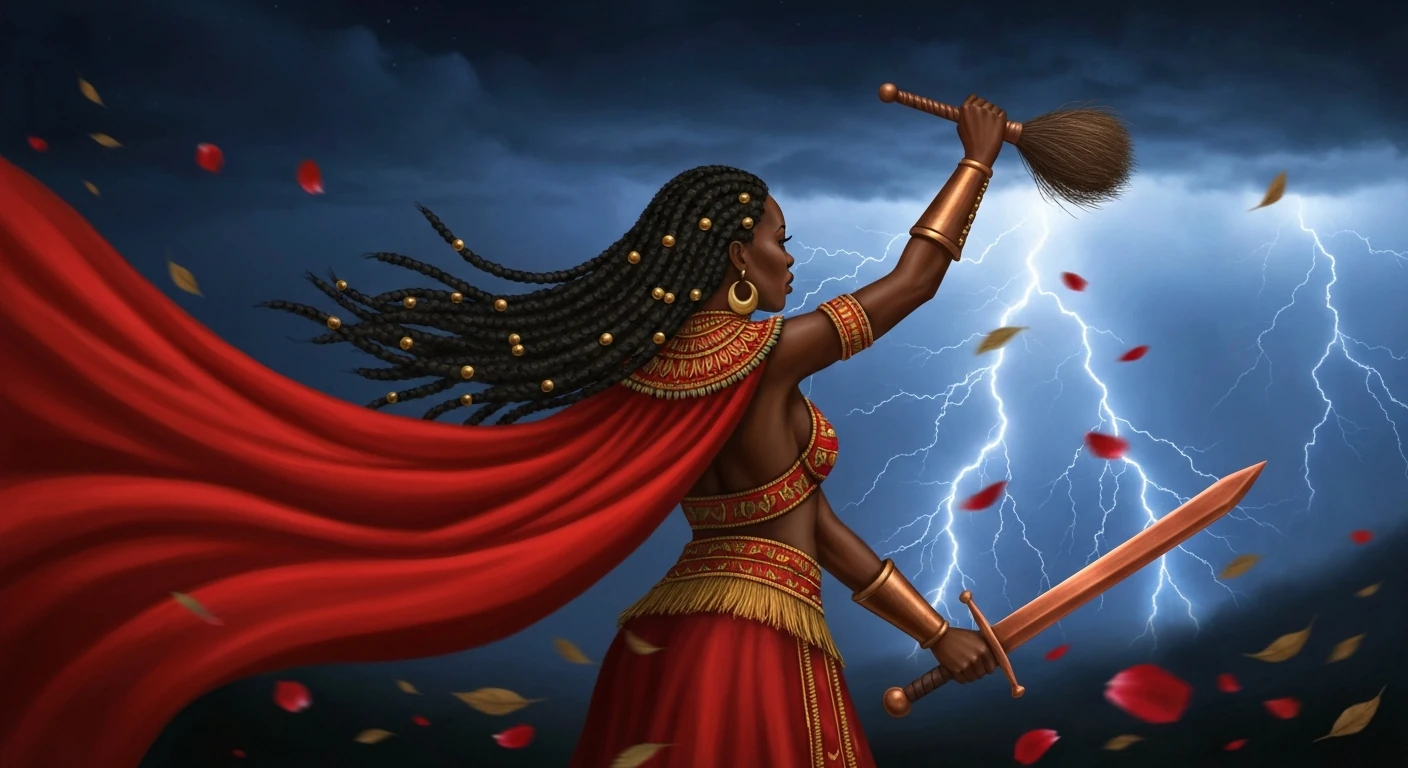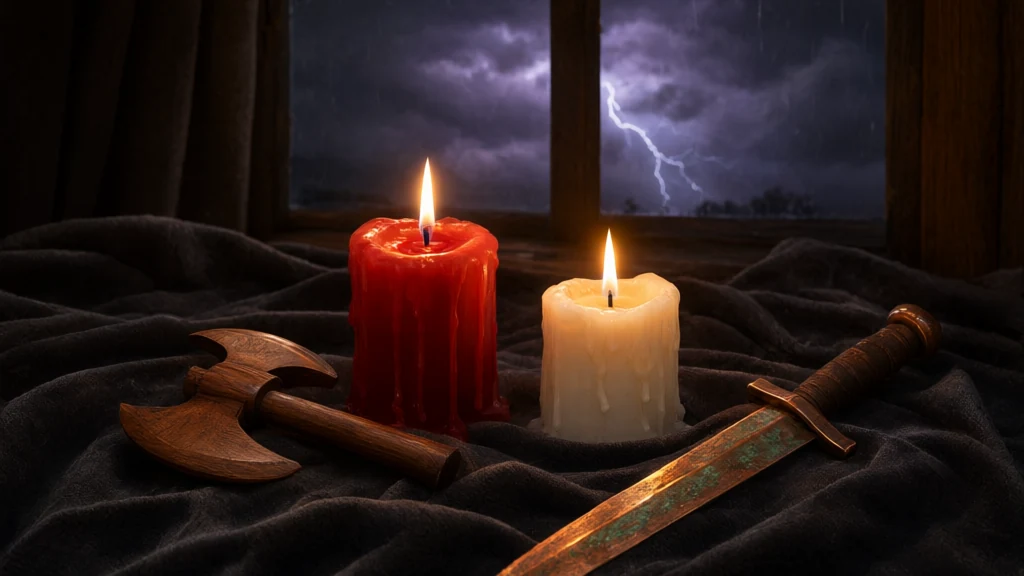
Iansã and Xangô are husband and wife in the myths: in the books and studies consulted, Iansã (Oiá) is the wife of Xangô who accompanies him in war. He has three wives, Iansã, Oxum (Oshun) and Obá (Oba), and Verger calls Iansã the first wife.
What the sources record about the couple is the fire potion, the lightning, the escape, the request to Olodumare and a difference regarding the dead.
Are Iansã and Xangô a couple?
Yes, in the myths. Verger writes that Iansã "was the first wife of Xangô". Bianca Purcino, from UFSB, repeats the same information, citing Verger, in her dissertation on the plants of two ketu and ijexá terreiros in Bahia. In Verger, the three wives are Oiá, Oxum and Obá. In the Batuque house Ilé Àsé Odé, in Rio Grande do Sul, the three are Oiá, Obá and Oxum.
None of the studies consulted describe them as siblings. Rita Segato, an anthropologist from UnB, records that, in the myths of Xangô do Recife, of the Nagô nation, the two are described as "the only ones formally married". In the myths gathered by Prandi, Iansã and Oxum "appear frequently as rivals", writes Andreas Hofbauer in a review of the Revista de Antropologia.
In the angola and in the jeje, the pair was not located in open sources. In Prandi's table, Iansã's line brings the jeje vodun Sobô and the banto inquices Matamba and Bumburucema, and Xangô's line brings the voduns Badé and Queviosô and the inquice Zázi. The profile of each is in who is Iansã and in who is Xangô.
The fire potion: how Iansã learned to spit fire
According to Verger, Xangô sent Iansã to the land of the baribas "to seek a preparation" that would allow her to "launch fire and flames through the mouth and nose." According to Verger and Verônica Costa, from UFRJ, she disobeyed his instructions and tried the preparation. In Prandi and Vallado, she tasted the potion on the way back, out of curiosity, and "spat fire."
The versions differ in the outcome. In Couto, from UFBA, Iansã "stole from him the power to control fire." In a variant that Carina Dias, from UCS, collects from "some practitioners" of the Cabinda Batuque, he "does not punish her for disobedience and shares with her the power to spit fire," because she is "the beloved of Xangô." In Verger, the discovery is "to the great dismay of Xangô."
Santos, from UFBA, links the potion to the origin of the acará: the potion explains why, "in the rituals of the gods of fire," Xangô and Iansã "compete to swallow the acarás," which there are lit torches, and not the cake. The text does not describe the rite.
The lightning: who kept what
The sources give three answers for the lightning, and they do not coincide.
- The two share. "Iansã shares with her husband the control of fire and the mastery of lightning," writes Santos.
- She gives him the lightning stones. In the account of Jacutá, a quality of Xangô, in Prandi and Vallado, Iansã's lightning falls "like stones from the sky," and the "eternal lover" gives Xangô "the power over the lightning stones, the edun-ará."
- She keeps the lightning, he keeps the sound. An alabê from the Cabinda house studied by Dias says: "she would keep the lightning and he would keep the sound of the lightning."
Dias records the belief that, when lightning falls in a storm, one should shout "eparrei, Oiá!", a greeting "linked to the great love of Xangô."
Ogum (Ogun), the escape and the request to Olodumare
Before Xangô, Iansã "had lived with Ogum", writes Verger. In an itã that Dias cites from Prandi (2001), Ogum, upon seeing the woman spit fire, "repudiated Oiá and handed her over to Xangô", who "cynically refused the offering" because he "had deceived Ogum". It is a single source, and the words are those of the myth.
At the end of Xangô's reign, Iansã was "the only one of the women" who followed him in the flight to Tapa. Prandi and Vallado tell what came after:
At the moment of Xangô's death, Iansã reached Orum and, before Xangô became an egum, asked Olodumare to transform him into an orixá.
Dias also cites two itãs from Prandi (2001). In one, Oiá frees Xangô from prison "with the lightning" and "with the wind". In the other, upon learning of his death, she transforms into the Niger River. Both are second-hand, from Prandi.
What separates them: the dead and the lamb
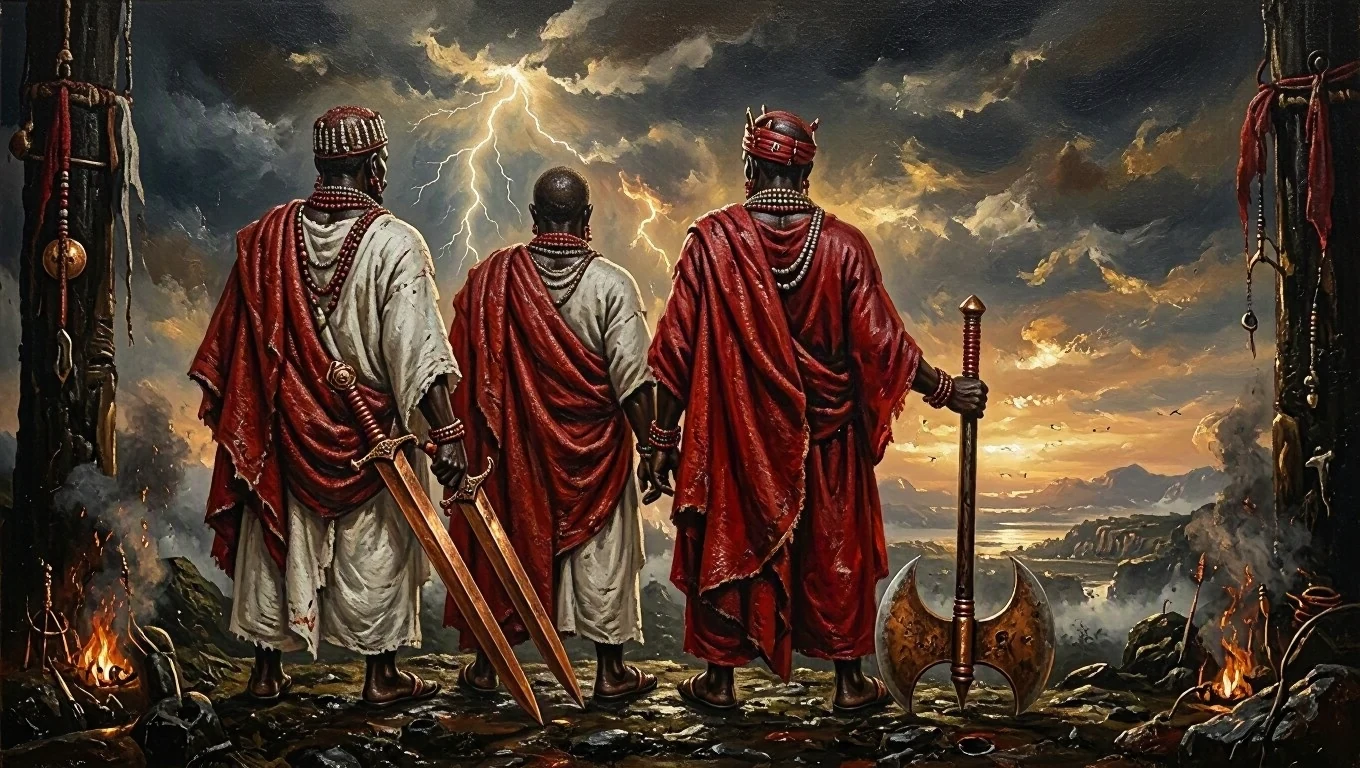
Iansã is the mistress of the dead. For Verger, she is "the only orixá capable of facing and dominating the Egúngún", and lamb meat is forbidden to her. In Prandi's table, the taboos of Iansã's children include eating lamb and eating pumpkin, and those of Xangô's children include "contact with the dead and cemeteries". The guide of the eguns is in egum in candomblé.
Segato, in Xangô do Recife, says that the two "fiercely disagree" about the lamb and that Xangô "has an aversion to death and to eguns". In this myth, Xangô is barred from the dead's ballroom. In the description of Iansã's children that Segato collects, it appears: "Xangô does not have the courage to go where Iansã goes". The text does not recount what he saw there, because Segato gives it as the most secret aspect of the Nagô tradition and does not reveal it.
In the house of batuque cabinda de Dias, the pai de santo says something else: Xangô "does not fear egum" and "does not give leeway to egum". The sources agree that Xangô does not deal with egum and diverge on the reason. The practice is in offering for Xangô.
What the two share: Wednesday, acarajé and okra
Wednesday is the day of the two. Verger gives it to Iansã and Xangô, and Prandi and Purcino repeat it. In the batuque, the house Ilé Àsé Odé gives Tuesday to the two, and the same house lists Xangô among the adjuntos of Iansã. It is one house, not the rule of the batuque. See Oiá in the batuque and Xangô in the batuque. The festival dates of Xangô in the year are in Xangô day.
The acarajé is "the ritual food of Xangô and Iansã", writes Couto. IPHAN records that, in Candomblé ceremonies, it is offered to Xangô and Oiá "without fillings". Santos says that Iansã and the Ibejis, the children, eat okra due to the "familial and real bond" with Xangô. The okra of the amalá is in Xangô amalá.
Saint Barbara and Saint Jerome: why does the saint appear with the two
In Prandi's table, of the Ketu terreiros in São Paulo, the saint of Xangô is Saint Jerome or Saint John, and the one of Iansã is Saint Barbara. Verger says that, in Cuba, the pair of Xangô is Saint Barbara. Santos writes that, until the 1930s, the saint also appeared with Xangô, and only later stayed with Iansã. In Alagoas, the wooden saint Xangô-Bomim, exposed after the Quebra of 1912, "in religious syncretism could also be taken for Saint Barbara", as it was said, tells Ulisses Neves Rafael.
The pair has a history and is not an identity. The Salvador city hall records that Candomblé practitioners "make a point of emphasizing the distinction between Saint Barbara and Iansã". The December 4th festival is in Saint Barbara and Iansã and the other association, in Saint Jerome and Xangô.
Frequently asked questions
Are Iansã and Xangô married?
In the myths, yes: Iansã is Xangô's first wife in open sources, alongside Oxum and Obá. Segato records that, in Xangô do Recife, they are described as "the only ones formally married". In angola and jeje, the pair was not located in open sources.
Do Iansã and Xangô have the same day of the week?
Yes: Wednesday is the day of the two in Verger and Prandi, and Purcino repeats Verger's record. In batuque, a house in Rio Grande do Sul gives Tuesday to both. The day of your house is worth more than any list.
Is Saint Barbara from Iansã or from Xangô?
From both, in different periods. In Brazil, Saint Barbara is the saint given to Iansã, and Saint Jerome, to Xangô. Santos tells that, until the 1930s, the saint also appeared with Xangô, and Verger records the connection in Cuba. The pair has a history and varies from house to house.
Who is the child of Iansã with Xangô?
The orixá of front and of joint is defined by the house, and not by an internet text. Open sources do not bring any personality traits for this combination. The explanation of the juntó is in orixá de frente e de junto.
References
- Reginaldo Prandi and Armando Vallado, Edusp: Xangô, king of Oió
- Reginaldo Prandi, Horizontes Antropológicos: African gods in contemporary Brazil
- Pierre Verger, Corrupio: Orixás, work record
- Carina Monteiro Dias, UCS: dissertation on the Rio Grande do Sul batuque
- Vagner José Rocha Santos, Revista Ingesta (USP): O acará de Iansã na festa de Santa Bárbara
- Edilece Souza Couto, ANPUH: Festival of Saint Barbara and Iansã
- Rita Laura Segato, Anuário Antropológico: Inventando a natureza, Xangô do Recife and Iemanjá em família
- Ulisses Neves Rafael, Etnográfica: Muito barulho por nada ou o xangô rezado baixo
- Andreas Hofbauer, Revista de Antropologia (USP): Resenha de Mitologia dos orixás, de Reginaldo Prandi
- Verônica Costa, UFRJ: Oyà-Iansã e a potência do Feminino
- Bianca Purcino, UFSB: dissertation on the plants of the orixás
- IPHAN: Ofício das Baianas de Acarajé
- Salvador City Hall: Festa de Santa Bárbara symbolizes faith and resistance