Who is Ogum: the orixá of iron, war, and paths, who goes ahead of the other orixás. In the table by sociologist Reginaldo Prandi for Ketu Candomblé, he is the "orixá of metallurgy, agriculture, and war," and his day is Tuesday. The greeting is "Ogunhê!", and the most well-known date is April 23, the day of Saint George.
There are houses that gave Ogum as the ruling orixá of the year. Who announced Ogum and who announced Oxóssi (Oshosi) is in ruling orixá of 2026.
Who is Ogum, the lord of iron
Ogum is the orixá who dominates iron. Prandi describes him as "God of war, iron, metallurgy, and technology" and as "the orixá who has the power to open paths, facilitating travels and progress in life," in a 1995 article in the magazine Horizontes Antropológicos. In the same table, he is the patron of "open roads, manual occupations, soldiers, and police".
Ogum's family changes with the location. In Africa, Pierre Verger writes that Ogum, "as a historical figure, would have been the eldest son of" Odùduà, the founder of Ifé. He took the city of Ire and returned using the title of Oníìré, "King of Ire". In Brazil, the story is different: "It is told in Brazil that Oxóssi was the brother of Ogum and Exu (Eshu), all three being sons of Iemanjá (Yemoja)". Even this varies. In the review that Andreas Hofbauer made of Prandi's book of myths, the doubt remains "if Ogum is the father or brother of Oxóssi?". Hofbauer also notes that "The fight between Xangô (Shango) and Ogum seems thus eternal".
The orixá who opens the road has more than one version of myth. In one of them, told by FUCESP, the federation of umbanda and Candomblé of São Paulo, the orixás cannot clear a field in Ifé, and only Ogum, owner of the secret of iron, clears the brush with the machete. Verger summarizes the idea: "He is, then and always, the first and opens the path for the other orixás."
In baiano Candomblé, Verger saw this in the ritual. Ogum is "the first to be greeted after Exú is dispatched with his despacho (ritual offering)", and when the orixás enter the barracão, "It is always Ogum who parades in front". In Brazil, he wrote, "Ogum in Brazil is known, above all, as the god of warriors". The Wikipedia entry gathers other names and correspondences. To situate him among the other divinities, see what the orixás are.
Technical sheet of Ogum
The sheet separates what comes from Ketu Candomblé, by Prandi's table and Verger's book, and what comes from the houses of umbanda.
- Domains: metallurgy, agriculture and war; open roads, manual trades, soldiers and police (Prandi)
- Colors: in Ketu Candomblé, clothes "dark blue, green and white" and beads "dark blue or green" (Prandi). In Umbanda, red: in 1933, Leal de Souza already gave the Ogum line the color "encarnada", and the TUCTVC, house of São José dos Campos, uses "Red, red and white and blue"
- Day of the week: Tuesday (Prandi and Verger)
- Element: the "forged iron" (Prandi)
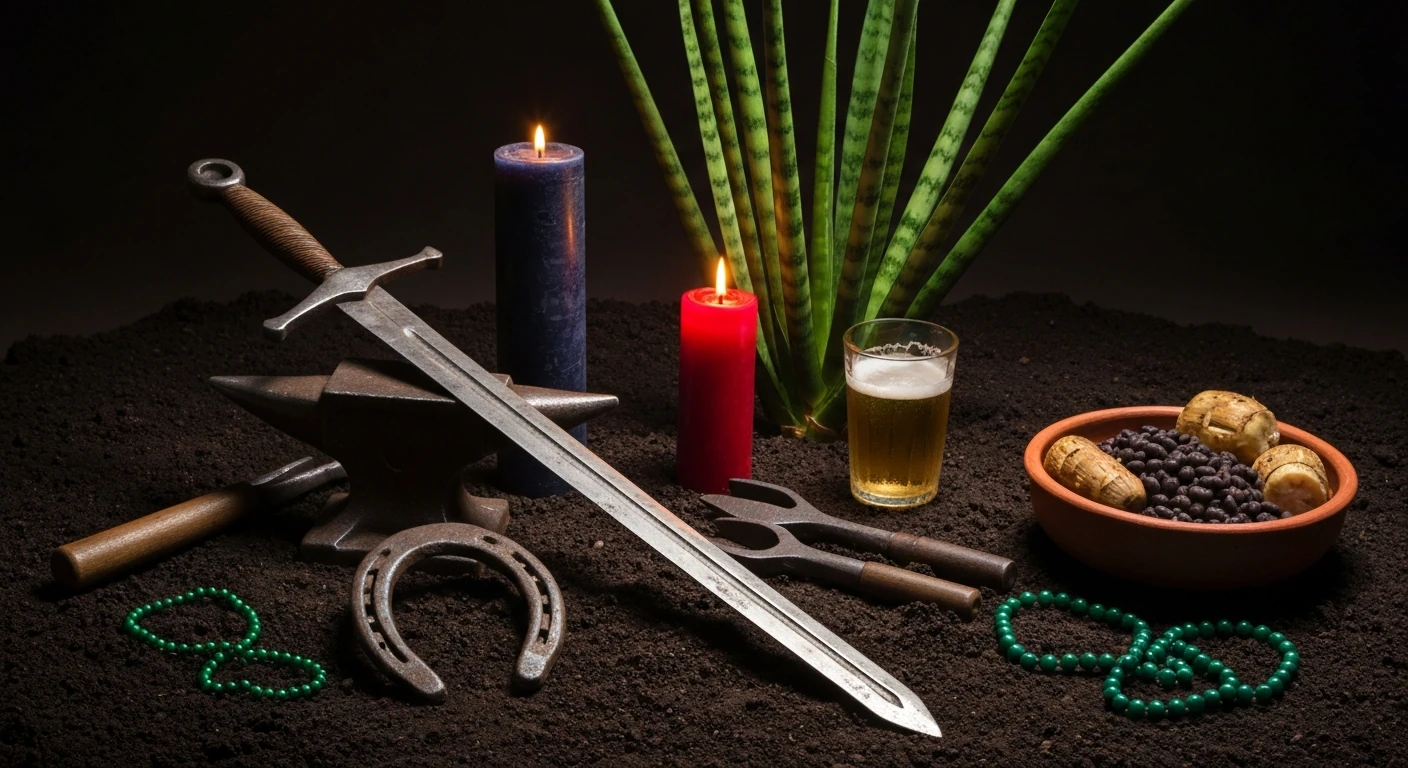
- Symbol: the sword (Prandi). In Ire, Verger records Ogum in iron instruments on a rod: "spear, sword, hoe, tongs, machete, arrowhead and adze"
- Greeting: "Ogunhê!" (Prandi). Umbanda houses like TUCTVC also use "Patakori Ogum", and Verger records "Ogum ieee!" in Bahia
- Number: seven. Verger writes that "Ogum is unique, but, in Ire, it is said that he is composed of seven parts"
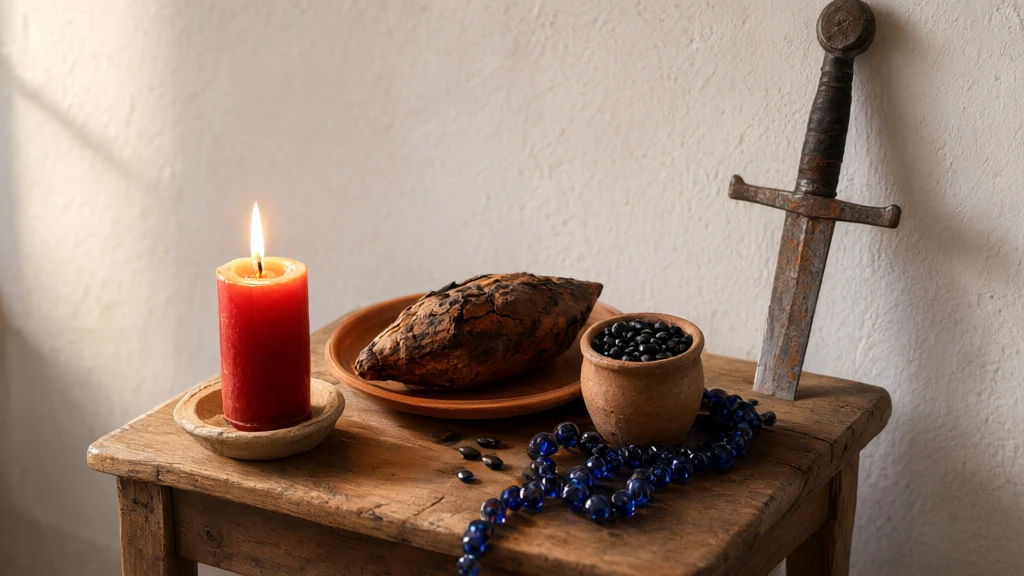
- Food: "feijoada and roasted yam" (Prandi)
- Taboo of the children in Ketu: "getting drunk" (Prandi)
- Herbs: aroeira and espada-de-são-jorge, among others, at the Terreiro de Umbanda Pai Maneco; espada-de-são-jorge, abre-caminho, arruda and rubber tree leaf at FUCESP
"Ogunhê!" According to Wikipedia, the greeting comes from the Yoruba "Ògún yè", "Ogum lives".
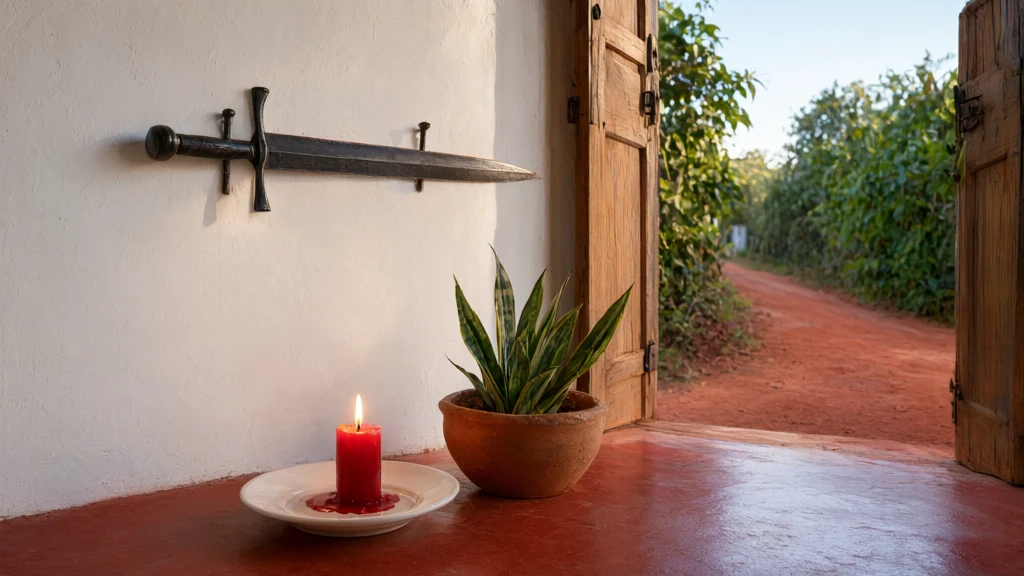
The warrior's most well-known herb takes the name of the saint to whom he was associated: see the espada-de-são-jorge, the plant of Ogum. The shredded palm leaf that protects the door of the terreiro is in mariô, the leaf of Ogum.
Why Ogum is the orixá of paths and war
Ogum's war is not blind violence, and understanding this dispels one of the most common prejudices about the orixá. His sword cuts what blocks the path: the brush that does not let passage, the demanda that holds someone's life. For this reason, he is sought by those who need to win a battle, open a door of work, or unlock a stalled situation.
The same iron that makes the spear makes the hoe. Prandi's table places under Ogum both soldiers and the police as well as manual occupations and agriculture. Hofbauer recalls that the importance that the Yoruba give to the smelting of iron "is expressed in various myths dedicated to the figure of Ogum". Those who turn to the warrior do not ask for the fight to disappear: they ask for strength to face it with firmness.
The orixá who opens the path is also read in the temperament of those who belong to him. How Prandi and Verger describe this archetype, and where it fails, is in filhos de Ogum.
The qualities and lines of Ogum
The warrior appears with many names: qualidades in Candomblé and linhas or falanges in Umbanda. The spellings and numbers vary from house to house.
In Candomblé, Verger records that in Bahia Ogum receives seven names, and the most cited are "Ogum Onirê, Ogum Akorô, Ogum Alagbedê, Ogunjá, ogum Mejê, Ogum Omini, Ogum Warí". Some have explanations in the sources:
- Onirê: comes from the title Oníìré, "King of Ire", which Ogum won upon taking the city (Verger)
- Akorô: Ogum could not use a crown, only a diadem called àkòró, and for this reason he is hailed as Ògún Aláàkòró (Verger)
- Ogunjá: Verger tells that the praises to Ògúnjajá, "Ogum eats dog", earned him the name Ògúnjá. Edison Carneiro, cited by Prandi, describes Ogunjá as "an Ogum who lives with Oxóssi and Exu, and feeds on raw food"
- Xoroquê: is not on Verger's Bahian list. Prandi writes, in Revista USP, that children of Exu ended up being initiated "especially for Ogum Xoroquê, a qualidade of Ogum with deep connections with the messenger"
What each name means and why the head qualidade is only discovered inside a house are in qualidades de Ogum.
In Umbanda, the list changes with the author. In the codification of Matta e Silva, summarized by researcher Sônia Lages (UFJF), the line of Ogum has Ogum de Lei, Yara, Megê, Rompe Mato, Malê, Beira-Mar and Matinata, and she warns: "But the classifications vary". In the houses of Fortaleza studied in Pereira's (UFC) dissertation, Ogum de Ronda, Ogum Dilé and Ogum Sete Rondas appear. Ogum Naruê is sung in the house of Zélio de Moraes and in Terreiro Pai Maneco, in Curitiba ("Salve Ogum Naruê"), and Ogum Sete Espadas appears in the pontos of Zélio's house.
In the angola nation, the corresponding nkisi is Nkosi, which Prandi spells as “Incáci” and “Roximucumbe”. The angola house Inzo Tumbansi describes him as “Guardian deity linked to war”. What an nkisi is can be found in what is an nkise in angola candomblé. In jeje, the vodun is Gu: Verger writes that the worship of Ogum extends to jeje countries, such as the former Daomé and Togo, “where he is called Gun”. In the gaúcho batuque, the warrior has his own passages, the theme of Ogum in batuque.
Ogum in umbanda and in candomblé
Ogum is not lived in the same way in the two traditions, and confusing them erases what each one has of its own.
In candomblé, Ogum is an orixá worshiped in the xirê, with consecrated foundation (assentamento), tools, qualities, and foods by nation. In Prandi's table, the consecrated foundation (assentamento) are “miniature iron agricultural instruments in a clay alguidar”. In a trance, Verger says, Ogum “dances with a martial air, waving his sword and looking for an opponent to strike”. The chants are in yoruba, such as Ogum Onire Alagbara. The foundations remain with the pai or the mãe de santo.
In umbanda, Ogum works primarily as a line. Leal de Souza, in 1933, already placed him as the second of the seven lines, that of Saint George. In Umbanda Sagrada, by Rubens Saraceni, “Ogum is the Orixá of the Law”; the TUCTVC summarizes Ogum as “Law, Order and Opening of Paths”.
The orixá itself rarely descends in the gira. Leal de Souza wrote that "The Orixás do not always descend" and that, in eight years, he saw only two, one of them "of Ogum, the Orixá Mallet". According to Matta and Silva, in the reading of Lages, the orixás pass on their attributes to the entities, "not presenting themselves, therefore, personally in the terreiro, as occurs in Candomblé". Those who arrive are caboclos and spirit guides with the name of Ogum, who come to cut demanda and open a path. The falanges, author by author, and those who descend in the gira are in Ogum in umbanda. What separates the two religions is in the difference between umbanda and candomblé.
Ogum, Saint George and Ogum Day
Who looks for the date of Ogum finds April 23, the day of Saint George. During colonization, faced with the prohibition of worshipping the orixás, enslaved Africans associated their deities with Catholic saints to continue revering them under another name. It was a survival strategy, not a declaration that orixá and saint would be the same thing. The TUCTVC writes that syncretism "does not mean that the two figures are exactly the same deity".
The saint changes with the region. Verger records: "In Rio de Janeiro, it is with Saint George that Ogum was associated", and "In Bahia, Ogum was syncretized with Saint Anthony of Padua", celebrated on June 13. FUCESP gives Saint George in São Paulo and Saint Anthony in Bahia. The history of each pair is in Saint George and Ogum and in Saint Anthony and Ogum.
April 23 is not a national holiday. In São Paulo, State Law 14.905, of 2012, established the "Day of Ogum" in the official State calendar, without a holiday. In Rio, the state holiday is Saint George Day, by Law 5.198, of 2008, which the Supreme Federal Court ruled constitutional. In Umbanda houses, the TUCTVC gives "Worship date April 23", and in the Tenda Espírita Mamãe Oxum (Oshun), studied by Pedro Nogueira (UFJF), "on April 23, the day dedicated to Saint George, the honored one is the Orixá Ogun". The laws, the Jeje date, and the day in 2027 are on Day of Ogum, and the dates of all orixás are in the calendar of the orixás.
How to honor Ogum
Reverence to Ogum is done with respect to his firmness and his role as guardian. What follows is a devotional reference: each house has its own guidelines, and foundation offerings are made with the pai or mãe de santo.
- Light a candle on a Tuesday, in the color of your house: red in Umbanda, dark blue in Candomblé
- Offer roasted yam or a feijoada, Ogum's food in the Prandi table. In Umbanda, Pai Maneco's amalá includes "white beer in coité, cigars, peanuts, and fruits". The step by step is in offering for Ogum
- Greet the warrior with "Ogunhê!" and sing to him: the best known pontos of Ogum and where they come from are in ponto de Ogum
- Use the bead necklace with authorization from the house: why it is red in Umbanda and dark blue in Ketu is in Ogum bead necklace
Devotion tip: the orixá does not respond to requests for revenge or to whoever wants the fight to be fought by him. Seek him to ask for strength, courage, and the opening of a path that is closed. The orixá goes ahead, but the one who walks the road is you.
To choose the candle color with awareness, see the guide on ritual candles and their meanings. And to learn about another herb linked to the warrior and Exu, read about arruda, the herb of Ogum and Exu.
Frequently asked questions
What is the day of Ogum?
Ogum's day of the week is Tuesday, in the Prandi table for Ketu, in Verger and in Umbanda houses like TUCTVC. The date of the year is April 23, the day of Saint George, in the Southeast and in Umbanda. In Bahia, the date is June 13, the day of Saint Anthony.
What is Ogum's greeting?
The greeting is “Ogunhê!”, recorded by Prandi. Umbanda houses like TUCTVC also use “Patakori Ogum”, and Verger heard “Ogum ieee!” in Bahian Candomblé.
What is Ogum's color?
In Ketu Candomblé, Prandi records beads in dark blue or green, and Verger says the same for Bahia. In Umbanda, red, the "encarnada" color that Leal de Souza already gave to the line in 1933. TUCTVC uses red, red and white, and blue. Combinations vary by nation and by house.
Who is Ogum's saint in syncretism?
In Rio de Janeiro, Saint George, according to Verger; FUCESP gives the same for São Paulo. In Bahia, Saint Anthony, on June 13. Syncretism is historical association, not equivalence.
What is Ogum's food?
In the Prandi table for Ketu Candomblé, Ogum's food is feijoada and roasted yam. In Umbanda, the amalá varies with the house. Foundation offerings follow the guidance of the pai or mãe de santo.
Where to buy items for Ogum
At Joia Mística Laroyê, you find everything to honor the warrior who opens the paths with respect and firmeza:
- Statues of Ogum with the sword, for your altar or consecrated foundation (assentamento)
- Red, blue, and white candles, in the colors of the warrior orixá
- Iron tools and symbols linked to his warrior strength
- Bead necklaces and beads in red, blue, and green for devotion
- Herbs and incense for protection, such as sword-of-saint-george and pepper tree (aroeira)
Visit our shop in Extrema, Minas Gerais and we ship to all of Brazil. For guidance on the correct use of products and the best way to reverence Ogum, talk to us via WhatsApp.
References
- Prandi, Horizontes Antropológicos (UFRGS, 1995): Deuses africanos no Brasil contemporâneo
- Prandi, Revista USP (2001): Exu, from messenger to the devil
- Pierre Verger: Orixás, Corrupio, 1981
- Hofbauer, Anthropology Journal (USP, 2001): review of Mythology of the orixás
- Leal de Souza, 1933 book: O Espiritismo, a Magia e as Sete Linhas de Umbanda
- Lages, UFJF (2003): Exu: light and shadows
- Nogueira, dissertation (UFJF, 2014): The intra-religious dialogue in Umbanda
- Pereira, dissertation (UFC, 2012): Umbanda in Fortaleza
- Saraceni, Umbanda Sagrada: Universal Orixás
- Tenda Espírita Nossa Senhora da Piedade: Book of Chanted Points
- Terreiro de Umbanda Pai Maneco: Ogum and apostila of Ogum pontos
- Houses and federations: TUCTVC, FUCESP and Inzo Tumbansi
- Legislative Assembly of São Paulo: Law 14.905 of 2012, Day of Ogum
- Supreme Federal Court: Informativo 1105, ADI 4.092, holiday of the Day of Saint George
- Wikipedia: Ogum