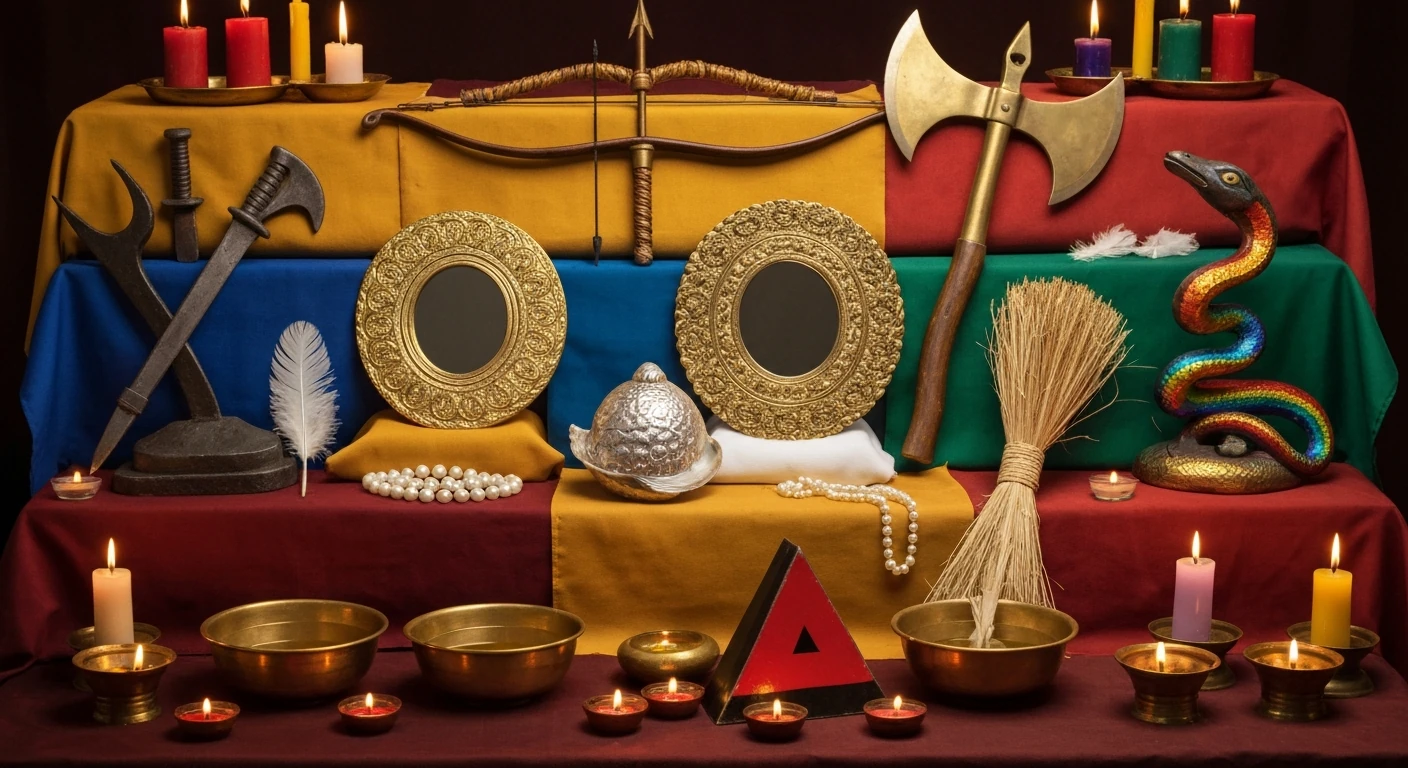
Three cinnamon sticks tied with golden ribbon in the high corner of the shop, renewed every full moon. A pinch at breakfast on the first day of the month, with a silent request before the first sip. The warm scent that rises when the bark burns on the charcoal of the commercial smoke cleansing. Cinnamon crosses Brazilian life like few spices: it is in the grandmother's sweet and in the axé of the terreiro, in the Sunday cake and in the ritual bath of approach. This transit is no coincidence: cinnamon is, above all, a spice of Oxum and Xangô, two Orixás whose mythological union explains why it works so well to attract love, prosperity, and firmeza at the same time.
In this guide, you will understand the spiritual foundation of cinnamon in the Afro-Brazilian tradition and the difference between Cinnamomum verum and cassia, information rare in texts about charms. It also includes the history that made the bark of a tree from Ceylon worth more than silver, the classic ritual uses, and the recipe for the three-stick charm, step by step. All with feet on the ground: the ritual opens the path, but the one who walks is you.
The only spice that honors Oxum and Xangô
Cinnamon occupies a unique place among the sacred herbs of axé. Unlike basil, rosemary, or guaco, leaves with a fixed belonging to an orixá (orisha) in the Yoruba tradition, cinnamon is an imported spice. It was assimilated by Afro-Brazilian ritualism through the marriage between its sensory qualities and the profile of two Orixás: Oxum, mistress of sweet waters, gold, and prosperity; and Xangô, lord of fire, thunder, and justice.
The aromatic sweetness of sweet cinnamon without being sugar aligns with the profile of Oxum, who conquers through subtlety, beauty, and the water that flows slowly until it reaches where it needs to be. The enveloping warmth, different from the aggressive heat of pepper, is seduction, not invasion. And the color of the bark, golden-brown when in powder, evokes old gold, the sacred metal of Oxum.
For Xangô, the bond is different. The curved and reddish bark of the cinnamon stick evokes the material ember associated with the Orixá of fire. The thermal sensation in the mouth, the hot sting, reinforces the connection with the igneous element. In Xangô rituals, cinnamon is used to firm authority, justice, and decision-making power, less popular than its use for prosperity via Oxum, but equally grounded. Who is the orixá is in who is Xangô, and the herbs that houses and research link to him, in herbs of Xangô.
The connection between the two Orixás in cinnamon has mythological roots. As recorded by Reginaldo Prandi in his studies on Afro-Brazilian religions, Oxum is one of the wives of Xangô in Yoruba mythology, along with Iansã (Oya) and Obá (Oba). The itan tells that Xangô disguised himself as a wanderer to win Oxum, and when she recognized him, she became his Queen. Therefore, cinnamon is one of the very rare ritual substances that honors both simultaneously, which makes it especially powerful in ritual work that unites love, prosperity, and firmeza.
Colors: gold and yellow (Oxum), reddish-brown (Xangô) | Day: Saturday (Oxum) or Wednesday (Xangô) | Element: Fire, with an aquatic link via Oxum | Regent Orixás: Oxum, Xangô
Cinnamomum verum vs cassia: which one is in your charm?
This detail almost never appears in sympathy texts and is what separates popular knowledge from well-founded knowledge. The cinnamon sold in Brazil belongs to two main species, with important differences for ritual use and, above all, for internal use.
| Aspect | Verum (Ceylon) | Cassia (Chinese) |
|---|---|---|
| Origin | Sri Lanka (formerly Ceylon) | China and Indonesia |
| Flavor | Subtle, sweet, floral | Strong, spicy, earthy |
| Bark color | Light beige | Intense reddish-brown |
| Wood structure | Soft, multiple thin layers | Hard, a single thick layer |
| Cumarin content | Very low (traces) | High (up to 1%) |
| Price | More expensive, more noble | Cheaper, "common" |
The Ceylon cinnamon (Cinnamomum verum) is considered the true cinnamon. Its sticks look like cigars rolled in thin layers, crumble to the touch and have a floral aroma. The cassia cinnamon (Cinnamomum cassia) is the one found in most Brazilian supermarkets: hard, hollow, more aggressive flavor and significantly higher coumarin content. Coumarin, in chronic internal consumption, is hepatotoxic, hence the importance of the distinction.
In the ritual plane, popular Afro-religious tradition does not distinguish between the two species. The axé is not in the botany, it is in the preparation, in the intention and in the foundation of who handles it. For a smoke cleansing (defumação), a ritual bath, or the folk charm (simpatia) of the three sticks, any cinnamon serves. But for regular internal use, daily coffee with cinnamon, frequent ritual teas, the verum is safer and more noble. When there is a choice and a budget, Ceylon cinnamon is the indicated one.
From the spice route to the Brazilian terreiro
Cinnamon is one of the oldest spices documented by history. It appears in Ancient Egypt in embalming rituals and sacred anointing oils are mentioned in the Old Testament as an ingredient of the holy oil of the Tabernacle. The Egyptians used it for ritual purification and to honor the dead. In the first century of the Christian era, Pliny the Elder recorded that 350 grams of cinnamon were worth more than five kilos of silver, about fifteen times the value of silver by weight. In certain Roman periods, it was more expensive than gold itself.
For approximately two thousand years, Arab merchants kept the origin of cinnamon in absolute secret from the Europeans. They invented outlandish stories that cinnamon came from nests of giant birds on inaccessible cliffs to justify the price and maintain the monopoly. Cinnamon reached Europe via Tyre, Carthage, Alexandria, and Constantinople, always through Arab mediation, and no one in Europe knew that it came from Ceylon.
The European search for a direct route to cinnamon was one of the engines of the great navigations. The Portuguese arrived in Ceylon in 1505 and dominated the trade for more than a century, until they were expelled by the Dutch in 1658, who in turn lost to the British in 1796. Cinnamon moves empires and moves money. This is the sympathetic key that justifies its ritual use: what costs gold attracts gold.
Cinnamon arrived in Brazil through Portuguese hands as a luxury spice in the mills and among the colonial elites. It quickly moved from culinary use to popular and mystical use, integrating into the forming Afro-Brazilian religious practices. Due to its association with European wealth and its sensory qualities aligned with Oxum (warm sweetness, golden color) and Xangô (reddish color, heat of fire), it was naturally assimilated by the terreiros as a spice of prosperity and attraction. Today, it crosses from the ilê coffee to the merchant's wallet, from the shop's smoke cleansing (defumação) to the ritual bath of approach.
When to use cinnamon
Cinnamon is one of the most versatile herbs of the Afro-Brazilian altar. Its application covers everything from the simple gesture on the first day of the month to the elaborate offering for Oxum in running water. See the most consecrated uses:
Breath ritual on the first day of the month. The most popular use. Cinnamon powder in the right palm, blow from the outside to the inside of the house or business door, visualizing prosperity. Leave the powder on the floor for 24 hours before sweeping. It is a ritual of opening energetic paths in the space.
Cinnamon in the wallet. Three small pieces of cinnamon stick in a clean wallet, on the first day of each month. Attracts abundance and fixes prosperous energy in the personal monetary instrument. It is a fixation ritual different from the breath, which opens. Use both together to enhance.
Commercial smoke cleansing (defumação). In an incense burner or clay plate with lit charcoal, burn broken cinnamon sticks with cloves and coffee grounds. Smoke cleanse the business on Wednesday (Xangô) or Saturday (Oxum), in the morning, before opening. From the door to the back cleanses; from the back to the door attracts.
Coffee with cinnamon ritual. A pinch of cinnamon powder in black coffee in the morning, for seven consecutive days, starting on Wednesday (firmness by Xangô) or Saturday (sweetness by Oxum). Before the first sip, ask clearly without miraculous promises, with a concrete objective.
Approximation ritual bath. Cinnamon stick, basil, honey, and yellow rose petals. Oxum ritual bath for healthy attraction. Do not confuse with love binding ritual: approximation ritual bath is an invitation, not an imposition. See how to prepare in the herbal bath guide for Oxum.
Important: prosperity in the Afro tradition is flow, not enrichment. Cinnamon attracts movement, opens energetic paths, activates intention. It does not replace effort, planning, and action in the material plane. A ritual without work is just smoke.
Recipe: ritual of the three cinnamon sticks
The three-stick charm is one of the most beautiful applications of cinnamon because it honors Oxum and Xangô at the same time: Oxum for the golden color of the ribbon, Xangô for the number three (strength, firmeza), and cinnamon for the spice itself. It works especially well for those who have a physical business, office, or point of sale, but it also serves for the home work environment.
What you will need
- 3 cinnamon sticks (preferably from Ceylon, but any cinnamon stick works)
- 1 golden ribbon (Oxum) or red ribbon (Xangô) choose according to the focus of the request
- A high and discreet corner of the business, office, or home office
How to do it
- On a night of full moon, tie the three sticks with the ribbon forming a braid or firm binding. At each knot, ask for one concrete thing: clientele, abundance, firmeza in the path. Three knots, three clear requests.
- Position the binding in a high corner of the commercial environment on top of a shelf, bookcase, or discreet piece of furniture. It does not need to be in plain sight.
- Renew every full moon. The old sticks go to running water: river, waterfall (Oxum's domain) or in a garden with fertile soil. Never in the trash.
- Speak the intention in a low voice while placing it, in a short phrase, without promising yourself anything miraculous. "May good clients find my work" works much better than "I will become rich this month".
Variation: morning ritual coffee
For seven consecutive days, starting on a Wednesday (Xangô, for firmeza) or Saturday (Oxum, for sweetness and opening), prepare your black morning coffee with a generous pinch of ground cinnamon. Before the first sip, hold the cup between your hands, feel the heat, clearly ask for what you need to set or open that week. Drink slowly.
Ora Yeye O, Mãe Oxum, mistress of the sweet waters and the running gold. Kaô Kabecilê, my Pai Xangô, lord of fire and justice. May the sweet heat of cinnamon bring what must come, through the path that must be. Axé.
Cinnamon vs basil vs clove
The three spices appear together in many smoke cleansings (defumação) and ritual baths, but each one does something different. Knowing the difference avoids crossed recipes and helps you build the right combination for the right request.
Basil is the sweet freshness of green Oxum, subtle, feminine-mother. Used for ritual baths of peace, protection, and welcoming love. Indicated when the request involves emotional healing, reconciliation, or affective closeness without a character of conquest.
Cinnamon is the sweet heat of Oxum and the gentle fire of hot, earthy Xangô, feminine-lover and masculine-firm at the same time. Indicated for attraction, conquest, material prosperity, firming, and opening of paths in commerce. Appears in power ritual baths and in money rituals.
Cloves are the fixing protection spice, imported and hot like cinnamon, but with a distinct energetic function. Cinnamon attracts (centripetal, magnetic energy). Cloves protect and fix (active, defensive energy). Therefore, they appear together in commerce smoke cleansings: cinnamon pulls the clientele, cloves hold the money.
For love with prosperity: cinnamon + honey. For firm commerce: cinnamon + clove + coffee. For peace in the home with prosperity: basil + cinnamon. Combinations always make sense when you know what each herb brings.
Contraindications
External ritual use of cinnamon (ritual bath, smoke cleansing, tied bundle of sticks, blowing on the ground) is safe for almost everyone. The warnings apply to internal use (teas, daily coffee with cinnamon, infusions) and for concentrated essential oil.
- Pregnant women: avoid internal use in large quantities. In high doses, cinnamon can stimulate uterine contractions. External use with minimal contact (shallow bath, smoke cleansing in a ventilated room) is safe, but the ideal during pregnancy is to consult the Pai or Mãe de santo before any ritual.
- Patients with liver disease: special attention to cassia cinnamon. Coumarin is hepatotoxic in chronic consumption. For regular internal use, prefer Ceylon cinnamon (verum), which has a much lower coumarin content.
- Children under two years old: avoid internal use.
- Anticoagulants (warfarin and similar): the coumarin in cassia has a mild anticoagulant effect and can potentiate the medication. Talk to your doctor before taking cinnamon regularly.
- Respiratory allergies: during smoke cleansings, ventilate the room. People with asthma may react to the dense smoke of any burned herb; cinnamon is no exception.
- Sensitive skin: pure cinnamon essential oil is caustic and can burn the skin. Always dilute in a carrier oil. For a ritual bath, use cinnamon sticks or natural powder, never pure oil.
Ritual is care. Caring for the body is part of the axé.
Frequently asked questions about cinnamon
Cinnamon is the herb of which orixá?
Cinnamon belongs mainly to Oxum, due to its sweet warmth, its golden color when powdered, and its connection to prosperity and gold. It is also associated with Xangô, due to the reddish color of the bark, its warm flavor, and its connection to fire and justice. It is one of the few ritual spices that honors both simultaneously, which makes it especially potent.
What is cinnamon used for in Umbanda?
Attracts prosperity, money, and love; condenses beneficial fluids in the commercial space; it is used in shop fumigations, Oxum attraction baths, first day of the month charms, and Xangô firmamentos. It also appears in morning ritual coffee and in bundles of three sticks for commerce.
How to do the cinnamon charm to attract money?
The most popular is the blow: on the first day of the month, place three fingers of powdered cinnamon in the palm of your right hand and blow from the outside to the inside of the door of the house or business, visualizing prosperity. Leave the powder on the floor for 24 hours before sweeping. It is a ritual of energetic opening of the space.
Can I drink cinnamon tea every day?
In small quantities (about one teaspoon per day), yes, preferring Ceylon cinnamon (verum). Cassia cinnamon in excess is hepatotoxic due to coumarin. Pregnant women should avoid internal use in quantity. People using anticoagulants should talk to a doctor.
What is the difference between the blown cinnamon charm and cinnamon in the wallet?
Blowing cinnamon is a ritual of opening energetic paths in the space (house or business): it opens. Cinnamon in the wallet is a ritual of fixing prosperous energy in your personal monetary instrument: it secures. Both are complementary and can be done together on the first day of the month.
Where to buy cinnamon and items of Oxum and Xangô
At Joia Mística Laroyê, you find the cinnamon and the items that combine with it in ritual:
- Cinnamon sticks selected for charms, fumigations, and bundles
- Powdered cinnamon for ritual coffee, blow on the first day of the month, and baths
- Yellow candles of Oxum and red-brown candles of Xangô see the ritual candles and colors guide
- Ritual honey pure to combine with cinnamon in offerings to Oxum
- Ready-made prosperity baths prepared with axé by mãe Joice Mística
- Cloves, coffee and other items for a complete commercial smoke cleansing (defumação)
- Complete line of sacred herbs check the herbs catalog and the cinnamon page
Visit the shop in Extrema, Minas Gerais (R. Benedito Zingari, 460) or talk to us via WhatsApp. We serve those who are starting with care and those who already walk with foundation.
References
- Química Nova, SciELO: the importance of coumarins for medicinal chemistry, about the class of compound that makes the difference between Ceylon cinnamon and cassia
- Revision in Journal of Ethnopharmacology (PMC): Cinnamomum cassia Presl, traditional uses, phytochemistry, pharmacology and toxicology