Oxalá is the orixá of creation and peace, the oldest of the pantheon and father of almost all other orixás. He wears white, rules over Friday, receives the greeting Epa Babá! and corresponds to Senhor do Bonfim in syncretism.
He manifests in two qualities, Oxaguiã, the young warrior, and Oxalufã, the elder who walks supported by a paxorô. In the best known myth, it was Oxalá who modeled the bodies of men from clay.
Who is Oxalá, the father of all orixás
This orixá is the deity of creation in the Yoruba tradition. His name in African land is Obatalá, which means something like "king of the white cloth," as recorded in the entry about Obatalá. In Brazil, he is worshiped as the most ancient orixá, the funfun (the white) par excellence, the father of almost all other orixás and of humanity itself.
In the myths that Reginaldo Prandi gathered, Olodumaré, the supreme being, charges Oxalá with creating the world. Oxalá, who did not make the offerings, is avenged by Exu (Eshu) with a great thirst, drinks palm wine, falls asleep intoxicated, and it is Odudua, the younger brother, who takes the bag of creation and descends to create the earth. Upon waking, Oxalá receives the task of creating living beings: he models human beings in clay, and the breath of Olodumaré animates them. For this reason, he is called the potter of the world. Prandi tells it this way, and Odudua appears in another way in Pierre Verger, for whom he is "more of a historical figure than an orixá," rival of Oxalá and founder of Ifé. The readings of each author about Odudua are in qualities of Oxalá.
Oxalá's prohibitions have more than one origin in the myths. In Prandi, Olodumaré forbids Oxalá from drinking palm wine forever, and the prohibition also applies to his descendants. In another myth, Exu ties a gourd of salt to his back, and he wakes up with a hunchback, begins to protect the hunchbacked, the albino, and other people with disabilities, and is forever forbidden from consuming salt. Dendê has a third myth, that of the parrot Ecodidé, in which "Oxalá cannot tolerate dendê, it is his taboo." To place him among the other deities, it is worth reading the overview on what the orixás are.
Technical sheet of Oxalá
Before deepening his qualities, it is worth fixing the elements that identify the orixá. The correspondences below mostly follow the ketu (nagô) nation, with the most common variations in umbanda.
- Domains: creation, peace, purity, serenity, wisdom, and fatherhood
- Color: white, the milky white of all things
- Day of the week: Friday in ketu candomblé; in umbanda houses, Friday or Sunday, depending on the house (see day of Oxalá)
- Element: the air, the atmosphere, the sky
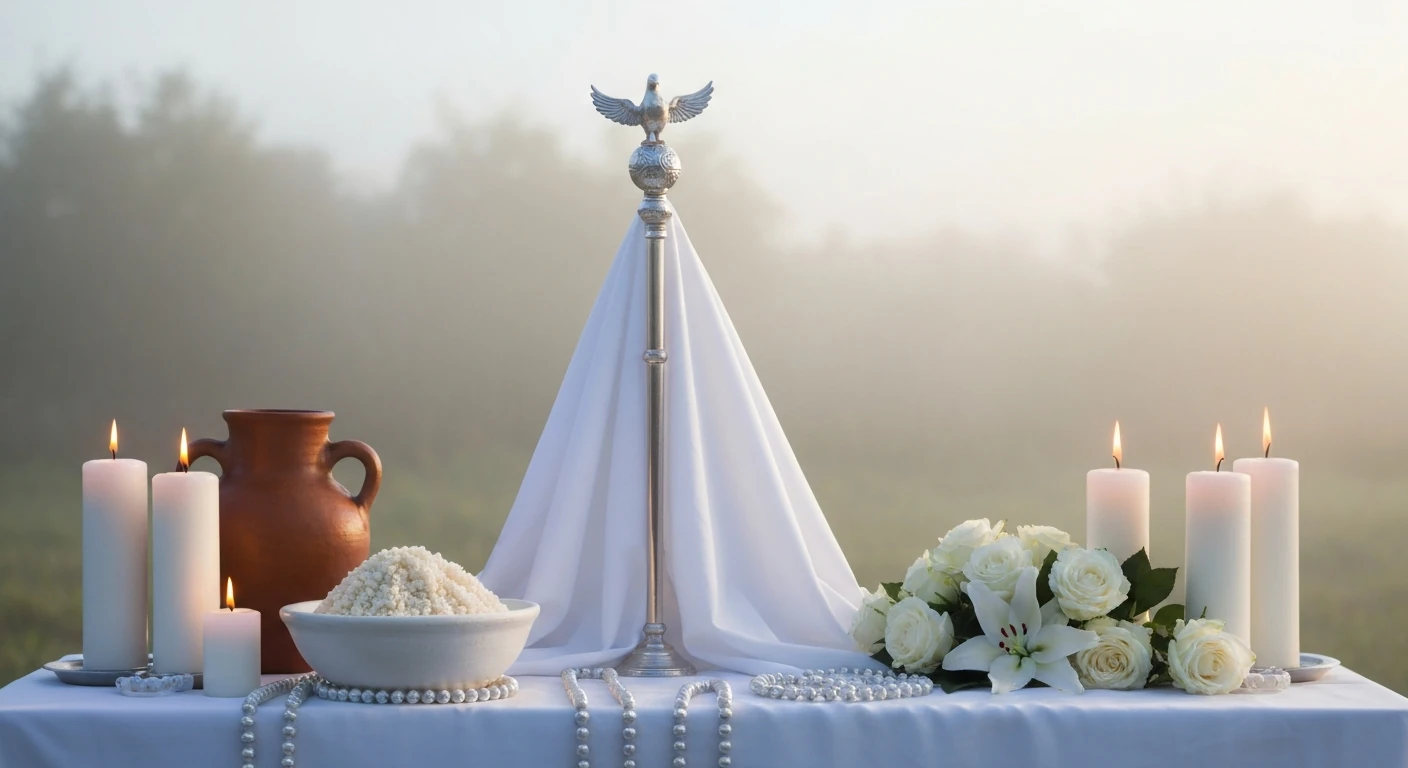
- Symbol: the paxorô (also opaxorô), a white metal staff, generally topped by a bird
- Greeting: "Epa Babá!", which means "hail, my father"
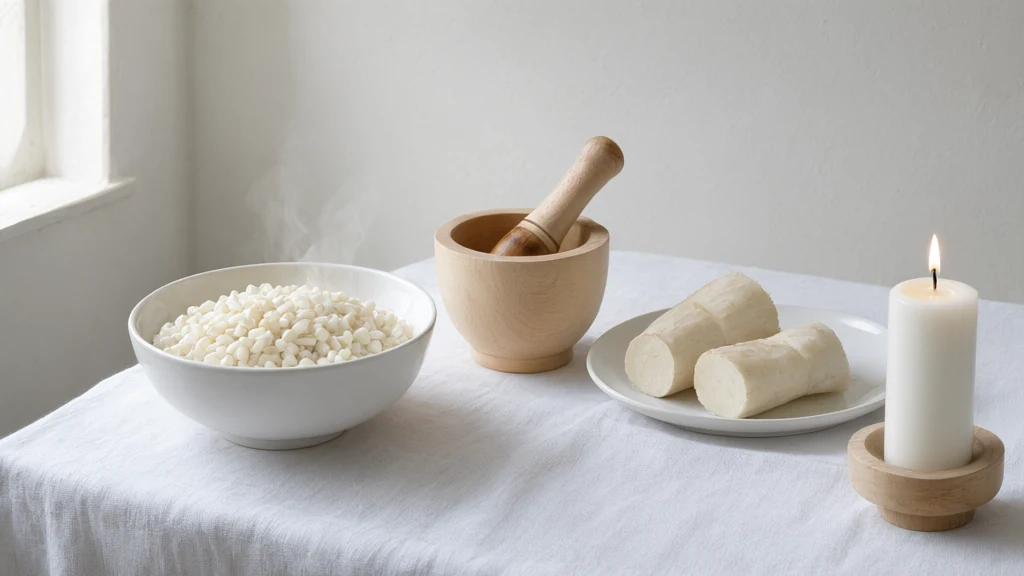
- Offerings: white foods, with emphasis on the ebô (white corn canjica cooked without salt and without seasoning)
- Quizilas: dendê oil, palm wine, and salt, prohibitions recorded by Verger and Prandi; Gaia and Scorsolini-Comin add charcoal
- Origin: nagô-ketu, corresponding to Obatalá in Yoruba land
Epa Babá, my father Oxalá! To greet Oxalá is to ask for the blessing of the eldest. In many houses, Friday is the day to wear white and lower the voice, as a sign of respect for the peace he represents.
The color white is not an aesthetic detail. It carries the meaning of purity and the calm that the orixá asks of his children, and therefore white clothes, candles, and flowers are always present in his devotion.
Oxaguiã and Oxalufã: the youth and the elder
Like other orixás, Oxalá does not manifest in a single way. The most well-known forms in Brazil are two, and sources diverge on what they are: Prandi speaks of two forms of Oxalá, and Gaia and Scorsolini-Comin write that "it is not about variations of the same Òrisà." Knowing this duality helps to understand why the orixá is, at the same time, a warrior and serene. The profile of each form and the divergences are in qualities of Oxalá.
Oxaguiã is the young, dynamic, and warrior aspect. Known as "the lord of the pounded yam," he receives mashed white yam as the main offering. He is an active Oxalá, who still carries the vigor of youth and the disposition for just struggle.
Oxalufã is the elder aspect. He walks hunched, leaning on a paxorô, with the slowness of someone who has lived through everything. He represents the peace, patience, and wisdom that only time brings. He is the old Oxalá of the Águas de Oxalá, linked to humility and reverence.
The portraits of the children of Oxalá in literature diverge. Prandi describes them as people who "like power" and "show themselves bossy and determined," and also as "quiet and dull." Verger speaks of people who are "calm and trustworthy." In a study with a single child of Oxalá, Augras and Correa describe him as "quite stubborn and oppositional." These are research characterizations, which vary from author to author, and not a test: the orixá of each person is confirmed in the house of axé.
The Waters of Oxalá: the myth of the imprisoned orixá
Among all the myths of the orixá, that of the Waters of Oxalá is the most celebrated, and Verger describes it as the legend that certain Bahian terreiros, "particularly those of Kêto origin," celebrate every year in a cycle of three weeks of festivities. The story teaches, through the very figure of the highest orixá, a lesson in humility.
Oxalufã decides to visit Xangô (Shango), the king of Oyó, his friend, in Verger's version. On the path, Exu asks him for help three times, and Oxalufã agrees and does not complain. In the FUCESP version, the babalaô advises the orixá to accept everything they ask of him without complaining, and he remains calm before Exu. Even so, he is imprisoned by mistake and spends seven years in prison, while seven years of unhappiness fall upon the kingdom of Xangô.
When Xangô discovers who the prisoner was, he orders everyone, dressed in white and in silence, to fetch water three times to wash him. In Prandi and Vallado, the king and the people dress in white and ask for forgiveness from the great orixá of creation. It is this gesture of water and white that the Águas de Oxalá repeat, and the date and the design of the cycle change from house to house. The complete description of the rite is in Águas de Oxalá, and the king who appears in the myth has its own article in who is Xangô. The orixá's profile in Verger can be checked on the page of the work Orixás.
Oxalá in Umbanda and in Candomblé
Although it is the same orixá, Oxalá is not lived in the same way in the two traditions, and confusing them erases what each one has of its own.
In Candomblé, Oxalá is an orixá worshiped in the xirê, with his assentamentos (consecrated foundations), his qualities (Oxaguiã and Oxalufã) and his votive foods, always led by the pai or mãe de santo. Oxalufã is the last one revered in the xirê, and his dance closes it.
In Umbanda, the houses and open research treat Oxalá as the greatest of the orixás. The FUCESP federation says "syncretized with Jesus Christ" and "the greatest of the Orixás worshiped in Umbanda", but each house explains the syncretism in a different way: for the Tenda de Umbanda Caboclo Tupinambá and Vó Catarina, it does not mean that the two figures are "exactly the same deity". In houses like those described in the research, permission is asked from Oxalá to open the gira, and Oxalá's color is white. The six house positions, the Jesus with open arms on the congá, the Oxalá line and the day are in Oxalá in Umbanda.
In the angola nation, of Bantu roots, the same energy of creation and whiteness is worshipped under the name of the inquice Lembá (also written as Lemba or Lembarenganga). Mentioning the nation is not a detail: treating Candomblé as a single block erases the real diversity of the traditions.
Is Oxalá Jesus? The syncretism with Senhor do Bonfim
This is one of the most common questions about the orixá, and the answer requires care. During slavery, faced with the prohibition of worshipping the orixás, Africans associated their deities with Catholic saints to continue revering them under another name. Syncretism is not a declaration that orixá and saint are the same thing, and sources provide more than one reading of the proximity. For Verger, Oxalá was syncretized in Bahia with Senhor do Bonfim "for no other apparent reason" than his enormous prestige in the city. The anthropologist Vilson Caetano sees similarities: both are worshipped in the heights and linked to creation and the origin of human beings. Gaia and Scorsolini-Comin understand syncretism as a strategy of cultural resistance and write that "there seem to be no relations of Òṣàlá" with Jesus Christ or with Senhor do Bonfim.
Oxalá was syncretized with Jesus Christ and, in Bahia, with the Senhor do Bonfim. The famous Lavagem do Bonfim, in January, when baianas wash the church stairs with scented water, is the most visible expression of this encounter between Catholic faith and the axé of Oxalá. The Lavagem falls on the Thursday before the Sunday of Bonfim, and the history of the festival is in Senhor do Bonfim e Oxalá.
Saying that "Oxalá is Jesus" oversimplifies things. They are figures from distinct traditions that history brought closer together, and in Umbanda each house responds in its own way, as shown by Oxalá in Umbanda. To follow the date of Oxalá and the other deities throughout the year, consult Oxalá's day and the calendar of the orixás.
How to honor the orixá of peace
Reverence to the orixá is done with simplicity and respect for his whiteness. What follows is a devotional reference, remembering that each house has its own guidelines and that foundational offerings are made under the guidance of a pai or mãe de santo.
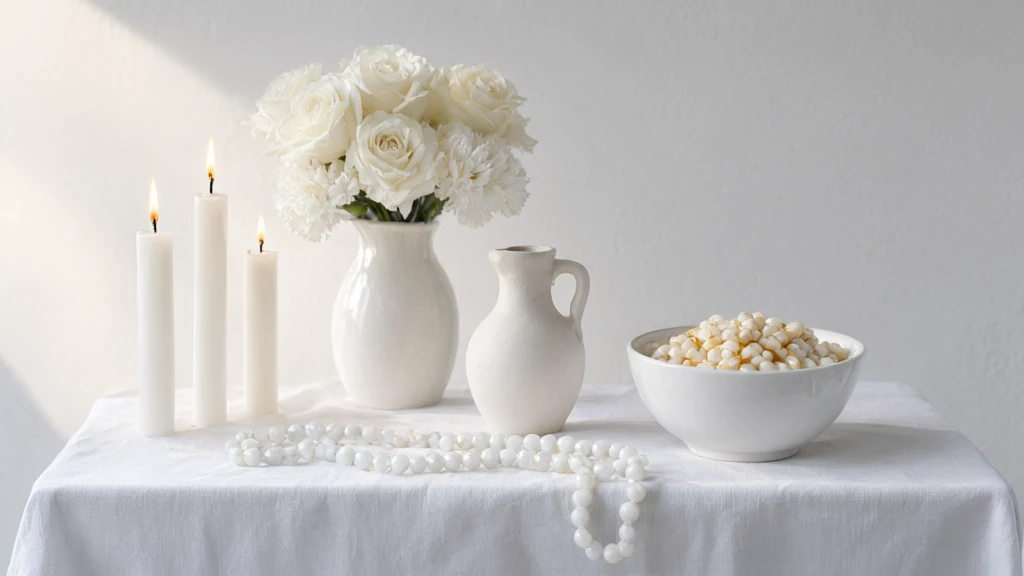
- Wear white on Friday, the day of the orixá, and try to keep the day in peace, without arguments or excesses
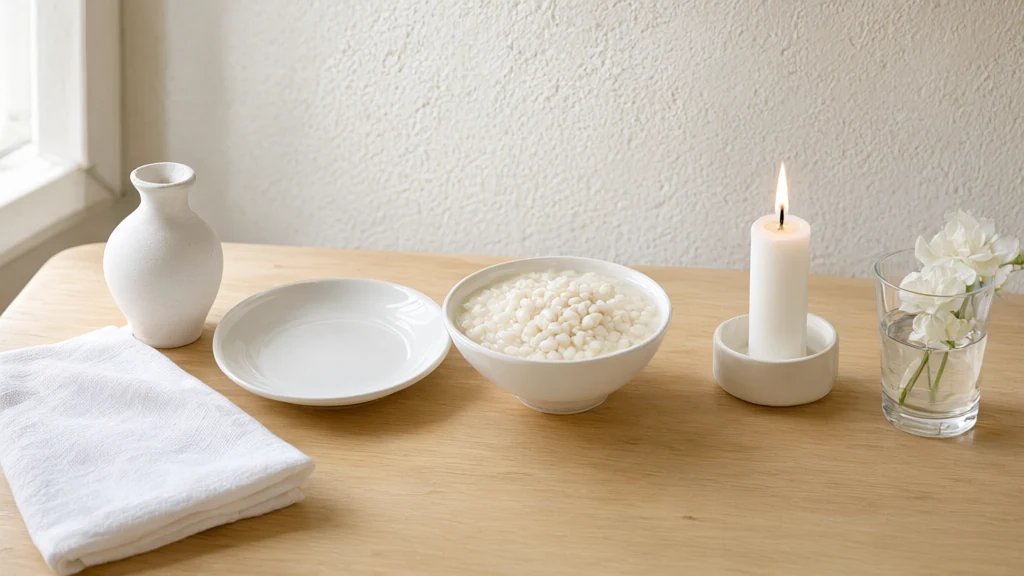
- Light a white candle in a clean place, visualizing serenity, gratitude, and clarity
- Offer white foods, such as ebô (unsalted canjica) or white rice, on a clean plate
- Use white flowers, such as roses and lilies, which well translate the energy of purity of the orixá
Devotion tip: Oxalá is the orixá of calm. The greatest offering to him is not on the plate, but in the attitude of one who seeks peace in their own heart and respect for elders.
Since 2027 begins on a Friday, Oxalá appears among the names of the ruling orixá of 2027, alongside Iemanjá (Yemoja); in Candomblé, the ruling orixá only comes out in each house's cowrie-shell divination. Friday is also a good day to light candles with intention. To choose the right color with awareness, see the guide on ritual candles and their meanings. And among the herbs linked to him, rosemary, Oxalá's herb is one of the most used in baths for peace and elevation.
Frequently asked questions
Who is Oxalá and what does he represent?
Oxalá is the oldest and most respected orixá of the Afro-Brazilian pantheon, the father of all orixás and of humanity. He represents creation, peace, purity, and wisdom. Dressed in white, he is the divinity linked to serenity and the balance of life.
What is the color and day of Oxalá?
The color of Oxalá is white, a symbol of purity and peace. The day of the week depends on the tradition and the house: in the sources of candomblé ketu it is Friday, when the children of Oxalá wear white, and in umbanda houses it is Friday or Sunday. In January, the Lavagem do Bonfim brings the orixá closer to the Lord of Bonfim. January 15 as "Oxalá day" has no source, and December 25 appears as a date of worship in some umbanda houses. The details and the rule of the Lavagem are in Oxalá day.
What is the difference between Oxaguiã and Oxalufã?
They are the two most well-known forms of the orixá in Brazil. Oxaguiã is the young and warrior aspect, the lord of pounded yam. Oxalufã is the elder aspect, who walks hunched over leaning on a paxorô and represents the peace and wisdom of time. If they are the same orixá, the sources diverge: see qualities of Oxalá.
What are the Águas de Oxalá?
It is a cycle of festivities that certain terreiros, particularly of ketu origin, celebrate every year. It recalls the myth in which Oxalufã was wrongly imprisoned and then washed with water, with everyone dressed in white. The date and the design of the cycle change from house to house, as shown in Águas de Oxalá.
Is Oxalá the same as Jesus?
Not exactly. In syncretism, Oxalá was associated with Jesus Christ and Senhor do Bonfim, and sources provide different readings of this proximity. They are figures from different traditions that history brought together, and treating them as identical erases the unique identity of each one. In Umbanda, each house responds in a different way: see Oxalá in Umbanda.
Where to buy items for Oxalá
At Joia Mística Laroyê, you find everything to honor the father of the orixás with respect and peace:
- Statues of Oxalá with the paxorô, for your altar or consecrated foundation (assentamento)
- White candles of various sizes, in the color of the orixá of purity
- White bead necklaces and beads for devotion and protection
- White flowers and items for offerings of peace and elevation
- Herbs and incense linked to the energy of serenity, such as rosemary and lavender
Visit our store in Extrema-MG and we ship all over Brazil. For guidance on the correct use of products and the best way to reverence Oxalá, talk to us via WhatsApp.
References
- Reginaldo Prandi, Horizontes Antropológicos: African gods in contemporary Brazil
- Reginaldo Prandi, Companhia das Letras: Mythology of the orixás, excerpt
- Pierre Verger, Corrupio: Orixás, work record
- Gaia and Scorsolini-Comin, Memorandum (UFMG): Representations of Òṣàlá
- IPHAN: Festa do Bonfim, dossier
- FUCESP: Oxalá
- Prandi and Vallado, Edusp: Xangô, king of Oió
- Augras and Correa, Arquivos Brasileiros de Psicologia (FGV): The identification of the owner of the head in Candomblé
- Wikipedia: entry about Obatalá, the name of the orixá in Yoruba land