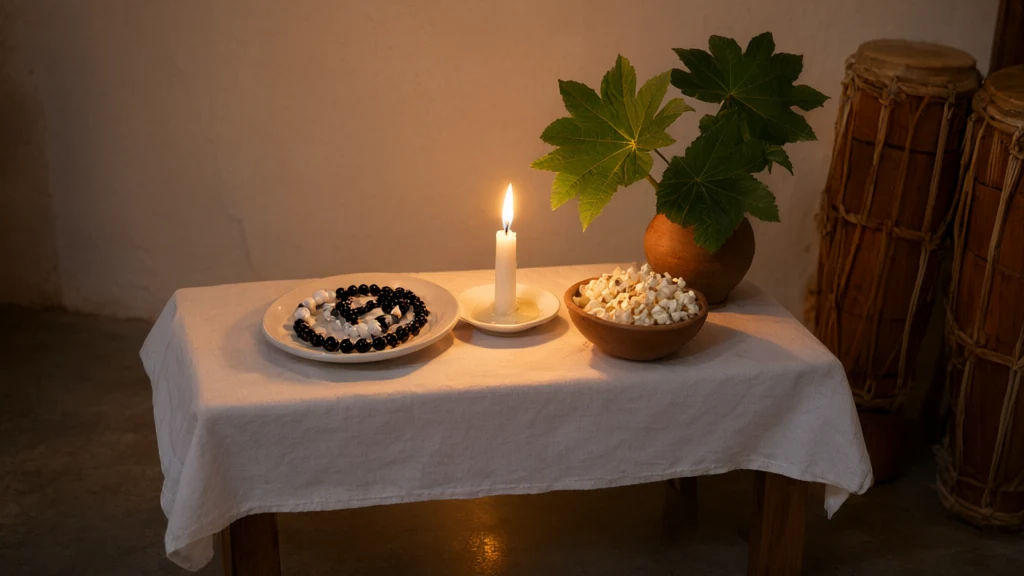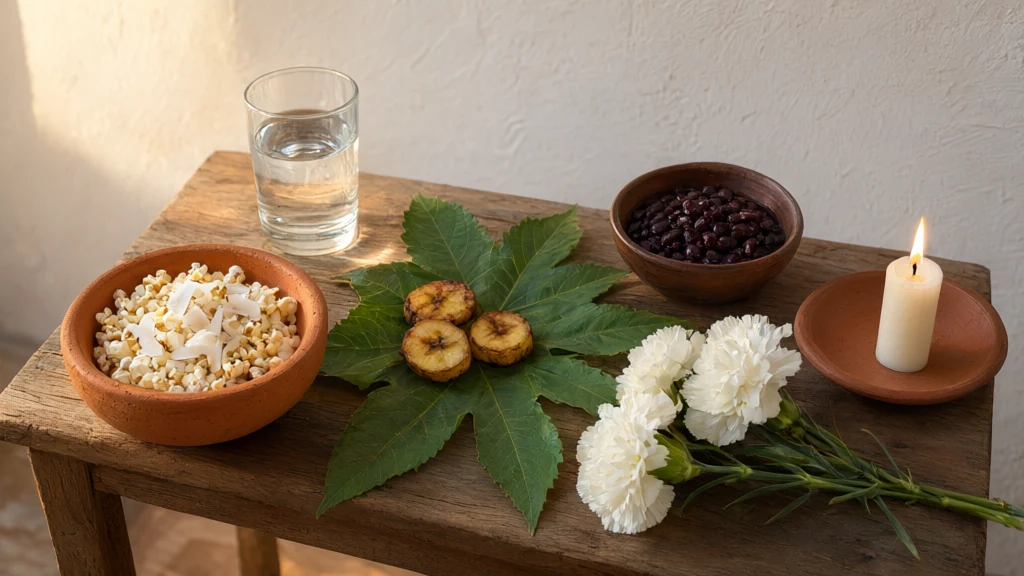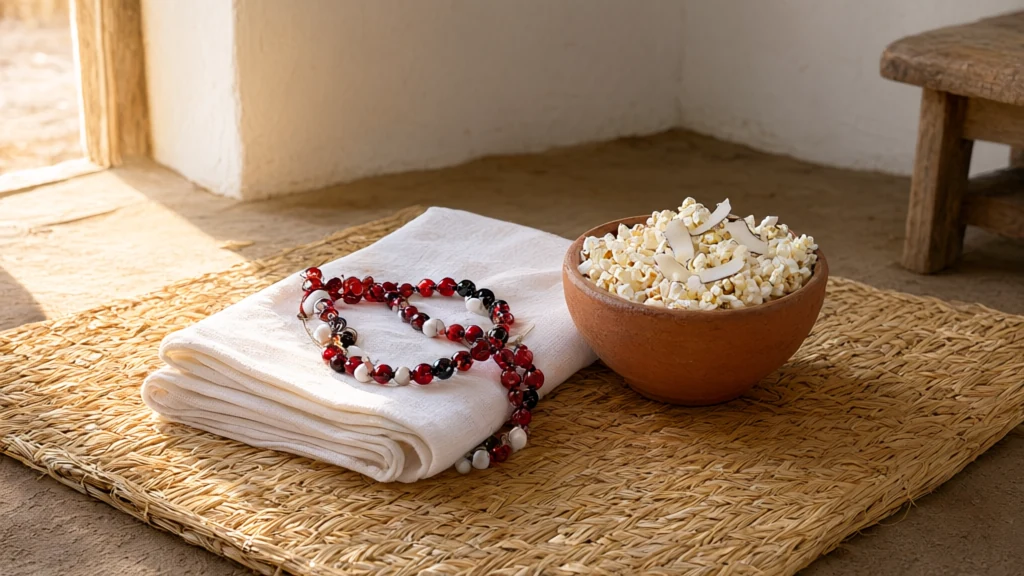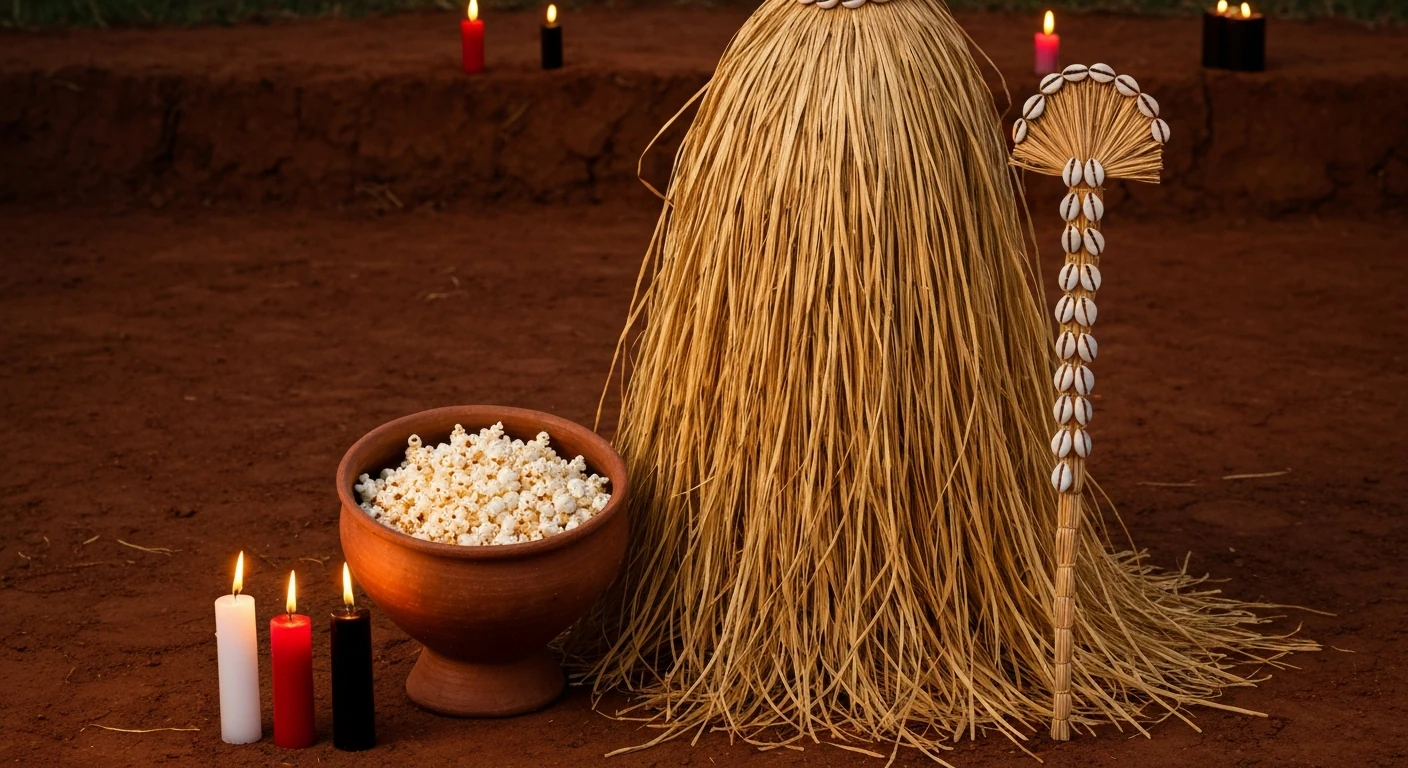
Obaluaê, also called Omulu or Omolu, is the orixá of smallpox, diseases, and healing. In the table by sociologist Reginaldo Prandi, he "is related to all types of physical evil and its cures" and is "associated with cemeteries, soils, and subsoils." He wears straw from head to toe, eats popcorn, has Monday as his day, and is greeted with Atotô!.
The name already calls for caution. Pierre Verger, cited by Gildeci Leite, writes that the true name of the orixá "is too dangerous to pronounce" and that, out of prudence, one says Obaluaiê (Babalu Aye), "The King, Lord of the Earth," or Omulu, "the Son of the Lord." August 16, the day of Saint Roch, is one of his festivals; there are houses that celebrate him on November 2, December 17, or at the end of January, as seen further below.
Who is Obaluaiê, the orixá of healing
In the table of nations by Prandi, in the magazine Horizontes Antropológicos, Obaluaiê or Omulu is the "orixá of smallpox, plagues, and diseases," and the area of life he sponsors is the "healing of physical diseases." A final course project from UFJF, by Samuel Novaes Guimarães, calls him "the doctor among the orixás".
As we explained in the guide about the orixás, each orixá rules a force of nature. Obaluaiê's domain is the earth: the ground that makes sick, heals, buries, and makes things grow. In the itãs, he is the son of Nanã, the oldest orixá, and the brother of Oxumarê.
Because the theme touches on health, it is worth saying in plain letters: the healing of Obaluaê is a spiritual dimension, of welcoming, faith, and axé. The Tenda de Umbanda Caboclo Tupinambá e Vó Catarina (TUCTVC) writes on the orixá page: "His strength does not replace medical treatments or healthcare." No offering, ritual bath, or prayer takes the place of a doctor.
Technical sheet of Obaluaê
Colors: red, white, and black in Candomblé (Prandi); black and white in Umbanda (FUCESP) | Day: Monday | Element: earth | Symbol: xaxará, a palm fiber staff with búzios | Attire: straw clothing from the coast, with the filá covering the face | Food: doburu, the popcorn with coconut slices | Greeting: Atotô! | Saints: Saint Lazarus and Saint Roch, with variations by house | Mythical family: son of Nanã, brother of Oxumarê | Taboo of the children: attending funerals
August is the month of Obaluaê in many houses. The Olubajé, the orixá's banquet, is celebrated in August "in the majority of Candomblé terreiros in Brazil," according to the Alma Preta report. But it is not a rule: Lucas Barreto de Souza photographed an Olubajé on January 15, 2017, at Ilê Axé Akaraizô, in Salvador (Photographs, UFRGS). The month is the month of Obaluaê and the festival is Olubajé, the healing banquet of Omolu.
Among the herbs, FUCESP lists "Omulu leaf (dog cinnamon) pariparoba, castor bean leaf, cambará," and Guimarães writes that "The ritual leaf of Obaluaê is the castor bean leaf." Two plants that Umbanda houses link to Omulu have their own articles: the losna, the herb of Omulu, and the mastruz.
Obaluaê and Omulu: the two faces of the same orixá
The most common answer is that they are the same orixá with two names. Agenor Miranda Rocha, cited in the dissertation by Samuel Abrantes (UFRJ), says that Obaluaê is usually called moço and Omolu is called velho, "but they are just two names for the same spirit". Ildásio Tavares, interviewed in the same research, goes further: "all are ORIKI of the same orixá, which is a form of greeting, of reverence".
There is no consensus. The Obaluaiê entry on Wikipedia argues that they would be distinct orixás, and that Obaluaiê is "constantly confused" with Omolu. The Salvador City Hall records both readings: "in some houses they are treated as the same orixá, and in others as distinct spirits".
The division between the moço and the velho has a very cited version, that of the Federation of Umbanda and Candomblé of the State of São Paulo (FUCESP), which opens by saying that "to speak of Obaluaê or Omulú is to speak of the same Orixá":
| Obaluaê | Omulu | |
|---|---|---|
| Face | young | old |
| Character, according to FUCESP | warrior, hunter and fighter | wise, sorcerer and guardian |
| Saint in the Bahian imagination, according to Leite | Saint Roch | Saint Lazarus |
The last line does not apply everywhere: TUCTVC does the opposite, as seen in the H2 of syncretism.
In Candomblé, the orixá unfolds into qualities, and the lists do not match. Abrantes warns that "there is a lot of contradiction and wrong information regarding names and functions," and Roger Bastide, cited by Monique Augras and Angela Maria Correa in the Arquivos Brasileiros de Psicologia (FGV), counted 14 subdivisions of Omolu.
In Umbanda, the count is different. The seven lines of Leal de Souza, in 1933, do not have Omulu: the seventh "is the line of Santo, also called the Line of Souls." The Núcleo Umbandista São Sebastião (NUSS) puts "Omulú and Ibeji in the Line of Oxalá (Obatala)," and FUCESP speaks of spirits linked to him "who arrive bowed" and who generally have their head "covered by a white cloth." Who descends in the gira, the color, the candle, and the dates of Umbanda are in Omolu in Umbanda. FUCESP also reminds that "whenever one enters a cemetery, Obaluaê is greeted," and the place where this is done is in Cross of Souls.
The straw that covers the body
Obaluaê's clothing is made of palha da costa. Guimarães calls the garment axóicó and gives the name of the top part: "The first part that covers his entire face and goes down to a good part of his back is called filá." In Prandi's table, the clothing is "red, white, and black, with a straw hood." The xaxará is not the hood: it is the scepter he carries in his hand, "made of fibers from the leaves of the oil palm with búzios".
Why the straw? In the itãs, it covers the marks of the disease (see below). Gildeci Leite, from UNEB, also reads the straw as wealth: "For Omolu, dressing in his straws from head to toe, besides adapting to his physical reality, must be understood as wealth, another wealth." And she quotes Edison Carneiro: the pai de santo Paim made a silk towel embroidered for Omolu, "all in vain, because the orixá did not want it in any way" (Leite, Fragmentos de Cultura). Verger, cited by Leite, says that in Africa the orixá "rejects the use of metal utensils in some of his rituals," because accepting metal would be entering the territory of Ogum.
The face remains covered. In the Santuário Nacional da Umbanda, the statue of the orixá "is a man who does not show his face, hunched over and generally hides under a cloth when he incorporates in the temples." This does not mean that there is no statue: the Sacred Arts of the Black Atlantic collection, from Duke University, catalogs a plaster statue of Omolú, with xaxará of beads and búzios.
Atotô! The greeting asks for silence. It is "Atotô, which means silence, he is among us," explain the priests heard by Alma Preta. At FUCESP, the long greeting is "Atotô Ajuberú."
A Ketu song for him, with lyrics and commentary, is in cantiga de Obaluaê Ejì Bará Loko.
The itãs: Nanã, Iemanjá, Ogum and the pipoca
The itãs gathered by Prandi in Mitologia dos orixás (2001) tell the story of the straw in more than one way. The versions below come with the book page, cited by those who read it.
Nanã covers the son with straw
On page 197, cited by Nágila Oliveira dos Santos in the Revista África e Africanidades, Nanã had two sons: "Oxumarê was the beautiful son and Omulu, the ugly son." And "Nanã felt pity for the ugly son and covered Omulu with straw, so that no one would see him and no one would mock him."
Iemanjá washes Omulu and gives him the pearls
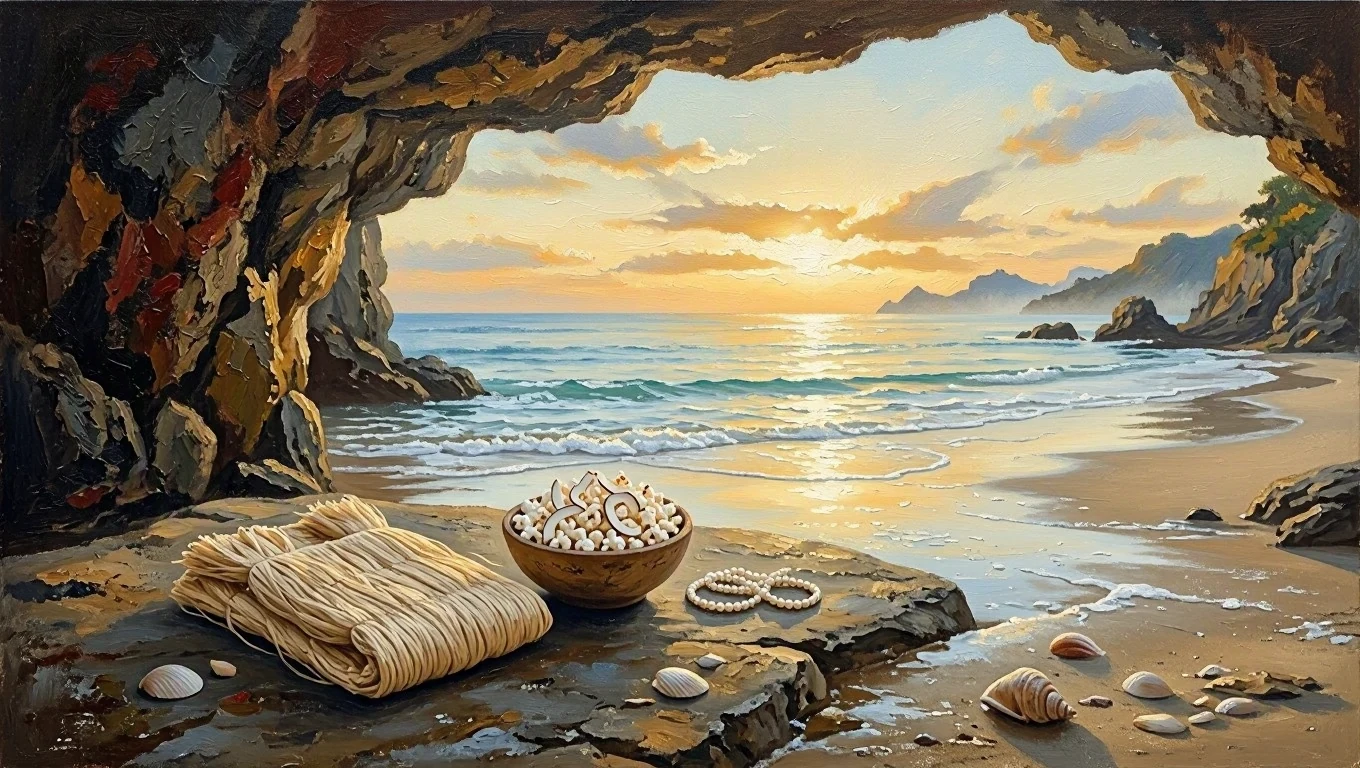
On pages 215 and 216, transcribed by Leite, the story is different. Nanã abandons the sick son: "She abandoned him in a cave near the beach." Then "Iemanjá gathered Omulu and washed him with seawater", "made him a garment entirely of raffia" and gave him the pearls: "You shall be called Jeholu, the Lord of the Pearls". The historian Murilo Melo, interviewed by the Salvador City Hall, tells a version in which Omulu is saved by Iemanjá "using banana leaves".
Ogum, Iansã (Oya) and the wounds that turned into pipoca
In the version summarized by Guimarães, Ogum sees Obaluaê spying on the party and "covered him with a straw garment". Iansã then "gave a breath that lifted his garment and caused all of Obaluaê's wounds to jump up and be transformed into pipocas". The two, Obaluaê and Iansã, "shared the power to reign over the world of spirits and the dead". The Santuário Nacional da Umbanda tells the same itã: "Ogum, noticing his anguish, covers his entire body with coastal straw (mariô)." Iansã's side is in who is Iansã.
Doburu: why is pipoca the food of Obaluaê
In Prandi's table, Obaluaiê's food is "popcorn with coconut slices". Leite describes the deburu of Salvador: "toasted in a pan with white sand. Obligatorily without fats of any kind", served "without salt" and with "strips of dried coconut". And he adds: "The electric popcorn maker facilitates the work and does not remove the Axé." He also records that, there, "the month of August is populated by daughters and sons of santo on foot, in the streets, with baskets full of popcorn", asking for alms for the obligations of Omolu, and that the deburu is called "the flower of the Old Man".
In Umbanda, FUCESP gives the popcorn "popped in dendê oil and without salt". In an itã summarized by Guimarães, the popcorn is already medicine before being transformed into a wound: the mother "took a handful of popcorn" and "threw it on your body, making the wounds disappear". The popcorn ritual bath, for the National Sanctuary of Umbanda, is "the main ritual that is done for Abaluaiê". In the feast of Saint Lazarus, in Salvador, the City Hall records an ialorixá who "for eight years" offers popcorn baths in front of the Church of Saint Lazarus. Ritual bath is a foundation of the house: whoever feels the call seeks the guidance of a pai or mãe de santo.
The meaning, the recipe, and the bath are in Obaluaiê popcorn. The dish that FUCESP lists besides the popcorn (black beans with dendê, sliced meats, fried plantain, couscous and corn) and where each tradition delivers are in offering for Omolu.
Syncretism: Saint Lazarus, Saint Roch and the saints of each house
Prandi gives the two saints together, without separating faces: Obaluaiê or Omulu is "Syncretized with Saint Lazarus and Saint Roch". The division by face is a reading of place. Leite records that, "in the popular Bahian imaginary", "Omolu is associated with Saint Lazarus and Obaluaiê with Saint Roch". Other houses do it differently:
- TUCTVC, from São José dos Campos: "Omulu is syncretized with Saint Roque and Obaluaê with Saint Lazarus", the inverse of the Bahian reading.
- Tambor de mina from São Paulo: in the terreiro studied by Prandi in "Nas pegadas dos voduns", each vodum has its saint: Acóssi is Saint Lazarus, Azile is Saint Roque, Polibogi is Saint Manoel, and the nagô Xapanã is Saint Sebastian.
- Santuário Nacional da Umbanda: "Can also be syncretized with Saint Roque and Saint Benedict."
- NUSS: besides Saint Lazarus, "Others syncretize it with Saint Roch and others with Saint Cyprian" (Omulú page).
As in all Afro-Brazilian syncretism, the approximation was born from the need to worship in hiding. "Saint Lazarus and Saint Roch are saints that our ancestors were intelligent enough to associate with the orixás, to cultivate and revere in a hidden way," said the ialorixá Tania Pereira de Jesus to the Salvador City Hall. And TUCTVC reminds that the syncretism "does not mean that the two figures are exactly the same divinity." The history of each saint is in Saint Roch and Obaluaê and in Saint Lazarus and Obaluaê; the mechanism in general, in Catholic saints and orixás.
The dates accompany the saints and the houses. FUCESP gives November 2, "along with All Souls' Day", December 17, "due to the syncretism with Saint Lazarus", and August 16, of Saint Roque. In Salvador, the feast of Saint Lazarus "is celebrated every year on the last Sunday of January, at the Church of Saint Lazarus and Saint Roque, in the Federação." The casa de mina of São Paulo celebrates Xapanã on January 20, Saint Sebastian's day, and Acóssi on February 11. How November 2 is lived in the terreiros is in All Souls' Day in Umbanda.
Xapanã, Sakpata and Kavungo: the names in the other nations
Xapanã is the name that is avoided. Leite summarizes Verger: "Xapanã is a dangerous name and, therefore, calling him Obaluaê, Lord of the Earth, or Omolu, Son of the Lord are ways of fulfilling some of his taboos." Guimarães records the same: it is a name that, "according to the practitioners, is dangerous to be pronounced".
In jeje, of Fon origin, the close divinity is the vodun Sakpata, which the Wikipedia entry Sapatá describes as "vodun of the earth", "titled Ayinon (the owner of the earth)". Prandi's table places Acóssi-Sapatá and Xapanã among the Jeje voduns. In Tambor de Mina, the São Paulo terreiro studied by Prandi worships the Dambirá family, which "gathers the voduns of the earth, linked to diseases and cures", with Acóssi Sapatá, "healer and scientist", who "knows the remedy for all diseases".
In angola, the parallel is the inquice Kavungo. Prandi gives Cafunã and Cavungo as Bantu inquices. Veridiana Silva Machado, in a dissertation at USP, records the names "Kavungo, Nsumbo, Tingongo, Impanzo or panzo, Ntoto" and the domain: "the force that acts on the earth, on the soil, as well as epidemic diseases, plagues, and the cure". Kavungo is the patron of an Angola terreiro in Bahia, the nkisi of Maria Genoveva do Bonfim, Maria Neném. In Inzo Tumbansi, an Angola house in Itapecerica da Serra (SP), Kavungu's food is "Masangu (Pipoca)". FUCESP uses the correct word: Obaluaê is "associated with Kavungo, a divinity of the Bantu nation, and with Sakpata, a divinity of the Jeje nation". Associated, not equal. The other inquices are in inquices of Angola Candomblé.
In the batuque of Rio Grande do Sul, the orixá is called Xapanã, without the care of not saying the name: see Xapanã in batuque.
The children of Obaluaê
Those who have Obaluaê as their head are called omolussi, according to Guimarães. The portrait that circulates is a stereotype, and Prandi describes them as follows: "Their children appear to have a depressed aspect," but they "seem unfriendly, but it is because they are shy and embarrassed." The most cited precept is the taboo of "going to funerals," in Prandi's table and in Guimarães. Augras and Correa tested three children of Omolu and described the orixá as "aggressive, but controlled."
The complete portrait, the quizilas recorded by house, and the doubt about eating popcorn are in filhos de Omolu. Only the cowrie-shell divination of a pai or mãe de santo confirms the head orixá; the website test serves to start the conversation.
Frequently asked questions about Obaluaê
Who is Obaluaê?
He is the orixá of smallpox, of diseases and of healing, linked to the earth and to cemeteries, according to Prandi. He is also called Omulu or Omolu; the name Xapanã is avoided in many houses of Candomblé. He wears coastal straw, eats popcorn with coconut, has Monday as his day, and is greeted with Atotô.
What is the difference between Omulu and Obaluaê?
For Agenor Miranda Rocha and for FUCESP, none at the root: they are two names for the same orixá, the young man (Obaluaê) and the old man (Omulu). Wikipedia argues that they would be distinct orixás, and the Salvador City Hall registers both readings among the houses.
Which saint is syncretized with Obaluaê?
Saint Lazarus and Saint Roch, in the Prandi table. In the Bahian imaginary, Omolu is Saint Lazarus and Obaluaê is Saint Roch; the TUCTVC does the opposite; the National Sanctuary of Umbanda adds Saint Benedict, and the NUSS, Saint Cyprian. Syncretism is an approximation, not equality.
Why is popcorn the food of Obaluaê?
Because, in an itã summarized by Guimarães, the wounds of the orixá jumped into the air and turned into popcorn when Iansã blew the straw clothing. Leite records the Salvador doburu made on the sand, without fat and without salt, with strips of dried coconut, called "the flower of the Old Man".
What are the colors of Obaluaê?
It depends on the tradition. In Candomblé, the clothing is red, white, and black, in Prandi's table. In Umbanda, FUCESP gives black and white and says that in Candomblé "red is also used"; NUSS gives white and black; the Sanctuary gives the color black and the white and black candle. The day is Monday, which in many houses is also the day of the line of souls.
Where to buy products to honor Obaluaê
At Joia Mística Laroyê, you find items prepared with respect to the fundamento:
- Black, white, and red candles: the ritual colors of the orixá for Monday
- Bead necklaces and strings of beads in the colors of Obaluaê
- Corn for doburu and ritual popcorn: for offerings and cleansing baths
- Wormwood and herbs of Omulu: fresh or dry, for protection ritual baths
- Statues with the traditional straw: respectful representations, always with the face covered
Visit our shop in Extrema, Minas Gerais or talk to us via WhatsApp and we ship all over Brazil. In August, the month of Obaluaê in many houses, light a white candle for the lord of the earth.
Atotô, Obaluaê!
References
- Reginaldo Prandi, "African Gods in Contemporary Brazil", Horizontes Antropológicos (UFRGS), 1995: SciELO
- Reginaldo Prandi, Mythology of the orixás, Companhia das Letras, 2001: entry on Google Books
- Reginaldo Prandi, "In the footsteps of the voduns: a tambor-de-mina terreiro in São Paulo", 2005: PDF on the author's site
- Gildeci de Oliveira Leite (UNEB), "Omolu, Obaluaê, Saint Lazarus, Saint Roque, faith, the medicine of the poor", Fragmentos de Cultura (PUC Goiás), 2019: PDF
- Nágila Oliveira dos Santos, "Orixás on the couch", Revista África e Africanidades, 2010: PDF
- Samuel Novaes Guimarães, Obaluaê, the doctor among the orixás, final course project, UFJF, 2017: PDF
- Samuel Sampaio Abrantes, Atotô Obaluayê Ajuberu, dissertation, UFRJ, 1996: PDF
- Monique Augras and Angela Maria Correa, Arquivos Brasileiros de Psicologia (FGV), 1979: PDF
- Veridiana Silva Machado, Lemba's staff: time in the Angola nation Candomblé, dissertation, USP, 2015: PDF
- Lucas Barreto de Souza, "Atotô Obaluayê! Olubajé in Ilê Axé Akaraizô", Fotocronografias (UFRGS), 2021: PDF
- Leal de Souza, Spiritism, magic and the seven lines of Umbanda, 1933: PDF
- FUCESP: Obaluaê page
- TUCTVC: Obaluaê and Omulu page
- NUSS: Lines of Umbanda and Omulú
- National Sanctuary of Umbanda: Obaluaiê
- Inzo Tumbansi: Bankisi worshipped
- Duke University, The Sacred Arts of the Black Atlantic: plaster statue of Omolú
- Alma Preta: What does Olubajé represent for those of Candomblé?
- Prefeitura de Salvador: Saint Lazarus festival and the popcorn ritual bath
- Wikipédia: Obaluaiê and Sapatá