Knowing who Ossaim is is understanding a simple truth that sustains the entire Afro-Brazilian religion: without leaf there is no axé. Ossaim is the orixá owner of the leaves, the herbs and the secrets of healing, the lord who knows the right plant, the right name and the right word to awaken the power of each herb. Ritual bath, smoke cleansing, amaci, consecrated foundation (assentamento) and offering pass through his hands, because it is the leaf that carries the living force of nature, and no one masters the leaf like Ossaim.
This guide presents the complete profile of the orixá of the leaves, with the technical sheet of colors, day, greeting and offerings. It also brings the myths that explain why he shares the leaves with all the orixás but keeps the secret only for himself, the reason for the iconography of a single leg, and how he is called in the Ketu, Jeje and Angola nations.
Who is Ossaim, the orixá owner of the leaves
Ossaim, whose Yoruba name is Ọ̀sányìn, is the orixá who rules the leaves, the medicinal and liturgical herbs and the secrets of healing. You will find the spelling written in many ways, such as Ossain, Ossãe, Ossanhe or Oçânhim, and all refer to the same divinity. The Wikipedia maintains an entry dedicated to the orixá that gathers these spellings, the symbol and the names in the three nations. He is the owner of the green that activates any ritual: the water of the ritual bath only has strength because it received the leaf, the smoke of the smoke cleansing only cleans because it burns the herb, the consecrated foundation (assentamento) only lives because it was washed with the agbo.
Because of this, the orixá of the leaves is treated as one of the most reserved and powerful in the pantheon. Constant companion of Orunmilá (Orunmila), the lord of Ifá and divination, Ossaim is the one to whom the other orixás turn when they need healing, medicine, or balance. Reginaldo Prandi and Pierre Verger, references in the study of Afro-Brazilian religions, record that no ceremony is complete without the leaves that are under his domain. To situate the orixá within the set of deities, it is worth reading the overview on what the orixás are.
Devotion to Ossaim crossed the Atlantic along with enslaved Africans and gained strength in Brazil, where the richness of the tropical forests offered a new repertoire of plants for worship. The priest specialized in the leaves is called Babalossaim, the father of the secret of the herbs, an essential figure in any terreiro of fundamento.
Ossaim technical sheet
Before deepening into the myths, it is worth fixing the elements that identify the orixá. The correspondences below mostly follow the ketu nation (Yoruba), with the most common variations noted where they exist, because the houses have their own traditions and treating everything as a single rule would erase the real diversity of the worship.
- Domains: leaves (ewé), medicinal and liturgical herbs, healing, health, and the secrets of nature
- Colors: green and white, with variations of green changing according to the nation
- Day of the week: Thursday in most sources, with variations from house to house (see the day of Ossaim in the week and in the year)
- Element: the forest, the bush, and wild plants
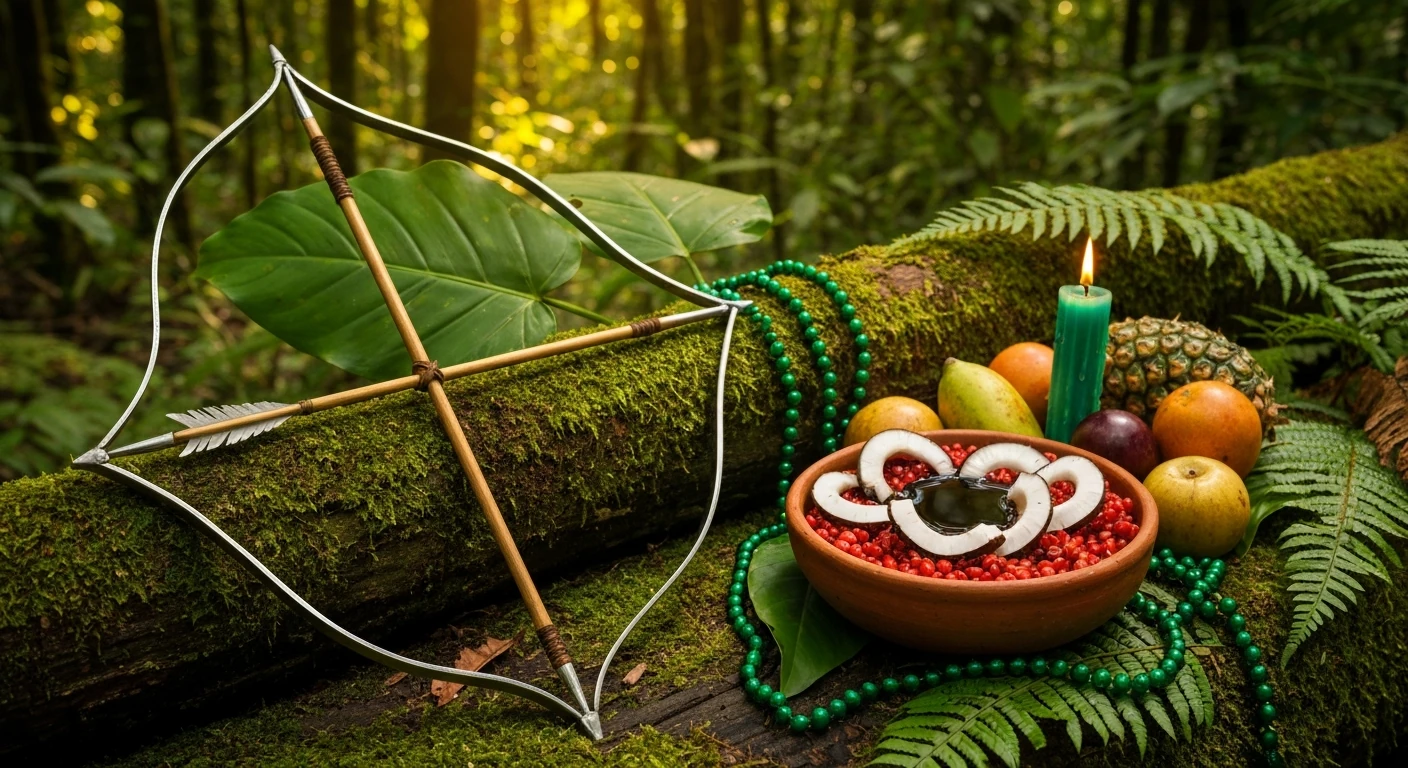
- Symbol: the opá Ossaim, a metal rod topped by a bird, with seven prongs coming out of the center, a stylized tree in iron
- Greeting: “Ewé ó!”, which means “Hail the leaves!”
- Offerings: tobacco leaf, honey and oti (aguardente) in the FUCESP record; cooked corn seasoned with tobacco leaf and fruits in Prandi. What each source records is in offering for Ossaim
- Syncretism: Saint Benedict in Umbanda, with a festival on October 5; Saint Onofre in Prandi, in Ketu Candomblé. It varies by tradition
- Priest: the Babalossaim, or Baba ewé, the father of the leaves
Ewé ó, my father Ossaim! To greet the owner of the leaves is to recognize that all healing and all axé begin in the green of nature. It is to ask permission from the forest before harvesting and to thank the plant that gives itself to heal, cleanse, and protect.
One point of respect that every devotee needs to know: the offerings and the preparations of fundamento have secrets, and secrets are not learned in an article. What follows explains the concept of the tradition, but any ritual practice must be guided by your leader or by your house of the orixás (casa de santo).
Without leaf there is no axé: what are ewé, ofó and agbo
To understand the greatness of Ossaim, it is necessary to know three Yoruba words. Ewé is the leaf, the herb. Ofó is the word, the enchantment that awakens the sleeping force inside the plant. And agbo is the ritual maceration of the leaves in water, the preparation that concentrates this green axé for sacred baths and washings. What abô is, and why the preparation is for initiates, is in what is abô.
The central thesis of the worship is direct and beautiful: each orixá has their leaves, but only the lord of the herbs knows the ofó that activates the power of each one. As the specialized portal ocandomble, without leaf there is no orixá summarizes, because it is the secret that transforms the plant into axé. In other words, having the leaf is not the same as knowing the leaf. Anyone can pick a rue or a rosemary, but the plant only becomes a spiritual remedy when it receives the right word, the right name, and the right respect. This knowledge is the treasure of the orixá of the leaves, and that is why he is surrounded by mystery.
Pierre Verger dedicated years to this theme in the work Ewé: The Use of Plants in Yoruba Society, gathering thousands of leaf recipes and the concept of the enchantment that activates them. José Flávio Pessoa de Barros did similar work in Brazil in The Secret of the Leaves. Both works show that the botany of Candomblé is not superstition, but rather a deep traditional knowledge about plants, anchored in an entire cosmology.
The itan of the division of the leaves
The most famous myth of Ossaim explains why all orixás have leaves, but only he has the secret. In the beginning, the owner of the herbs kept all the knowledge of the plants alone, and the other orixás depended on him for any cure or ritual work. This monopoly was bothersome, especially Xangô (Shango), the orixá of justice and thunder, who saw in the concentrated power a form of imbalance.
Xangô then asked for help from Iansã (Oya), his companion, the orixá of the winds and storms. Iansã blew the strongest wind ever seen, and the gale knocked down the gourd where Ossaim kept the most powerful leaves, scattering them throughout the forest. Each orixá ran and grabbed some leaves, and that is how each one came to have their herbs: those of Oxum (Oshun), those of Ogum (Ogun), those of Oxalá (Obatala), and so on.
But the itan holds a subtle lesson. The orixás were left with the leaves, not with the secret. They came to have the plant in their hands, but they remained without knowing the ofó that makes it work. Ossaim lost the leaves, never the secret. The story teaches that possessing is not the same as knowing, and that true power lies in knowledge, not in possession. Whoever wants to know the orixá who blew the wind can read the profile of who is Iansã, and the judge of the myth is in who is Xangô.
Why Ossaim has only one leg
The traditional iconography represents Ossaim with only one leg, and sometimes with only one arm or only one eye. To those who see from the outside, the image may seem strange, but it carries a profound meaning that is worth reading calmly.
The body of the orixá of the leaves is the tree itself. The foot planted in the ground is the root, the single leg is the firm trunk, the open arms are the branches, and the hair is the leaves that sprout at the top. Represented this way, Ossaim is not a disabled god, but rather the plant nature in the form of an orixá, the axis that connects the earth to the sky through the sap that rises.
The single leg also speaks of concentration and specialization. He does not scatter: he is rooted in a single point, firm, dedicated entirely to his domain. This firmeza is the archetype of the children of Ossaim, described by tradition as reserved, intelligent, patient, and meticulous people, of few words and firm character, like someone guarding a valuable secret.
Ossaim, Agué and Catendê: the owner of the leaves in the three nations
The orixá of the leaves is worshiped in all nations of Candomblé, but receives different names according to the African root of each one. Knowing these variations is part of the respect for the diversity of the worship, and the collection of the Museu Afro Brasil gathers the tools of the three nations side by side precisely to show this unity in difference.
- Ketu (Yoruba root): Ossaim (Ọ̀sányìn), the lord of the leaves.
- Jeje (Fon root, from ancient Daomé): Agué, vodun of hunting and forests. Prandi places him in the line of Ossaim, and the newspaper A Tarde describes him as Oxóssi (Oshosi). The equivalence is an approximation, as shown in Ossaim and Oxóssi: why are they confused.
- Angola (Bantu root): Catendê (Katende), the lord of insabas, a word that means leaves in Kimbundu.
Each nation has its own songs, its own drum rhythms, and its own foundations for the owner of the leaves, even if the domain is the same. To better understand these roots, it is worth reading about the nations of Candomblé: ketu, jeje and angola and, in the case of the Angola tradition, about what is an nkisi, the concept that organizes the Bantu deities.
Ossaim in Umbanda, in Candomblé and the syncretism
The way to worship the orixá of the leaves changes significantly between traditions. In Candomblé, Ossaim is a foundation: the leaves wash the assentamentos, prepare the initiate, and activate all the axé of the house, always under the care of Babalossaim. He is a reserved orixá, who rarely manifests by dancing in the barracão, because his work is the silence of the woods and the secret of the herbs.
In Umbanda, the lord of the herbs is equally respected, but also appears little embodied in the giras. His presence is, above all, in the leaves of each ritual: in the ritual bath that the medium takes, in the smoke cleansing (defumação) that cleans the terreiro, in the herbs that the caboclos know and indicate. Where there is herb working, there is the signature of Ossaim.
The syncretism of Ossaim varies according to the tradition. In Umbanda, FUCESP and a tenda (Umbanda house) in São José dos Campos register Saint Benedict, the Black saint protector of the humblest, with a festival on October 5. Prandi, in Ketu Candomblé, registers Saint Onofre, and in Gaucho Batuque, Saint Roch appears. October 5 has been the date of Saint Benedict in Brazil since 1983, and no open source explains why Umbanda gave it to Ossaim: what is known and what is not known is in Ossaim day: October 5. The Batuque perspective is in Ossanha in Batuque. Syncretism needs to be understood in its historical context. During the slave period, worshipping orixás was prohibited, and Africans hid their divinities behind Catholic saints to be able to continue their faith. This was a strategy of resistance, not theological equivalence: Saint Benedict is not Ossaim, he was the mask that allowed the orixá of the leaves to survive. To deepen this relationship between the two religions, see the difference between Umbanda and Candomblé.
The leaves of Ossaim in the daily life of the terreiro
Here is the point that connects Ossaim to the practical life of those of faith: practically every herb used in the religion is under his domain. Even when a plant belongs to another orixá, it is the lord of the leaves who holds the secret that makes it work. Therefore, knowing the orixá of the leaves is knowing the heart of almost all rituals.
An important distinction is worth making here, so as not to confuse two orixás. Ossaim is the owner of the leaf, of the herb itself and its secret. Oxóssi is the owner of the forest, of the forest territory and the hunt. They work together, because the leaf is born in the forest, but they are not the same divinity. Anyone who wants to know the hunter can read who is Oxóssi and notice the difference, and the confusion between the two, nation by nation, is in Ossaim and Oxóssi: why are they confused. As for the herbs, the FUCESP record responds "all": each orixá received theirs, and the set belongs to Ossaim.
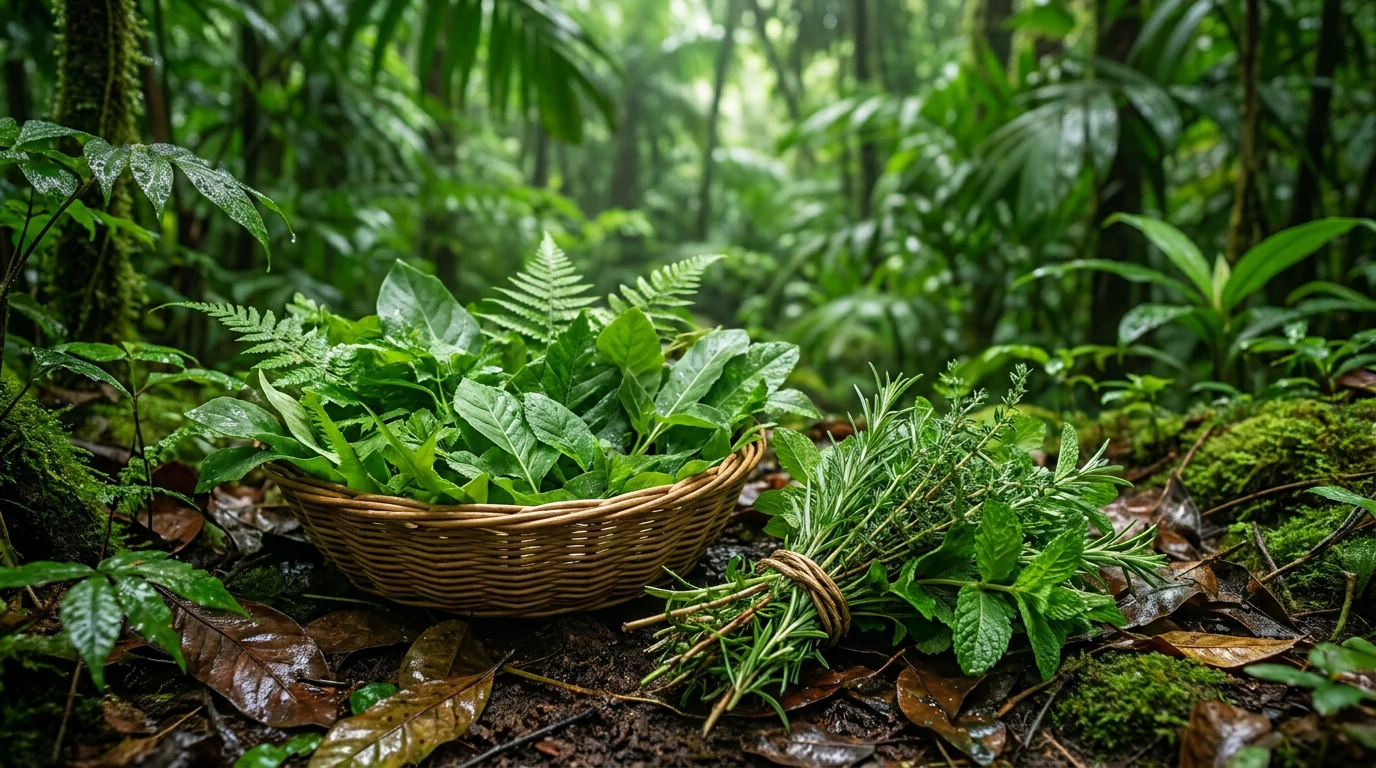
Ossaim's herbs appear in every corner of the worship:
- In arruda, the herb of Ogum and Exu used in the descarrego, and in guiné, a companion for cleansing.
- In alecrim, the herb of Oxalá of renewal, and in basil of Oxum, of love and harmony.
- In herbal baths, such as the classic herbal bath of Oxum, and in the smoke cleansings, as taught by the guide how to do smoke cleansing for cleansing.
Each leaf has an owner, a day, and a purpose. But respect for Ossaim begins before the bath: permission is asked from the forest to harvest, thanks are given to the plant, and the herb is never pulled with haste or contempt. This care is the first foundation of the owner of the leaves.
Frequently asked questions
What is the color of Ossaim?
The colors of the orixá of the leaves are green and white, with green representing the life of the plants and the forest. The shades of green can vary depending on the nation and the house of the orixás (casa de santo). Green is so associated with him that many devotees wear green beads in his honor.
What is the day of Ossaim?
The day of the week of the orixá of the leaves is Thursday in most sources, and there are those who record Tuesday, Saturday, or Monday. In the year, the date of October 5 is what Umbanda houses record, with Saint Benedict, and in the batuque the cited day is August 16. It is best to follow the calendar of your own casa de santo. The answers, one by one, are in day of Ossaim: October 5.
Why does Ossaim have only one leg?
Because his body represents the tree itself: the single leg is the trunk, the arms are the branches, and the hair is the leaves. The statue symbolizes rooting, concentration, and the firmeza of one who guards a secret, not a deficiency. It is nature in the form of an orixá.
What is offered to Ossaim?
Open sources record tobacco leaf, honey, and oti (aguardente), and Prandi notes cooked corn seasoned with tobacco leaf and fruits. However, the ritual work offerings have secrets and must always be guided by your leader. One never performs a ritual work offering on their own. What each source says, and what belongs to the house, is in offering for Ossaim.
What is the difference between Ossaim and Oxóssi?
Ossaim is the owner of the leaves and the herbs and the secret that activates them. Oxóssi is the owner of the forest, the hunt, and the abundance of the forest. They work together, since the leaf is born in the forest, but they are distinct orixás, with their own domains and foundations. Why people confuse them is in Ossaim and Oxóssi.
Where to find herbs and products of Ossaim
At Joia Mística Laroyê, you find everything you need to honor the orixá of the leaves with respect:
- Fresh and dry herbs: rue, guinea hen weed, rosemary, basil, snake plant and many others, sold separately or in combos
- Ready herbal baths: prepared with intention for cleansing, protection, and prosperity
- Incense burners and incense: herbs and resins for the smoke cleansing (defumação) of the environment
- Green and white candles: in the colors of the orixá of the leaves
- Bead necklaces and green beads: for devotion and ritual use
Visit our physical store in Extrema, Minas Gerais or talk to us via WhatsApp and we ship all over Brazil. Our team guides you on the correct use of each herb with the respect that tradition demands.
References
- Wikipedia: entry about Ossanhe, with the spellings, the symbol, and the names in the three nations
- Ocandomble: article about Ossaim and the secret of the leaves