Knowing who Nanã is is returning to the beginning of everything. Before iron, before cities, even before many of the best known orixás, there already existed the lady of the mud, of the still waters, and of the clay at the bottom of the mangrove. Nanã Buruquê is the oldest of the iabás, the grandmother of the orixás, the one who guards the memory of creation and the portals through which life enters and through which it returns to the earth.
This guide presents the complete profile of the orixá: her very ancient origin in ancient Daomé, the domains of mud and ancestry, and the technical sheet, with colors, greeting, and offerings. It also explains the reason for her quizila with iron, her children, and the meaning of July 26, when Umbanda greets her in syncretism with Saint Anne.
Who is Nanã, the oldest of the orixás
Nanã is revered as the oldest of the feminine deities, the iabá who existed before the others. Her origin is not pure Yoruba: she comes from the fon people, from the ancient kingdom of Daomé (current Benin), and only later was she incorporated into the Nagô pantheon worshipped in Brazil. For this reason, she is treated as one of the most ancestral deities of all, linked to a time prior to the Iron Age itself, a reading that the ethnographer Pierre Verger supports by placing the orixá and her son Obaluaê among the most archaic cults of West Africa.
Her domain is still water: the lake, the swamp, the marsh, and, above all, the mud at the bottom of the mangrove. Where the flowing water of Oxum (Oshun) is movement and the salt water of Iemanjá (Yemoja) is vastness, the water of Nanã is quiet depth, rest, the fertile mud where life is formed and where life returns. This mud is not dirt: it is sacred raw material, the primordial silt that carries ancestry and wisdom.
There is a very widespread itan that explains this centrality. Tradition tells that, when Olodumare wanted to create human beings, Oxalá (Obatala) could not give shape to the creature until Nanã brought the mud from the bottom of the waters with which man was modeled. For this reason, she is seen as the matter of which we are made and the destination where the flesh returns. To situate the orixá within the set of Afro-Brazilian deities, it is worth reading the overview on what the orixás are.
Nanã technical sheet
Before deepening into ancestry and itans, it is worth fixing the elements that identify the orixá. The correspondences below follow what is most consensual among the houses, with the most common variations signaled.
- Domains: ancestry, primordial mud, still waters, wisdom, memory, the portals of life and death
- Colors: purple and lilac, almost always accompanied by white; some houses include indigo
- Element: still water and mud, the swamp, the marsh, and the mangrove
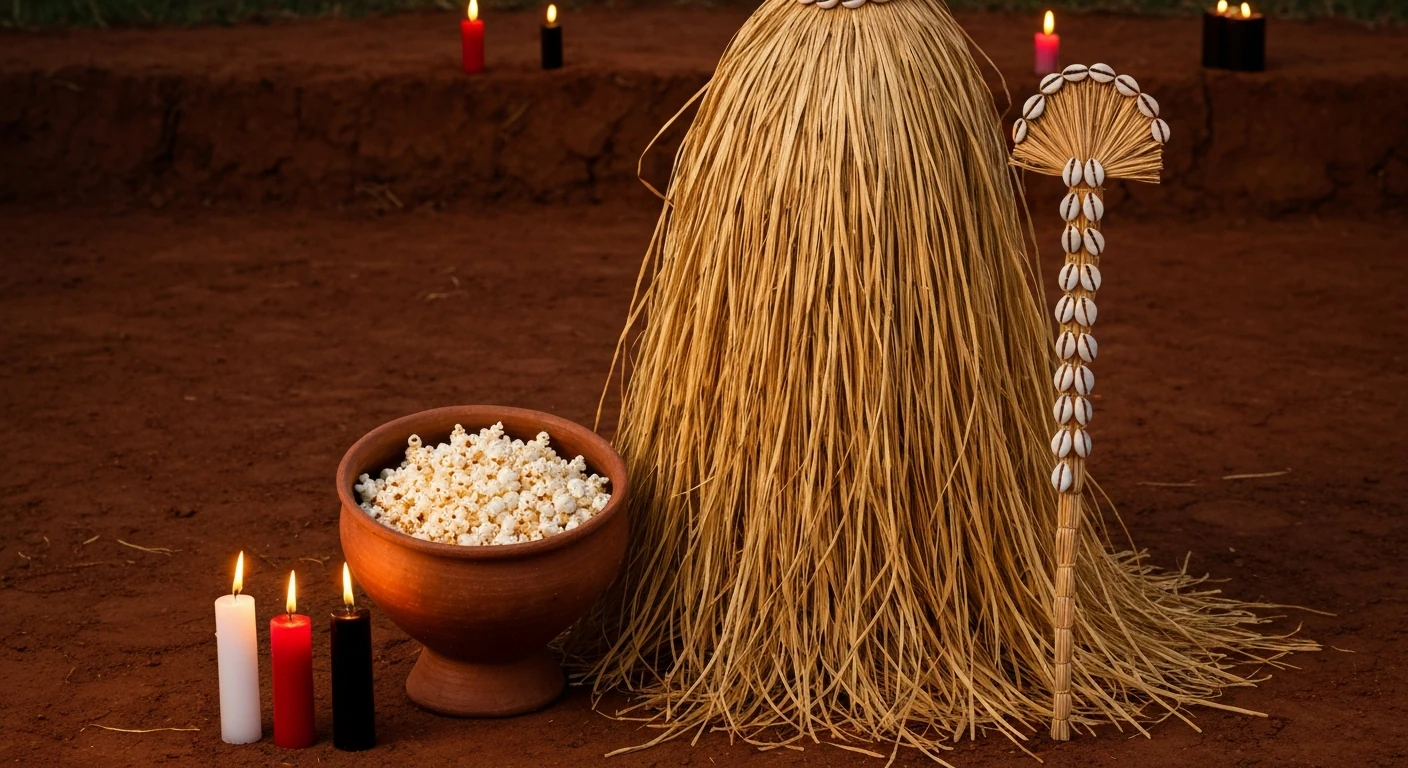
- Symbol: the ibiri, a straw scepter decorated with búzios and beads, which she carries curved as if supporting
- Greeting: “Saluba, Nanã!”, something like “Hail, Nanã” or “we take refuge in Nanã”
- Offerings: feijão-fradinho, white canjica (mungunzá), sweet potato, shrimp, and caruru, served in a clay alguidar, never in a metal vessel
- Origin: jeje-fon, from ancient Daomé (current Benin); in the angola nation, her energy appears under the name of the inquice Nzumbarandá
- Syncretism: Saint Anne, celebrated on July 26 in Umbanda
Saluba, Nanã! The greeting is a gesture from those seeking comfort and protection from the oldest of the mothers. Before Nanã, one usually bows the head in reverence, in the respect one has for the grandmother who saw everything and forgives everything.
Regarding the day of the week, it is honest to say that sources diverge: Monday is the most cited in many terreiros of umbanda, but there are houses that dedicate Sunday or Tuesday to her. The firm point is the annual date, July 26. When it comes to color, purple is the strongest consensus, present in the bead necklaces, in the candles, and in the clothes used to honor her.
Lady of the portals of life and death
One of the most misunderstood aspects of the orixá is her connection with death. Nanã rules the portals through which the souls arrive in the world and through which they depart. She receives those who pass away, welcomes the spirit back to the clay from which it came, and prepares it for a new cycle. There is nothing dark or scary here: it is the opposite of fear.
For the Afro-Brazilian tradition, death is not an end, it is a passage, and the lady of this passage is the same loving grandmother who supports birth. Therefore, Nanã is also the orixá of serene mourning and of reconciliation with time. Those who seek her in a moment of loss usually seek in her the welcoming of one who understands that everything has its season. She teaches patience, acceptance, and the wisdom that only the elders carry.
This serenity is the opposite of the world's haste. Nanã does not act with the impetus of a warrior nor with the brilliance of an orixá of the living waters. Her strength lies in deep quietude, in that which matures slowly, in what needs time to transform.
Why Nanã does not accept iron
A characteristic mark of Nanã's worship is the quizila with iron: in many houses, nothing that touches the orixá or her offerings can be made of metal. Cuts and ritual preparations for her are made with instruments of wood or bamboo, and her foods are served in clay, not in aluminum.
The explanation is in an itan involving Ogum (Ogun), the orixá of iron and technology. Tradition tells that, in an assembly where the orixás were going to recognize Ogum as the most important for having forged the knife and the metal instruments, Nanã disagreed. To show that life did not depend on the invention of iron, she reportedly performed her sacrifice without using any blade. Since then, Ogum's metal has been excluded from her worship.
There is also the historical reading, defended by Verger: as a divinity prior to the arrival of iron in West Africa, Nanã belongs to a time when this material simply did not exist, and her worship preserved this antiquity. An important caveat is worth noting: quizilas vary from house to house and from nation to nation. Iron being kept away from Nanã's worship is a widely followed tradition, not a single dogma, and each terreiro keeps its own foundations. The Wikipedia entry on Nanã records this Daomean origin and the itan of iron for anyone who wishes to go deeper.
The children of Nanã
Motherhood is a central part of the orixá's identity. Nanã is considered the mother of deities linked to the earth, transformation, and mystery. The most famous of her children is Obaluaê (Omulu), the orixá of the earth, of diseases, and of healing, who learned from his mother the mastery over the cycles of dying and being reborn. Knowing the son helps to understand the mother: it is worth reading the profile of who is Obaluaê (Omulu), the healing orixá covered by his straw cloak.
Tradition also attributes other children to her. Oxumarê, the rainbow serpent orixá, lord of cycles and renewal, and Iroko (Loko), the deity of the sacred tree and time. In some itans gathered by Reginaldo Prandi, Nanã also appears as the mother of Ewá and linked to Ossaim (Osanyin), the lord of the leaves. In many narratives, she is pointed out as the first woman of Oxalá, which places her at the root of the great lineages of orixás.
This place of grandmother and matriarch reinforces why she is invoked in matters of family, ancestry, and lineage. Whoever seeks Nanã seeks, deep down, the wisdom of origins.
Nanã in Umbanda and in Candomblé
Although she is the same orixá, Nanã is not lived in the same way in the two traditions, and confusing them erases what each one has of its own.
In Candomblé, Nanã is an iabá worshipped with her assentamentos, her fundamentos, and her specific foods, varying according to the nation. In ketu and in jeje, the Daomean origin and the quizila of iron are strongly preserved; in the angola nation, of Bantu roots, the energy of the lady of mud and ancestry is worshipped under the name of the inquice Nzumbarandá. Mentioning the nation is not a detail: treating Candomblé as a single block erases the real diversity of the houses.
In Umbanda, Nanã acts primarily as a vibration or line of work linked to ancestry, the wisdom of the elders, and support in mourning. It is common for her energy to be associated with that of the pretos-velhos, spirit guides of ancestral wisdom, due to the proximity of the themes. The syncretism with Sant’Ana, more present in Umbanda than in root Candomblé, completes this portrait of the grandmother orixá.
Day of Nanã: July 26 and the syncretism with Sant’Ana
Those looking for the date of Nanã find July 26, and the reason lies in the history of Brazil. During colonization, faced with the prohibition of worshipping the orixás, enslaved Africans associated their deities with Catholic saints to continue revering them under another name. It was a survival strategy, not a declaration that orixá and saint would be the same thing.
Nanã was associated with Sant’Ana, mother of Mary and grandmother of Jesus according to Christian tradition. The connection is transparent: just as Sant’Ana is the venerated grandmother, Nanã is the grandmother of the orixás, the oldest matriarch, guardian of ancestry. Both carry the same archetype of the wise elder who supports the generations. Nanã's profile from the Federação de Umbanda e Candomblé do Estado de São Paulo records the syncretism with "Saint Anne celebrated on July 26", and it is on this date that many terreiros greet the lady of still waters and ancestry.
Therefore, as the end of July approaches, houses of Umbanda and Candomblé prepare tributes to the oldest orixá. To follow the celebrations of each deity throughout the year, consult the calendar of the orixás.
How to revere Nanã
Devotion to Nanã is done with the calmness and respect one has for elders. What follows is a devotional reference, remembering that each house has its own guidelines and that foundation offerings are made under the guidance of a pai or mãe de santo.
- Light a purple or lilac candle in a clean and quiet place, visualizing gratitude for ancestry and asking for wisdom and patience
- Offer in clay, never in metal, foods such as feijão-fradinho or white canjica, respecting the quizila of iron
- Greet the orixá with "Saluba, Nanã!", with your head bowed, like someone speaking to the oldest grandmother of the family
- Honor your ancestors, because worshipping Nanã is worshipping the memory of those who came before us
Devotion tip: seek Nanã to ask for serenity in the face of changes, strength in mourning, and wisdom to mature decisions. The orixá of mud works in the time of the roots, slowly and deeply, and teaches that some things only bloom when the right time is respected.
The conscious choice of candles is part of the reverence. To understand the meaning of each color, see the guide of ritual candles and their meanings.
Frequently asked questions
Who is Nanã in Umbanda?
Nanã is the oldest orixá, lady of the mud, of still waters and ancestry. In Umbanda, she acts as a vibration linked to the wisdom of elders, to support in mourning and to the memory of ancestors, being syncretized with Sant’Ana and celebrated on July 26.
What is the day of Nanã?
Nanã's annual date is July 26, in syncretism with Sant’Ana. As for the day of the week, it varies according to the house: Monday is the most cited, but there are terreiros that dedicate Sunday or Tuesday to her. The July date is the point of greatest consensus.
Nanã is the mother of which orixá?
Nanã is considered the mother of Obaluaê (Omulu), the orixá of healing, and also of Oxumarê and Iroko. In some itans, she is linked to Ewá and Ossaim. In many narratives, she also appears as the first woman of Oxalá.
Why does Nanã not accept iron?
Tradition tells an itan in which Nanã refused to recognize the supremacy of Ogum, the orixá of iron, performing his sacrifice without using metal. Therefore, in many houses, iron is excluded from her worship, with wooden instruments in its place. The quizilas, however, vary from house to house.
What does Saluba Nanã mean?
“Saluba, Nanã!” is the traditional greeting of the orixá. The expression is understood as “Hail, Nanã” or “we take refuge in Nanã”, a prayer request for support and protection directed to the oldest and wisest of the mothers.
Where to buy items for Nanã
At Joia Mística Laroyê, you find everything to honor the oldest orixá with respect and devotion:
- Statues of Nanã with the ibiri, for your altar or consecrated foundation (assentamento)
- Purple, lilac, and white candles, in the colors of the lady of ancestry
- Alguidares and clay vessels for offerings, respecting the quizila of iron
- Bead necklaces and beads in purple and white for devotion
- Herbs and incense linked to the energy of wisdom and ancestry
Visit our shop in Extrema-MG and we ship all over Brazil. For guidance on the correct use of products and the best way to reverence Nanã, talk to us via WhatsApp.
References
- Wikipedia: entry about Nanã, Daomean origin and the itan of iron
- FUCESP: Nanã Buroque record, with the syncretism with Saint Ana on July 26