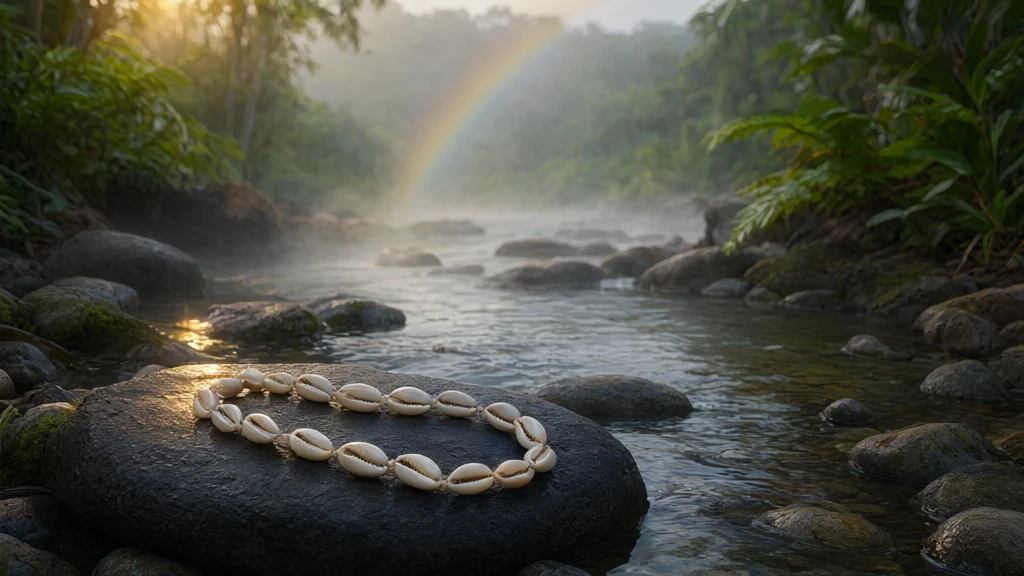
Ewá is the orixá of the springs, of the headwaters and of the horizon, the one who sees far. In Ketu Candomblé, Reginaldo Prandi registers her as "orixá of the springs," with the element "headwaters and streams." Clairvoyance is her most remembered attribute, and the mastery over the passage of the dead completes the portrait.
She is also written as Euá or Yewá, and is one of the most rarely worshipped orixás in Brazil. Therefore, her profile changes so much from one house to another. Here, each piece of data comes with the name of who registered it.
Who is Ewá, the orixá of the springs and of the horizon
Ewá is an iabá, a female orixá, linked to the fresh water that rises from the earth. In Prandi's table for Ketu, besides the springs, she rules "domestic harmony." In an itã that he gathered, Ewá is the horizon itself, "the meeting of heaven and earth," and pulls the sun with her harpoon at the end of the day.
In the thesis by Luciano Lima Souza (UESB, 2019), she appears as the lady of possibilities, guardian of untouched things and owner of clairvoyance, given by Orunmilá (Orunmila). She is also a warrior and a hunter.
Element: springs, headwaters, mist and horizon | Nation: Ketu and Jeje | Greeting: Ri ró | Day: Saturday (Prandi)
The image that many people know comes from music. In "As ayabás" by Caetano Veloso and Gilberto Gil (1976), Ewá is the "troubled girl who hides in the woods" and the "virgin of the woods".
Where Ewá comes from: the Yewa river and the Fon reading
The worship of Ewá was born in a river of the same name. The Yewa river flows between Nigeria and Benin and crosses the border of the two countries. Pierre Verger, cited by Rodolfo Figueiredo, links each African orixá to a region and places "Iyewa" in Egbado. According to Verger's Notes, the river is "very close to the Ogum (Ogun) river", where Iemanjá (Yemoja) is worshipped.
Prandi recalls that the rivers of various orixás "still keep the same name" as the deity today. In Brazil, these orixás stopped being tied to the river of origin. An itã tells the origin of the river: Ewá, lost in the woods with two children dying of thirst, asks Olodumaré and becomes a spring, which becomes a lagoon and then the Euá river.
Some read another origin. The ialorixá Mãe Lúcia de Omidewá says that Ewá is part of Ketu, but "has more to do with the people of Dan, she is Fon". Mãe Beata de Iemanjá also calls her Fon.
In Prandi's table, Ewá has a corresponding vodun in the jeje, with the same name, and no inquice in the Angola nation column. The differences between the nations are in candomblé nations, and the voduns in voduns in Brazil.
The Cuban Yewá
In Cuban santería, Yewá is the owner of the cemetery, according to the Cuban encyclopedia EcuRed, which describes her as chaste and greeted with "Maferefún Yewá". The anthropologist Roberto Garcés Marrero records that, there, the sons and daughters of Yewá cannot have sexual relations. It is another tradition, with its own rules.
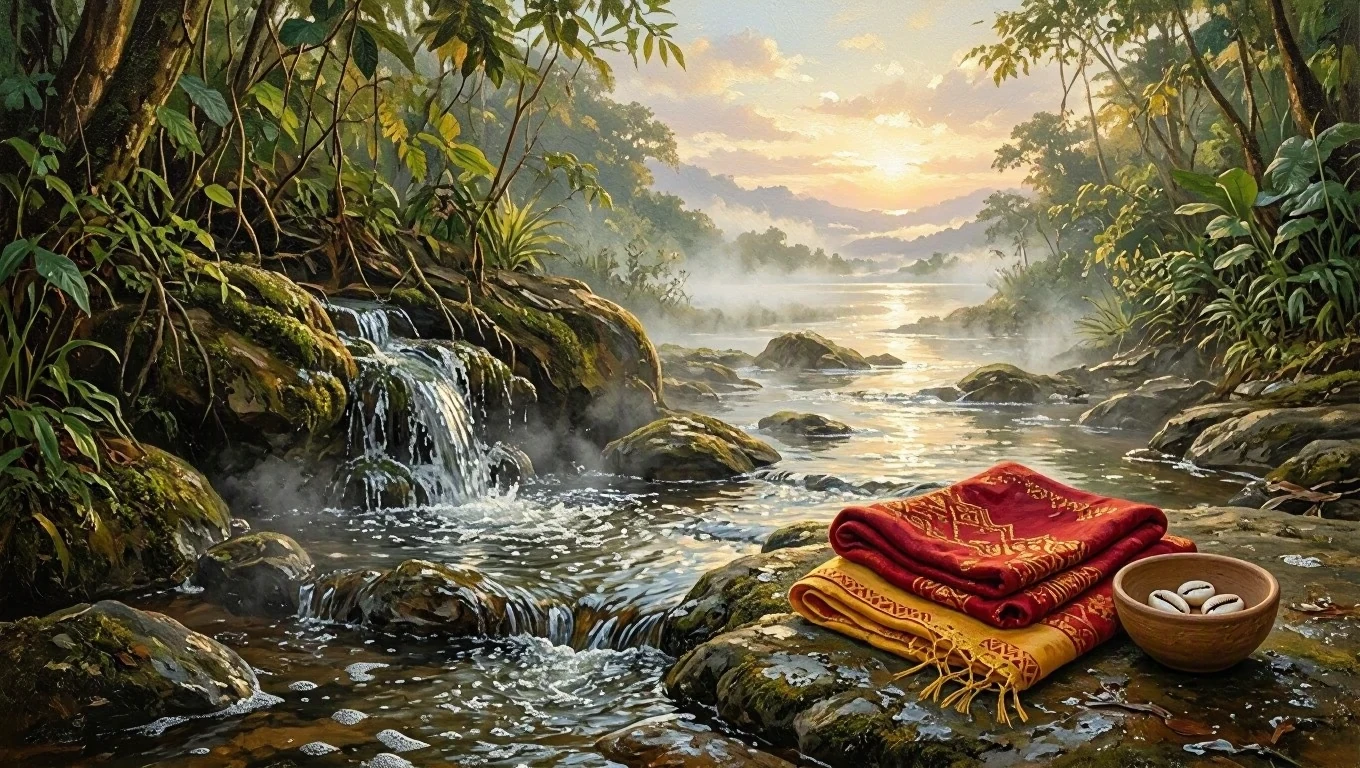
Whose daughter is Ewá?
It depends on the itã. In the stories gathered by Prandi in Mitologia dos orixás (2001), Ewá is the daughter of Nanã in some narratives and of Obatalá in others. The FUCESP federation calls her the "beloved daughter of Oxalá (Obatala) and Oduduwá." In the Tambor de Mina of Casa das Minas, in Maranhão, she is the daughter of the vodun Azonce, according to Prandi, who summarizes Sérgio Ferretti.
It circulates on the internet that Ewá is the daughter of Nanã and Oxalufã. No source we opened supports this pair. The name of Oxalufã only appears in an entry without a verifiable source, and there he is not the father of Ewá. The version we published before repeated this error, and it was corrected here.
Through her mother, Ewá is from the family of Nanã, with Obaluaê and Omolu and Oxumaré. In a house heard by Souza, the laguidibá, a disk necklace, belongs to the "jeje family: Omolu (Omulu), Oxumaré, Euá and Nanã."
Ewá and Oxumaré: siblings or a couple?
Both things, in the same book by Prandi. In one itã (p. 226), Ewá flees from marriage and her brother Oxumaré hides her where the rainbow ends. In another (p. 236), she falls in love with the rainbow and marries it.
| Version | Who says |
|---|---|
| Siblings | itã in Prandi, p. 226 |
| Couple | itã in Prandi, p. 236; a terreiro heard by Souza |
| Twins | the ialorixá Mãe Andreia do Catimbó |
| It is not known if they are siblings | Mãe Beata de Iemanjá |
What certainly connects the two is the snake and the rainbow. The complete comparison, with the sayings of each house and the reading of the tambor de mina, is in Oxumaré and Ewá: siblings, couple or twins?.
The itãs of Ewá: Xangô (Shango) and the kingdom of the dead
The most told itã connects Ewá to Xangô. In Prandi, she is the daughter of Obatalá and lives guarded in her father's palace. Xangô seduces her, she renounces the passion and asks for a place where no man can see her.
“Obatalá then gave Ewá the kingdom of the dead, which the living fear and avoid.”
In the profile that circulates through FUCESP, Ewá flees from Xangô and is welcomed by Obaluaiê (Babalu Aye), and lives in the forests, near Iroko and Oxóssi (Oshosi). Another narrative, also gathered by Prandi, marries her to Omulu, who covers her with red palha-da-costa. Mãe Beata tells a peaceful itã: Ewá blinds the enemy army with mirrors and avoids the war.
The story that Iansã (Oya) would have become enraged and Oxóssi would have welcomed her in the forest appears on websites and in an open encyclopedia without a source. For this reason, she was left out of this version. Ewá's relationship with the orixá of thunder is also in who is Xangô.
Ewá, death and transition
Ewá has a place in the rite of the dead. Prandi lists her among the orixás who participate in the axexê, the funerary rite of the queto candomblé, with Nanã, Omulu and Oxumaré. What happens in this rite is in what is axexê.
In Vitor Azevedo's dissertation (UERJ), Ewá is "mistress of the springs, of the sacred soil, where the dead rest." Naiara Paula Eugenio, quoting Cléo Martins, places her "in a middle ground," in the transition between death and the afterlife.
It is not a domain of fear. It is the domain of passage, the same horizon of the itã: the place where one thing ends and another begins.
Colors, day, symbols and greeting of Ewá
The profile varies according to the nation and the house. The only academic source with the complete profile is the Prandi (1995) table, made with Ketu terreiros from São Paulo and Bahia. The other lines come from houses heard in theses and from the FUCESP federation.
| Field | What they record |
|---|---|
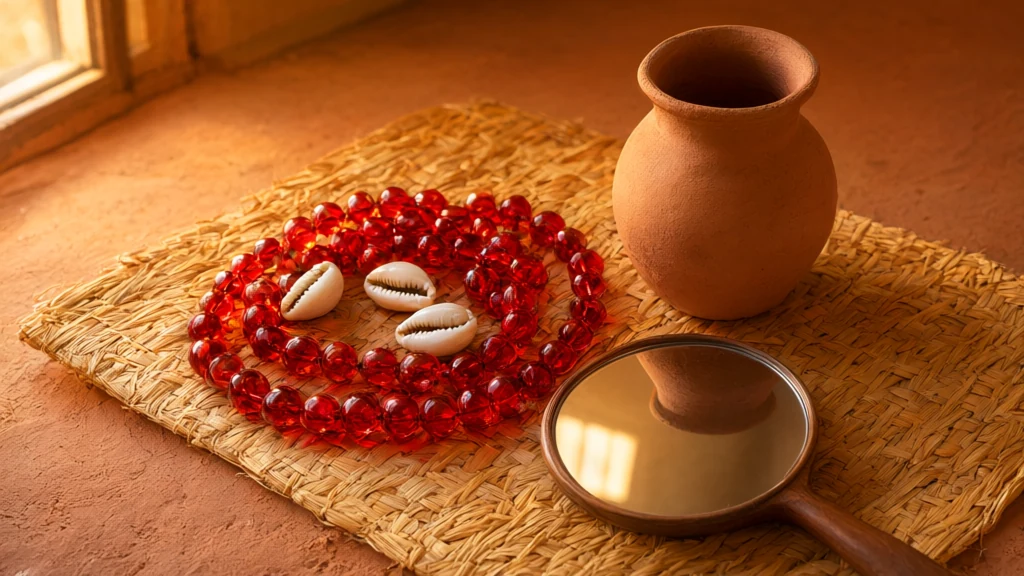
| Colors | red and yellow in the clothing, cowrie shells (búzios) (Prandi); translucent red, coral and gold (houses heard by Souza); crystal red (Mãe Beata's house); bright red, coral and pink (FUCESP) |
| Day | Saturday (Prandi and FUCESP) |
| Symbols | sword, rattle made of plant material and sphere (Prandi); ofá, bow and arrow, anchor, harpoon and brass sword in some houses (Martins) |
| Food | beans with boiled eggs (Prandi); fried fish, freshwater (Mãe Beata) |
| Taboo of the children | eating female birds (Prandi) |
| Greeting | Ri ró |
The greeting Ri ró, according to Cléo Martins, cited by Eugenio, means "softness, sweetness, whiteness, cuteness". It also appears written as "Riró" and "Ri Ro Ewá!". Tuesday, which has already circulated as her day, does not appear in any open source we consulted.
Whoever lights a candle for Ewá finds the single color red candle at Joia Mística. The color of the bead necklace, however, is what the house indicates. The general chart is in colors of the orixás.
What is offered to Ewá, according to the sources
The food for Ewá that academic research records is beans with boiled eggs, in Prandi's table for Ketu Candomblé. Mãe Beata de Iemanjá, interviewed by Eugenio, says that Ewá "really likes fish from the rivers" and "eats fried fish".
Cléo Martins, cited by Eugenio, records a house rule: "Ewá's delicacies must be arranged and offered only by women". The fish with yam that many sites repeat comes from a 2008 text copied page by page, without saying from which house it comes.
The chicken divides the sources. A survey with practitioners from Rio Grande do Norte, in a thesis from UFRN, records "chicken meat" as a quizila of Ewá, and Prandi puts another taboo, that of the children eating female birds. What is quizila is in quizilas in Candomblé.
There is little record because there are few children. Even the dissertation on the kitchen of a terreiro in Paraná leaves Ewá without a dish, because the house did not have a child of hers. Obrigação, preparation of fundamento, and the place of delivery are from the house, and we did not locate a reliable source for where it is delivered. The offerings in general are in how to make offering to the orixás.
Who is a child of Ewá
They are few. Maranhão records that Ewá is of rare worship and that "she does not always show herself in the cowrie-shell readings", appearing as Oxum (Oshun) or Oiá. In Mãe Beata's house, between 2012 and 2014, there was a single child made of Ewá. A pai pequeno interviewed by Souza says he never put his hand on the head of Ewá's people.
The rule that only virgin women can be initiated into Ewá circulates. It is contested by named ialorixás. Mãe Beata says "there is none of that," and Mãe Andreia do Catimbó tells that a brother of santo was initiated in Ewá. At Gantois, according to anthropologist Clara Flaksman, Ewá, "as everything indicates," also belonged to Mãe Menininha. A daughter of Ewá from Gantois was Mãe Senhora de Ewá, initiated by Mãe Menininha in 1950, who died in 2026 at 104 years old.
Why they are so few, where they are and what is said about their temperament is in filhos de Ewá. Who is from Ewá only a cowrie-shell divination of a pai or a mãe de santo shows. See what is the cowrie-shell divination and if it is possible to be a child of more than one orixá.
Saint Lucy, December 13 and the other syncretisms
In Candomblé, syncretism put Ewá alongside Saint Lucy, the Saint Lucy of the Prandi table. The Church celebrates the saint on December 13. A bill from Curitiba describes the date as "recurring in celebrations of Ewá." She appears in the calendar of the orixás.
Syncretism changes with tradition. Casa das Minas de Tóia Jarina is a tambor de mina terreiro in São Paulo. There, the vodun that corresponds to Ewá goes with Our Lady of Mount Carmel and has a festival on July 16. In Cuba, Yewá is associated with Our Lady of the Abandoned and of Montserrat.
Syncretism was a way to keep the worship alive under repression. Saint Lucy and Ewá remain distinct, each in its tradition.
Ewá in Umbanda and in Batuque
In Umbanda, Ewá appears little. Maranhão records that she is "eventually" called in Umbanda rituals and is more worshipped in Candomblé. In a study by the magazine Religare (UFPB), the nine most worshipped orixás in Umbanda do not include Ewá. We did not find an open source describing a specific line of hers in Umbanda.
In the Gaucho batuque, Ewá is left out: the list of twelve orixás that a person settles to be ready does not have her name. The Gaucho pantheon is in orixás do batuque.
In Tambor de Mina, as we have already seen, she is the vodun of the Dambirá family. In the xirê of a Ketu house of the Casa de Oxumaré lineage, she is sung after Obá (Oba) and before Oyá. The order of the xirê is in what is xirê.
Frequently asked questions
Whose daughter is Ewá?
It depends on the itã. In the myths gathered by Reginaldo Prandi, Ewá is the daughter of Nanã in some stories and of Obatalá in others. FUCESP speaks of Oxalá and Oduduwá, and in Tambor de Mina she is the daughter of the vodun Azonce. There is no source for the couple Nanã and Oxalufã.
What is Ewá the orixá of?
Of the sources, the springs, and the horizon, according to Prandi. Clairvoyance is the most remembered attribute, and she participates in the rite of the dead in Ketu Candomblé. In Cuba, Yewá is the owner of the cemetery.
What is Ewá's greeting?
Ri ró, also written as Riró or Ri Ro Ewá. According to Cléo Martins, cited by researcher Naiara Paula Eugenio, the greeting means softness, sweetness, whiteness, cuteness.
What is Ewá's color?
It varies by house. Prandi records red and yellow clothing and cowrie shells beads. Houses heard in theses use translucent red, coral, or crystal red, and FUCESP gives bright red, coral, and pink. Confirm the color with your house.
Is there Ewá in Umbanda?
She appears little. She is eventually called in Umbanda rituals, but is more worshipped in Candomblé, and is not among the most common orixás of Umbandista terreiros. In Gaucho batuque, Ewá is not among the twelve orixás.
References
- Reginaldo Prandi: Deuses africanos no Brasil contemporâneo, Horizontes Antropológicos, 1995
- Reginaldo Prandi: Concepts of life and death in the axexê ritual, 2000
- Reginaldo Prandi: In the footsteps of the voduns, 2005
- Nágila Oliveira dos Santos: Orixás on the couch, with the itãs of Prandi, Revista África e Africanidades, 2010
- Naiara Paula Eugenio: A warrior face of the iabás Obá, Ewá and Oiá, dissertation, UERJ, 2014
- Luciano Lima Souza: The sacred necklaces of memory, thesis, UESB, 2019
- Du Flor Maranhão: Amar e mudar as coisas no arco-íris de Euá, Mandrágora, 2022
- Rodolfo Aquino Figueiredo: Pierre Verger and the worship of the orixás, dissertation, Unesp, 2005
- Janaina Couvo Teixeira Maia de Aguiar: article in Diálogos magazine, UEM, 2014
- Clara Flaksman: Of blood and of orixá, kinship in Candomblé, Mana, 2018
- Vitor Amorim Moreira de Azevedo: Ewé Igbo, dissertation, UERJ, 2015
- Roberto Garcés Marrero: Los patakís de Ifá en la santería cubana, INDIANA, 2025
- Esposito e Bastos: The mythology of the orixás in the Umbandista imaginary, Religare, UFPB, 2022
- João Daniel Dorneles Ramos: article in the Proceedings of ReACT, Unicamp
- Reginaldo Prandi e Santos: Orixás in Brazilian popular music
- Tayane Sahara Medeiros de Oliveira: Candomblé, dietary practices, TCC, UFRN, 2016
- Tereza de Fatima Mascarin: Orixá food in the Ilê Ast’Oyá Onirá terreiro, dissertation, UEM, 2014
- FUCESP: Ewá file