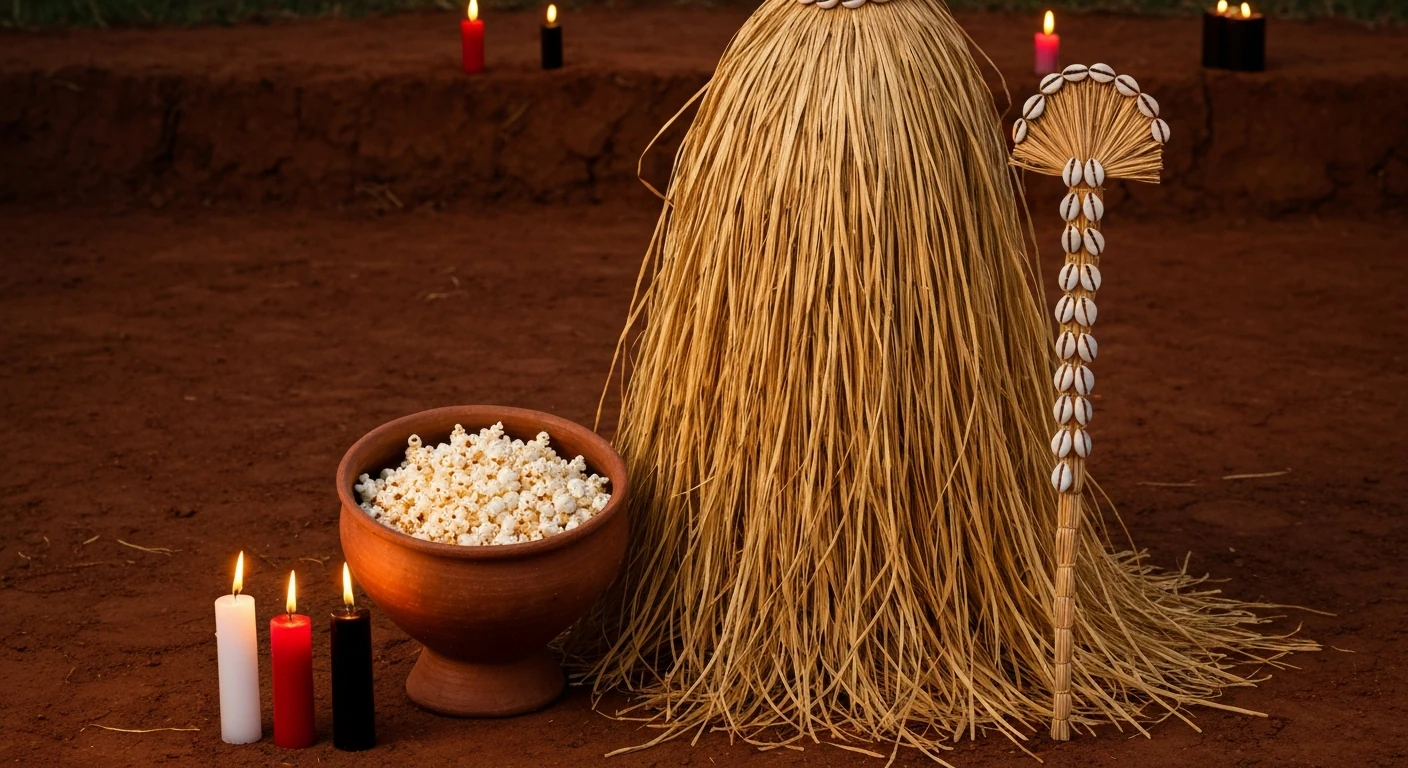
The pipoca of Obaluaê is much more than food. It is the doburu, the ritual food of the orixá of healing, and carries one of the most beautiful stories of the Afro-Brazilian pantheon. In Salvador, according to Gildeci Leite, the deburu is called "the flower of the Old Man": it is born from hard corn that pops and turns into a white flower, just as disease in the hands of the orixá can turn into healing.
In the table of sociologist Reginaldo Prandi, the food of Obaluaê is "popcorn with coconut slices" (Horizontes Antropológicos). In the houses of Salvador, it is popped in the sand, without fat and without salt; in Umbanda, FUCESP teaches the popcorn in dendê.
What is the doburu, the popcorn of Obaluaê
The doburu (also written as deburu) is the ritual popcorn offered to Obaluaê, the same orixá known as Omolu. In some houses, it appears by the names gugurú or abadô. It is popped popcorn, placed in a clay alguidar and decorated with coconut flakes. Simple in appearance, it is the most direct offering to the lord of the earth and health.
Orixá: Obaluaê (Omolu) | Food: doburu (pipoca) | Dishware: clay alguidar | Decoration: coconut flakes | Colors: black and white in Umbanda, with red in Candomblé | Day: Monday | Greeting: Atotô!
The popcorn is not chosen by chance. As the guide about the orixá Obaluaê (Omulu) tells, he is the orixá who knows disease from the inside and therefore knows the path of healing. The corn that opens into a white flower is the image of this passage from disease to healing.
The meaning of the popcorn for Obaluaê
The meaning of the popcorn is kept in the itãs, the sacred stories of the orixás, which Reginaldo Prandi gathered in Mitologia dos orixás (2001). There are more than one version. On pages 215 and 216, transcribed by Gildeci Leite, Nanã (Nana Buruku) abandons her sick son "in a cave near the beach," and "Iemanjá (Yemoja) gathered Omulu and washed him with seawater" and made for him "a garment entirely of raffia".
In the version summarized by Samuel Novaes Guimarães, in a graduation thesis at UFJF, it is Ogum (Ogun) who covers Obaluaê with straw so he can enter the party. Iansã (Oya) then "gave a breath that lifted his garment and made all of Obaluaê's wounds jump up and be transformed into popcorn." In another itã, the mother herself "took a handful of popcorn" and "threw it on his body, making the wounds disappear." From this comes the reading that from a wound a flower can be born, and from illness, a cure.
The popcorn teaches that nothing in us is just a wound. What burns today can, with time and care, bloom into a flower. This is the axé of Obaluaê.
This symbolism transforms a hard grain into a sign of hope. The popcorn does not deny the pain, it shows the passage. It is the reason why the food appears in the Olubajé, the great banquet of healing of Omolu, and in almost every tribute to the orixá.
Why does the popcorn pop in the sand without oil
In Salvador, the doburu is not made with oil. Leite describes the popcorn as "toasted in a pan with white sand. Obligatorily without fats of any kind," served "without salt" and with "strips of dried coconut." The National Sanctuary of Umbanda speaks of popcorn "popped with beach sand or dendê oil." Then, the popcorn is sifted to separate the sand from the grains.
There is a meaning in this. The sand connects the offering to the earth, which is the domain of Obaluaê, and to the beach of the story of Iemanjá with the child orixá. The popping without oil keeps the popcorn pure, the way the fundamento requires. It is a preparation that speaks of simplicity and roots.
Not everyone has beach sand at home. In Umbanda, the FUCESP provides the popcorn "popped in dendê oil and without salt," and Leite records that "The electric popcorn maker facilitates the work and does not remove the Axé." What does not change is the care: popcorn without salt, without sugar, and without butter, made only for the orixá.
How to offer popcorn to Obaluaê at home
The popcorn offering is a gesture of devotion, never a bargain for a result. Made with calm and faith, it brings you closer to the orixá of healing. See a simple and respectful path to prepare it, similar to what we teach in the guide on how to make offering to the orixás.
What you will need:
- Popcorn corn (about one and a half cups)
- A clay alguidar or straw basket
- Dendê oil (or clean sand, in the tradition of Salvador)
- A dry coconut, cut into strips
- A white candle
How to prepare:
- Pop the popcorn gradually, without salt and without sugar, and let it cool.
- Place the popcorn in the clay alguidar or in the straw basket.
- Decorate with the coconut strips on top.
- Light the white candle nearby and say your prayers, asking for health and protection.
Where to deliver varies from house to house. FUCESP says that offerings to Obaluaê "are delivered, preferably, at the cemetery crossroads," and the Santuário Nacional da Umbanda puts the popcorn "in a clay alguidar." The entire plate, the delivery locations, and what to do at home are in offering for Omolu. Upon delivery, hail the orixá with the "Atotô!", the greeting that asks for silence before the king of the earth. The deepest fundamentals, however, belong to your house: always confirm with your pai or mãe de santo.
The popcorn ritual bath and popcorn in the descarrego
Besides food, popcorn also becomes a banho and cleansing. For the Santuário Nacional da Umbanda, "The main ritual performed for Abaluaiê is the popcorn bath, invoking him for the healing of the sick." The preparation varies from house to house and is a matter of fundamento (tradition): whoever will take the bath follows the guidance of the pai or mãe de santo.
In some houses, the popcorn is passed over the person's body as a descarrego, rolling the grains over the skin to collect what is heavy. It is a symbolic gesture of removing the "wound" from above, in the spirit of the orixá's itan. Afterwards, this popcorn is carefully discarded, away from home.
A reminder that Obaluaê, the orixá of health, would be the first to make: spiritual healing goes hand in hand with medicine, never in its place. No bath, offering, or prayer replaces the doctor. If the body asks for attention, also seek physical health. The losna, the herb of Omulu, and other plants of the orixá complete these cleansing cares.
Frequently asked questions
Why is popcorn the food of Obaluaê?
Because an itan tells that the wounds of the orixá turned into white flowers, which were the pipoca. The hard grain that pops and turns into a flower represents the disease that turns into healing, the central axé of Obaluaê. That is why, in Salvador, the pipoca is called the flower of the Old Man.
What is the difference between doburu and common pipoca?
The doburu is the pipoca made only for the orixá, without salt, without sugar, and without butter, in the tradition popped on the hot sand of the beach. Common pipoca takes salt or sugar and is made to be eaten. What changes is the intention and the pure preparation, dedicated to Obaluaê.
Can you make Obaluaê's pipoca in oil?
In the oldest tradition, the doburu is popped in the sand, without fat. In Umbanda, FUCESP teaches the pipoca popped in dendê oil, and Leite records that the electric popcorn maker does not remove the axé. The important thing is to keep the pipoca pure, without salt or sugar, and confirm the custom with your house of the orixás (casa de santo).
Which day to offer pipoca to Obaluaê?
Monday is the day of Obaluaê in the week and the most indicated for the offering. The month of August, especially the 16th, is also strong for the orixá, syncretized with Saint Roch. See more in the guide about the month of August in Umbanda.
What to do with the pipoca after the offering?
Leave the offering in the location chosen for the proper amount of time and then collect what is left, discarding it in nature with respect, away from home. The pipoca used in descarrego never goes back inside the house. The clay alguidar can be washed and reserved only for the orixá.
Where to buy items for the offering to Obaluaê
At Joia Mística Laroyê, you find everything to prepare your Obaluaê pipoca with respect and fundamento:
- Popcorn corn and dendê oil: the base of the doburu
- Clay pots and vessels: in the right sizes for the delivery
- White candles: to light next to the offering
- Omulu herbs: wormwood (losna) and other plants for the orixá's cleansing
- Statues and bead necklaces of Obaluaê: to set your altar and your devotion
Visit our physical store in Extrema, Minas Gerais and we ship all over Brazil. Talk to us via WhatsApp and Joice will guide you on the right offering for your moment.
Atotô, Obaluaê!
References
- Reginaldo Prandi, Horizontes Antropológicos, 1995: African gods in contemporary Brazil
- Gildeci de Oliveira Leite, Fragmentos de Cultura (PUC Goiás), 2019: Omolu, Obaluaê, Saint Lazarus, Saint Roque
- Samuel Novaes Guimarães, TCC, UFJF, 2017: Obaluaê, the doctor among the orixás
- FUCESP: Obaluaê page
- National Sanctuary of Umbanda: Obaluaiê
- Wikipedia: entry about the doburu, the ritual popcorn
- Wikipedia: entry about Obaluaiê, the orixá of healing