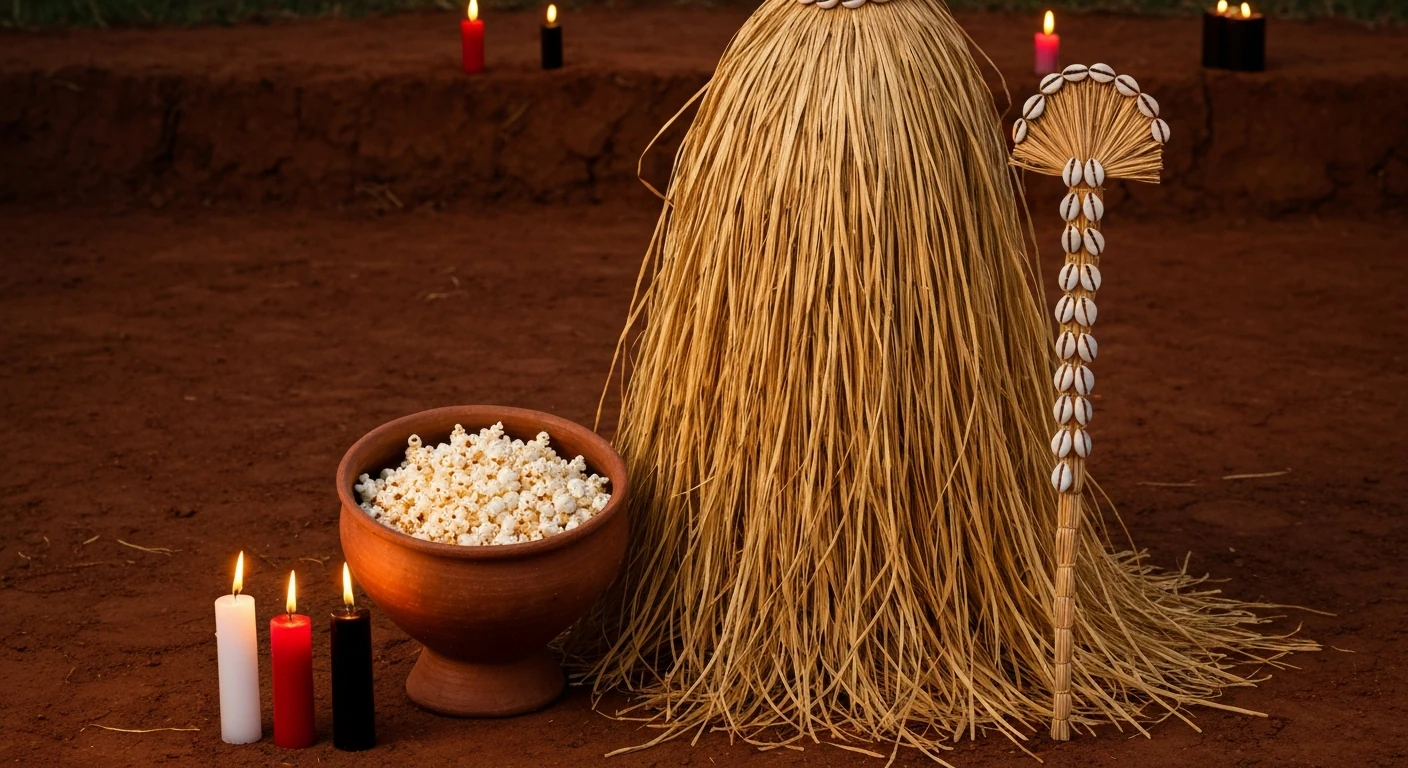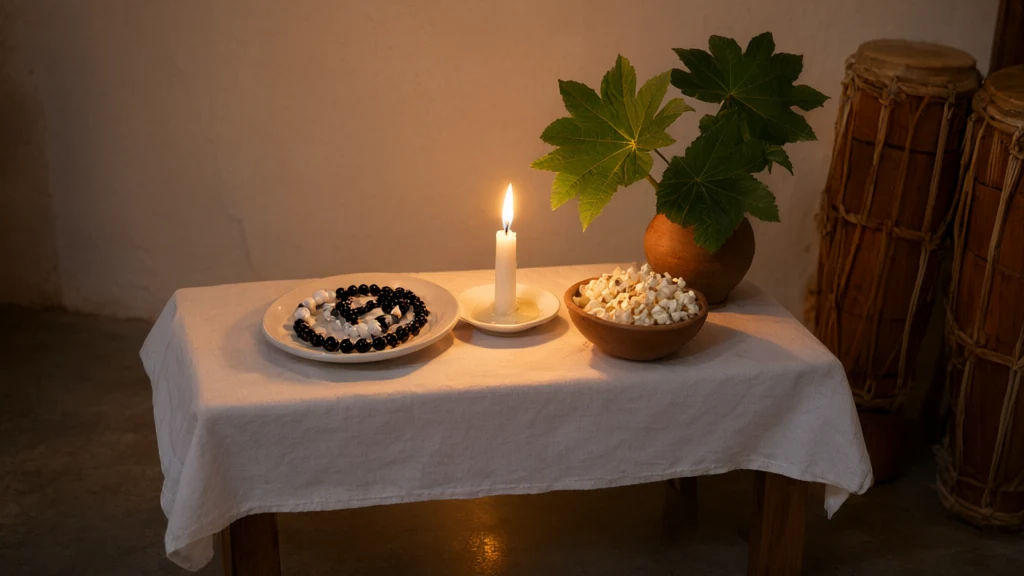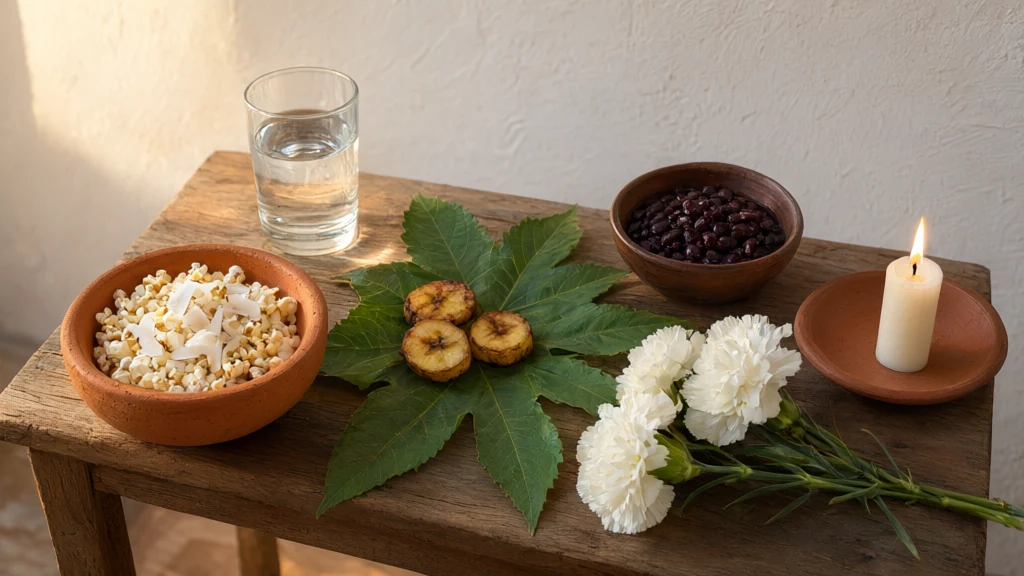
The offering for Omolu begins with saltless popcorn decorated with coconut, and in Candomblé the FUCESP list adds black beans in dendê, fried plantain and corn. In Umbanda, the custom is shorter: popcorn, white candle or white and black, white flower and water, preferably delivered at the cemetery cross.
What is offered to Omolu
Base: unsalted popcorn with coconut | Candomblé: black beans in dendê, plantain, corn | Umbanda: white candle, or white and black, white flower and water | Place: cemetery cross | Day: Monday | Greeting: Atotô
Popcorn is the center in all traditions. In the table by sociologist Reginaldo Prandi for Ketu candomblé, Omolu's food is "popcorn with coconut slices". The day is Monday. The rest changes from house to house. Therefore, each item below comes with the house or the author.
The orixá (orisha) behind the dish is in the pillar who is Obaluaê.
In candomblé: the dish beyond popcorn
Sand popcorn or dendê popcorn
In Salvador, researcher Gildeci Leite describes the doburu popcorn as "toasted in a pan with white sand", without fat, served without salt and with strips of dried coconut. He also records that the electric popcorn maker "does not remove the Axé". In other houses, the popcorn pops in dendê. The preparation and the popcorn ritual bath are in popcorn of Obaluaê.
What comes along
The Obaluaê card from FUCESP, the São Paulo federation of umbanda and candomblé, is the most complete one we found. On the candomblé side, it lists:
- Doburu, the popcorn decorated with coconut slices;
- Ewa dudu, black beans with dendê;
- Dodokindó, fried plantain;
- Cuscuz and corn.
In a house in Bocaiuva (MG), the book of fundamentals adds bearded yam to the popcorn. One column from Estado de Minas cites black beans and plantain farofa in dendê. Samuel Guimarães' (UFJF) thesis gives mamona as a ritual leaf and says that dendê "is also welcome".
The babalorixá Mário Cesar Barcellos, summarized by Samuel Abrantes (UFRJ), gives plantain as the fruit of Omolu.
The Olubajé and the angola
The collective banquet is something else: in the Olubajé, according to babalorixá André Gomes, "the foods of all orixás are prepared". In the Olubajé photographed by Lucas Barreto de Souza at Ilê Axé Akaraizô, in Salvador, the food goes on the mamona leaf and is eaten with the hands. The rite is in Olubajé, the banquet of Omolu; his month, in month of Obaluaê.
In the angola, the inquice that FUCESP associates with Obaluaê is Kavungo. In Inzo Tumbansi, his food is "Masangu (Pipoca)". The other inquices are in inquices of the angola candomblé.
Offering for Omolu in umbanda: candle, white flower and water
In umbanda, FUCESP records popcorn "popped in dendê oil and without salt; white and black candles; white flowers and water".
The Núcleo Umbandista São Sebastião (NUSS) gives white candles or white and black, white clove or another white flower, and pure water or sweet white wine. The house warns that popcorn in dendê for descarrego is from candomblé and that "In Umbanda it is rare".
The Santuário Nacional da Umbanda puts the popcorn, from beach sand or from dendê, with coconut, in a clay alguidar, with a white and black candle.
Tip: NUSS recommends the all-white candle for those who do not know how to handle the two-colored one. The white and black one that the house describes is the one with "half of each color".
Whoever descends in the gira of Omolu, the colors and the day are in Omolu in Umbanda.
Where to deliver the offering of Omolu
The most cited place is the cemetery cross. FUCESP writes that offerings "Are delivered, preferably, at the cemetery cross." The Sanctuary gives the cemetery, the small calunga, as his field of force.
Barbara Thompson (UFBA) researched the Saint Anthony cemetery, in Vitória (ES). At the cross, she found "alguidar with popcorn" delivered to Obaluaê and Omulu. At the gate, coins. The Sanctuary delivers to Abaluaiê the prayer for the dead at its Cross of Souls (Cruzeiro das Almas). See the Cross of Souls.
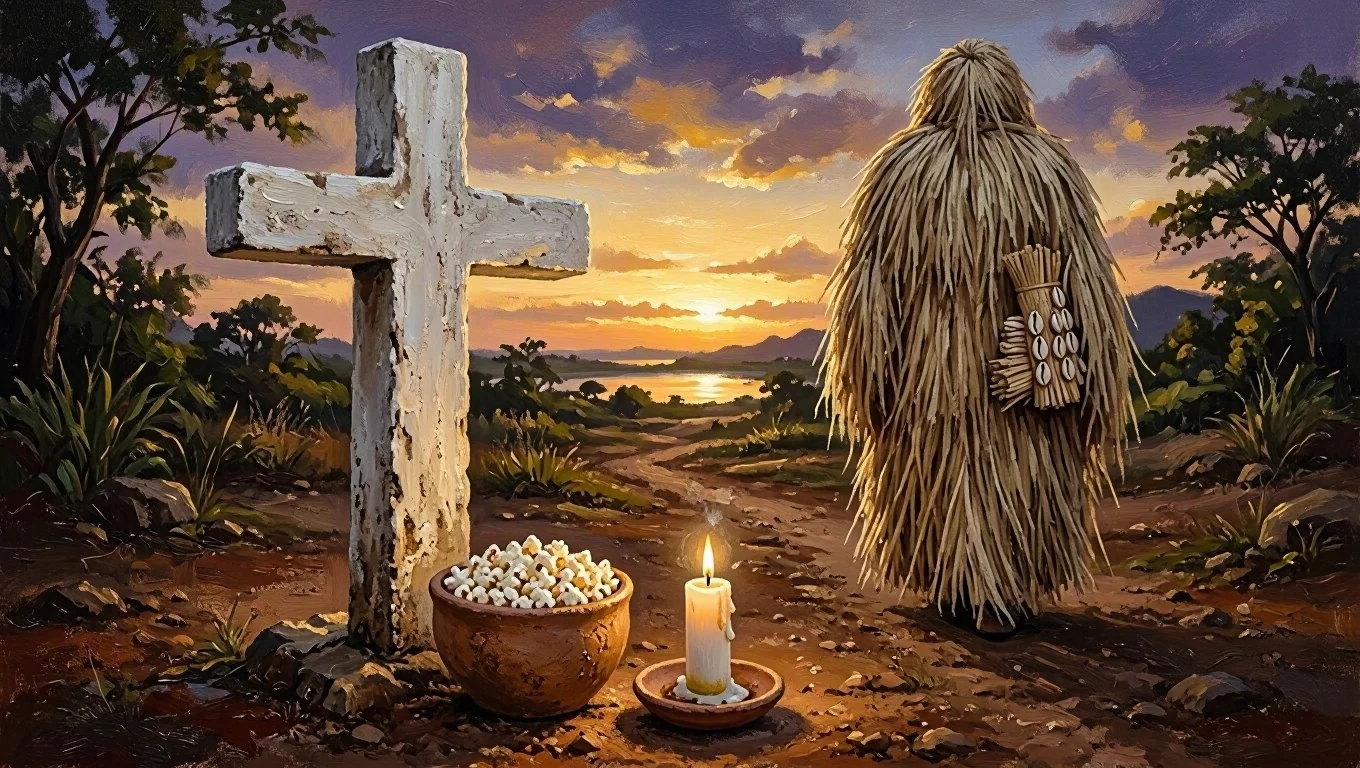
The Estado de Minas column takes the popcorn in a straw basket to the forest, at the foot of a tree. In a house of Bocaiuva, the food of Obaluaiê (Babalu Aye) is spread in the cemetery, along with that of the pretos-velhos.
At home, the alguidar stays in the place the terreiro indicates. The place and the day depend on the house, and whoever is initiated follows its precept. TUCTVC reminds that cemeteries are treated "with respect and never with reckless curiosity".
Offering for health, without a promise
In Prandi's table, Omolu is the orixá of "healing of physical diseases." Hence the search for an offering for health. The Tenda de Umbanda Caboclo Tupinambá e Vó Catarina (TUCTVC) states the limit in all its letters:
His strength does not replace medical treatments or healthcare.
The babalorixá André Gomes, heard by Alma Preta, explains the request in another way: "we do not ask for health. We ask for him to see if we are worthy and for him to remove the disease from among us".
The offering also gives thanks. In Pará, the Olubajé of Ilè Àsé Iyá Ogunté is done to thank for the return of the priestess's health. The popcorn bath, the main ritual of Abaluaiê in the Sanctuary, is done at home, with whoever conducts it.
What to avoid and what to do after
- Salt: the popcorn goes without salt.
- Fat, when the house follows the tradition of the sand.
- Pineapple and pork: in two Bocaiuva houses, pineapple is quizila of Obaluaiê in both and pork in one of them; there, the quizila of the orixá applies to his mediums. See quizilas in Candomblé and the precautions of filhos de Omolu.
- Animal: the Sanctuary does not accept "offering with dead animals, nor sacrifice of animals".
What is taken must decompose. The Sanctuary asks for clay, like the alguidar, and "flowers without plastic wrappings". There, plastic and glass are removed and "The alguidares are broken and delivered to the soil".
Outside the Sanctuary, the rule of Pai Nilton D’Ogum (Ogun) applies, heard by the Tribuna de Minas. The alguidar can turn into a castor bean leaf. And whoever takes what does not decompose must "go there and then remove it". The castor bean, moreover, is the leaf of Obaluaê in the UFJF study.
Whoever cannot light a candle can set the virtual candle of Obaluaê. The test which offering to make helps choose among the orixás. To check the alguidar, the candle, or the material your house requested, Joia Mística Laroyê can be reached via WhatsApp.
Frequently asked questions
Can you make an offering for Omolu at home?
You can, when the terreiro instructs. The National Sanctuary of Umbanda sets the popcorn in a clay alguidar, with white and black candles, and the NUSS adds white flower and water. At home, your house determines the place, the day, and the disposal.
Which fruits does Omolu accept?
We did not find a list of Omolu's fruits with a source. The babalorixá Mário Cesar Barcellos gives plantain as his fruit. FUCESP puts fried plantain on the Candomblé plate. In two Bocaiuva houses, in Minas, pineapple is quizila. Ask your house first.
Does an offering for Omolu take salt?
No. FUCESP records the popcorn without salt in Umbanda. Gildeci Leite writes that, in Salvador, the doburu must still be served without salt today. In the sand tradition, the popcorn also goes without fat. The coconut goes on top, in slices or strips.
Can an offering for Omolu be in the cemetery?
It can, and it is the most cited place. FUCESP gives the cemetery cross as a preference. Barbara Thompson found popcorn alguidares at the cross of a cemetery in Vitória. Go with respect, take material that decomposes and follow your house.
References
- Prandi, Horizontes Antropológicos (UFRGS, 1995): Deuses africanos no Brasil contemporâneo
- Leite, Fragmentos de Cultura (PUC Goiás, 2019): Omolu, Obaluaê, Saint Lazarus, Saint Roch, faith, the medicine of the poor
- Guimarães, TCC (UFJF, 2017): Obaluaê, the doctor among the orixás
- Abrantes, dissertation (UFRJ, 1996): Atotô Obaluayê Ajuberu
- Gonçalves, dissertation (UFMG and Unimontes, 2017): the food in the terreiros of Bocaiuva
- Thompson, IV Seminário PGCS UFES (2019): umbanda rituals at Santo Antônio cemetery
- Souza, Photocronographies (UFRGS, 2021): Olubajé in Ilê Axé Akaraizô
- Döler and others, Revista Internacional de Folkcomunicação (UEPG, 2020): Olubajé in Ilè Asè Iyà Ogunté
- FUCESP: Obaluaê
- Núcleo Umbandista São Sebastião: Omulú
- Santuário Nacional da Umbanda: Abaluaiê, Environmental Commitment and Frequently Asked Questions
- TUCTVC: Obaluaê and Omulu
- Inzo Tumbansi: Bankisi worshipped
- Alma Preta (2022): what Omolu, the orixá of healing, teaches us
- Estado de Minas (2026): Omolú, orixá of my devotion, by Arthur Guedes
- Tribuna de Minas (2023): the disposal of offerings