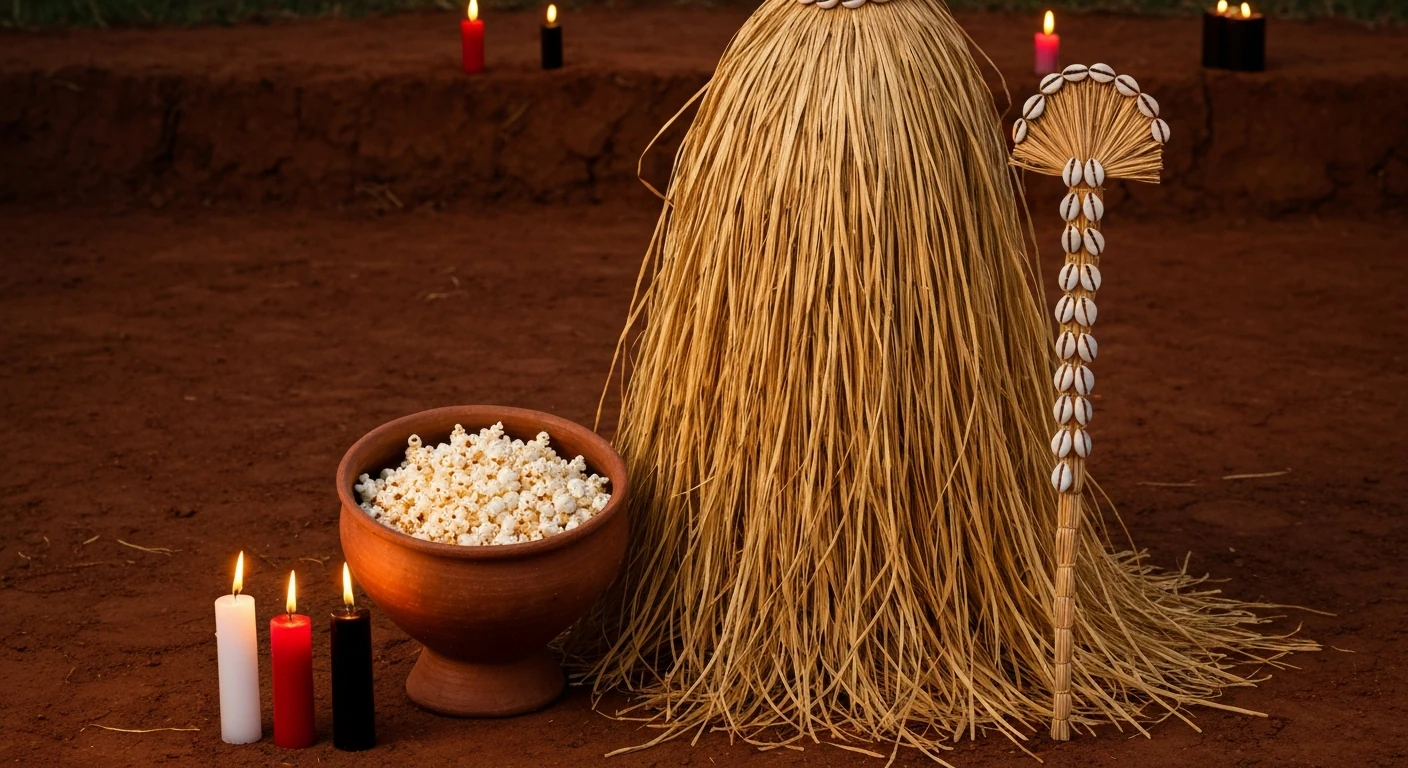
The Olubajé is Omolu's healing banquet, celebrated in August in most terreiros de candomblé, often near August 16. In it, the orixá (orisha) of the earth and health shares with the community the food that wards off disease, in a large collective ebó.
The symbol dish is the doburu, the popcorn of Omolu, served on the mamona leaf and eaten with the hands. Each house marks its date, and it is not always in August.
What is Olubajé
The Olubajé is the ritual banquet of healing and sharing dedicated to Omolu (also called Obaluaê), held once a year in most terreiros de candomblé. The babalorixá and historian Amaro Silva, heard by Alma Preta, explains the word: "Olú", the one who; "Ba", accepts; "Je", eats. The same report calls it "the great banquet of the king". The itã he tells explains the feast: after being left out of a feast of Xangô (Shango), Omolu agreed to give "once a year a feast in which all orixás would be revered and served, with the exception of Xangô". Wikipedia, in the Olubajé entry, records the same: all orixás participate, "with the exception of Xangô".
It works in two layers at the same time. It is a public feast, with chants, dance, and abundance, and it is a large collective ebó, an offering of health that asks for the warding off of disease and death for all those present. As the orixá Obaluaê (Omulu), lord of healing teaches, disease and healing walk through the hands of the same orixá, and Olubajé is the moment of the year when this healing is shared as food.
What it is: ritual healing banquet | When: August in most houses, with Olubajé registration in January | Orixá: Omolu (Obaluaê) | Symbolic food: doburu (popcorn) | Dish: castor bean leaf | Greeting: Atotô! | Tradition: Candomblé, Ketu nation as a reference
In the rite, Omolu manifests, and orixás such as Oxumarê, the rainbow brother, and Nanã, the mother of Omolu, can make the court. The central offering, however, is his: the king who knows disease from the inside and therefore distributes health.
When Olubajé happens
August is the month of Omolu in many terreiros, and Olubajé is his great festival. The most symbolic date revolves around August 16, the day when popular Catholicism celebrates Saint Roch, the protector saint against plagues associated with Obaluaê in syncretism. The report from CNN Brasil about Obaluaê's day records this connection between the orixá of healing and the date of Saint Roch.
In practice, there is no single fixed date. Each house marks its Olubajé, according to the terreiro's liturgical calendar and the guidance of the pai or mãe de santo. In most cases it is August, but not in all: Lucas Barreto de Souza photographed an Olubajé of Obaluayê on January 15, 2017, at Ilê Axé Akaraizô, in Salvador (Photocronographies, UFRGS). And in Pará, the Olubajé of Ilè Àsé Iyá Ogunté, in Ananindeua, "happens with the main interest of thanking for the restoration of the temple's priestess's health" (International Journal of Folkcommunication). Anyone who wants to participate in an Olubajé follows the house's announcement, not a national date. To understand how each orixá has its own time in the year, it is worth knowing the calendar of the orixás' festivals.
Note the distinction: the Obaluaê profile deals with the orixá himself, his two faces, and the syncretism of August 16. Here, the protagonist is the ritual, the feast in which this orixá shares the table.
Deburu: the popcorn that is the flower of Omolu
The food that best translates Olubajé is deburu (also written as doburu), the popped popcorn without salt, traditionally on hot sand or in dendê oil. In Salvador, according to Gildeci Leite, it is called “the flower of the Old Man”.
The name holds an itã. In one of those Reginaldo Prandi gathered in Mythology of the orixás, summarized by Samuel Novaes Guimarães (UFJF), Iansã (Oya) blows on Obaluaê's straw clothing and his wounds "so they would be transformed into popcorn." The popcorn is the living proof of this story: from the wound a flower can be born, from the disease a cure can be born. Therefore, deburu is, at the same time, an offering and a symbol of everything that Olubajé celebrates.
Omolu's popcorn is also used in spiritual cleansing, in the popcorn ritual bath. It is not about "throwing disease" on anyone: it is descarrego, the gesture of removing the weight and returning lightness. Ritual baths and foundation rituals, however, belong to the house and the orixá: whoever feels the call seeks the guidance of a pai or mãe-de-santo.
What is eaten at Olubajé (and why with hands)
In the banquet, Omolu's votive foods are arranged on castor bean leaves, which serve as natural plates. Wikipedia, in the entry on Olubajé, records the tradition of at least nine Afro-Brazilian culinary delicacies served this way, symbolizing the cycle of life and death that the orixá governs.
These are simple and popular dishes, typical of Omolu's table, such as:
- Deburu, the popcorn without salt, the star of the banquet
- Black beans and other cooked grains
- Aberém, acaçá and corn doughs
- Roots and cooked vegetables, in humble abundance
The guests eat a little of each food, with their own hands, chanting and dancing in praise of the orixá. In many houses, the older initiates serve the community. Eating with hands and from the same table is not a lack of etiquette: it is the heart of the rite. There is no cutlery to separate, no individual plate, no one pays for the food. Everyone shares the same abundance, like a great gesture of offering to the orixás that returns in the form of a blessing for those who eat.
The food that heals: the sharing of axé
Here is the deepest meaning of Olubajé, and the point that asks for respect when writing about Omolu. This is not a morbid rite nor a "party of disease". It is exactly the opposite: it is the feast where the community eats together to ward off disease, reconcile conflicts, and celebrate the life that continues.
It is food that circulates without price, that is given to create bonds and distribute axé. Whoever eats from Omolu's banquet leaves there connected to the community and to the orixá, carrying a bit of the health that was shared at the table.
It is also for this reason that Omolu, an orixá so often stigmatized by his connection to disease, is in fact the lord of healing. Olubajé is the annual proof of this: the abundant table of the orixá who knows pain and, precisely because he knows it, knows the path back from it.
Olubajé in Candomblé and Obaluaê in Umbanda
O Olubajé as a banquet is a ceremony of Candomblé, with Yoruba-Nagô roots and the ketu nation as the main reference. It is in the Candomblé terreiro, within its liturgical calendar, that the rite happens with all its structure of chants, foods, and fundamento. To understand the context of this religion and its festivals, see what is Candomblé.
In Umbanda, Obaluaê is also highly worshipped, but the old codifications do not give him his own line: the seven lines of Leal de Souza, in 1933, do not include Omulu, and the Núcleo Umbandista São Sebastião puts "Omulú and Ibeji in the Line of Oxalá (Obatala)" (NUSS). The dates that the FUCESP gives for Umbanda are November 2, December 17, and August 16. Who descends in the gira, the color and the candle are in Omolu in Umbanda. But the Olubajé, the ritual banquet served on the castor bean leaf, is a practice of Candomblé. An Umbanda reader honors Obaluaê in other ways, with candles, herbs such as wormwood, Omulu's herb, and pontos cantados (sung sacred songs), without reproducing at home the foundation banquet of the Candomblé terreiro.
Differentiating the two traditions is respect: they share orixás, but have their own liturgies, and each one honors Omolu in its own way.
Frequently asked questions about Olubajé
What is Olubajé?
Olubajé is the great ritual healing banquet dedicated to Omolu (Obaluaê), celebrated once a year in Candomblé terreiros. It is at the same time a public festival of sharing and a collective ebó, in which the community eats from the same table to ward off disease and share the axé of the orixá of the earth and of health.
What does Olubajé mean?
According to the babalorixá Amaro Silva, heard by Alma Preta, "Olú" is the one who, "Ba" is accepted and "Je" is to eat. The report calls it "the king's great banquet": Omolu's table, opened so that the entire community can eat together.
When does Olubajé happen?
In most terreiros, in August, often near August 16, the day of Saint Roch in syncretism. There is no fixed national date: each terreiro marks its own, and there is a record of Olubajé on January 15, in Salvador.
What is eaten at Olubajé?
Votive foods of simple preparation are served over castor bean leaves, with emphasis on the doburu, the unsalted popcorn called in Salvador "the flower of the Old Man." Beans, corn doughs such as aberém and acaçá, roots, and vegetables also appear. The guests eat a little of each dish with their own hands, singing and dancing.
Why is popcorn the food of Omolu?
Because, in the itan of the orixá, the wounds that covered Omolu's body turned into white flowers, the popcorn. The doburu, unsalted popped corn, is the symbol that from the wound a flower is born and from disease healing can be born. It is the central offering of the Olubajé.
Where to honor Omolu in August
At Joia Mística Laroyê, you find the items to light a light to Omolu in the month of Olubajé, always with respect to the fundamento:
- Black, white, and red candles: the ritual colors of Obaluaê for Monday
- Corn for doburu: for the popcorn offering and for the cleansing ritual bath
- Bead necklaces and strings of beads in the colors of Omolu
- Wormwood and herbs of Omulu: fresh or dry, for protection ritual baths
- Statues with the traditional straw: respectful representations, always with the face covered
Visit our shop in Extrema, Minas Gerais or talk to us via WhatsApp and we ship all over Brazil. In August, the month of Omolu, light a white candle for the health of those you love.
Atotô, Omolu!
References
- Alma Preta: What does Olubajé represent for those of Candomblé?
- Lucas Barreto de Souza, Fotocronografias (UFRGS), 2021: Atotô Obaluayê! Olubajé at Ilê Axé Akaraizô
- Döler and others, International Journal of Folkcommunication (UEPG), 2020: Olubajé, a thanksgiving ritual
- Gildeci de Oliveira Leite, Fragmentos de Cultura (PUC Goiás), 2019: Omolu, Obaluaê, Saint Lazarus, Saint Roque
- Samuel Novaes Guimarães, TCC, UFJF, 2017: Obaluaê, the doctor among the orixás
- Leal de Souza, 1933: Spiritism, magic and the seven lines of Umbanda
- NUSS: Lines of Umbanda
- FUCESP: Obaluaê page
- CNN Brasil: Day of Obaluaê, learn the history of the orixá of healing and diseases
- Wikipedia: entry about Olubajé