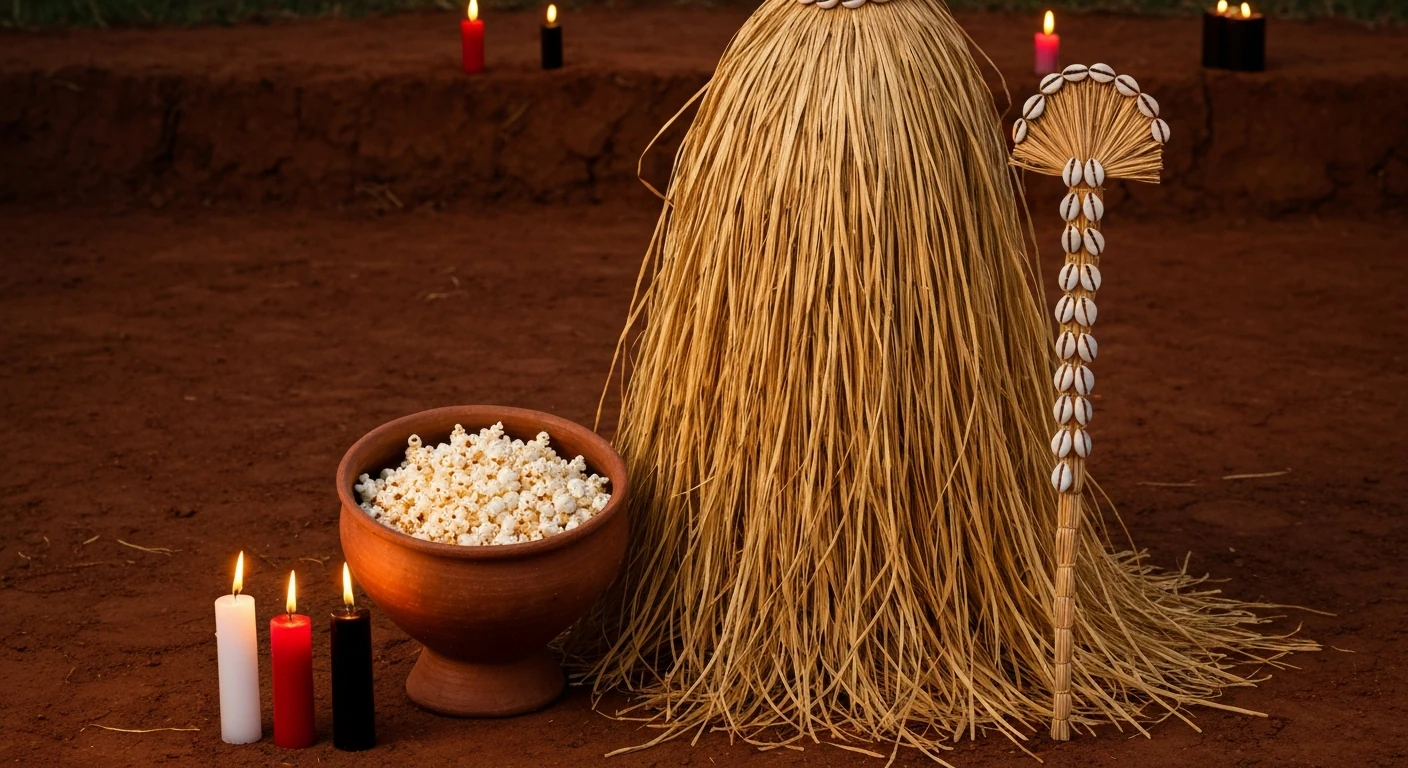
The month of Obaluaê is August, the time when many terreiros turn toward the orixá of healing and the earth. While common sense treats August as a month of bad luck, the povo de santo sees the opposite. It is a period of health, care, and renewal, ruled by one of the most revered lords of the pantheon. The greeting that opens the month is only one, spoken in a low voice and with respect: “Atotô!”.
The Alma Preta records that Olubajé is celebrated in August “in the majority of terreiros de candomblé in Brazil”. In Salvador, Gildeci Leite says, “the month of August is populated by filhas and filhos de santo on foot, in the streets, with balaios full of popcorn” (Fragmentos de Cultura).
Why August is the month of Obaluaê
August is dedicated to Obaluaê, also called Omolu, because August 16 falls on it, the day of Saint Roch, one of the saints associated with him. In the angola, Veridiana Silva Machado (USP) records August as “Period in which the Nkisi Kavungo and the orixá Obaluayê are worshipped”. He is the lord of the earth, of health, and of diseases, the one who knows illness from the inside and therefore guards the path of healing. In a month of heavy fame, having the orixá of health at the forefront is an invitation to care, not to fear.
Orixá: Obaluaê (Omolu) | Month: August | Strong day: August 16 | Day of the week: Monday | Colors: black and white in umbanda, with red in candomblé | Food: doburu (popcorn) | Greeting: Atotô! | Syncretism: Saint Roch
August is not a rule everywhere. The FUCESP also gives November 2 and December 17; Lucas Barreto de Souza photographed an Olubajé on January 15, 2017, in Salvador (Photocronographies); and the tambor de mina house studied by Reginaldo Prandi celebrates Xapanã on January 20 (In the footsteps of the voduns). The dates and the color of the orixá in umbanda are in Omolu in umbanda.
An important reminder. August is also remembered as the month of Exu (Eshu) in umbanda, the guardian of the paths. If you want to understand this other side of the period, with the baths and the protection, see the guide about the month of August in umbanda. Here, the focus is only on Obaluaê, the owner of healing.
August 16: the strongest day of Obaluaê
The heart of the month is August 16. It is when the Church celebrates Saint Roch, the saint who healed the sick and protected against the plague, and it is with him that Obaluaê is found in popular syncretism. The two care for the same pain: the illness of the body and the search for health.
This meeting is not by chance. Saint Roch is the saint of the sick, and Obaluaê is the orixá of wounds and healing. The memory of the saint became, in Brazil, also the festival of the orixá. To understand this bridge calmly, and the difference between Saint Roch and Saint Lazarus, read the guide about Saint Lazarus and Obaluaê.
Atotô is the greeting that asks for silence before the king of the earth. On the 16th, this silence is even deeper: it is the time to thank for the health one has and to ask for the one that is missing.
It is not necessary to be from candomblé to respect the date. Many people light a candle, say a prayer, and take care of their own health on this day, in the simple gesture of those who honor the orixá of healing.
The Olubajé, the great banquet of August
In the Candomblé terreiros, the month of Obaluaê reaches its peak in Olubajé, the healing banquet of the orixá. It is a festival that happens once a year, in most houses in August. In it, the community eats the same food to ward off disease and share the axé.
Olubajé is at once a public festival and a large collective ebó, an offering of health for all those present. The symbolic food is the doburu, the popcorn of Omolu, served in abundance. Understand the rite in its entirety in the guide about Olubajé, the healing banquet of Omolu.
Even those who do not attend a terreiro can experience the spirit of the month. The central idea is sharing and care: eating with gratitude, thinking about the health of those you love, and sharing what you have. This is the axé that Obaluaê teaches in August.
How to honor Obaluaê in the month of August
You do not need a large ritual to honor the orixá of healing. Throughout the month, some simple gestures made with faith bring you closer to Obaluaê. Remember that everything here is devotion, never a bargain for results.
- Offer the popcorn (doburu): the most traditional food of the orixá, made without salt and without sugar. See the meaning in popcorn of Obaluaê and the entire dish, including where to deliver it, in offering for Omolu.
- Use wormwood: the losna, herb of Omulu, is used in baths and fumigations for cleansing linked to the orixá.
- Light a candle: white, or white and black as taught by Umbanda houses, on Monday, the day of Obaluaê in the week.
- Care for the earth and your health: step on the earth, take care of a plant, do an exam that has been pending for a long time. It is the tribute that most pleases the lord of health.
Strengthen your devotion with a simple prayer, in your own words, asking for health for yourself and those you love. To know the orixá in depth, with his itans and his two faces, read the guide about who is Obaluaê (Omulu). And always remember: spiritual healing walks alongside medicine, never in its place.
Frequently asked questions
What is the month of Obaluaê?
In many houses, the month of Obaluaê is August. The strongest day is August 16, in syncretism with Saint Roch, and it is also the period of the Olubajé, the great healing banquet of Omolu in Candomblé.
Why is August 16 the day of Obaluaê?
Because it is the day of Saint Roch, the Catholic saint who healed the sick and protected against the plague. In Afro-Brazilian syncretism, Saint Roch meets with Obaluaê, the orixá of diseases and healing. The two care for the same pain, and for this reason, the date became marked for the orixá.
What is the difference between the month of Obaluaê and the month of Exu?
August is associated with both. In Umbanda, Exu is the guardian of the paths that opens the month, and Obaluaê is the orixá of healing that rules the period. Here the focus is Obaluaê; for the side of Exu, of protection and baths, see the guide about the month of August in Umbanda.
What to do in the month of Obaluaê?
Offer popcorn (doburu), light a candle on Monday, use wormwood (losna) in cleansing baths, and take care of the body's health. Above all, say a prayer of gratitude and ask for health. Everything is devotion to the orixá, done with respect and without promise of results.
Is August really a bad month?
No. The reputation of being a month of bad luck is an old popular superstition, with no connection to Afro-Brazilian religions. In tradition, August is the month of Obaluaê, the orixá of health, and therefore a time of care and renewal. What changes the month is the care for one's own life.
Where to buy items to honor Obaluaê
At Joia Mística Laroyê, you find everything to live the month of Obaluaê with devotion and axé:
- Popcorn corn and clay pots: for the doburu, the food of the orixá
- Wormwood (losna) and cleansing herbs: for the baths and fumigations of Omulu
- White, black, and red candles: in the colors of Obaluaê, to set on Monday
- Statues of Obaluaê and Saint Roque: for your devotion altar
- Bead necklaces and protection items: to cross August with faith
Visit our physical store in Extrema-MG and we ship to all of Brazil. Talk to us via WhatsApp and Joice will guide you on the right devotion for the month.
Atotô, Obaluaê!
References
- Alma Preta: What does Olubajé represent for those of Candomblé?
- Gildeci de Oliveira Leite, Fragmentos de Cultura (PUC Goiás), 2019: Omolu, Obaluaê, Saint Lazarus, Saint Roque
- Veridiana Silva Machado, dissertation, USP, 2015: The staff of Lemba
- Lucas Barreto de Souza, Fotocronografias (UFRGS), 2021: Olubajé in Ilê Axé Akaraizô
- Reginaldo Prandi, 2005: In the footsteps of the voduns
- FUCESP: Obaluaê page
- Wikipedia: Obaluaiê, the orixá of healing in Candomblé
- Wikipedia: Saint Roch, the Catholic saint of the sick