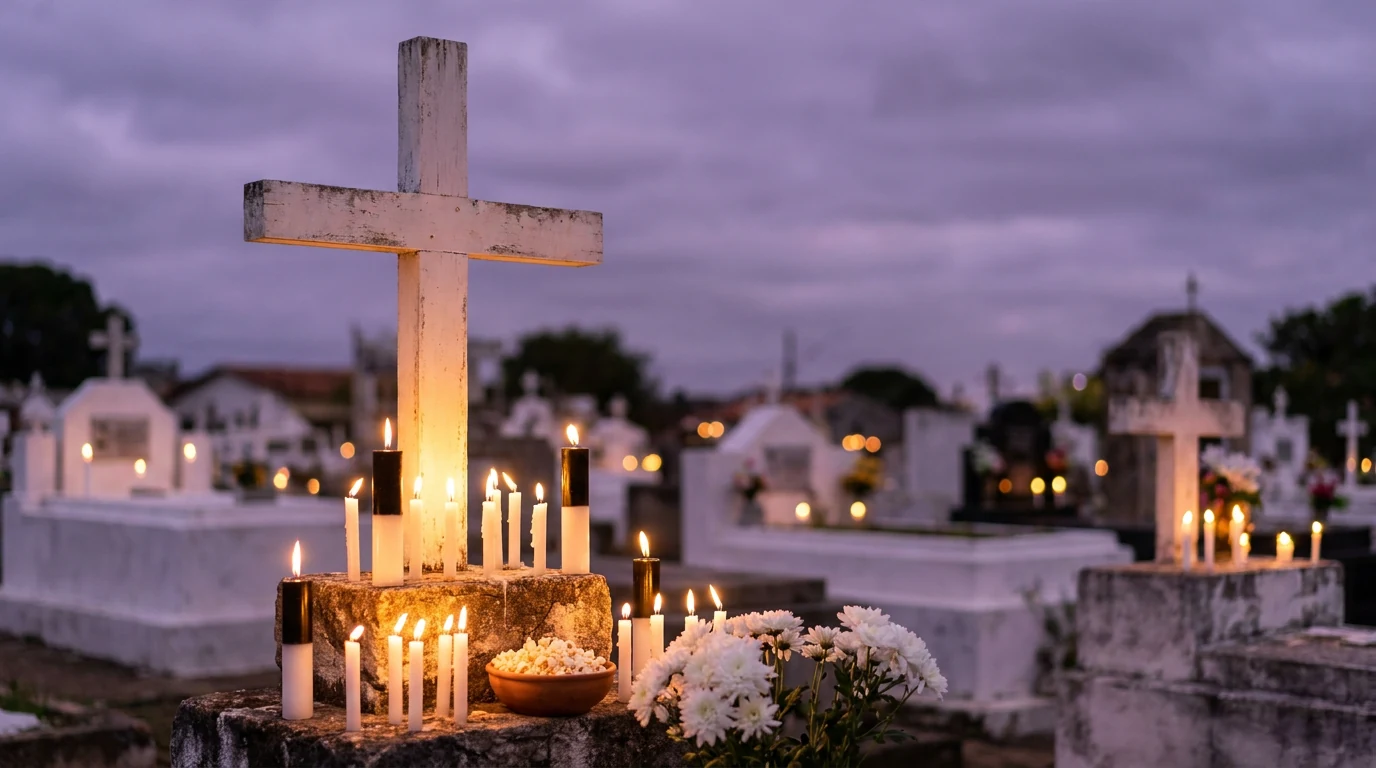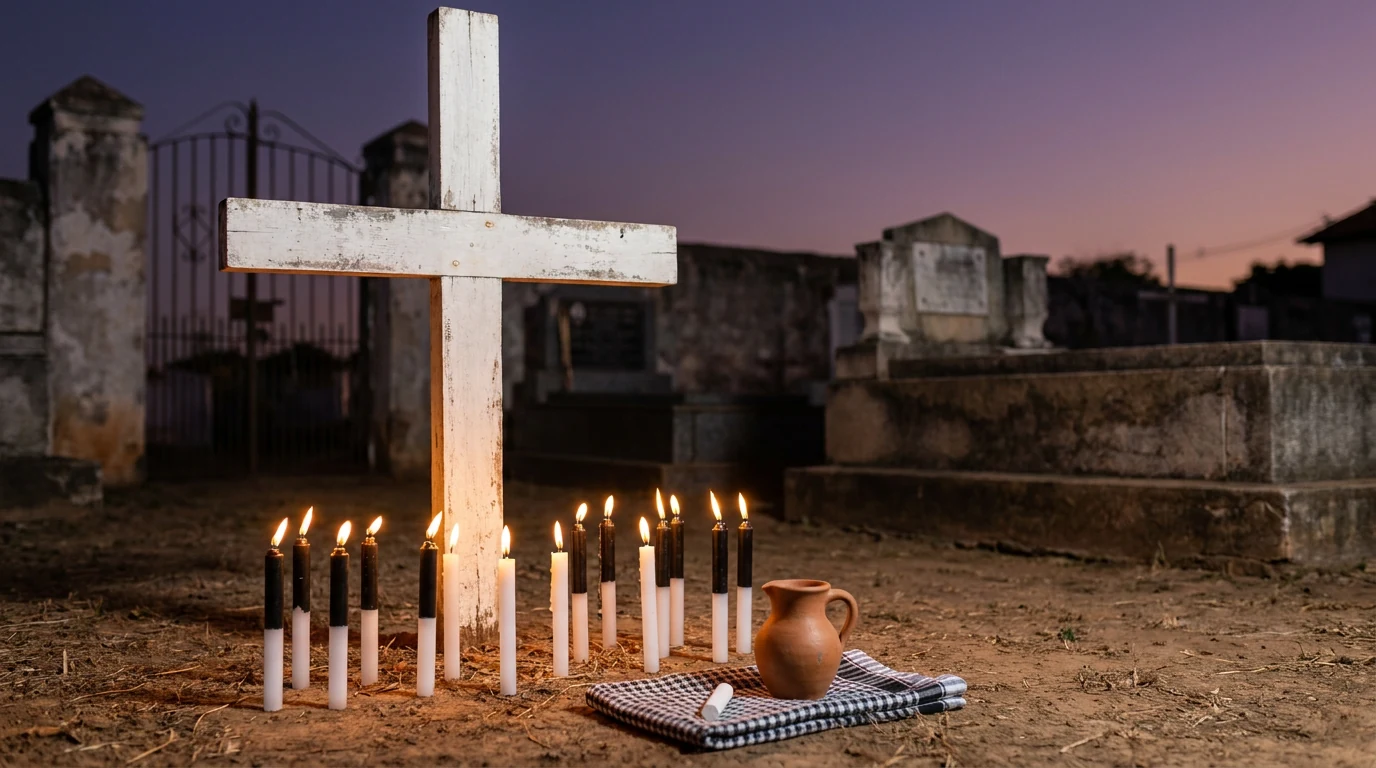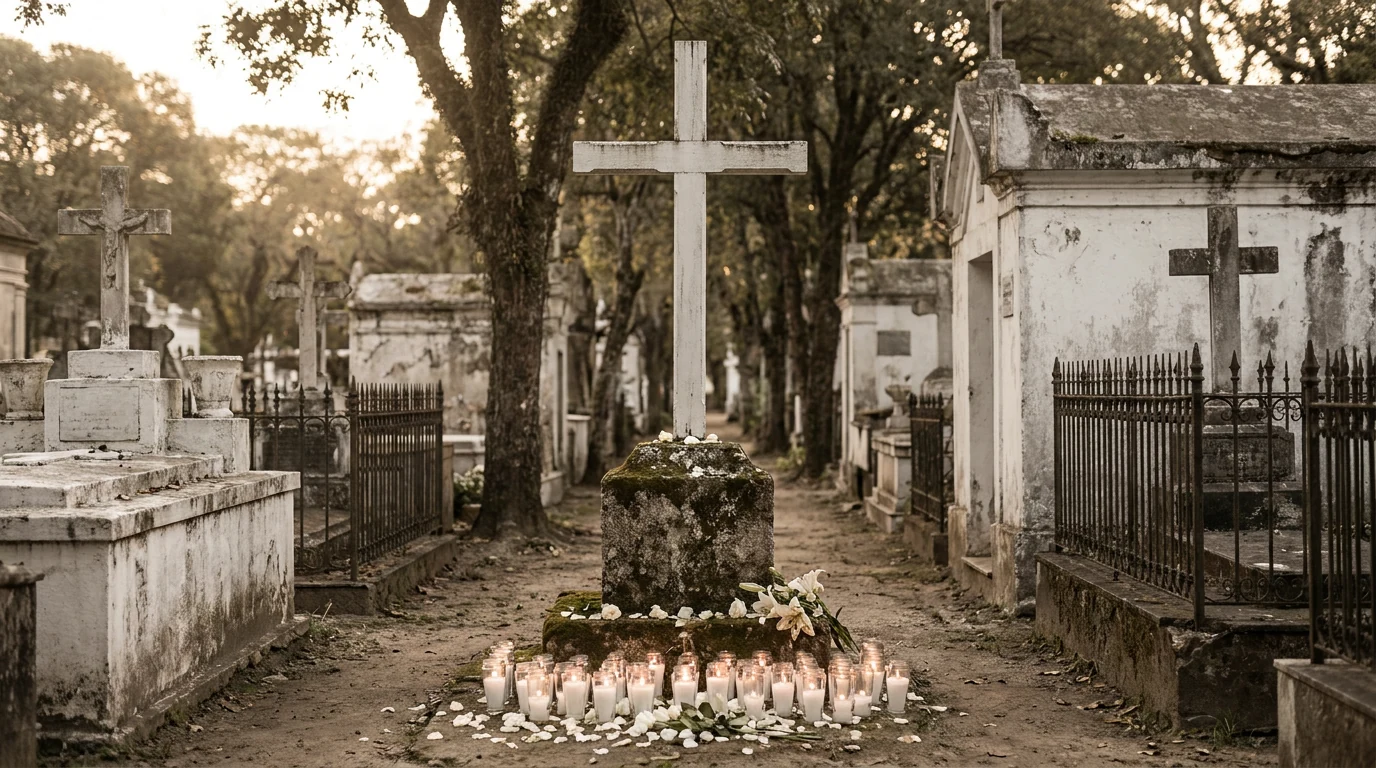
The Cross of Souls (Cruzeiro das Almas) is the large cross in the middle of the cemetery. At its feet, a candle is lit for all souls at once. In Umbanda and Quimbanda, it is also a point of passage. And there are terreiros that keep their own cross, next to the tronqueira.
They are two places with the same name. One was born from the history of Brazilian cemeteries, the other is the fundamento of each house. Both become clearer when one knows who works in each one.
What is the Cross of Souls
It is the central cross of the cemetery, also called the master cross. At its feet, people light candles for the dead in general, not for a single grave. The researcher Barbara Thompson, from UFBA, describes the place as "a large white cross." At its feet, "people light candles for all souls."
Two dates of Catholic origin lead Brazilians to the cemetery, the same researcher records. One is Monday, the day of the souls. The other is November 2nd. What this date represents for those from a terreiro is in the guide of the day of the dead in Umbanda.
Where it is located: in the center of the cemetery; in the terreiro, where the leader set it up | Day: Monday | Who works: pretos-velhos, Obaluaê and Omulu, exus and pombagiras of the souls, depending on the house | Most recorded candle: white; in Vitória, white and black for pretos-velhos
The entire cemetery is the calunga pequena, and the cross is one of its points, along with the gate and the tombstones. The difference between the realm of the sea and that of the cemetery is in calunga grande and calunga pequena.
Where does the cemetery cross come from
The cross came before Umbanda. Historian Maria da Conceição Vilela Franco studied the public cemetery of Campos dos Goytacazes (RJ). The doctoral thesis was published by UNIRIO in 2019. It shows that Catholic and public cemeteries of the 19th century generally had a central cross. The cross indicated that the land was campo santo, that is, blessed.
In Brazil, the author writes, these "central or master" crosses of 19th-century cemeteries "are known as cruzeiros." Some have the date of the cemetery's creation engraved on them.
The case of Campos has its own weight. There, the cruzeiro was erected over the stone column of the old pelourinho. The column was removed from the street to become the pedestal for the cross. The thesis adopts 1875 for the change, based on historian Júlio Feydit. An almanac from 1881 gives 1856. The author also notes that the central cemetery cross is a local "of devotion to the souls and of worship of Afro-Brazilian religions."
Where is the Cross of Souls (Cruzeiro das Almas) near you? In practice, in the oldest traditional cemetery in your city. Cemeteries opened in the 19th century usually have the central cross, because it was the landmark of the campo santo. In a new cemetery, the administration can say if there is a cruzeiro and where.
The Cross of Souls (Cruzeiro das Almas) in the cemetery, according to those who researched
The most detailed description we found comes from the Saint Anthony cemetery, in Vitória (ES), where Thompson conducted fieldwork in 2015 and 2016. Everything that follows is what that research saw in this cemetery, not a rule for Brazil.
The Umbandistas there use three points: the cruzeiro, the tombstones, and the gates. All three are treated as places of passage, where the dead dialogue with the world of the living. For those interviewed, the cross is the crossing of forces, the meeting of the high with the low and of the left with the right.
Saint Anthony has two crosses. The one in the white line stays in the lower part, the noble and more visible area. The other, known as the "cross of Exu or black line," stays in the upper part, set apart. The author herself warns that only some cemeteries have more than one cross.
Two interviewees tell what they do right after the gate: they go to the cross "to greet all the souls." The recorded gesture is clapping three times, the right hand over the left. The cross allows for the worship of souls buried in other cemeteries, and for this reason, according to the author, it attracts more visitors.
The cemetery is also the place where other families mourn their loved ones. Those who go to the cross arrive in silence, respect the burial that is taking place, and take away what does not decompose.
Ritual work in the cemetery is done with a leader, within the foundation of the house. This article explains the place and does not teach any offering. For the simple candle, the one of devotion, the step by step and the precautions are in lighting a candle for the souls.
Pretos-velhos and the Cross of the Holy Field
In Vitória, the white cross is the only place in the cemetery where offerings are left for pretos-velhos, according to the interviewees. The candle recorded for them is white and black. Nearby, the research found an alguidar with popcorn for Obaluaê and Omulu, who act there "at the gate and at the Cross of Souls." The FUCESP says the same of the offering to Obaluaê in Umbanda: "They are delivered, preferably, at the cemetery cross." What goes into it is in offering for Omolu.
The link also appears in the sung chants (ponto cantado). The historian Lourival Andrade Júnior presented a work at ANPUH in 2013. In it, he cites the chant of Pai André do Cruzeiro, printed in a collection by Editora Eco in 1974:
“At the Cross of the Holy Field, / An old man worked / Crying with contrition / Remembering the captivity.”
The holy field of the chant is the cemetery, the same name that the UNIRIO thesis uses for the blessed land. The preto-velho works at the foot of the cross, and the memory of captivity comes along. Who are these workers, and why in some houses the line also includes the left, is in the line of souls in Umbanda.
The people of calunga: exus and pombagiras of the cross
The cross is not only of the right. In Vitória, the exus receive offering at the gates, on the tombstones, and at the crosses, according to the same research. What is done at the black cross remains outside this text: it is a matter of the house, not of the blog.
The names say where each one works. The anthropologist Vagner Gonçalves da Silva, from USP, shows that most of the names of Exu refer to the domain he rules. Among these domains are the points of passage between the living and the dead, such as cemeteries, catacombs, and skulls. The people of calunga carry this territory in their surname.
Three records show this closely:
- Maria Padilha of the black cross. On All Souls' Day in 2016, in Vitória, an Umbanda practitioner told that he goes straight to the cross. It is there that the pombagira of his mãe de santo works.
- Tranca Ruas das Almas. In the chant booklet of a terreiro in Curitiba, he is the Exu “who is at the cross”, “son of the souls also”.
- Maria Padilha das Almas and Rosa Caveira. The research by Fábio Gonçalves, from UFMG, studied an Umbanda house with Quimbanda worship in Bocaiuva (MG). There, the two are among the spirits that eat in the calunga.
In the Umbanda literature that the sociologist Reginaldo Prandi analyzed, names such as Pombagira do Cruzeiro and Pombagira das Almas also appear. Prandi describes these lists to show how Exu was demonized by syncretism, not to endorse them. Why so many Exus carry "das Almas" in their name is in Exu das Almas.
In the seven kingdoms model that circulates in part of Quimbanda, the cruzeiros form their own kingdom, separate from the crossroads and the calunga. The list changes from house to house, and the layout is in kingdoms of quimbanda. The overview of the tradition is on the quimbanda page.
Cruzeiro das almas is not a crossroads
The confusion comes from the word. Cruzeiro and encruzilhada have the same root, the cross, but they are different points.
The encruzilhada is the meeting of paths, on the street ground, and is the territory of the povo da rua. The cruzeiro is an erected cross, a landmark of the cemetery (campo santo), and its people are those of the souls. One is defined by the crossing of roads, the other by the dead and the blessing of the land.
Even inside the cemetery, in Vitória, each point had a specific recipient, as seen above. The house knows which Exu responds in each place, and the spirit's surname usually says so. The formats of encruzilhada, and what each ground changes, are in encruzilhada in quimbanda.
The cruzeiro das almas in the umbanda terreiro
There are houses that bring the cruzeiro inside their own grounds. The Santuário Nacional da Umbanda, in Santo André (SP), maintains a Cruzeiro das Almas on the road of Vale dos Orixás. It is a place of prayer for the disincarnate. The psychologist Rafael de Nuzzi Dias described another one, up close, in the master's thesis he defended at USP in Ribeirão Preto in 2011. The field was made at Terreiro Pai José do Rosário.
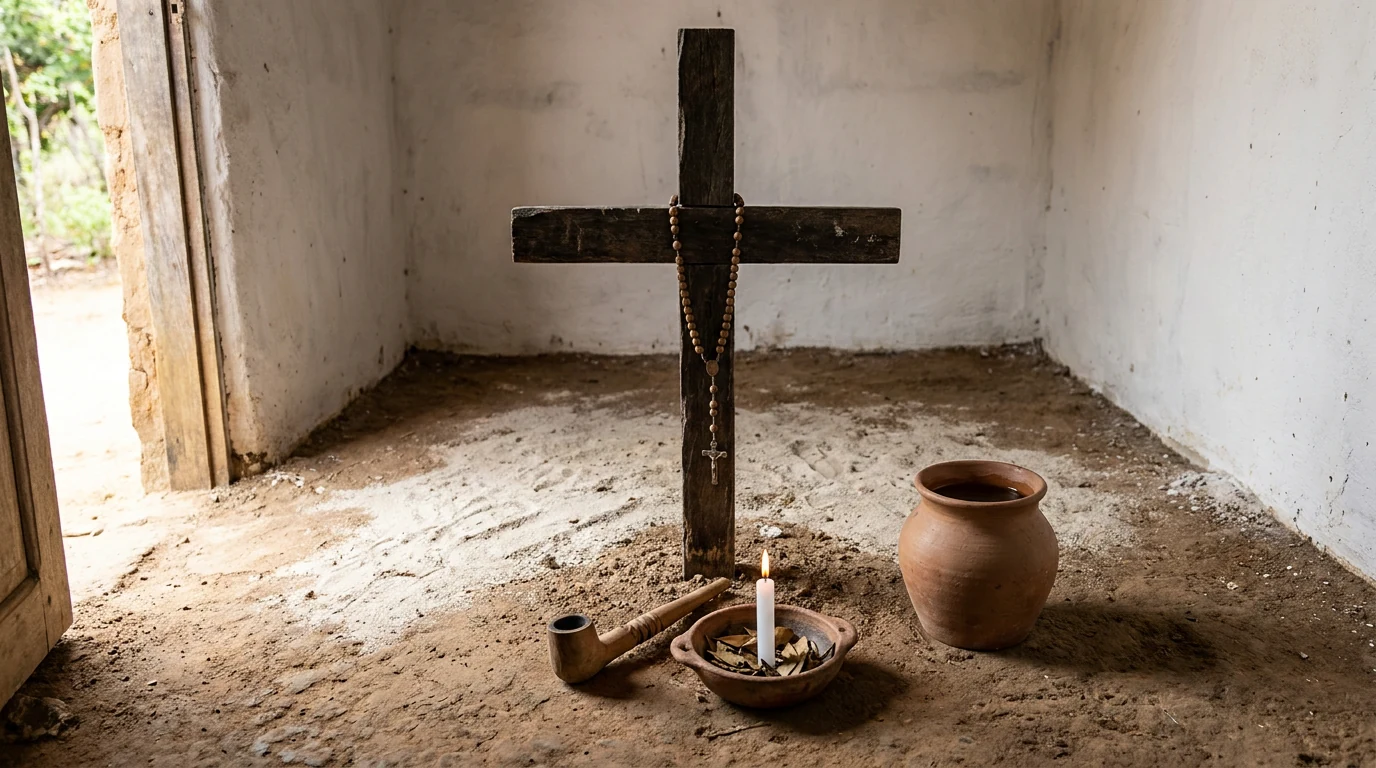
Right there, at the entrance, there are two structures side by side: the tronqueira, of the exus and pombagiras, and the house or Cross of Souls (Cruzeiro das Almas). It is the only place in the terreiro without flooring, only packed earth with beach sand. In the center, a cross made of aroeira wood made by the leader himself, driven into the ground, with a rosary hanging.
Around it, the research recorded a clay quartinha with water, a wooden pipe, and an alguidar. There is also a white candle, which the leader replaces every day. Under the ground, there is a fundamento planted in the foundation of the house, which only he knows what it is. For this leader, "the house of the souls is a devotion of the pretos-velhos line." Everything that is done for them, there, is done on Monday.
The researcher reads this worship as a relative of the worship of the souls of purgatory in popular Catholicism. With one difference: there, the dead of the family and of the house itself are also revered.
This answers those looking for a "wooden" cross for a terreiro. The cross is made and planted by the leader, along with the fundamento, and is not assembled on your own. Whoever is a medium of the house takes care of what it asks for: white candle, quartinha, rosary, pipe and tobacco leaf of the preto-velho. Whoever lights it at home, without a cross, can use the virtual black and white candle as a reference for color and intention.
Frequently asked questions
Where is the Cross of Souls (Cruzeiro das Almas) near me?
In the oldest traditional cemetery in your city. Brazilian cemeteries of the 19th century generally had a central cross that marked the land as a consecrated field, and that is the cruzeiro. In a new cemetery, ask at the administration. Some cemeteries have more than one cruzeiro, such as Saint Anthony, in Vitória.
What is the meaning of the Cross of Souls (Cruzeiro das Almas) in Umbanda?
It is a point of passage between the living and the dead, where all souls are greeted at once. In the research conducted in Vitória, Umbandistas describe the cross as a crossing of forces. They go to it before any other point in the cemetery. Pretos-velhos, Obaluaê, and Omulu appear linked to the cruzeiro in this research.
Can I light a candle at the cruzeiro das almas alone?
A devotion candle, for the souls in general, is a gesture that the Vitória research recorded among Catholics and Umbandistas at the cruzeiro. Use a firm support, do not leave trash, and respect those in mourning. An offering for a spirit is another thing: ask for guidance from the leader of your house, because each terreiro has its own fundamento.
What is the difference between cruzeiro das almas and casa das almas?
In the cemetery, the cruzeiro is the central cross. In the terreiro, the name applies to the corner of the souls, which in a house studied by USP is also called casa das almas. There, it has a dirt floor, aroeira cross, rosary, quartinha, and a white candle, and it stays near the tronqueira.
Did your house ask for a candle, quartinha, rosary, or fumo for the souls' Monday? We separate them in the shop in Extrema-MG or via WhatsApp, with shipping to all of Brazil.
References
- THOMPSON, Barbara (UFBA). Proceedings of the IV Seminar of Social Sciences PGCS-UFES, 2019. At the gates, tombstones, and cruzeiros das almas: Umbanda rituals and cultural multiplicity in the public cemetery of Saint Anthony, in Vitória-ES
- VILELA FRANCO, Maria da Conceição. Doctoral thesis, PPGH, UNIRIO, 2019. From the hallowed ground to the monumentalized necropolis: The Public Cemetery of Campos dos Goytacazes
- NUZZI DIAS, Rafael de. Master's dissertation, FFCLRP, USP, 2011. Ancestral chains: the pretos-velhos of the Rosário
- ANDRADE JÚNIOR, Lourival. Proceedings of the XXVII National History Symposium, ANPUH, 2013. I Adored the souls: Umbanda, preto-velho and slavery
- SILVA, Vagner Gonçalves da. Anthropology Journal (USP), v. 55, n. 2, 2012. Exu of Brazil: tropes of an Afro-Brazilian identity in the tropics
- PRANDI, Reginaldo. USP Journal, n. 50, 2001. Exu, from messenger to devil: Catholic syncretism and demonization of the orixá Exu
- GONÇALVES, Fábio da Silva. Master's thesis, UFMG and Unimontes, 2017. Food in the terreiros of Candomblé, Umbanda and Quimbanda in Bocaiuva/MG
- National Sanctuary of Umbanda, Santo André (SP). Cross of Souls (Cruzeiro das Almas)
- Terreiro de Umbanda Pai Maneco, Curitiba. Handout 25: Exu