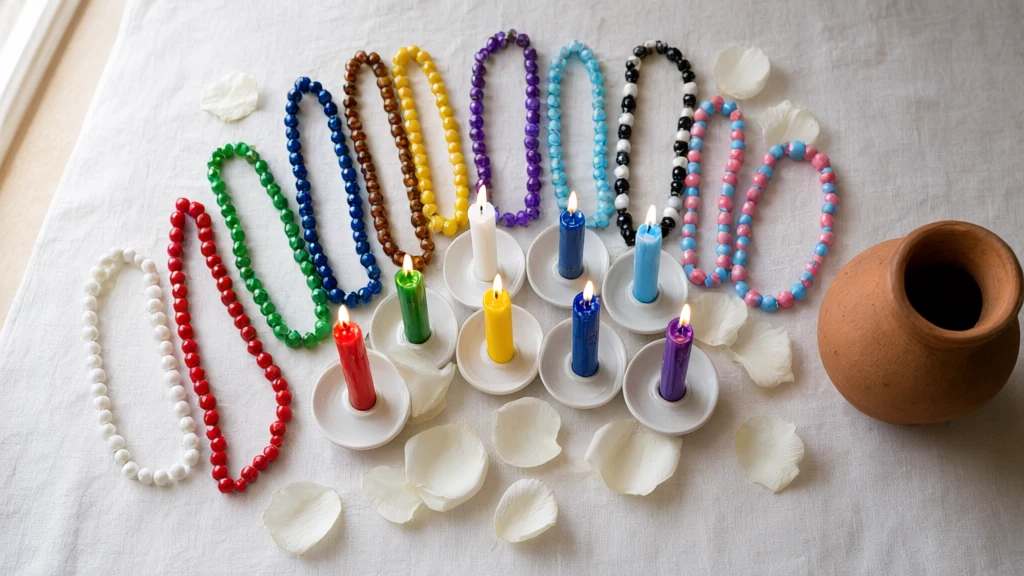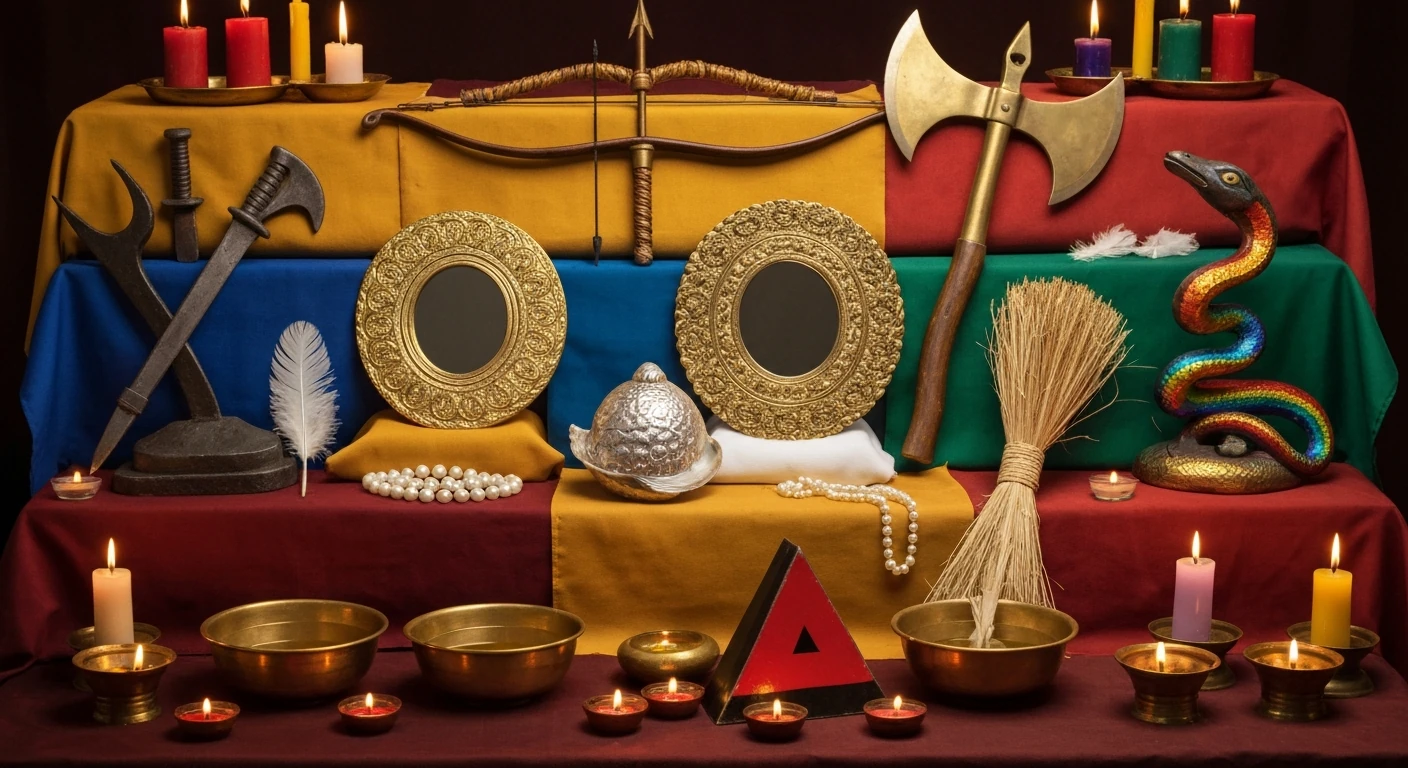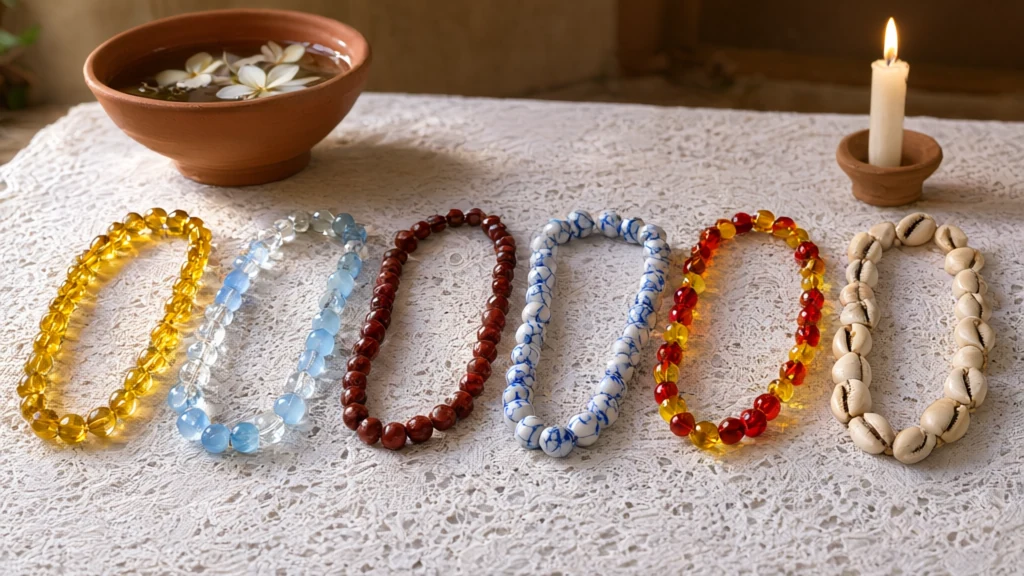
The female orixás of Candomblé, called iabás, are six: Oxum, Iemanjá, Iansã, Nanã, Obá and Ewá. Oxum rules fresh water, Iemanjá the sea, Iansã the wind and lightning, Nanã the mud, Obá the rivers and Ewá the springs.
The list comes from the table by Reginaldo Prandi for the Ketu nation Candomblé. In Umbanda, the most worshipped are four, and the count changes from house to house.
Who are the female orixás: the iabás table
Domain, element, clothing color and day are from Ketu Candomblé, according to Prandi.
| Iabá | Dominion | Element | Color | Day | Greeting |
|---|---|---|---|---|---|
| Oxum | love, gold, fertility and pregnancy | fresh water: rivers, lagoons and waterfalls | yellow or gold | Saturday | Ora yeyê ô! |
| Iemanjá | motherhood and family | sea and large rivers | light blue, white and light green | Saturday | Odoyá! |
| Iansã (Oiá) | lightning, winds and spirits of the dead | wind, lightning and thunder | brown and dark red | Wednesday | Eparrei! |
| Nanã | seniority, education and death | mud and swamp | purple, blue and white | Monday | Saluba Nanã! |
| Obá | domestic work and woman's power | rivers | red and gold | Wednesday | Obá Xirê! |
| Ewá | sources and domestic harmony | springs and streams | red and yellow | Saturday | Ri ró! |
The greetings of Oxum, Iemanjá and Iansã are from Prandi; those of Nanã, Obá and Ewá are from FUCESP, the São Paulo federation of Umbanda and Candomblé. FUCESP gives Tuesday for Nanã and "Monday or Wednesday" for Obá. To hear each one, see the greetings of the orixás.
The table is a starting point. Color, day and food belong to the house: what counts in your terreiro is what your mother or your pai de santo teaches.
What does iabá mean
Iabá is the generic name for female orixás, also written as aiabá, iyabá and yabá. For Raphael de Jesus, a researcher at PUC Minas, it is a Yoruba term that means queen. Daniela Moraes, in the article "Iyabás in the scene", translates it as mother.
Moraes recalls that the orixás appear as masculine, feminine or fluid gender. "Feminine" is the nature of the orixá, and it does not say who can be her child: according to Prandi, if a person's first orixá is masculine, the second is generally feminine, and vice-versa. The entire pantheon is in what are the orixás.
How many female orixás are there
In the Prandi table for the queto, six orixás have the F mark: Iansã, Obá, Oxum, Ewá, Iemanjá, and Nanã. Outside of this table, the list changes with the nation, the house, and the author. The count on the other side, of the aborôs, is in masculine orixás.
Oxumaré and Logunedé: masculine and feminine
In the same table, Oxumaré is "M and F (androgynous)" and Logunedé is "M and F", alternately. Therefore, there are lists that include them among the iabás and others that do not.
Odudua: the sources do not agree
In the creation myth gathered by Prandi, Odudua is the son of Olorum (Olodumare), "the youngest", and takes the creation bag. Wikipedia describes it as a feminine divinity. Historian Irinéia Franco dos Santos says that Odudua "can be feminine or masculine". There is no tie-breaker: it depends on the house.
The iabás in the xirê: why they come last
In the xirê, the circle of chants that calls the orixás, the iabás usually come from the middle to the end. Jesus describes the xirê that "goes from men to women": after Xangô (Shango) come Iansã and Obá, who make the transition, and then Oxum.
The order changes from house to house. In a ritual work from UFU about a Ketu house, the sequence is Nanã, Oxum, Obá, Ewá, Oyá, Logunedé, Ayrá and Iemanjá, before Xangô and Oxalá (Obatala). In the order of Rita Amaral, cited by Jesus, come Iansã, Obá, Oxum, Ewá, Ibeji, Nanã, Iemanjá and Oxalá. In both, Iemanjá is the last iabá chanted. How the circle works is in what is xirê.
Iyami Oxorongá: the ancestral mothers
Behind the iabás, the Yoruba tradition keeps the Iyami, the ancestral mothers. According to Irinéia Franco dos Santos, in the Sankofa magazine from USP, they are called Iyami Osorongá, "My Mother Oxorongá", and they are the ajés, and not orixás. Therefore, they are left out of the count of the iabás.
Their power is to give life and to take it away. For orixás, this power is distributed among Iemanjá, Oxum, and Iansã, and Nanã is also linked to them. The dissertation by Naiara Eugenio (UERJ) cites Carneiro and Cury: the iabás "represent the socialized aspects of Iyá mi". In Africa, secret societies were formed to worship these mothers, such as the Gueledé, in Ketu regions. It is a reserved worship, and what is done for them is not a matter of recipes.
Iabás in Umbanda
In the Umbanda that worships orixás, the most worshipped iabás are four: Iemanjá, Iansã, Oxum, and Nanã, the mothers of water, according to an article in the magazine Linguagens (FURB). Obá and Ewá appear less.
The color also changes. FUCESP dresses Oxum in dark blue in Umbanda and in golden yellow in Candomblé. Therefore, the Oxum candle can be the yellow candle in one house and blue in another. The gira of each one is in Oxum in Umbanda and Iemanjá in Umbanda.

Each iabá in a few words
Oxum is the orixá of fresh water and precious metals. She rules love, gold, fertility, and pregnancy, carries the abebê, a yellow metal fan, and eats omolocum, fradinho beans with five boiled eggs.
Iemanjá is the orixá of the great waters and the sea, linked to motherhood and family. She carries a white metal fan and a sword, and in Ketu her children do not eat crab. For the home altar, the shop has her statue in plaster; the history of this statue is in Iemanjá statue.
Iansã, or Oiá, is the orixá of lightning and mistress of the spirits of the dead. Prandi describes her as a warrior who takes the souls of the dead to the other world. Her instrument is the eru, the fly-whisk, and her food is acarajé.
Nanã is the orixá of the mud at the bottom of the waters, of seniority and of death. She carries the ibiri, a palm fiber staff with cowrie shells, and has the taboo of using a metal knife. FUCESP gives purple as her color and the lilac candle among the offerings, and the purple candle meets this request.
Obá is the orixá of the rivers, of domestic work and of the power of women. She carries a sword and a circular shield and is associated with Saint Joan of Arc.
Ewá is the orixá of the springs, of the headwaters and of domestic harmony. She uses a sword and a rattle made of plant material and is associated with Saint Lucy. She is an orixá of quite rare worship in Brazil, according to the researcher Du Flor Maranhão.
If your house requested a candle, bead necklace or statue for an iabá and you want to check the material, Joia Mística Laroyê helps via WhatsApp.
Frequently asked questions
What are the female orixás?
In the queto nation Candomblé, the female orixás, the iabás, are six: Oxum, Iemanjá, Iansã, Nanã, Obá and Ewá. Some lists add Oxumaré and Logunedé, which the Prandi table records as masculine and feminine.
How many female orixás are there?
Six, in the most cited table of queto Candomblé. The count changes with the nation and the house: in Umbanda, the four most worshipped are Iemanjá, Iansã, Oxum and Nanã. Oxumaré, Logunedé and Odudua change sides depending on the source.
What are the female orixás of Umbanda?
The most worshipped iabás in Umbanda are Iemanjá, Iansã, Oxum and Nanã, known as mothers of water. The color can change: FUCESP gives dark blue for Oxum in Umbanda and golden yellow in Candomblé. Confirm with your house.
Is Oxumaré a female orixá?
In the Prandi table for queto, Oxumaré is "M and F (androgynous)", masculine and feminine at the same time. For this reason, it appears in some lists of iabás and is left out of others.
References
- Reginaldo Prandi: African gods in contemporary Brazil, Horizontes Antropológicos, UFRGS, 1995
- Reginaldo Prandi: Mythology of the orixás, excerpt of Oxalá, Companhia das Letras, 2001
- Raphael Felipe da Silva de Jesus: In the sway of the sea, the dance of Iemanjá, Em Sociedade, PUC Minas, 2022
- Daniela Beny Polito Moraes: Iyabás in scene, Arte da Cena, UFG
- Irinéia M. Franco dos Santos: Iá Mi Oxorongá, the ancestral mothers and feminine power in African religion, Sankofa, USP, 2008
- Naiara Paula Eugenio: A warrior face of the iabás Obá, Ewá and Oiá, dissertation, UERJ, 2014
- Pavei e Geraldes Junior: The feminine orixás of Umbanda, Linguagens, FURB, 2021
- Fernando Cardoso Rezende Alves: Xirê, the ritual as performance, TCC, UFU, 2017
- FUCESP: orixá cards, the one of Obá
- Wikipedia: Odudua entry