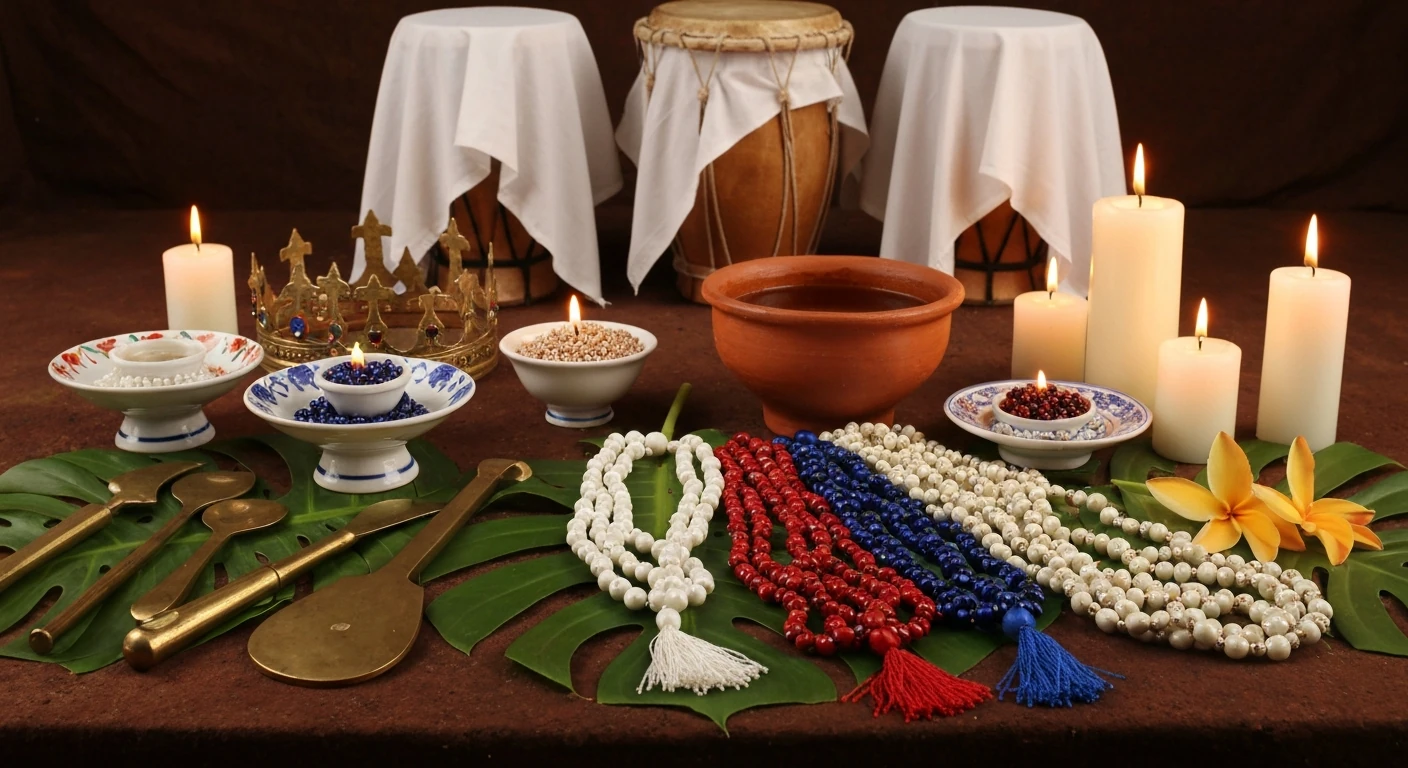
When the atabaques break out and the community forms the circle in the barracão, the xirê begins: the sequence of chants, dances, and greetings that calls, one by one, all the orixás of the house to descend and play with their children. It is the festive heart of Candomblé, the moment when the axé moves in body, voice, and drum.
This guide explains what the xirê is, why the circle turns counterclockwise, how Exu opens the ritual work with the padê, and what is the order in which the orixás are greeted in ketu Candomblé, with each one's greeting. It also shows why the Candomblé xirê is not the same thing as the Umbanda gira.
What is the xirê
Xirê (also written as siré) is a word of Yoruba origin that means circle, play, dance. In Candomblé, it is the public and festive part of the ritual: the ordered sequence of chants and dances in which the community greets each orixá worshipped in that house. Each deity has its own chant, its atabaque rhythm, its choreography, and its greeting.
The tone is one of joy and reverence at the same time. Unlike a silent worship, here the sacred is revered with the whole body. The children of santo dance in a circle, the ogãs play the atabaques, and with each chant the energy of an orixá is summoned and celebrated. When the axé settles, a child may enter a trance and receive their orixá, who then begins to dance among the community.
The xirê is also a living lesson in theology. By following the order of the chants, those who watch learn who each orixá is, what their nature is, and how the house organizes its pantheon. That is why understanding the xirê is understanding the logic of Candomblé itself: the religion presents itself in the sequence of the circle. The Candomblé chant, sung in Yoruba, is the thread that stitches this presentation together, orixá by orixá.
Keep this point in mind: xirê is not a folkloric spectacle or a dance show. It is liturgy. The circle is a ritual of praise with precise rules, transmitted from barracão to barracão for generations.
Why does the circle turn counter-clockwise
The xirê circle is formed in a counter-clockwise direction, against the movement of the clock hands. This is not an aesthetic detail: it carries a reading of time and ancestry.
Turning counter-clockwise symbolizes a return to the origin. While common time moves forward, the candomblé circle moves backward, bringing the community closer to the ancestors and the force that founded the tradition. With each turn, those present reconnect with what came before: the elders, the orixás, the Africa from which the religion departed. It is a gesture of memory made with the feet.
This reading is the most widespread in the terreiros, although explanations vary from house to house. What does not vary is the direction: the circle always turns in the same direction, and whoever enters it follows the flow of the group, never against it.
The padê de Exu: who opens the xirê
Before any orixá is greeted in the circle, Exu is the first to eat and to be pleased. This happens in the padê, the votive opening offering, made with foods such as farofa de dendê, water and, in some houses, drink. It is a rite of food and reverence, not of sacrifice.
The reason is the function of Exu. He is the orixá of the paths and the messenger, the one who communicates the aiê (the earth, the world of the living) and the orum (the spiritual world of the orixás). Without his good will, the messages do not arrive and the other orixás are not reached. The padê asks that Exu open the paths, manage the communication with the pantheon and not disturb the ritual work with his playful side.
It is time to undo the most unjust confusion surrounding the religion: Exu is not the demon. This association is a Christian projection that has nothing to do with Yoruba theology. Exu is dynamic, he is the owner of movement, and that is why he comes first. To know the orixá in depth, it is worth reading who is Exu.
A technical detail for the practitioner: the opening padê, restricted to Exu, is not the same thing as the broader ipadê, a foundation that also greets the ancestors (eguns) and appears in specific situations, such as the Waters of Oxalá. The sources distinguish the two, as recorded in the entry about the ipadê de Exu. In a common xirê, what opens the circle is the padê de Exu.
The order of the orixás in the ketu xirê
After the padê, the circle follows an order. In a ketu house of the House of Oxumarê lineage, studied by Fernando Alves in a ritual work at UFU, the sequence is this, and Exu "is praised in another ritual", outside the circle. The website O Candomblé gives the same order "according to the precepts of the Ketu Nation", with Exu first:
- Ogum, the lord of iron and war
- Oxóssi, the hunter, lord of the forests
- Omolu (Omulu), lord of the earth, of disease and of healing
- Ossaim (Osanyin), owner of the leaves and the axé of the herbs
- Oxumarê, the rainbow, the cycles and the renewal
- Nanã (Nana Buruku), the elder, the primordial mud
- Oxum (Oshun), lady of the fresh waters, of gold and of love
- Obá (Oba), the warrior
- Ewá (Yewa), linked to the springs
- Oyá / Iansã (Oya), lady of the winds, lightning, and storms
- Logun Edé, the young hunter and fisherman
- Ayrá, Xangô (Shango) dressed in white
- Iemanjá (Yemoja), the mother of the sea waters
- Xangô, the king, lord of justice and thunder
- Oxalá, the father, ancestor of ancestors, who closes the circle
This order is not a universal rule. It is fixed within each house, but changes from barracão to barracão and from nation to nation, "especially in the middle of the sequence," as Raphael de Jesus writes in the magazine Em Sociedade (PUC Minas). In the ketu order he cites from Rita Amaral, Xangô comes right after Oxumarê and before Iansã. In the Bembé do Mercado, in Santo Amaro, the IPHAN dossier records Xangô near the end, before Oxalá, as in the house studied by Alves. What remains firm is the beginning and the end: Exu opens, Oxalá closes. How each orixá dances in the circle is in how to dance the xirê.
Each nation of Candomblé has its own circle. In jeje and in angola, the sequences and chants are different, and in angola, the inquices are worshipped, and not exactly the same orixás with the same names. Therefore, there is no "the order of Candomblé," but rather the order of each tradition. To understand these differences, it is worth reading about the nations of Candomblé.
The greetings of each orixá
Calling the orixá is also greeting them with the right shout. The greeting is a word or expression of praise, spoken by the community when that orixá's chant begins. These are the most widespread greetings in ketu Candomblé:
| Orixá | Greeting | Meaning |
|---|---|---|
| Exu | Laroyê | Hail the messenger, the lord of the paths |
| Ogum | Ogunhê | Hail the lord of iron and war |
| Oxóssi | Okê Arô | The hunter's cry, lord of the forests |
| Ossaim | Ewê Ewê | Praise to the owner of the leaves and the axé of the herbs |
| Obaluaê / Omulu | Atotô | "Silence", the respect before healing and death |
| Nanã | Saluba | We take refuge in the elder, the primordial mud |
| Oxumarê | Arroboboi | Hail the rainbow, the cycle and the renewal |
| Xangô | Kaô Kabecile | "Hail the king", justice and royalty |
| Oyá / Iansã | Eparrei | Hail the lady of the winds and the storms |
| Oxum | Ora ie ie ô | Hail the benevolent mother of the fresh waters |
| Iemanjá | Odoyá | Hail the mother of the sea waters |
| Oxalá | Epa Babá | Hail the father, the greatest ancestor |
The greetings of Obá, Ewá and Logun Edé also exist and are used in the houses that worship them, but they vary from terreiro to terreiro, so it is best to learn them in the house itself, with those who lead the worship. If you want to delve deeper into this theme, also see the greetings in Angola Candomblé, which follow another nation logic.
Xirê and gira: why they are not the same circle
It is common for those coming from Umbanda to call the xirê a "gira", and vice versa. They are distinct things, from distinct traditions.
The xirê is from Candomblé. It is the festive circle that calls and greets the orixás with chants in Yoruba, dances, and atabaques. The focus is praise: the orixás come down to dance and receive reverence, not to give consultations. When an orixá manifests, he dances and blesses, but in general does not "attend" people with verbal advice.
The gira is from Umbanda. It is the work session in which spirits such as caboclos, pretos-velhos and children (erês) incorporate to attend the seekers, give passes, listen and orient. The chant (the ponto) is in Portuguese, and the focus is charity and direct service to the public.
Summarizing the difference: in the xirê, the community rises to the orixás in celebration; in the gira, the spirits come down to the people to work. If this contrast interests you, it is worth reading the full comparison between Umbanda and Candomblé.
How to behave in a xirê open to the public
Many houses hold public festivals, and the visitor is welcome, as long as they respect some simple precepts:
- Light and discreet clothing. White is always well received. Avoid black and short clothes.
- Men on one side, women on the other, as the house organizes it. Observe where the attendees sit.
- Do not turn your back to the center of the circle or to the place of the atabaques when standing up.
- Do not take photos without permission. Many moments are private, and the image of the children in trance is preserved.
- Follow the greetings when you can, but without imitating trance or entering the circle without being invited.
Good sense summarizes everything: you are in the house of a religion, as you would be in a mass or a service. Respect and silence at the right moments are the best conduct.
Frequently asked questions
What does the word xirê mean?
Xirê comes from Yoruba and means circle, play, or dance. In Candomblé, it names the festive and public part of the ritual, in which the community calls and greets each orixá with chants, dances, and atabaques, in an order established by the house.
Which orixá is greeted first in Candomblé?
Exu is always the first to be pleased, in the padê that opens the ritual work, before the circle begins. As the messenger orixá and owner of the paths, he guarantees communication between the world of the living and that of the orixás. Without Exu, no other is reached.
Why does the Candomblé circle turn in a counter-clockwise direction?
Turning counter-clockwise symbolizes a return to the origin and to ancestry. While common time moves forward, the circle moves backward, reconnecting the community to the elders and to the force that founded the tradition. It is a gesture of memory made with the body.
What is the difference between xirê and gira of Umbanda?
The xirê is from Candomblé: a circle of praise that greets the orixás with chants in Yoruba. The gira is from Umbanda: a work session in which spirit guides incorporate to attend to consultants. In the xirê the community celebrates; in the gira the spirits attend the public.
Is the order of the xirê the same in every Candomblé?
No. The order is fixed within each house, but it changes from barracão to barracão and from nation to nation. In ketu, a common sequence goes from Ogum to Oxalá, but jeje and angola have their own circles. What remains is Exu opening and Oxalá closing.
Where to buy items for Candomblé
At Joia Mística Laroyê, you find what you need to honor the orixás and live your faith with respect:
- Statues of the orixás for your altar or assentamento, from Exu to Oxalá
- Bead necklaces and beads in the colors of each orixá of the pantheon
- Ração clothing and white clothing for the festivals and obligations
- Ritual candles in the colors of the orixás
- Herbs and axé items for baths, fumigations, and offerings
Visit our shop in Extrema-MG and we ship to all of Brazil. For guidance on the correct use of the products, talk to us via WhatsApp.
References
- Wikipedia: Candomblé chants
- Wikipedia: Exu Ipadê
- Fernando Cardoso Rezende Alves, TCC (UFU, 2017): Xirê, the ritual as performance
- Candomblé: Siré Orisá (Xirê Orixá): basic
- Raphael Felipe da Silva de Jesus, In Society (PUC Minas, 2022): In the sway of the sea, the dance of Iemanjá
- IPHAN and UFRB: registration of Bembé do Mercado