



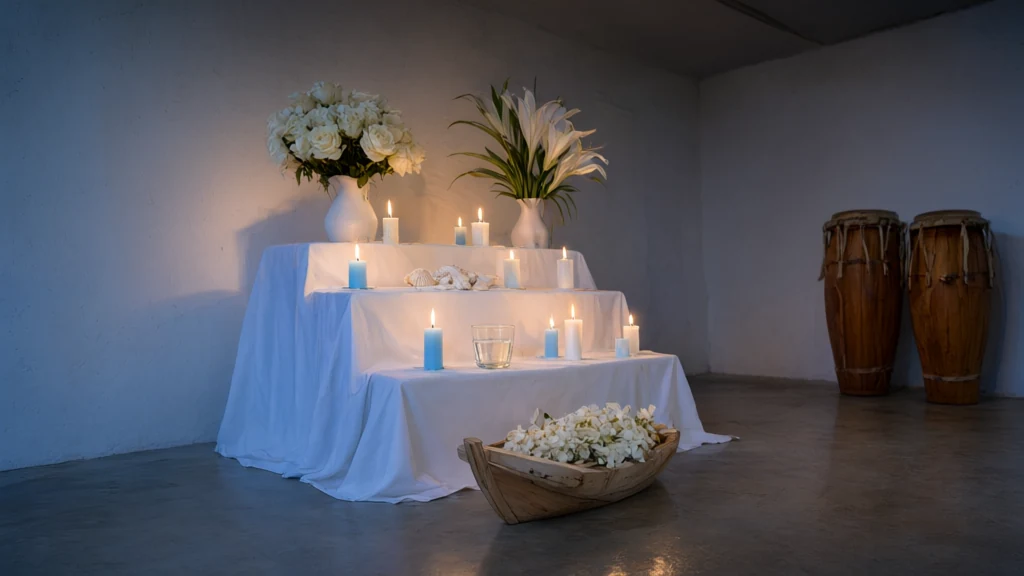
Iemanjá in Umbanda is the owner of one of the seven lines, the line of the waters or the people of the sea, and she rarely incorporates: those who descend in the gira in her name are the people of the water.
In the terreiros studied by Barros, the festival falls on December 8. Each answer below carries the name of the house or the author, because the list of lines changes from terreiro to terreiro.
Who is Iemanjá in Umbanda
Iemanjá rules one of the seven lines of Umbanda. In 1933, Leal de Souza described the White Line of Umbanda with seven lines. The sixth was that of "Amanjar", as he wrote her name, and the color was blue.
In 2006, the dissertation by Cristiane Amaral de Barros, from UFJF, registered the "Line of Iemanjá: line of the people of the water" among the most widespread. The author herself warns that there is no consensus on the composition of the lines "among the different terreiros". The complete comparison is in the 7 lines of Umbanda.
The orixá profile, with myths and qualities, is in who is Iemanjá.
Does Iemanjá incorporate in the gira?
Rarely. Barros writes that the Umbandista Janaína "generally does not incorporate in any of her children".
"In Umbanda, it is rare for Iemanjá to descend in the giras." Cristiane Amaral de Barros, UFJF, 2006
For Armando Vallado, a doctor from USP, Iemanjá is the great mother, but "her daily Umbandista role is quite reduced". Prandi had already recorded, in 1995, that caboclos and pretos-velhos have a more important role in the daily life of Umbanda "than the orixás themselves".
Two more recent studies say this for all orixás. For Oliveira and Jorge, in the magazine Horizonte, "in Umbanda the Orixás do not incorporate in the mediums, only the Ancestors". Joana Bahia, from UERJ, writes: "Orixás do not incorporate."
Barros' word is "rare", and there are houses where the orixá descends. The same debate appears in Oxalá in Umbanda. In case of doubt, what your house teaches is what counts.
Who descends in the line of Iemanjá: the water people
The falange descends, and the list changes with the author. Leal de Souza described the line as made of "workers of the sea, spirits of coastal tribes, of sailors, of people who perish drowned in the ocean", the "people of the sea".
- Barros (UFJF): falanges of "sailors, caboclas iaras, juremas".
- Vallado (USP): spirits of caboclos and iaras, such as "Caboclo do Mar, Caboclo Estrela do Mar, Janaína, Cabocla Iara".
- Graminha and Bairrão (USP): the sailors are a class "habitually subordinate to Iemanjá", often spirits of those who lived at sea or died drowned.
- NUSS (Itanhaém house): from the line come "the famous mermaids and the Oxuns", and caboclos and pretos-velhos call these workers "with great frequency". In the same house, the falange of mermaids is "headed by Mamãe Oxum (Oshun)".
- Matta and Silva (via Lages, UFJF): Cabocla Oxum is one of the falanges of the line of Iemanjá. As each author and each house situates the orixá of fresh waters is in Oxum in Umbanda.
Graminha and Bairrão studied 155 sung points and observed giras. The sailors are the ones who speak the most, and other classes, "such as mermaids and saints", only dance. When the medium receives a sailor, the body sways back and forth, "in reference to the swaying of the waters and the ship". Who these spirit guides are is in sailors in Umbanda.
No open source lists an Exu (Eshu) or a Pombagira "from the line of Iemanjá", and therefore this text does not list names.
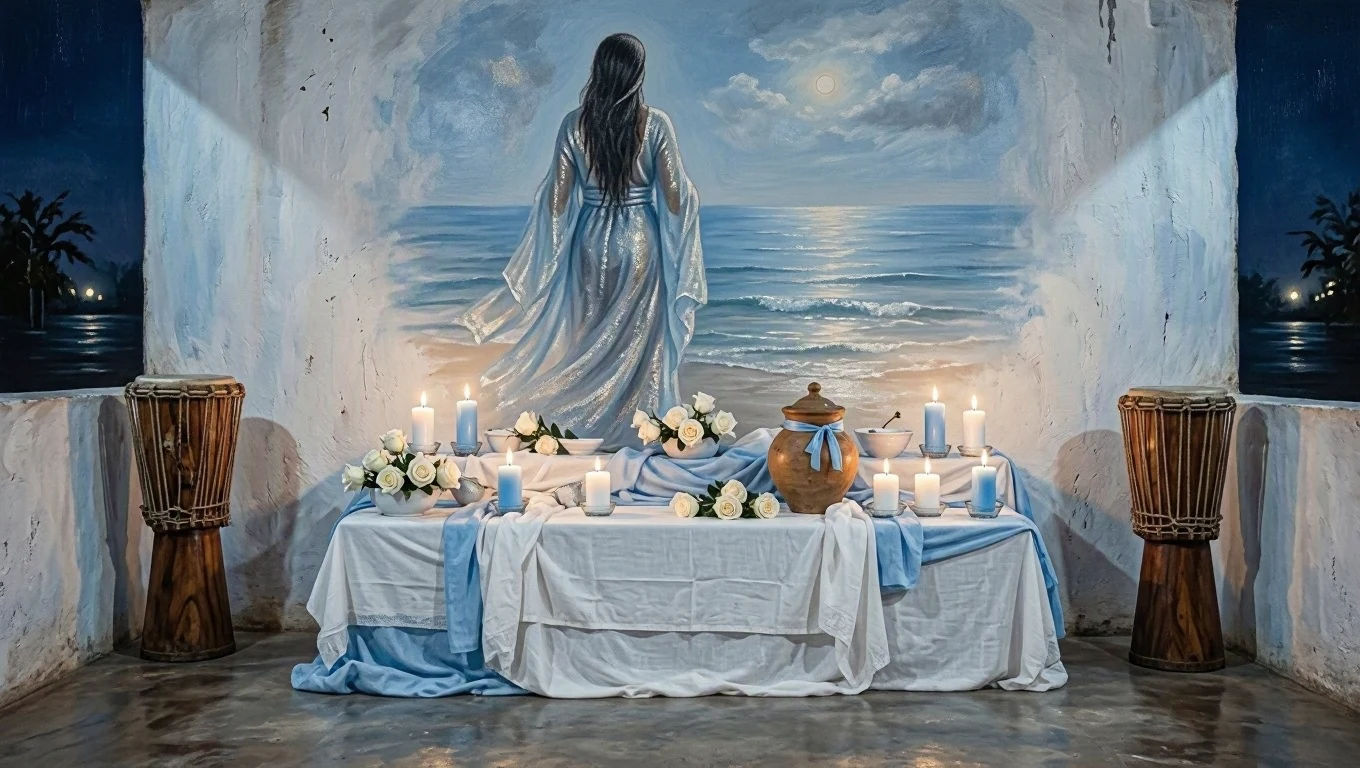
Name, greeting, color and day of Iemanjá in Umbanda
Name: Janaína or Dona Janaína | Greeting: Odoyá | Color: light blue, white and silver | Day: Saturday
Verger registered "Dona Janaína", and Barros speaks of the "Janaína umbandista". In 193 popular songs, Queiroga and Nascimento, from UFMG, found Janaína, Sereia and Mãe d'água among her names. Everton Alfonsin, president of Fauers, the Rio Grande do Sul federation, told the BBC that in umbanda she "is not called an orixá", but rather a caboclo. It is the position of one federation.
In TUCTVC, the greeting is "Odoyá!"; FUCESP writes Odoiá, and Prandi registers Odoyá in Ketu Candomblé. The greetings of the other orixás are in greeting of the orixás.
The color varies by house. Leal de Souza gave blue; TUCTVC uses a bead necklace and candle in "light blue, white and silver"; FUCESP lists white, silver, blue and pink. Saturday is her day at FUCESP, at TUCTVC and in Verger. In the shop there is a light blue candle and a white candle of a single color, but the color of your house matters more.
What is the Iemanjá festival in umbanda
Inside the terreiros, the festival is on December 8, the day of Our Lady of the Conception. Barros writes that she is celebrated "inside the terreiros, on December 8", and at TUCTVC the main celebration "takes place on December 8". Vallado says that the Cidade Ocian festival, on the São Paulo coast, occupies the first two weekends of December. Belém and João Pessoa also celebrate on the 8th, according to the newspaper O Povo.
August 15 is a city date:
- Rio de Janeiro: the festival accompanies Our Lady of Glory. Barros, quoting Labanca, links the Carioca worship to the festivals of Glória do Outeiro.
- Belo Horizonte: the Pampulha festival is on the day of Our Lady of Boa Viagem, the city's patron saint, and reached its 73rd edition in 2026.
- Fortaleza: the procession leaves the União Espírita Cearense de Umbanda, which estimated 100,000 people in 2025.
On New Year's Eve, the party goes to the beach and is for everyone, Umbandistas or not, as told in Iemanjá in the new year. The other dates, with the source of each one, are in Iemanjá's day and in the calendar of the orixás.
Is Iemanjá Our Lady in Umbanda?
It depends on who is speaking. For Leal de Souza, in 1933, the Iemanjá line meant "the Virgin Mary, in her invocation of Our Lady of the Conception." The TUCTVC links the party to the Conception, but writes that the syncretism "does not mean that the two figures are exactly the same deity."
The statue of the congá changed with this. Vallado tells that, with the Umbanda of the 30s, Iemanjá became "white, with long black and straight hair," in a blue dress, like Our Lady. Barros calls this figure "white virgin" and remembers that the mermaid and the girl in the blue dress are the same Iemanjá. The history of this figure, from Africa to the black Iemanjá, is in Iemanjá statue.
Whoever is going to put a statue of Iemanjá on the congá checks with the leader first. Joice clears up doubts about the statues and the candles from the shop via WhatsApp. What to take to her is in offering for Iemanjá.
What changes from the Iemanjá of Candomblé
In Ketu Candomblé, Iemanjá has her own consecrated foundation (assentamento): "sea pebbles in a porcelain bowl," in Prandi's tables. The beads are of "colorless glass with blue or green alternately," and the food includes rice with beaten egg white, canjica, and roasted fish. Verger tells that, in the dance, the iaôs imitate the waves.
In Umbanda, her strength arrives through the line and the falange, through the statue of the congá and the festival at sea. The qualities are in qualities of Iemanjá, and the two religions side by side, in difference between umbanda and candomblé.
Frequently asked questions
What is the name of Iemanjá in Umbanda?
Janaína, or Dona Janaína, is the name that Verger and Barros record. Queen of the Sea and Princess also appear. In 1933, Leal de Souza recorded Amanjar. For Fauers, the Rio Grande do Sul federation, in Umbanda she is called caboclo.
What is the greeting of Iemanjá in Umbanda?
Odoyá, in TUCTVC and in Prandi; Odoiá, Erù-Iyá and Odó-Iyá, in FUCESP. Verger and Vallado write Odò Ìyá and translate it as Mother of the river. The spelling changes from house to house, and the form your house uses in the gira is valid.
What is the color of Iemanjá in Umbanda?
Light blue, white and silver in TUCTVC; white, silver, blue and pink in FUCESP; blue in Leal de Souza, in 1933. In TUCTVC, the candle follows the colors of the bead necklace. If your house uses another combination, follow the house.
What is the day of Iemanjá in Umbanda?
Saturday, in FUCESP, in TUCTVC and in Verger. In the year, the festival inside the terreiros is on December 8, with the Conceição. In Rio, in Belo Horizonte and in Fortaleza, the great public festival is on August 15.
References
- Barros, UFJF: Iemanjá and Pombagira, images of the feminine in umbanda
- Vallado, Le Monde Diplomatique Brasil: Iemanjá, the powerful mother
- Leal de Souza: The Seven Lines of Umbanda, 1933
- Graminha and Bairrão, Memorandum (UFMG): Torrents of meanings, the symbolism of waters in the Umbandist context
- Oliveira and Jorge, Horizonte (PUC Minas): Umbandist spirituality
- Joana Bahia, Domínios da Imagem (UEL): Candomblé in German lands
- Prandi, Horizontes Antropológicos (UFRGS): African gods in contemporary Brazil
- Queiroga and Nascimento, Memorandum (UFMG): Lady of the waters and the song
- Pierre Verger: Orixás, Yoruba gods in Africa and the New World
- TUCTVC: Iemanjá
- FUCESP: Iemanjá
- NUSS: Iemanjá Line
- Lages, UFJF (2003): Exu: light and shadows
- BBC News Brasil, via O Povo: Why Iemanjá became a white woman in Brazil
- Wikipedia: Festa de Iemanjá
- O Povo: Iemanjá Day on August 15
- Estado de Minas: Iemanjá Festival in Pampulha in 2026
- Diário do Nordeste: Iemanjá Festival in Fortaleza


