



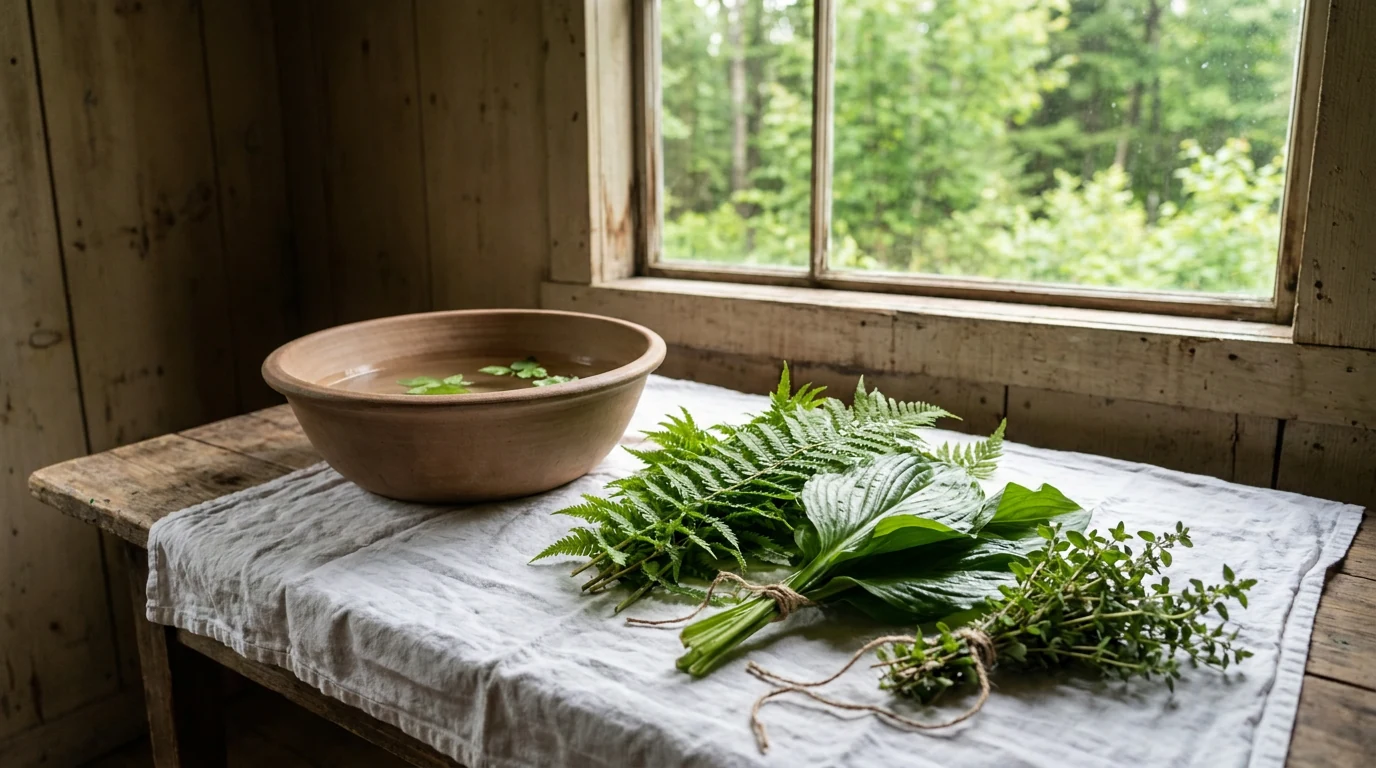
The herbs of Oxóssi change from house to house. In Candomblé, the leaf is of Ossaim, and Ketu and Ijexá terreiros in Bahia give Oxóssi the São-gonçalinho, the quioiô, and the sword. In Umbanda, fern, guinea hen weed, rosemary, pepper tree, and lemon balm appear as his leaves in more than one house.
What are the herbs of Oxóssi
The short answer is: the ones your house gives to him. Sources attribute different leaves to Oxóssi, and each list comes from a terreiro or a tradition. The table combines those that have a record.
| Where | Leaves of Oxóssi |
|---|---|
| Ketu and Ijexá Candomblé, southern Bahia | São-gonçalinho, quioiô, espada-de-Ogum (Ogun), clover, Surinam cherry |
| Umbanda, Teixeira de Freitas (BA) | fern, large mint, rosemary, pepper tree, guinea hen weed, lemon balm |
| Umbanda, Curitiba | fern, pepper tree, lemon balm, orange tree, pink mallow, jurema |
| Umbanda and Candomblé Federation of SP | guinea hen weed, peregum, rosemary, basil, fern |
The fern is the leaf that repeats in Umbanda: it appears in both houses and in the federation, but the species changes from place to place. Guinea hen weed, pepper tree, lemon balm, and rosemary also appear in more than one source, always shared with other orixás (orishas).
Day: Thursday | Owner of the leaf in Candomblé: Ossaim | Quizila in ketu: honey
Whose leaf it is: Oxóssi and Ossaim
In Candomblé, the owner of the leaves is Ossaim. In the table by Reginaldo Prandi, which follows the queto rite, Oxóssi is the orixá of hunting and fauna, and Ossaim, the one of vegetation and flora. Both have Thursday as their day.
The itã recorded by Prandi tells that Ossaim gave a leaf to each orixá. Each leaf received "its axés and its ofós", the chants without which it does not work. This is why people speak of "Oxóssi's herbs": they are the leaves that tradition separated for him.
“Each leaf with its axés and its ofós, which are the chants of enchantment, without which the leaves do not work.”
Reginaldo Prandi, Mythology of the orixás, cited by Bianca Purcino (UFSB, 2022)
Oxóssi is the orixá closest to Ossaim. Pierre Verger writes that hunters, by living in the forest, "learn part of his knowledge from him". In the Candomblé of Bahia studied by Pedro Botelho, the two can share the same roncó. In houses without a son of Ossaim, he can be celebrated in the festival of Oxóssi. A myth that Verger recorded in Brazil tells that Ossaim gave Oxóssi a drink of leaves that made him forget who he was. The profile of Ossaim is in who is Ossaim.
In Umbanda, the reading changes. Terreiro Pai Maneco, in Curitiba, calls Oxóssi "the knower of herbs and the great healer". The two readings coexist, each in its tradition.
Oxóssi's herbs in Candomblé ketu and ijexá
The researcher Bianca Purcino identified the plants of two terreiros in southern Bahia: one of nação ketu, in Itabuna, and one of nação ijexá, in Arataca. In both, these leaves are given to Oxóssi:
- São-gonçalinho (alékèsì): used in baths "to obtain good fluids." A ketu house records its prestige in the terreiros of the nation for being a leaf of Oxóssi, patron of ketu.
- Quioiô, the same plant that many people call alfavaca: shared with Omolu (Omulu), in body cleansing, sacudimento, and defumação.
- Espada-de-Ogum, which there is also called espada-de-Oxóssi: shared with Ogum, in sacudimento and protection. The leaf is toxic if ingested.
- Trevo: used in baths for prosperity, according to the terreiros researched.
- Pitanga: in defumação and incense.
The akòkó shows how the leaf changes owners. In the terreiros of Purcino, it belongs to Xangô (Shango). In a ketu house, it belongs to Ossaim, Ogum, and Oxóssi, and in a candomblé portal, to Ossaim, Ogum, and Oyá. Whoever says whose leaf it is in your house is your pai or your mãe de santo.
Herbs of Oxóssi in umbanda and in the line of the caboclos
In umbanda, the caboclos appear as children of Oxóssi, and his leaves are linked to them. In the points of Terreiro Pai Maneco, the caboclo is a "child of Oxóssi." The profile of the line is in caboclos in umbanda.
At the Tenda de Umbanda Luz Divina de São Jorge, in Teixeira de Freitas (BA), eight of the 39 plants raised were attributed to Oxóssi. The samambaia belongs to Oxóssi and the caboclos, and enters into baths, passes, firmezas, and descarregos. The hortelã-grosso goes in the baths. The alecrim, the aroeira, the guiné, and the erva-cidreira belong to Oxóssi along with other orixás.
At Terreiro Pai Maneco, the list is different: malva-rosa, mil-folhas, sete-sangrias, aroeira, samambaia, laranjeira, erva-cidreira, and jurema, among others. The color of the house for Oxóssi is green and white, and his amalá takes seven green candles and seven white ones.
Rue divides the sources. The house of Teixeira de Freitas links it to Ogum, Oxóssi, Xangô, and Iansã (Oya). A Candomblé portal gives it to Oxalá (Obatala). The arruda card on the site brings its use.
How Oxóssi's leaves enter the herbal bath
The herbal bath washes the body from the neck down. In an Umbanda house in São Paulo, the one who says which plants to use and on which days is the spirit, in the consultation. With the house's indication in hand, the preparation recorded there is simple:
- Separate the leaves that the house indicated, fresh or dry. The shop has the bath herbs, and through WhatsApp you can check the leaf that your house requested.
- Boil the water, put the leaves, generally in an odd number, wait a few seconds and turn off the heat.
- Use a pot only for this, and not the food pot.
- Let it cool down and, after the hygiene bath, pour it from the neck down.
The boiled bath never goes on the head. The São Paulo federation explains that "nothing boiled should be placed" on the ori. In Ketu, eating honey is a taboo for the children of Oxóssi. In doubt, leave the honey out of this bath. The difference between hot and cold leaf is in hot and cold herbs.
Amaci of Oxóssi: why it is a house matter
The amaci is the head bath. In the Candomblé of Bahia, it is the liquid of sacred leaves macerated in the water of the roncó's quartinhas, to bathe the heads of the initiates. In an Umbanda terreiro in São Paulo, there is an amaci for each orixá, and it is made exclusively by mães and pais de santo and iabás. After it, the medium remains in seclusion, with a cloth covering the head.
The amaci is not put to fire: the leaves are macerated by hand, and the mixture follows the orientation of the leader. The São Paulo federation accepts that the experienced son makes his own, and the São Paulo terreiro does not. Therefore, the recipe and the moment of the Oxóssi amaci remain with your house. What is the rite, in general, is in what is amaci.
Frequently asked questions
Is rue an herb of Oxóssi?
In some houses, yes. An Umbanda house in Teixeira de Freitas (BA) links rue to Ogum, Oxóssi, Xangô, and Iansã. A Candomblé portal gives it to Oxalá. There is no agreement between sources, and who defines it in your house is the leader.
What is the main herb of Oxóssi?
No source fixes just one. In Candomblé, the São-gonçalinho has academic and Ketu terreiro records. In Umbanda, the fern is the one that repeats in two houses and in the São Paulo federation. The main one, in practice, is the one your house uses.
What is the day of the Oxóssi ritual bath?
Thursday is the day of Oxóssi in Candomblé and Umbanda. The day of the ritual bath, however, is indicated by the house: in Umbanda, the spirit says which plants to use and on which days.
Can I make Oxóssi amaci at home?
In an Umbanda terreiro in São Paulo, only mothers and fathers of santo and iabás prepare and apply the amaci. The São Paulo federation says it follows the orientation of the leader and accepts that the experienced son makes his own. For those who do not have a house, the herbal bath from the neck down is the path.
References
- Bianca Purcino: ethnobotanical profile in Candomblé terreiros in southern Bahia, dissertation, UFSB, 2022
- Joyce dos Santos and Jorge Fortuna: the ethnobotany of the Tenda de Umbanda Luz Divina de São Jorge, Research, Society and Development, 2023
- Pedro Freire Botelho: Ewé Awo, the secret of the leaves in the Candomblé of Bahia, Education, Management and Society, 2011
- Pedro Crepaldi Carlessi: Jeitos, sujeitos e afetos, Boletim do Museu Paraense Emílio Goeldi, 2017
- Reginaldo Prandi: os deuses africanos no Brasil contemporâneo, Horizontes Antropológicos, 1995
- Pierre Verger: Orixás, deuses iorubás na África e no Novo Mundo, Corrupio, 1981
- FUCESP: amacis, amalás, comidas e bebidas de santo, 2013, and Oxóssi page
- Terreiro de Umbanda Pai Maneco: Oxóssi, King of the forests and points booklet
- O Candomblé: as ervas dos orixás, 2008
- Àsé Dan Fè Èrò: èwés


