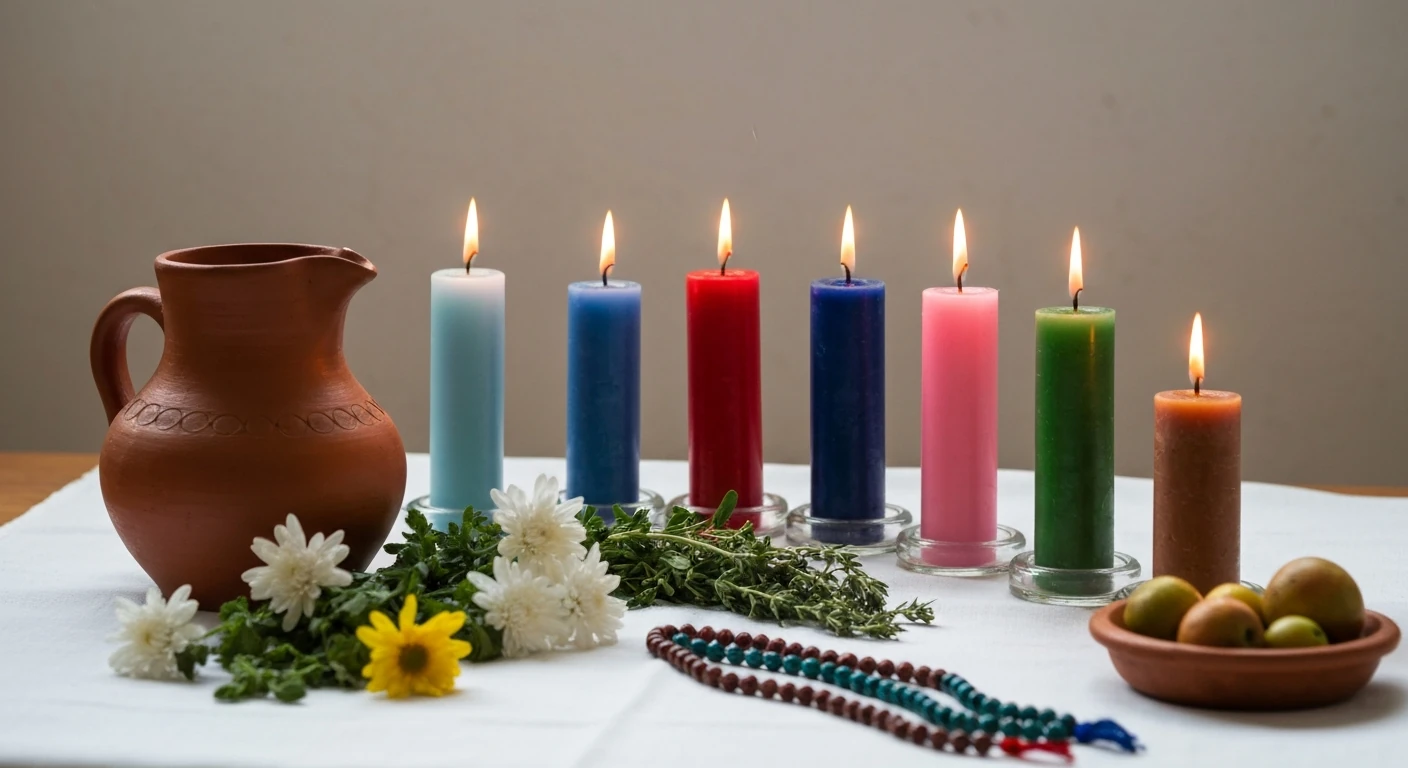
The 7 lines of Umbanda are the great currents of energy that organize everything that happens in a terreiro: each line is a vibration ruled by an orixá, and within it work the caboclos, pretos-velhos, children, and guardians who manifest in the gira. Understanding these seven lines is understanding the map of Umbanda, the way the house distributes the axé and the ritual work.
But there is a trap: there is no single official list. The seven lines appear with names and rulers that vary slightly from school to school, and this confuses many people. This guide shows the most used version today, explains what each one does, and why the lists change.
What is a "line" in Umbanda
Before the names, the concept. A line (also called irradiation or vibration) is a great river of energy that descends from Olorum (Olodumare), the supreme God, and has an orixá at its head. It is not a person or a spirit: it is a force, a field of action. When it is said "line of Ogum," it refers to the vibration of opening paths and the Law, not a specific caboclo.
The number seven is not random. It represents the seven original vibrations of Creation, the seven rays that sustain the spiritual work. Each of these currents unfolds into falanges (hierarchical subdivisions), and within the falanges work the povos, the spirits who actually descend in the gira. Keeping this distinction avoids the most common error on the subject, which is confusing the line with those who work within it.
In Umbanda, line is the vibration ruled by an orixá; povo is who works within it. A caboclo is not an orixá, a preto-velho is not an orixá. They are entities of light that act under the irradiation of one of the seven lines.
If you are arriving now, it is worth reading first what Umbanda is to situate these lines within the religion as a whole.
The 7 lines of Umbanda and their orixás
The most widespread organization today associates each line directly with a ruling orixá. It is the clearest entry point for those who are starting. See the chart and, next, what each line governs.
| Line | Ruling orixá | Action |
|---|---|---|
| Line of Faith | Oxalá | peace, creation, faith, coordinates the others |
| Line of Waters | Iemanjá (and Oxum) | love, emotions, motherhood, welcoming |
| Line of Justice | Xangô | law, balance, just decisions |
| Line of Demandas | Ogum | opening of paths, protection, breaking of demanda |
| Knowledge Line | Oxóssi | nature, wisdom, abundance, healing through herbs |
| Children's Line | Ibeji (Cosme and Damião) | joy, purity, light energy |
| Linha das Almas | Pretos-velhos / Obaluaê | healing, humility, ancestral wisdom |
Faith Line (Oxalá)
It is the highest of the seven, ruled by Oxalá, the orixá of peace and creation. It coordinates all others and is responsible for faith, serenity, and the connection with the divine. Its color is white, and many terreiros open and close ritual works by greeting this vibration.
Waters Line (Iemanjá)
The current of love, emotions, and motherhood, ruled by Iemanjá, the Queen of the Sea, with a strong presence of Oxum in the fresh waters: Matta and Silva, cited by Sônia Lages (UFJF), places Cabocla Oxum among the phalanges of Iemanjá's line, and her place in each author is in Oxum in umbanda. It is the current of welcoming and emotional healing. In 1933, Leal de Souza described this line as the "people of the sea," made of sailors and people who died by drowning. The celebration changes with the city: August 15 in Rio, as told by the day of Iemanjá, and December 8 inside the terreiros, according to Iemanjá in umbanda.
Justice Line (Xangô)
Governed by Xangô, the orixá of thunder and Law, it is the line of balance and just decisions. It acts in causes, in processes, in situations that demand upright judgment. Its stone is the quarry, and its cry is "Kaô Cabecile".
Line of Demands (Ogum)
The chain of the battle of good, governed by Ogum, the lord of iron and paths. It opens passage, protects, and undoes demands (negative ritual work sent against someone). It is one of the most called upon in consultations for undoing and protection.
Line of Knowledge (Oxóssi)
Governed by Oxóssi, the hunter, it is the current of nature, wisdom, and abundance. It is in this line that the great people of the caboclos work, the spirits who appear most in Umbanda giras and who master the secret of herbs and the forest. How Umbanda experiences the orixá itself, and why the one who descends in the gira is the caboclo, is covered in Oxóssi in Umbanda.
Line of Children (Ibeji)
The line of joy and purity, governed by the Ibeji, the twin orixás, syncretized in Cosme and Damião. In it work the erês, the child spirits who bring lightness, untie emotional knots, and treat issues of the inner child.
Line of Souls (Pretos-velhos)
The irradiation of ancestry, humility, and healing, linked in many houses to Obaluaê and the very idea of the Souls. It is the irradiation of the pretos-velhos, the spirits of enslaved African elders who advise, bless, and teach through patience. Who works in it, right and left, and why its sense changed since 1933 is in line of souls in Umbanda. In the book by Leal de Souza, from 1933, the seventh "is the line of Santo, also called the Line of Souls", and Omulu does not appear in any of the seven; the connection with Obaluaê is a house reading, told in Omolu in Umbanda.
Line, falange and people: who works in each irradiation
Here lies the greatest confusion of the subject, and it is worth unraveling calmly. Each of the seven chains functions like an army organized in levels:
- Line: the great vibration ruled by an orixá (the Oxóssi line, for example).
- Falange: the subdivisions within the line, each with a leader and its own field of work.
- People / spirit: the spirits that actually manifest, such as caboclos, pretos-velhos, children, baianos, sailors, boiadeiros, and guardians.
Therefore, a caboclo de pena can work in the Oxóssi line, and a preto-velho in the Almas line, without any of them being the orixá of the line. They act under that vibration. If you want to know each of these peoples inside out, the blog has a guide dedicated to the spirits and spirit guides of Umbanda.
Why the lists change from one house to another
If you search, you will find different lists of the seven lines, and none are "wrong". Umbanda was born at the beginning of the 20th century without a central authority, and each codifier organized the vibrations in their own way. Knowing this history helps understand the variations:
- Leal de Souza (1933): in one of the first published codifications of the lines, they were Oxalá, Ogum, Oxóssi, Xangô, Iansã (Oya), Iemanjá, and the Almas. Note that Iansã had its own vibration.
- 1st Brazilian Congress of Umbanda (1941): ratified seven lines keeping Iansã among them.
- W. W. da Matta e Silva (1950s): in esoteric Umbanda, gave Yoruba names to the seven original vibrations (Orixalá, Yemanjá, Xangô, Ogum, Oxóssi, Yori and Yorimá), replacing Iansã with the lines of the Children and the Pretos-velhos.
- Rubens Saraceni (2000s): in Umbanda Sagrada, proposed seven lines ruled by pairs of Orixás, a total of fourteen, and there Iansã reappears linked to Ogum, in the Line of the Law.
The fixed point is the number seven and the idea of vibrations ruled by Orixás. The names and the rulers are what vary. Therefore, the golden rule for any serious practitioner: the foundation and the custom of your house have the final word. Before adopting a list from the internet, ask your leader how your house organizes the lines.
The right line and the left line
Besides the seven lines, you will hear about the "right line" and the "left line." They are not two of the seven: they are two axes of ritual work. The right gathers the spirits of guidance and charity (caboclos, pretos-velhos, children). The left is the field of the guardians, the Exu (Eshu) and Pombagiras.
And here we must be direct: the left line is not the line of evil. Exu is the guardian of the Law, the one who protects the terreiro, executes the orders of the Orixás, and works on the margin, at the limit, where others do not go. The association of Exu with the devil is a result of colonial prejudice that demonized Afro-Brazilian religions, and it has no basis in tradition. Left, in Umbanda, means margin and protection, never evil.
Frequently asked questions
What are the 7 lines of Umbanda?
In the most used organization today, they are the lines of Oxalá (Faith), Iemanjá (Waters), Xangô (Justice), Ogum (Demands), Oxóssi (Knowledge), Ibeji (Children), and the line of the souls, of the pretos-velhos. The names and rulers vary according to the school and the foundation of each terreiro.
Are the 7 lines of Umbanda 7 orixás?
Not exactly. Each line is a vibration ruled by an Orixá, but the line is not the Orixá, but rather the current of energy and the spirits that work within it. Furthermore, some lines (such as the Children's line and the Souls line) gather spirits under a radiation, and not a single Orixá.
What is the most important line in Umbanda?
The Line of Faith, of Oxalá, is considered the highest, because it coordinates all the others and is responsible for the connection with the divine. This does not mean that the others are lesser: each line has its function, and the work of Umbanda depends on the balance between all of them.
How to know what my line is in Umbanda?
What defines this is the jogo de búzios and the reading of your leader within the terreiro, not internet tests. In general, people speak of the head orixá and the spirits that work with you. Look for a serious house and speak with the pai or mãe de santo.
Is the Exu line one of the 7 lines?
No. The Exus and Pombagiras form the left line, an axis of work for the guardians, and not one of the seven vibratory lines ruled by the Orixás. They are spirits of Law and protection, treated with respect like any other people of Umbanda.
Where to set up and care for your point of faith
At Joia Mística Laroyê, you find what you need to honor each line at home:
- Statues and bead necklaces of the Orixás: Oxalá, Iemanjá, Xangô, Ogum, Oxóssi and more
- Candles in the colors of each line: white, blue, red, green and others
- Herbs and incense: for cleaning and firmeza of the ritual work
- Items for the congá: towels, small jars, statues of pretos-velhos and children
Visit our shop in Extrema, Minas Gerais or talk to us via WhatsApp and we ship all over Brazil.
References
- Eufrazia Cristina Menezes Santos: The Preto Velho in Umbanda, NER Debates, UFRGS, 2010, on the Bantu heritage in the institutionalization of the line of souls
- José Henrique Motta de Oliveira: a theoretical discussion on the interpretations of the founding myth of Umbanda, UFRRJ, on the 1908 scene and the organization of the religion
- Leal de Souza: The Seven Lines of Umbanda, 1933, on the line of Iemanjá and the people of the sea
- Sônia Regina Corrêa Lages: Exu, light and shadows, UFJF, 2003, with the falanges of Matta e Silva in the line of Iemanjá