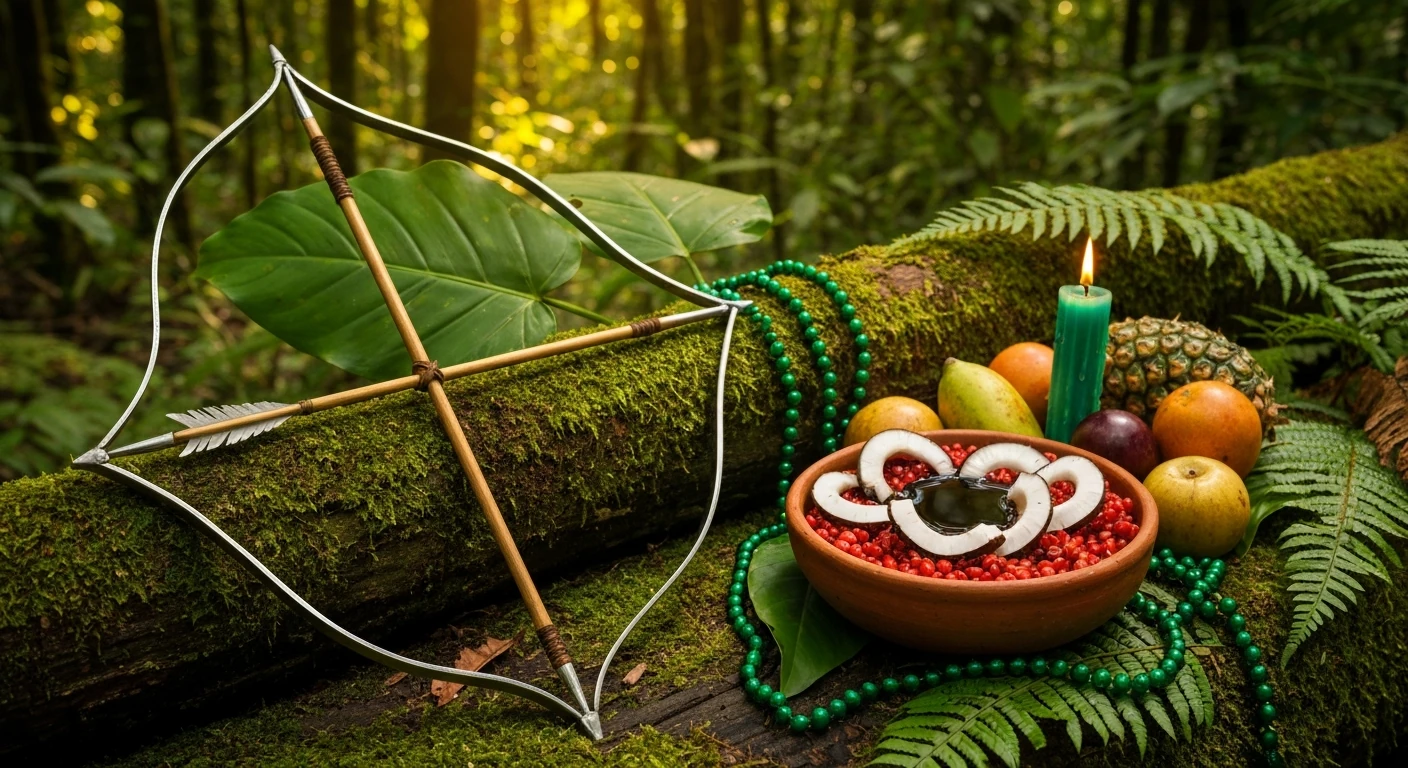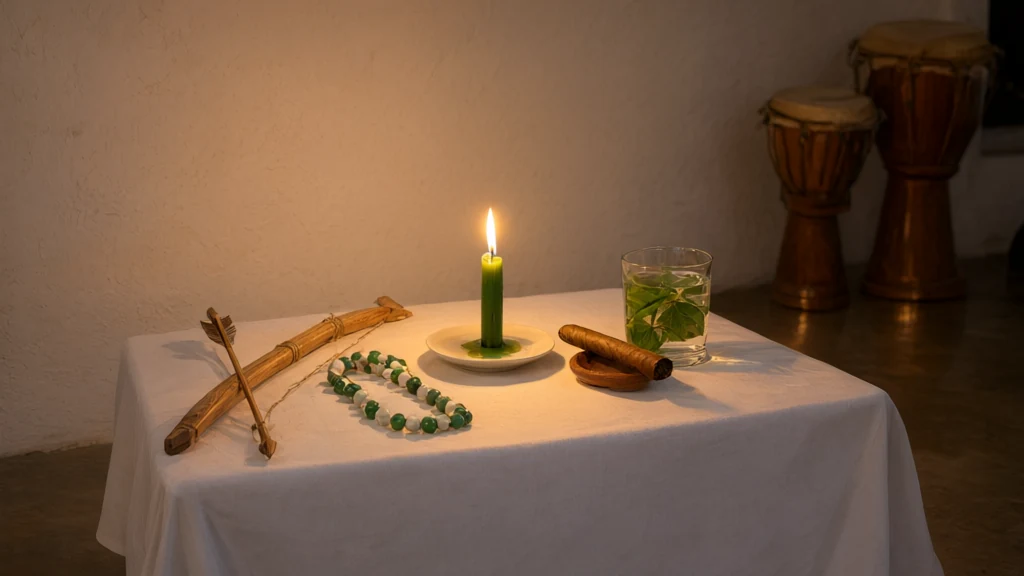
Oxóssi in Umbanda is the orixá who rules the line of the caboclos, the spirits of indigenous Brazilians who work in the giras. For most houses and authors, the orixá himself does not descend: who incorporates is the caboclo of his line. The most cited color is green, the day is Thursday, and the festive date is January 20.
Who is Oxóssi in Umbanda
Oxóssi is the hunter of the forests, the same orixá of Candomblé, lived in a different way. The origin and the complete profile are in who is Oxóssi.
In Umbanda, he is first of all the regent of a line. In 1933, in Rio de Janeiro, the writer Leal de Souza listed the seven lines of Umbanda of his time. The third was "of Euxoce (Oxóssi)", which in the language of Umbanda was called "S. Sebastião". For him, this line "is, par excellence, that of the indigenous Brazilians".
Other codifiers put together different lists. Matta and Silva, for example, put Oxóssi among seven lines that included Children and Pretos-Velhos. The researcher Sônia Lages (UFJF), who summarizes this list, warns: "the classifications vary". The comparison of the lists is in the 7 lines of Umbanda.
The Tenda de Umbanda Caboclo Tupinambá e Vó Catarina (TUCTVC), in São José dos Campos (SP), says that Oxóssi "is a very present force in the lines of Caboclos".
Does Oxóssi incorporate in the gira?
In most houses and for most authors, no. Who incorporates is the caboclo of the line of Oxóssi.
The historian Lourival Andrade Júnior (UFRN) cites the Revista Espírita de Umbanda: Oxóssi "becomes the Father of the Caboclos, who are the ones who manifest in the giras, not the orixá itself." Lages summarizes Matta and Silva in the same sense: the orixás "pass on their attributes to the spirits," without presenting themselves "personally in the terreiro, as occurs in Candomblé." And a 2023 dissertation (UFMS) cites the sociologist Renato Ortiz: "in Umbanda, the orixás do not descend."
In the Terreiro de Umbanda Pai Maneco, in Curitiba, the son of Oxóssi receives as a Pai-de-Cabeça "a Caboclo from the governing line of the same Orixá as the medium." What tradition says about those who are of Oxóssi is in sons of Oxóssi.
"In eight years of ritual work and research, I only had the occasion to see two Orixás, one of Euxoce (Oxóssi), the other of Ogum (Ogun)." Leal de Souza, 1933
For Leal de Souza, it was rare, but it happened. The same house in Curitiba, speaking of another orixá, recognizes that "there are houses where these incorporations occur."
Why do so many people say that "Oxóssi descended"? Andrade Júnior explains: "in many cases the caboclo is placed on the same level as the orixá Oxóssi." Many houses call the caboclo by the name of the orixá, and this is not anyone's mistake. If the doubt is about your gira, ask the leader of your house.
Who descends in the line of Oxóssi: the caboclos
Who works in the line of Oxóssi are the caboclos and the caboclas. In the Templo de Umbanda Pai Oxalá (Obatala), in Campo Grande (MS), they "generally work in the line of Oxóssi. That is, under the vibration of the orixá".
In the same house, researcher Thaís Constantino recorded caboclos such as Pena Branca, Jurema, Jupira, 7 Flechas, Tupinambá, Cobra Coral, Ubiratã and Pedra Verde. Many times they incorporate "representing hunters with bows and arrows." A medium told her: "I work with the Caboclo Pena Branca, who is a caboclo of the forests of the Oxóssi line."
This is the list of one house, not a closed catalog. In TUCTVC, for example, Oxóssi "is deeply linked to the Caboclo Tupinambá." Each terreiro has its own caboclos, and the same caboclo can work with the energy of other orixás.
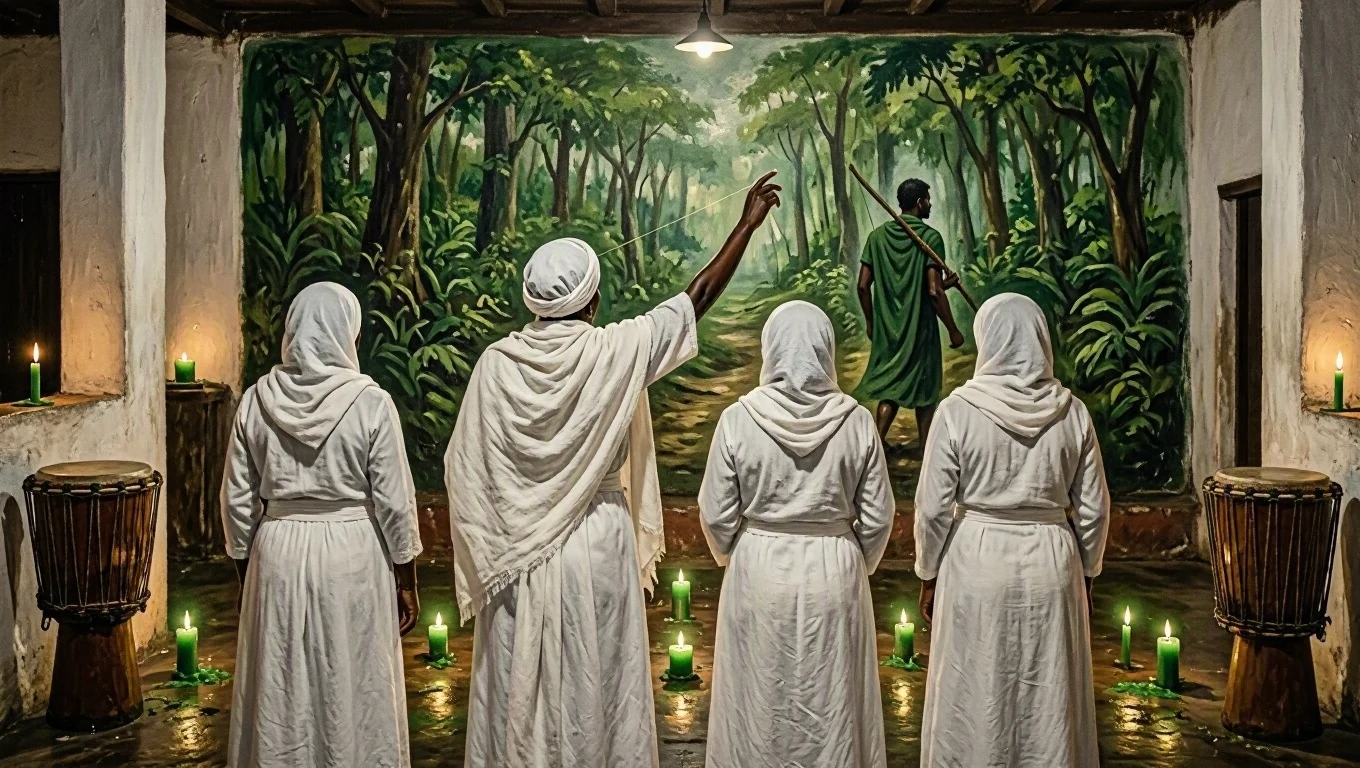
The entire line is in caboclos in umbanda, and the history of the caboclo who opened umbanda, in the Caboclo das Sete Encruzilhadas. The discover your spirit test is a starting point, not the house's answer.
Color, day and greeting of Oxóssi in umbanda
Color: green, or green and white | Day: Thursday | Date: January 20 | Greeting: Okê Arô
- Color. Leal de Souza already gave "green" to the Oxóssi line in 1933. TUCTVC uses a green and white bead necklace and candle, and Terreiro Pai Maneco also gives "green and white." Light blue appears more in the candomblé terreiros of Bahia, according to researcher Raphael de Jesus (UFJF), who cites Lody. He himself remembers that this "does not prohibit" blue in Rio.
- Day and date. TUCTVC gives "Day of the week Thursday" and "Date of worship January 20", the day of Saint Sebastian. The reason for the date is in Saint Sebastian and Oxóssi; the holiday law, 2027 and the Salvador festival, in Oxóssi day.
- Greeting. Andrade Júnior records “Okê Aro! Okê Oxóssi! Okê Odé!”. The “Okê Caboclo” heard in the giras came from “an adaptation of the Okê Oxóssi greeting”. The MASP translates “Okê arô” as “Hail the great hunter”. The greetings of all orixás are in orixá greetings.
What to ask of Oxóssi
One asks Oxóssi for what the hunter brings home: sustenance. The TUCTVC lists “prosperity and worthy sustenance”, in addition to studies, work, and healing. Terreiro Pai Maneco calls him “the knower of herbs and the great healer”.
A green candle of a single color, lit on a Thursday on a firm plate, is the simplest gesture. The green and white bead necklace is the one these houses describe for the line; what each color means is in bead necklace of Oxóssi. The herbs are also his, and the list with the use of each one is in Oxóssi herbs.
Offering is a matter of the house. Leal de Souza recorded that the ritual offerings of the Oxóssi line were made “in the woods”, and Terreiro Pai Maneco indicates “at the entrance of the woods”. Before taking anything to the woods, ask your house what goes and where it goes. If you want to check the material the house requested, Joia Mística Laroyê helps via WhatsApp.
Ponto (sacred song) and statue of Oxóssi on the congá
A ponto is the sacred song of the gira, and each house sings its own. Tenda Espírita Nossa Senhora da Piedade, the house founded by Zélio de Moraes, publishes in its Livro de Pontos Cantados a section of “Pontos de OXOSSI”. One of them begins like this:
Ai não me toque no bodoque de Oxossi / He is the king of the woods / He is a hunter
In the congá of many houses, who represents Oxóssi is the statue of Saint Sebastian, the saint pierced by arrows. The painting Umbanda (1968), by Maria Auxiliadora da Silva, at MASP, shows on the altar "the figure of Saint Sebastian, or Oxóssi, the hunter", and on the floor, "the Caboclo". Syncretism, says the TUCTVC, "does not mean that the two figures are exactly the same deity".
The common symbol is the ofá, the bow and arrow, which Abdias Nascimento called "the emblem of Oxóssi" in the painting Okê Oxóssi (1970).
What changes from the Oxóssi of Candomblé
The great difference is presence. Lages summarizes it like this: in Umbanda, the orixás pass their attributes to the spirits, and do not appear personally in the terreiro, "as occurs in Candomblé". Therefore, Candomblé speaks of the qualities, nation, and initiation of Oxóssi, and Umbanda speaks of the line and of caboclos.
The color also changes with the region. In the Candomblé terreiros of Bahia, Oxóssi wears more light blue; in those of Rio, more green. The National Museum (UFRJ) keeps a sculpture of Oxóssi made in a Candomblé terreiro in Magé (RJ), "with parts painted in light blue" and the ofá beside it.
The general comparison is in difference between Umbanda and Candomblé, and the confusion with the owner of the leaves, in Ossaim and Oxóssi. The orixá profile is in Oxóssi.
Frequently asked questions
Does Oxóssi incorporate in Umbanda?
For most houses and authors, no: who incorporates is the caboclo of the Oxóssi line. Lages, Andrade Júnior, and Ortiz record this. Leal de Souza, in 1933, said to have seen an orixá of Oxóssi incorporated in eight years. Many houses call the caboclo by the name of the orixá.
What is the color of Oxóssi in Umbanda?
Green, since Leal de Souza in 1933. Houses like TUCTVC and Terreiro Pai Maneco use green and white bead necklace and candle. Light blue appears more in the Candomblé terreiros of Bahia. The color that counts is the one your house uses.
What is the day of Oxóssi in Umbanda?
In the week, Thursday. In the year, January 20, the day of Saint Sebastian, the date that TUCTVC uses for the worship of Oxóssi.
What to ask Oxóssi?
Prosperity, sustenance, work, study, and healing, according to TUCTVC. Terreiro Pai Maneco calls him a great healer and knower of herbs. The offering follows what your house instructs.
Is Oxóssi Saint Sebastian?
No. Saint Sebastian is the statue that represents Oxóssi in the congá of many houses, because of syncretism. TUCTVC reminds that syncretism does not make the two figures the same deity.
References
- Leal de Souza, 1933 book: O Espiritismo, a Magia e as Sete Linhas de Umbanda
- Lages, Clio Edições Eletrônicas (UFJF, 2003): Exu: light and shadows
- Andrade Júnior, Mneme (UFRN, 2014): The caboclos in Afro-Brazilian religions
- Constantino, dissertation (UFMS, 2023): Corpo encantado, caboclas and caboclos in the Templo de Umbanda Pai Oxalá
- Jesus, Sacrilegens (UFJF, 2024): The chromatics of the Orixás
- MASP: Umbanda, by Maria Auxiliadora da Silva and Okê Oxóssi, by Abdias Nascimento
- Museu Nacional (UFRJ): catalog of the Coleção Ilé Ògún Àlákòró
- TUCTVC: Oxóssi
- Terreiro de Umbanda Pai Maneco: Oxóssi, King of the forests and Oxalá in Umbanda
- Tenda Espírita Nossa Senhora da Piedade: Book of Chanted Points