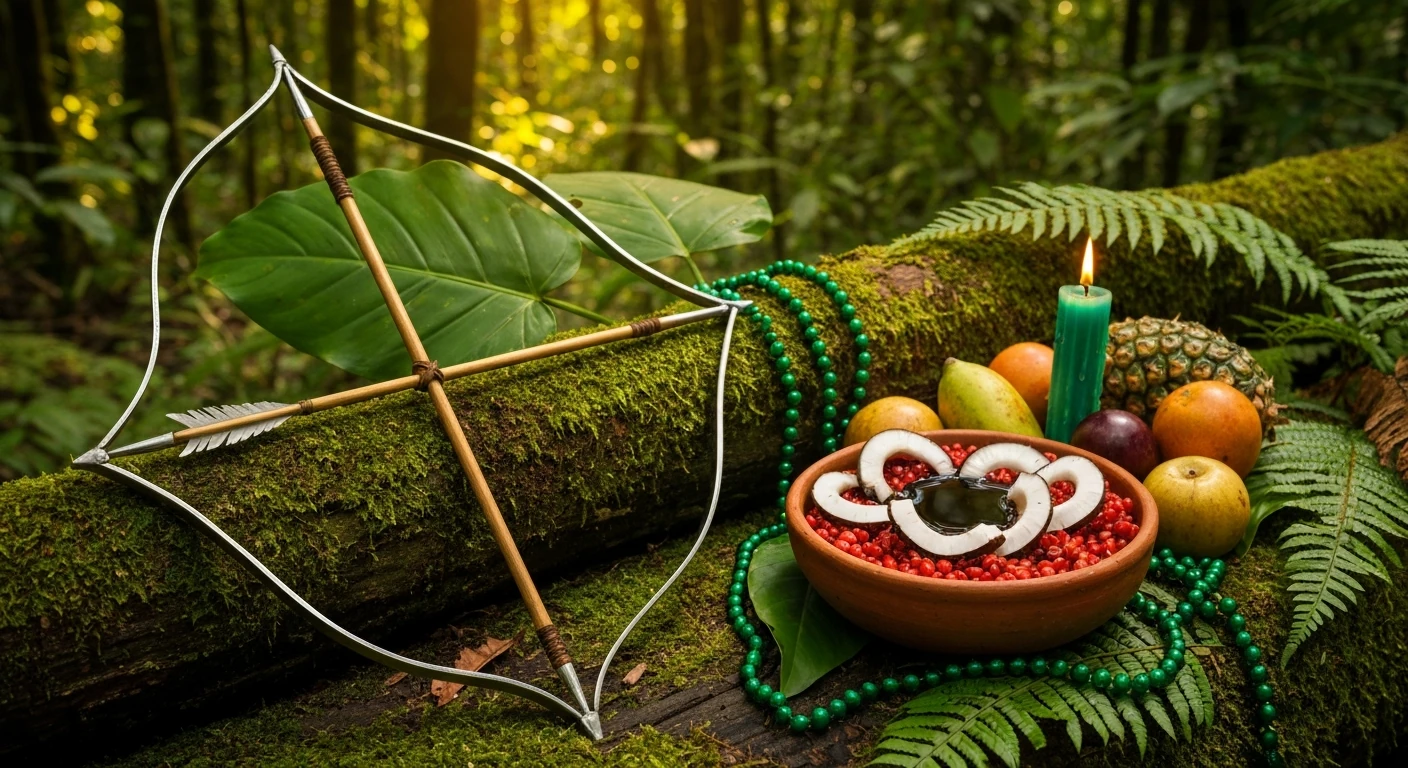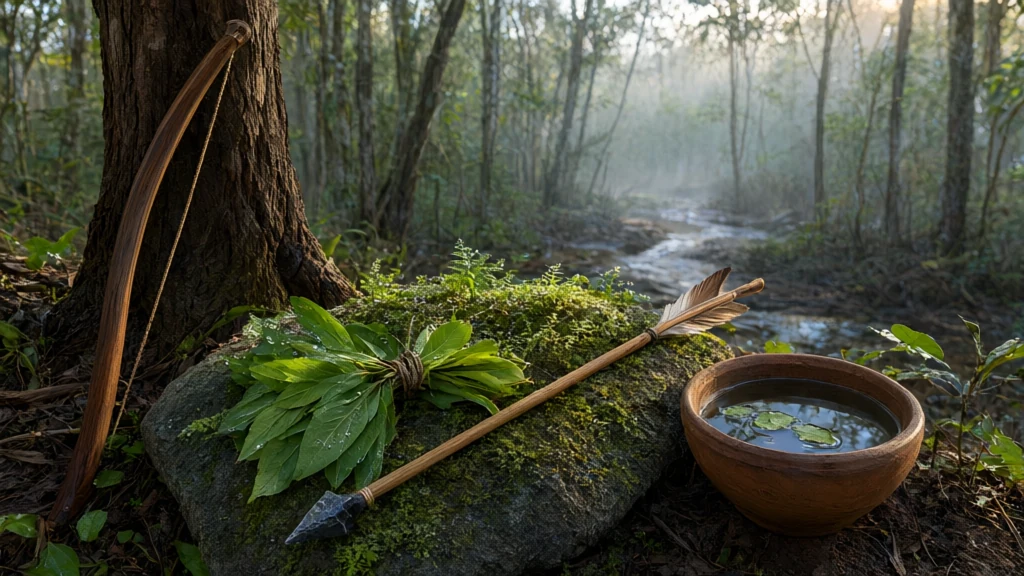
Ossaim and Oxóssi are confused because Candomblé literature puts them in the same place: the forest, Thursday, and, in some houses, the same roncó. Each nation still arranges the pair in a different way. Ketu has two orixás. Angola worships two inquices in contact. Jeje has Agué, which sources attribute to one or the other.
The text uses Ossaim and leaves Ossain where the source writes it. It does not correct anyone: it shows where the confusion comes from.
Is Ossain the same orixá as Oxóssi?
No. In Ketu Candomblé, they are two orixás. In Reginaldo Prandi's table, Ossaim is of the vegetation (flora) and Oxóssi, of the hunt (fauna). The profile of the owner of the leaves is in who is Ossaim. The division between leaf and forest, with the day and the roncó in common, is in herbs of Oxóssi. This is where the doubt is fueled.
FUCESP, the federation of Umbanda and Candomblé of São Paulo, writes that the two "possess numerous affinities: both are orixás of the same space, of the forest, of the bush, of the leaves." In an itã, Iemanjá (Yemoja) fears that Oxóssi will find Ossain in the forest. Pierre Verger writes that Exu (Eshu), Ogum (Ogun), Oxóssi, and Ossain "are equally symbolized by forged iron objects and live outdoors."
Pedro Botelho heard ialorixás and babalorixás in Bahia. He records that Ossaim is "orixá I’odê", from outside, from the street, like Exu, Ogum, and Oxóssi. Few are the initiated children of him.
Angola: two inquices for what Ketu divides
In Angola, the leaf and the forest appear as a pair of inquices. In Terreiro Tumbenci, in Salvador, Catendê is the lord of the leaves and of healing. Mutalombô is the lord of the hunt, of plenty, and of abundance. According to Hildete Costa and César Vitorino, the Angola nation worships Catendê "in partnership with Mutalombô", who "lives in contact with Catendê".
A dissertation from USP about the Candomblé of the Angola nation reaches the same pair. The nkisi of the leaves is Katendê. The one of the woods, of the forests, and of the animals is Mutalombo, or Mutalambo, or Mutakalombo, "very close to Nkisi Katende". Prandi also records both names. The inquice Catendê appears in the Ossaim line, and Mutacalombo, in the Oxóssi line.
Open sources do not say that Catendê and Mutalombô are Ossaim and Oxóssi with another name. They describe the pair that the Angola nation worships in close contact, and Prandi places each one in the line of one of the orixás. If it is the same figure with another name, the house provides the answer. More inquices in inquices of the Candomblé of Angola.
Erinlé and Ibualama: the third hunter
Between the woods and the leaf there is a third figure. Verger describes Erinlé, called Inlé in Brazil and in Cuba, as the god of hunting in Ijexá, with a temple in Ilobu. His emblem is of forged iron: a bird over a central rod, surrounded by sixteen others, each with a bird. The one of Ossain, in the same Verger, is an iron rod with a bird, surrounded by six. Both figures have iron and a bird. The number of rods changes.
Ibualama enters by another path. For Verger, it is one of the deep places of the river of Erinlé, and "it is always Erinle who is worshiped under all these names". In Bahia, he dances with the iron bow and arrow of Oxóssi.
Whether Erinlé is a separate orixá or a quality of Oxóssi, the literature is not conclusive. Adail Rodrigues Júnior places Erinlé and Ibualama next to Oxóssi among the "hunter orixás". He recalls, citing Prandi, that the invocations of an orixá are called qualities in Brazil. Cacciatore's dictionary, cited in a thesis from UnB, writes "Inlé (Oxóssi)" in the entry for Logunedé (Logun Ede). Which reading is valid is the house's answer.
Agué: the vodun that each source gives to one
In Jeje Candomblé, the confusion has another name. Prandi puts Agué in the Ossaim line, next to the inquice Catendê. The newspaper A Tarde describes the Bogum, a Jeje house in Salvador, and writes "agué, vodun of hunting and forests (Oxóssi)". Two sources give the same vodun to two Ketu orixás.
An article from UnB helps read this. Most of the voduns of the Mina Jeje cult "do not have a correspondence between the Nagô Orixás". Looking for the Ossaim or the Oxóssi of Jeje is getting closer. Those who say what Agué is are the Jeje houses.
Honey: an offering for one, a taboo for the other
Honey shows how the records cross. FUCESP lists as main offerings for Ossain "tobacco leaf, cachaça (Oti) and honey". The Catendê record in Tumbenci brings honey along with corn and rolled tobacco leaf. In the Nagô Batuque of Rio Grande do Sul, informants of Angélica Mortagua say that Ossaim accepts honey and molasses, among other things. The Gaúcho perspective is in Ossanha in batuque.
For Oxóssi, the table is inverted. In Prandi's table, eating honey is a taboo for the children of Oxóssi, and Wikipedia records bee honey as the great euó of the orixá. The FUCESP page on Oxóssi lists candles, cigars and fruits and does not mention honey. It is silence, not prohibition. The blog already records, in offering for Oxóssi, that some Umbanda houses use honey. What the taboo changes for those of the orixá is in children of Oxóssi.
The text does not teach offering: what is taken to each orixá is a decision of the house.
The end of the potion itã, in Verger
In the itã that Verger records, Oxóssi finds Ossain, who gives him to drink a potion in which certain leaves were macerated. Oxóssi stays "living in the woods with Ossain" until Ogum goes to fetch him. Brought back, he is not received by Iemanjá. He returns to the company of Ossain, and Iemanjá transforms into the Ògùn river.
“He then lived in the forest with Ossain, as the babalaô had predicted.”
Pierre Verger, Orixás
The outcome that Verger records is the potion, the return of Oxóssi to Ossain and Iemanjá turning into a river. FUCESP says something in the same direction. On Oxóssi's page, he learned the secret of the leaves from Ossaim, “but he had to submit to the enchantments of Ossaim”. The hunter's profile is in who is Oxóssi.
What each one is, nation by nation
| Nation | Ossaim | Oxóssi |
|---|---|---|
| Ketu (Prandi) | orixá of vegetation, of leaves and the efficacy of medicines | orixá of hunting, of forests and the abundance of food |
| Angola (Tumbenci) | Catendê, lord of the leaves and of healing | Mutalombô, lord of hunting and of abundance |
| Jeje | Agué, in Prandi | Agué, in A Tarde |
Day: Thursday for both in Prandi and in Tumbenci | Colors: green and white for Ossaim
Whoever asks which of the two it is is led to the house, which defines the orixá, the quality, and the nation.
Frequently asked questions
Is Ossain the same as Oxóssi?
No. In ketu, Prandi separates the two: Ossaim is the orixá of vegetation and Oxóssi, the one of hunting. Angola worships two inquices, Catendê and Mutalombô, and jeje has Agué, whom the sources give to one or the other.
Is Ossain a son of Oxóssi?
Open sources give Nanã (Nana Buruku) as the mother of Ossaim, in the itã of Prandi, cited by Purcino, and do not bring kinship between him and Oxóssi. No source for "Ossain is a son of Oxóssi" was located.
Can Oxóssi receive honey?
In Prandi, eating honey is a taboo for the children of Oxóssi, and Wikipedia records bee honey as the euó of the orixá. Some Umbanda houses use honey, as the blog records in offering for Oxóssi. What is taken to Oxóssi is a decision of the house, and this text does not teach offering.
What is the difference between Ossaim and Oxóssi?
In Prandi, Ossaim is the orixá of vegetation (flora) and the efficacy of medicines. Oxóssi is the one of hunting (fauna), of forests, and of abundance. Both have Thursday. The comparison by nation is in the chart above.
References
- Reginaldo Prandi: Deuses africanos no Brasil contemporâneo, Horizontes Antropológicos, 1995
- Pierre Verger: Orixás, deuses iorubás na África e no Novo Mundo, Corrupio, 1981
- Pedro Freire Botelho: Ewé Awo, the secret of the leaves in the Candomblé of Bahia, Education, Management and Society, 2011
- Hildete Santos Costa and César Costa Vitorino: Terreiro Tumbenci and the use of plants that heal, Fragmentos de Cultura, 2020
- Bianca Cristina de Lima Conceição Purcino: Ethnobotanical profile in Candomblé terreiros in southern Bahia, dissertation, UFSB, 2022
- Veridiana Silva Machado: The Staff of Lemba, the tempo in Angola nation Candomblé, dissertation, USP, 2015
- Adail Sebastião Rodrigues Júnior: ethno-stylistic study of mythical narratives of Ketu candomblés in Bahia, Revista Brasileira de Linguística Aplicada, 2022
- Mariana de Lima e Silva: Ọmọ Mímọ, the son of love, thesis, UnB, 2012
- Ronan Gaia and Alice Vitória: Orixás, nkises and voduns, Calundu Journal, UnB, 2021
- FUCESP: pages Ossain and Oxóssi
- A Tarde: Bogum has a cult to the vodun of the tree, 2023
- Angélica da Rosa Silva Mortagua: final course project on Batuque, UFPel, 2023
- Wikipedia: Axoxô entry