



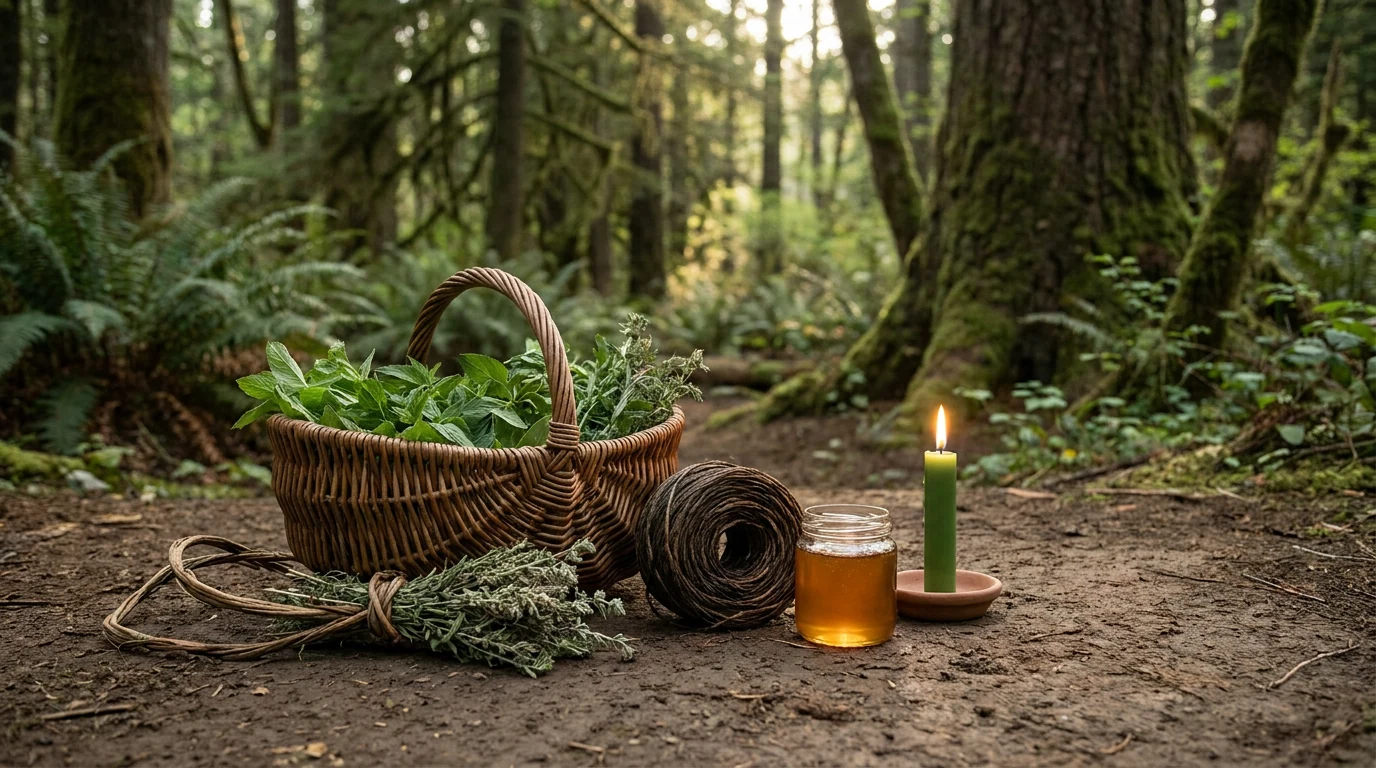
The offering for Ossaim (also written as Ossain) recorded in open sources is tobacco leaf, cachaça and honey, delivered in the woods. The rest belongs to the house. Preparation, order and obrigação are not in public sources.
What is offered to Ossaim, according to open sources
Open sources record tobacco leaf, cachaça and honey as an offering for Ossaim. The FUCESP federation lists the three as the main offerings of the orixá (orisha). Tobacco leaf is the most repeated item. It appears in the five sources: FUCESP and the four below. For the profile of the orixá, see who is Ossaim.
What each source records, with the tradition of its origin:
- Ketu candomblé, São Paulo terreiros (Prandi): cooked corn seasoned with tobacco leaf, and fruits.
- Candomblé angola, Salvador (Tumbenci terreiro): corn, acaçá, honey and rolled tobacco leaf, for Catendê, the inquice that corresponds to Ossaim in the angola nation.
- Candomblé angola, Belo Horizonte: at the entrance of the woods, the house greets the spirits of the place and makes offerings of water, a lit candle, acaçá, aguidi, cachaça and tobacco leaf, with a gift to Katendê.
- Batuque, Pelotas: cigar, rolled tobacco leaf and pipe, in addition to grains, honey, peanuts and fruits, and in Nagô pineapple and avocado.
Items mentioned: tobacco leaf, cachaça (oti), honey, corn, fruits | Day: varies, with Thursday in the lead | Color: green and white in several sources
This is the list of what is recorded. It is not a recipe. Several of these sources also list obrigações with animals, and they belong to the fundamento of the house, so they are not included here. The day, moreover, changes from one tradition to another.
Honey is an offering for Ossaim and a taboo for Oxóssi, according to Prandi
Honey is an Ossaim offering in three independent sources: FUCESP, the Tumbenci terreiro in Salvador, and the houses of batuque in Pelotas. For Oxóssi, Reginaldo Prandi records the opposite: "eating honey" is the taboo of his children.
Whoever confuses the two orixás takes the honey to the wrong plate. In the Ossaim line, the same Prandi table gives another taboo: whistling. For Oxóssi, the Axoxô entry on Wikipedia says that bee honey is the great euó of the orixá and that the axoxô takes molasses, not honey.
The two orixás divide the forest. In the sources, honey only appears on Ossaim's side. The itã that explains Oxóssi's rule is in offering for Oxóssi.
Where the Ossaim offering is delivered
The open source of delivery says only one thing: the forest. The FUCESP records that Ossaim receives offerings "in the virgin forests." No reading source indicates the street, the crossroads, or the trash.
The sociologist Roger Bastide, cited by Pedro Freire Botelho, summarizes the place of the orixá:
“The kingdom of Ossaim begins where the kingdom of men ends”
Botelho explains that Ossaim is an "orixá of the street" in the sense of orixá of the exterior, like Exu (Eshu), Ogum (Ogun), and Oxóssi. It is not the street of Exu. No one should read from that the delivery goes to the asphalt.
An ialorixá from Nazaré das Farinhas, in Bahia, interviewed by Botelho, helps to understand the distance. Ossaim "likes to live alone, isolated" and "does not like much noise, or many people".
Two taboos appear with names. Prandi records whistling as a taboo for the children of Ossaim. FUCESP lists wind as a quizila of the orixá, and it is the only one that brings this line: other sites repeat the text without independence. What is quizila is in quizilas in candomblé.
Taking care of the place (asking for permission, not leaving plastic or dishes, collecting what does not decompose) is common sense of the site, not a rule taken from a source about Ossaim.
Candle, greeting, and permission: the devotee's offering
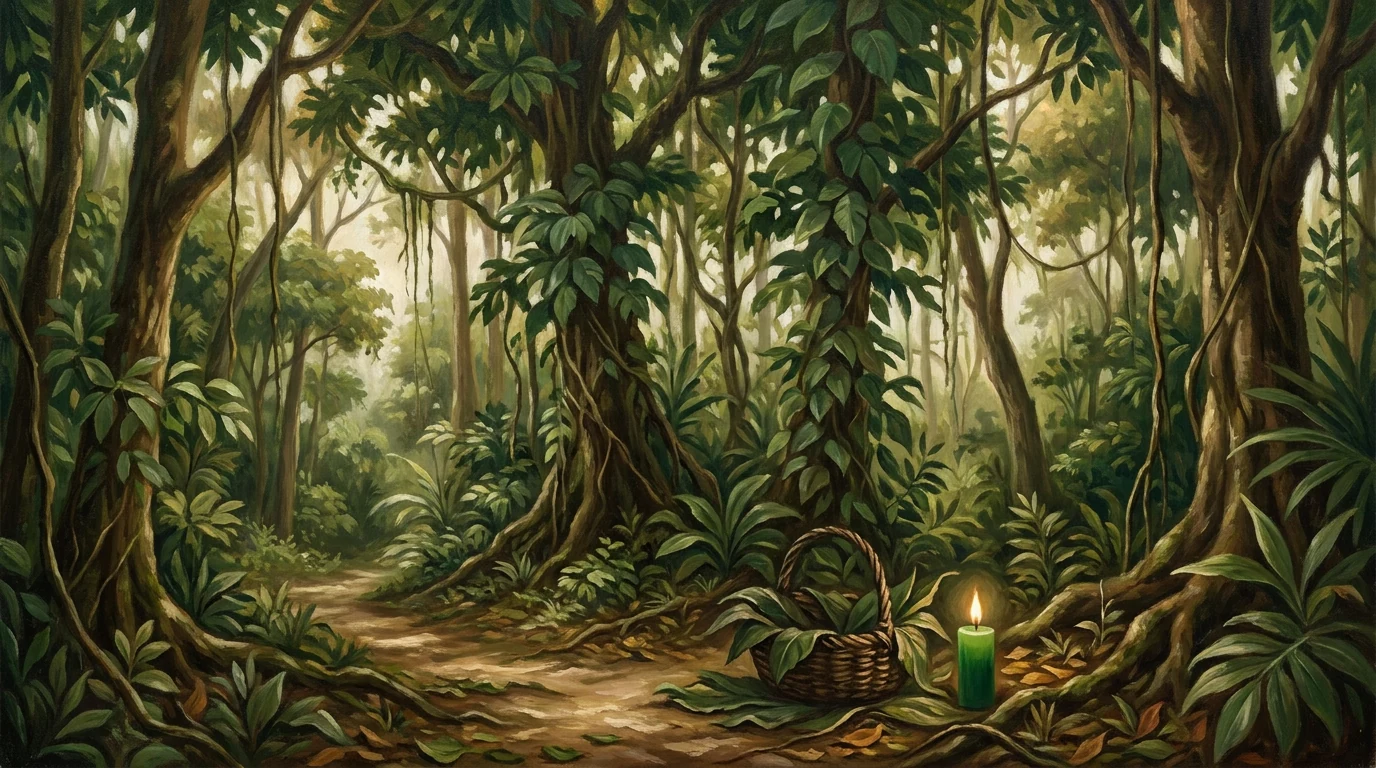
The candle is a variation of the house. In an Angola house in Belo Horizonte, the lit candle is among the offerings at the entrance of the forest. An ogã of Umbanda from Pelotas says that each herb used is paid for with a greeting and a green candle, or green and yellow. The TUCTVC, from São José dos Campos, records green and white as the color of the candle.
It circulates on the internet that Ossaim does not accept candles because it cannot withstand fire. Reliable source for this: not located. Open sources record a lit candle, and the choice belongs to the house. Whoever will light it finds at Joia Mística the unique green candle, sold individually. The final color is the one the house indicates.
The scene of the Angola house in Belo Horizonte shows the gesture without a recipe. Before entering the forest, the mametu says:
“Let's give an offering to Katendê so we can enter the forest, the god of the leaves”
The permission also appears in the sources. A researcher cited by Costa and Vitorino points, for the Candomblé ritual, to the gesture of “bowing to the leaf and asking permission from its patron, which is Ossain”. In Pelotas, the leader talks to Ossaim while harvesting and says he will not harm the herbs.
As for the money left on the ground, it is a custom described by Pierre Verger among healers in an African community. It is not a rule in Brazil nor the price of an offering.
Offering for Ossaim in Umbanda
In Umbanda, the answer varies, and some houses only greet the orixá. FUCESP and TUCTVC, both from São Paulo, bring Ossain with color and day, and FUCESP also lists the offering.
In Pelotas, on the contrary, the leader Airton de Oxalá (Obatala) does not practice the direct worship of Ossaim, but he greets him whenever he uses the herbs. In the Nagô Umbanda of Porto Alegre, Vladimir Torres' survey records that Ossain "does not integrate his main pantheon." The leaves are used "without, however, consecrating them to this orixá."
Whoever asks "what is offered to Ossaim in Umbanda" receives an honest answer. It is what his house does. In some houses, the offering is the greeting to the herb.
And the offering for prosperity?
No academic source prescribes an offering of Ossaim for money, and Joia Mística does not promise results. In Prandi and in Verger, the function of the orixá is the leaf and the healing.
Two points touch on money, and neither is an offering to prosper. An itã recorded by Prandi and transcribed by Mortagua tells that Ossaim stipulated a payment for the cure. And Verger describes the money offering that the curandeiros leave to the herb.
A single gaúcha casa de batuque, Ilé Àsé Odé, calls Ossanha the “owner of current currency.” It is a unique source. It is from one house and does not apply as a rule.
No offering buys a result. It gives thanks, firms the relationship with the orixá and organizes the intention of the one who offers.
What stays with the house
There are foundation obligations with animals, and they belong to the house. The abô, the mixture of leaves, is "the most important of the plant mixtures of the cult," according to Barros, cited by Botelho. The ialorixá of Nazaré says that the leaves have a singing order and that "some cannot pass in front of others." What abô is can be found in what is abô.
None of this is learned in open text. For the concept of obrigação, see what is ebó. For offerings in general, how to make offering to the orixás. The excerpt on Batuque is in Ossanha in Batuque.
If your question is about the material the house requested, the shop team checks via WhatsApp. Whoever has an obrigação to fulfill fulfills it at the house, with the leader.
Frequently asked questions
What is offered to Ossaim?
Open sources record tobacco leaf, cachaça, and honey, and in some houses corn, fruits, and acaçá. FUCESP lists the first three as the main offerings. What else enters, and how, is the decision of the house, and the obligation of the foundation remains with the leader.
Does Ossaim accept a candle?
It varies by house. There is a record of a lit candle at the entrance of the forest in an Angola house in Belo Horizonte, and of a green candle, or green and white, in Umbanda houses. The idea that he cannot withstand fire has no reliable source located.
Is there an Ossaim offering for prosperity?
No academic source prescribes it. The tradition that Prandi and Verger record links Ossaim to the leaf and to healing. A single Batuque house calls him the owner of current currency. Joia Mística does not promise results for any offering.
Can I make the offering alone?
Greeting the herb and asking for permission before harvesting are gestures that sources describe in the harvest. The comida de santo, the obrigação, and everything involving animals or assentamento belong to the house. In doubt, ask your leader before setting up anything.
References
- Reginaldo Prandi: Deuses africanos no Brasil contemporâneo, Horizontes Antropológicos, 1995
- Hildete Santos Costa and César Costa Vitorino: Terreiro Tumbenci and the use of plants that heal, Fragmentos de Cultura, 2020
- Angélica da Rosa Silva Mortagua: Orixá Ossaim, from invisibility to the habitual in Pelotas, TCC, UFPel, 2023
- Pedro Freire Botelho: Ewé Awo, the secret of the leaves in the Candomblé of Bahia, Education, Management and Society, 2011
- Vladimir Stolzenberg Torres: Botanical species in Nagô Umbanda temples, UNISANTA Bioscience, 2018
- César Guimarães and Pedro Aspahan: The enchantment of the leaves, Forumdoc.bh, 2024
- Pierre Verger: Orixás, Corrupio, 1981
- FUCESP: Ossain file
- TUCTVC: Ossanha file in Umbanda
- Ilé Àsé Odé: orixá page
- Wikipedia: Axoxô entry


