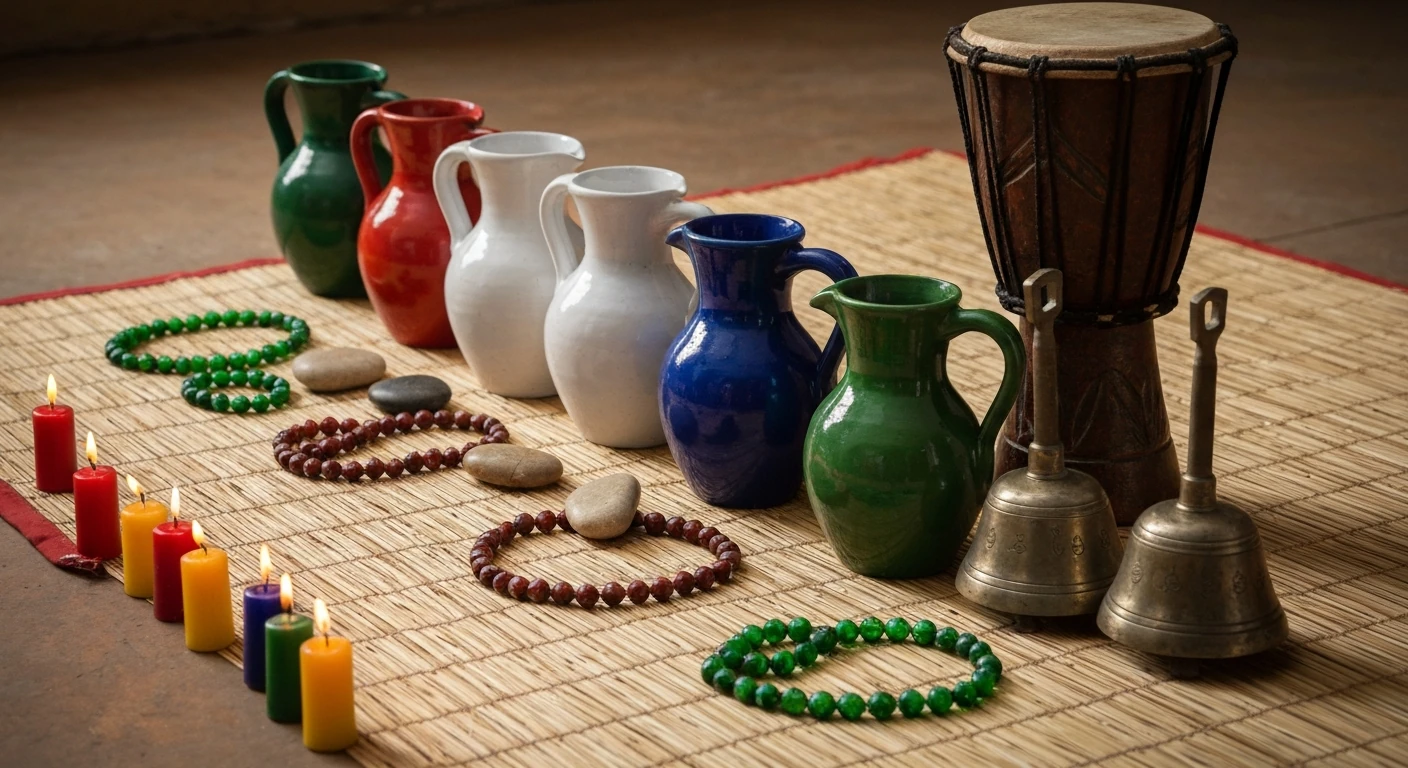
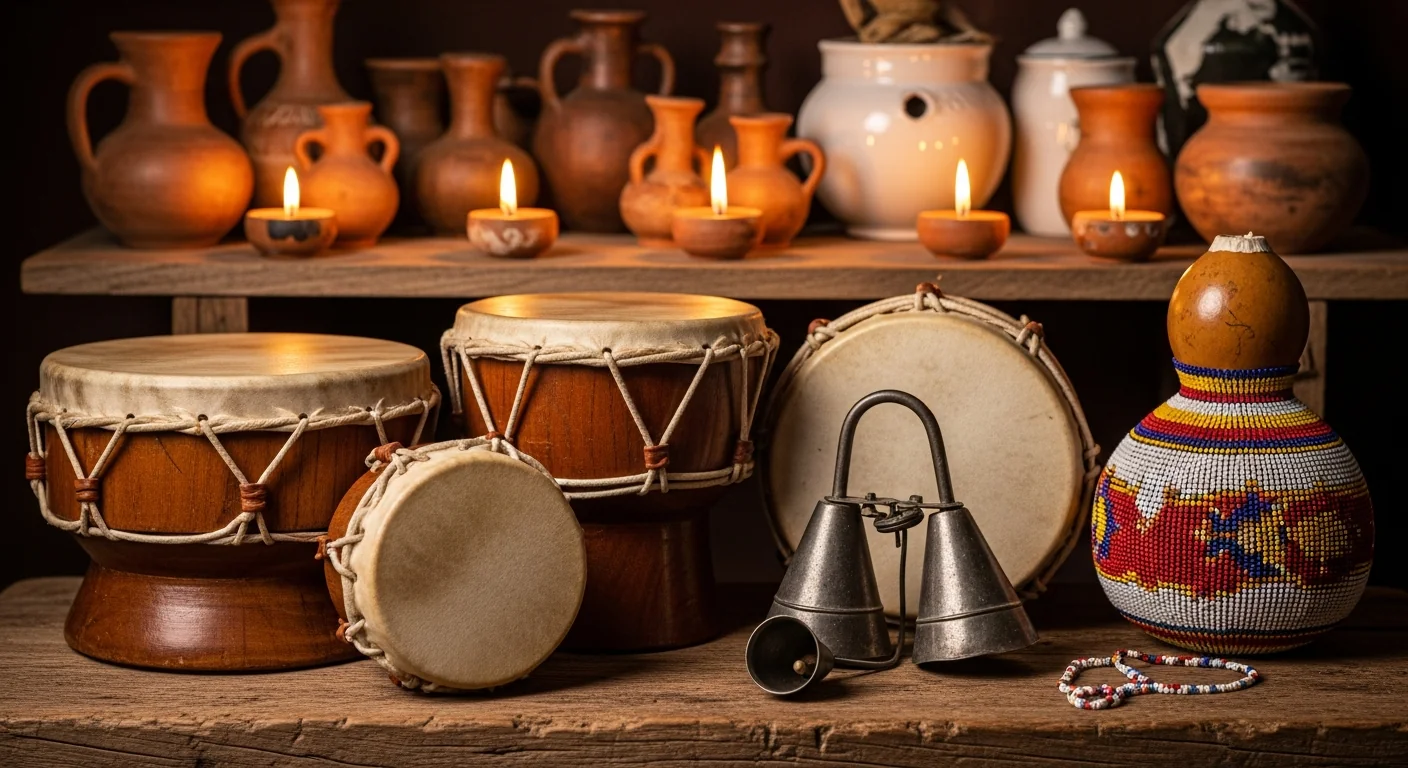
There is a task that almost no one does in the houses of the South. Before any obrigação, someone needs to go to the forest to fetch leaf. Without this leaf, the rest does not happen.
Ossanha in Batuque is the owner of this secret. He rules the herbs, the forests, and the healing, and it is from him the axé that lives in the ritual bath of macerated leaves. No other orixá is settled, no head is made, without his leaves entering first.
This guide gathers the profile of Ossanha in the Gaucho Batuque: position in the line, colors, day, greeting, foods, tools, and syncretism. And it records, without sugarcoating, everything that changes from nation to nation.
Who is Ossanha in the Batuque line
In Batuque, the orixás are called in a fixed sequence called linha. Ossanha enters after Obá and before Xapanã, at the point where the line leaves the new orixás behind.
This position is one of passage. He stays between the class of the new and the old, and the intermediate place suits his function: serving all the others.
A disclaimer is made right now. Some sources place Ossanha before Obá (Oba), and the order varies by house. Anyone who wants the complete overview can find the sequence used here in the orixás of Batuque.
His domain is well delimited. Ossanha rules the liturgical and medicinal leaves, the forests, the secret of the plant, and the healing. In the human body, the current reading in the South gives him the bones, the nerves, and the muscles.
The fundamento says that without leaf there is no orixá. It is the shortest way to explain why Ossanha crosses all of the worship, even without being the first in the line.
Technical profile of Ossanha in Batuque
| Item | In Batuque |
|---|---|
| Name | Ossanha (also Ossânha, Ossãe) |
| Regency | leaves, herbs, woods, healing, secret of the plant |
| Position in the line | after Obá, before Xapanã |
| Class | orixá of the middle line |
| Colors | green and yellow in the Ijexá |
| Number | 7 and its multiples |
| Bead necklace | alternating green and yellow beads |
| Day | Monday in most houses |
| Greeting | Eu-Eu |
| Foods | white popcorn, fried pork sausage, figs and potato apetê |
| Tools | metal coconut tree, crutch, scalpel, cágado, coins and cowrie shells (búzios) |
| Adjuntó | Oxum (Oshun) Demum in most records |
| Syncretism | varies by house: Saint Roch, Saint Christopher, Saint Jude Thaddeus, Saint Joseph |
The consecrated foundation (assentamento) is made upon the otá, the stone that guards the axé of the orixá. The detail of the pottery, the tools, and what goes inside is house foundation, and it is not learned through the internet.
The crutch is his most recognizable tool. It comes from the mythical attribute of the single leg, and reappears in the dance, when the orixá leans on one side only.
The owner of the omieró: why nothing begins without Ossanha
Here lives the point that most texts overlook. The omieró, also called abô, is the sacred water made with macerated leaves. It washes the head, washes the consecrated foundation (assentamento), and washes the tools.
This water is the material base of almost every obrigação. Without it, the head is not washed, the orixá is not settled, and the initiation is not fulfilled. And the one responsible for the leaves is Ossanha.
That is why the elders say he is not the seventh item of a list of twelve. He is the condition for the other eleven to receive what they need.
In daily practice, this appears in three places:
- In the head obligations: the amaci and the omieró open the process
- In the consecrated foundations (assentamentos): the tools and the otá are washed in leaf before everything
- In the ritual baths and fumigations: each herb belongs to an orixá, and the set belongs to Ossanha
If you want to understand how the herbs are organized by orixá outside of the sacred room (quarto de santo), the ritual bath of seven herbs shows this logic in an accessible way.
An honest caveat closes the section. The preparation of the omieró is a matter for the initiated, with its own cutting, prayer, and order for each house. This article explains what the thing is, it does not teach how to do it.
Foods, tools and adjuntó
The most cited votive food for Ossanha gathers white popcorn, fried pork sausage and figs. The apetê also appears, mashed potatoes with dendê, called epô in the South.
Some houses record sautéed kale in dendê with farofa. As almost everything in Batuque, the menu follows the house's fundamento.
The tools form a recognizable set:
- Metal coconut palm: represents the forest and the leaves
- Muleta: the support of the single leg
- Bisturi: the knife of the leaf cut and of healing
- Cágado: the creature linked to secret and patience
- Coins and búzios: present in almost all assentamentos
Adjuntó is the Batuque term for orixás worshipped together, settled in the same space and receiving obrigação together. Ossanha makes adjuntó with Oxum Demum in most of the Rio Grande do Sul records.
There are houses that record another combination, with Iemanjá (Yemoja) Bocí. Neither of the two cancels the other, because adjuntó is a house arrangement and not a general rule.
What changes from nation to nation
Batuque has five historically relevant nations: Oyó, Jeje, Ijexá, Cabinda and Nagô. The anthropologist Ari Pedro Oro, from UFRGS, records Ijexá as predominant today and Oyó as almost extinct in the state.
Whoever seeks a single answer about Ossanha will find conflicting information. The conflict is real, and it is part of the religion.
| Item | Registered versions |
|---|---|
| Colors | green and yellow in Ijexá; green and white in Cabinda and in Jeje-Ijexá houses |
| Day | Monday in most; Friday in Jeje-Ijexá houses |
| Position in the line | after Obá in the most used reading; before Obá in other records |
| Syncretism | Saint Roch, Saint Christopher, Saint Jude Thaddeus, Saint Joseph |
Syncretism deserves extra care. It was born as a survival strategy for the cult in the face of repression, and not as theological equivalence.
In other words, Ossanha is not Saint Roque. Ossanha is an orixá of Batuque, and Saint Roque is a saint of the Catholic Church. The association protected the cult in a time of persecution.
The Sociedade Africana Reino de Xangô, a traditional Gaúcho house, records the syncretism with Saint Roch and the color green. A Gaúcho babalorixá gives August 16, the day of Saint Roch, as the date of Ossanha in Batuque, and the comparison with October 5 of Umbanda is in day of Ossaim: October 5. Other houses record other saints, and each piece of information is valid within its own foundation. To understand why this happens, it is worth reading the nations of Batuque.
Ossanha in Batuque and Ossaim in Ketu Candomblé
This is the most common confusion, and it has a simple explanation. For the Candomblé profile, see who is Ossaim, and for what is offered to the orixá in open sources, offering for Ossaim. Batuque is a religion native to Rio Grande do Sul, formed in the 19th century. It is not Candomblé nor Umbanda, as shown by Oro's work on the Afro-Brazilian religions of Rio Grande do Sul.
The same orixá appears with different names and profiles in each tradition. Wikipedia records the spelling variations, including Ọ̀sányìn in Yoruba, Agué in Jeje, and Katendê among the Bantus.
| Item | Batuque (RS) | Candomblé ketu |
|---|---|---|
| Name | Ossanha | Ossaim, Ossãe |
| Greeting | Eu-Eu in one house; others record Ewé ô, Ewé assá | Ewé ó, Ewê Assá |
| Colors | green and yellow | green and white |
| Symbol | metal coconut tree and crutch | iron rod with seven prongs and a bird |
| Syncretism | varies: Saint Roch, Saint Joseph, Saint Christopher | Saint Benedito in the most widespread reading |
Note the detail of the greeting, because it varies. One house in Rio Grande do Sul records Eu-Eu for Ossanha, another gives "Ewé ô, Ewé assá", and a study from Pelotas records "Ewé Ásà" in Nagô and "Ewé Ó" in Linha Cruzada. The greeting is the one from your house.
The myth of the single leg and the secret of the leaves
Ossanha appears in tradition as a one-legged figure, supported by a crutch. When he manifests, he dances on that leg, and those who frequent the house recognize the gesture immediately.
The most told myth explains why the leaves ceased to be his exclusive possession. Ossanha kept all the herbs in a gourd and did not share the secret. Iansã (Oya) raised a strong wind, the gourd opened, and the leaves spread among the orixás.
Since then, each orixá has their own herbs. But the secret of their use remained with Ossanha, and for this reason, he is consulted before any ritual work with leaf.
Two incorrect readings circulate around. The single leg is neither a defect nor a punishment: it is a mythical attribute, treated with naturalness in the religion. And Ossanha's leaf does not replace medicine or medical treatment, because his field is spiritual preparation.
Frequently asked questions
What is Ossanha's day in Batuque?
In most gaúcha houses, the day is Monday. In Jeje-Ijexá houses, the record appears as Friday. There is no single answer, because the day accompanies the foundation of the nation. Always confirm with your pai or mãe de santo before consecrating any candle.
What is Ossanha's greeting?
In a gaúcha house, the registered greeting is Eu-Eu, also written as Eueu. Other Batuque houses record "Ewé ô, Ewé assá", "Ewé Ásà" or "Ewé Ó", and "Ewé ó" is also the cry that Verger translates as "Oh! The leaves!". Each greeting is valid within its own house.
What does Ossanha eat?
The most cited foods are white popcorn, fried pork sausage, figs, and apetê, which is mashed potatoes with dendê. Some houses include kale sautéed in dendê with farofa. The exact menu is part of the foundation of each house and varies greatly.
What is the difference between Ossanha and Ossaim?
It is the same orixá read by different traditions. Ossanha is the form of the Gaúcho Batuque, with a coconut tool and a crutch and a greeting that varies by house. Ossaim is the form of the Ketu Candomblé, with the Ewé ó greeting and the iron rod with seven points and a bird.
Why does Ossanha have only one leg?
The single leg is a mythical attribute of the orixá, linked to secrets and the forest. It appears on the crutch among the tools and in the dance gesture, when the orixá leans to one side. It is not a deficiency or a punishment, but a mark of identity within the tradition.
Where to buy items for Ossanha
At Joia Mística Laroyê, you find what the house asks for to set and care for Ossanha:
- Fresh and dry herbs: guiné, arruda, alecrim, sword of Saint George and forest leaves for ritual bath
- Green and yellow bead necklaces: assembled in the orixá pattern, ready for the Pai or Mãe de santo to cross
- Metal tools: coqueiro, muleta, and bisturi in the size of a quarto de santo
- Clay alguidar and quartinha: for the assentamento and for laying down (arriar) food
- Green and white candles: and dendê, popcorn, and corn for the obligations
Visit our shop in Extrema, Minas Gerais or contact us on WhatsApp with delivery to all of Brazil.
With this article, the series of the twelve orixás of the Batuque is complete on the blog. For those who want to delve deeper into the Afro-Gaúcho religion, the foundational work continues to be O Batuque do Rio Grande do Sul, by Norton F. Corrêa.
References
- Sociedade Africana Reino de Xangô (Shango): Ossanha profile, syncretism and green color
- Ari Pedro Oro (SciELO): the Afro-Brazilian religions of Rio Grande do Sul
- Wikipedia: Ossanhe, name variations and spellings between traditions