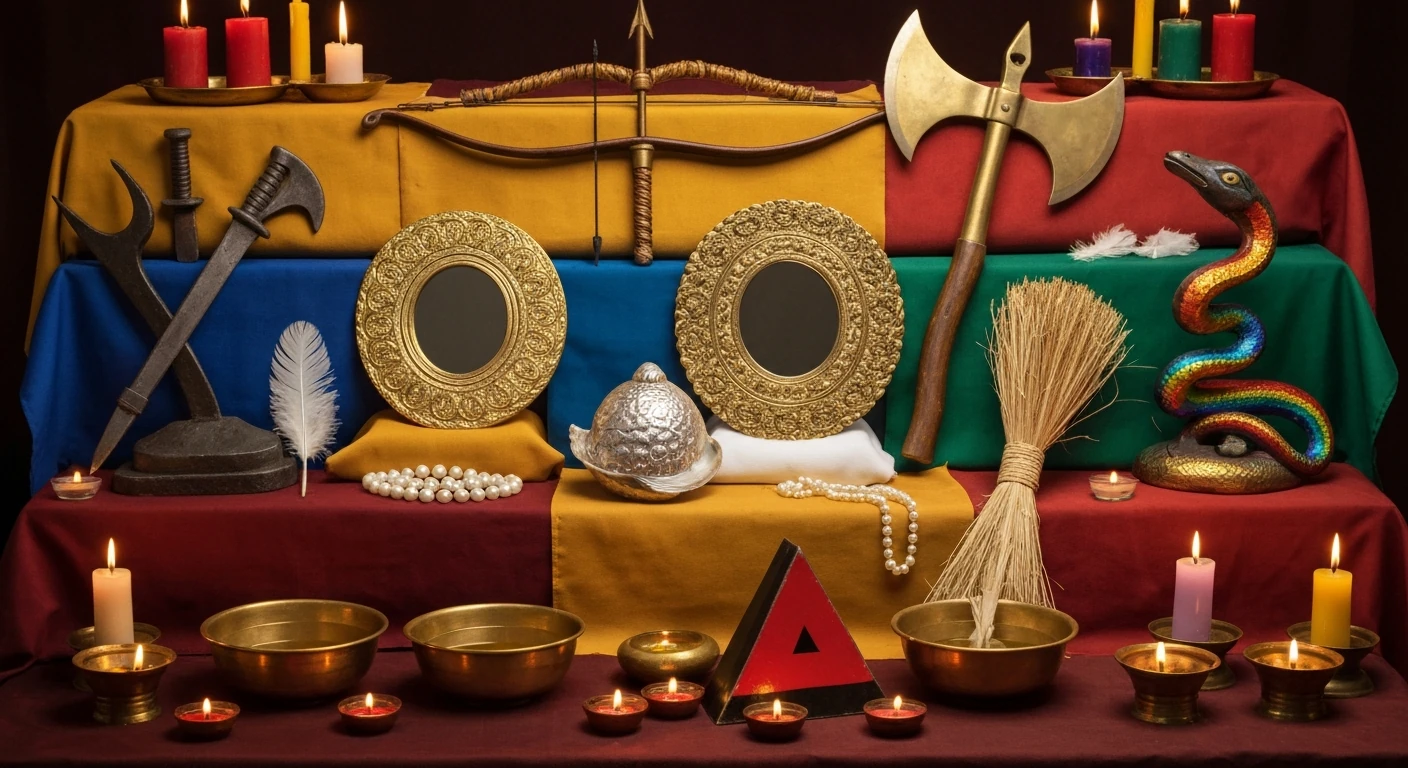
There is a rue plant that thrives in any garden and another that withers from one week to the next, and those who are from a terreiro know that this is no coincidence. Rue is one of the oldest herbs used in ritual in the West, and in Brazil it became a common tool for descarrego, door protection, and the blessing of children. Here in Umbanda, it carries the axé of two orixás at once: Ogum, who cuts, and Exu, who guards the paths.
This guide is for those who want to understand why rue works, and not just how to repeat a ritual bath recipe. We will go from its Mediterranean origin to the leaf that your folk healer (benzedeira) grandmother left on the doorframe, passing through mythology, validated recipes in the terreiro, and the contraindications that no one usually tells you properly.
The leaf of Exu that Ogum carries
Rue (Ruta graveolens) is a hot herb, of the fire element, and its main job is to burn dense charge: evil eye, envy, heavy fluids from hospitals, wakes, family fights. It is not a lukewarm or gentle herb. It is a green blade.
That is why it responds to two orixás who work with cutting and protection. Ogum is the orixá of iron, of pioneering, of paths opened with a machete. When the folk healer (benzedeira) passes the rue branch over a person's body, it is the gesture of Ogum cutting off what does not belong. Exu, in turn, is the orixá of the mouth, of the word, and of the crossroads; it is he who filters who enters and who leaves. Rue on the doorframe is a typically exuistic function: a silent guardian.
In a traditional expression, heard and validated in terreiros of various houses: "rue is the leaf of Exu that Ogum carries on his belt". It summarizes the functional division well: Exu rules, Ogum operates. The other plants that research links to Exu are in Exu herbs.
Some houses still attribute female rue (smaller and rounded leaves) to Oxóssi (Oshosi), and there is a minor tradition that cites Xangô (Shango). It is not a serious theological divergence, but a liturgical variation. Use the one you have on hand and the one your house indicates.
Scientific name: Ruta graveolens L. | Family: Rutaceae | Origin: Mediterranean | Colors: green, red, black, navy blue | Day: Tuesday (Ogum) and Monday (Exu) | Element: Fire | Ruling orixás: Ogum, Exu
Mediterranean origin, Afro-Brazilian function
Rue is not a native African plant. This is an important detail that many mystical blogs forget to mention. It came from the Mediterranean, Southern Europe, Northern Africa, and the Balkan Peninsula and was already cited by Hippocrates in the 5th century BC as an antidote against poisons. Pliny the Elder recorded its use among the Romans against the evil eye, and the legionaries carried branches for protection in battle. A curious parallel with the warrior Ogum, who centuries later would adopt it on the other side of the Atlantic.
In the Middle Ages, Christian monks grew rue in liturgical gardens under the name "herb of grace" from the Latin ruta, grace. It was used in Catholic exorcisms, spraying holy water with branches of the plant. This Catholic liturgical use is fundamental to understanding how, in colonial Brazil, rue moved between popular Catholicism and terreiros without great conflict.
When it arrived in Brazil with Portuguese and Spanish colonizers, rue already brought all that Mediterranean baggage of protection. It found here a fertile soil of Afro-Indigenous ritual technologies, and the enslaved population re-signified its European liturgical uses with the already existing Yoruba and Bantu axé. There are records from Colonial Brazil in which rue branches were sold as an amulet in markets, one of the first evidences of popular trade of mystical herbs in the country.
In Candomblé, any leaf including rue passes first through the sieve of Ossaim (Osanyin), orixá of the leaves, who delivers the vegetal axé to the other orixás. In Umbanda formalized at the beginning of the 20th century, rue enters as a canonical herb of descarrego, used by Pretos Velhos in benzimentos, by Caboclos in defumações, and in the chain of Ogum and Exu for firmeza and protection.
For those who want to go deep into the history of liturgical leaves, the unavoidable reference is Pierre Verger in Ewé: o uso das plantas na sociedade iorubá (1995), and Reginaldo Prandi in Mitologia dos Orixás (2001) for the mythology of Ogum and Exu.
When to use rue (and when not)
Rue is a herb for specific situations. It is not a relaxing bath, it is not an afternoon tea. It is a tool of descarrego used when there is a load to remove.
Use rue when:
- Returning from a hospital, wake, cemetery, or a heavy environment
- Being in a period of explicit envy, conflict, lawsuit, or difficult separation
- Feeling weight on your shoulders, tiredness without cause, a sensation of "load"
- To open a business, attend an important interview, or travel
- Wanting to protect the house (foot at the entrance or branch behind the door)
- Cleaning a newly opened business or a new house before moving in
Popular signs that the rue is working:
- The stem wilts or dries up suddenly: tradition interprets this as the plant absorbing energy from the environment or from a visit. Give thanks and replace it.
- The scent becomes strong even without touching the plant: it is in vigil.
- The leaf breaks easily between the fingers during the ritual bath: effective descarrego.
- The stem does not take root in the garden: they say the rue "chooses" the house. It may be a sign that the home needs a larger cleansing first.
Important: rue is not a charm with guaranteed results. It is spiritual technology: the axé is in who uses it, with faith, intention, and respect. The herb is a tool, not an automatic miracle.
Practical recipe: cleansing bath (banho de descarrego) with rue
This is the base recipe validated in three terreiro sources and used in traditional homes. The secret is in the steeping: never boil the rue in water, because excessive heat degrades the volatile oils that carry the axé of the plant.
Cleansing bath (banho de descarrego) with rue
What you will need
- 1 generous handful of fresh rue leaves
- 1 liter of water
- Optional: 1 small handful of rosemary (to balance)
Preparation
- Boil 1 liter of water in a clean pot.
- Turn off the heat and add the arruda. Never boil the arruda together; the steeping is what preserves the power.
- Cover the pot and let it rest for 10 minutes.
- Strain the infusion into a clean container.
How to take
- Take a normal hygiene bath first, with neutral soap.
- Pour the infusion from the neck down never on the head. The arruda cannot touch the ori (the crown of the head, where the person's spiritual assentamento is located). This rule is firm in almost every Afro-Brazilian tradition.
- Do not rinse after. Dry yourself without rubbing, with a clean towel.
- Wear light clothing, white if possible.
- Discard the residue (used leaves) on bare ground, in a plant pot, or in a place where nature receives it, never in common trash.
When to take: Tuesday is the day of Ogum, ideal for the ritual bath. Monday also works, it is the day of Exu and the souls.
Frequency: at most once a week. More than that can energetically drain the person; the arruda removes what weighs down, but it can also remove what sustains if used without measure.
Simple request before taking the bath, directed to Ogum:
“Ogum, my father, open my paths with your sword of light. Take from me everything that does not belong to me. May your arruda cut what needs to be cut, and may I move forward in peace. Ogunhê, my father.”
Arruda, guiné, alecrim, and coarse salt: how to choose and combine
Arruda rarely works alone in traditional recipes. It is combined with other herbs and minerals to cover different "layers" of spiritual cleansing.
Arruda vs guiné
The guiné (Petiveria alliacea) is native, indigenous-Afro-Brazilian, and has a different function than arruda. While arruda burns dense charge, guiné cuts energetic cords. Guiné is hotter, more aggressive, linked to the magic of breaking demanda and despacho. Combined, arruda cleanses first and guiné cuts afterward.
Arruda vs alecrim
The alecrim (Rosmarinus officinalis) is a warm, balancing herb, ruled by Oxalá (Obatala). The difference is simple: arruda removes what weighs down, alecrim puts lightness in its place. This is why many pais and mães-de-santo recommend combining the two in the banho de descarrego; without alecrim or another warm herb, the person remains "empty" after the cleansing, and energetically vulnerable.
Arruda + coarse salt
Coarse salt is a mineral, not a plant, and belongs to the category of ritual minerals that cut astral fluid. The combination with arruda works in two layers:
- Coarse salt cuts negative vibration in the material and immediate auric plane.
- Arruda burns the charge in the more subtle astral plane.
Most traditions recommend not boiling the coarse salt with the rue the salt only goes into the final bath water, after the strained infusion, or in a separate recipe. Some houses completely forbid the use of salt in head baths or on people who are in obrigação of an orixá. If in doubt, consult your house.
Traditional descarrego ritual bath
The classic recipe combines the three: 1.5L of boiled water, a handful of each herb (rue + guinea hen weed + rosemary), steep for 15 minutes, strain and apply from the neck down on Tuesday. Do not rinse. Wear light clothing afterward.
Serious contraindications of rue
This section is not decorative. Rue has documented toxicity and religious tradition has known this for centuries, which is why there are so many rules regarding its use. Read carefully.
| Situation | Why avoid |
|---|---|
| Pregnant women | Rue contains methylnonylketone, which induces uterine contractions. It is abortifacient for internal use and phototoxic for external use. Bath is also advised against. |
| Lactating women | Substances pass through milk. Avoid. |
| Children under 8 years old | Hepatic and cutaneous toxicity. Do not use in baths or internally. |
| Bath on the head (ori) | Prohibited in most traditions. Always from the neck down. |
| Internal use (tea) | Not recommended even for non-pregnant women. Contains rutin, alkaloids, and furanocoumarins with hepatic and renal toxicity. |
| Sensitive skin or open wound | Risk of phytophotodermatitis: dark spots on the skin after sun exposure. |
| Use of anticoagulants | Documented drug interaction. |
| Pets | Toxic to cats, dogs, and horses. Be careful with pets at home. |
| People in recent obrigação (santo feito, bori) | May interfere with the axé placed. Consult your house. |
| Frequency greater than 1x/week | It can be energetically emptied. |
For those who want to go deeper into the ethnobotanical and pharmacological side, there is a good academic article on terreiro ethnobotany published in the RSD Journal that documents uses and precautions in Afro-Brazilian religious houses in Brazil.
Frequently asked questions about rue
What is the rue ritual bath for?
The rue ritual bath is for spiritual cleansing (descarrego) to burn off and remove from the energetic body dense charges such as the evil eye, envy, hospital or funeral fluids, and a persistent feeling of heaviness. It is not a bath for relaxation or prosperity: it is a specific cleaning tool, ruled by Ogum and Exu in Umbanda.
How do you correctly make a rue ritual bath?
Boil 1 liter of water, turn off the heat and add a handful of fresh rue leaves. Cover and let it steam for 10 minutes. Strain. After a normal bath, pour from the neck down never on the head. Do not rinse, dry without rubbing, and put on light-colored clothes. Ideally on Tuesday.
Who cannot take a rue ritual bath?
Pregnant women, lactating women, children under 8 years old and people with very sensitive skin or those using anticoagulants should avoid the bath. Rue is abortifacient and phototoxic: this is not a mystical restriction, it is documented toxicology. People in a recent orixá obrigação should also consult the house first.
What is the difference between male rue and female rue?
The male rue has larger and more elongated leaves, with a stronger scent, and is attributed to Exu and Ogum. The female rue has smaller and rounded leaves, and in some houses it is attributed to Oxóssi. In the daily practice of terreiros, most pais and mães-de-santo use the rue they have on hand: the division is more botanical than strictly liturgical.
What does it mean when rue wilts or dries up suddenly?
Popular tradition interprets a wilting rue plant as a sign that the plant absorbed negative energy from the environment or from a specific visit. It is seen as successful protection, not as a bad sign. Thank the plant, discard the stem in running earth, and plant a new one. If no rue thrives in your garden, perhaps the house asks for a larger cleansing first.
Can I pour a rue bath on my head?
No. Rue must not touch the ori (the crown of the head, the seat of personal axé). This rule is practically universal in Afro-Brazilian traditions, applying to Umbanda, Candomblé, and even for the popular Catholic benzedeira. Always from the neck down, without exception.
Which orixá does rue belong to?
In Umbanda, rue is primarily ruled by Ogum (cutting, iron, opening of paths) and Exu (protection of crossroads, guard of the house). Some houses attribute female rue to Oxóssi, and there is a minor tradition citing Xangô. In Candomblé, every leaf first passes through the sieve of Ossaim, the orixá of the leaves, who distributes the vegetal axé.
Where to buy rue and items for Ogum and Exu
At Joia Mística Laroyê, you find everything you need to work with rue at home, with the axé of those who belong to the house:
- Fresh and dry rue leaves selected for ritual bath and defumação
- Red and black candles of Ogum and Exu, in different shapes
- Ritual coarse salt to enhance the descarrego
- Statues of Ogum and Exu for altar and domestic assentamento
- Ready-made ritual baths prepared with axé by Joice Mística
- Incense burners and breu for burning dry herbs
Visit our physical store in Extrema, Minas Gerais (R. Benedito Zingari, 460 Bela Vista). To ask questions or request a personalized recommendation, talk to us via WhatsApp.
References
- Pierre Verger, Companhia das Letras: Ewé, the use of plants in Yoruba society
- Reginaldo Prandi, Companhia das Letras: Mythology of the Orixás
- RSD Journal: academic article on terreiro ethnobotany