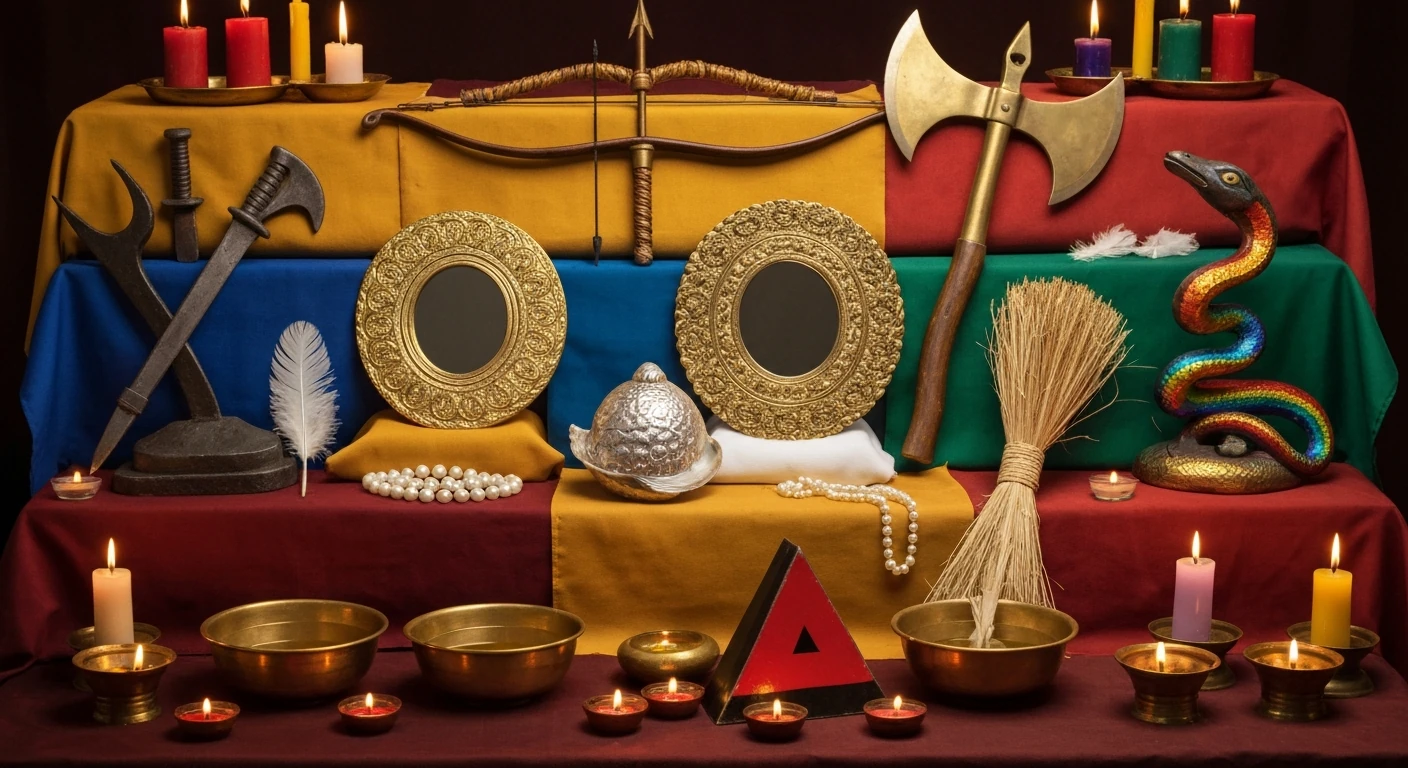
The guiné is an herb of Ogum and of Exu, the leaf of the cut that old terreiros keep for when the divination points to a demanda.
There is an herb garden that lives in the routine, and there is an herb garden that is called upon in moments of distress. The guiné belongs to the second group; it is the leaf that old terreiros keep for when others are no longer enough, when the demanda is confirmed and the axé asks for a clean cut. It is not an herb for a weekly ritual bath or a social tea: it is a serious ritual instrument, linked to Ogum and Exu, with a triple history and real contraindications that need to be respected.
The most serious herb in the Afro-Brazilian herb garden
In traditional herb shops, guiné is treated with the same careful reverence reserved for the iron of Ogum: raw power, effective, and for that very reason dangerous when handled without criteria. It is not mixed into any ritual bath, it does not enter an amaci, it is not used "to take care of the week's energy." When a mãe-de-santo orders guiné, it is because the game pointed to a demanda, an attack, or an energetic cord that needs to be undone at once.
The Petiveria alliacea scientific name is classified in terreiros as hot herb, alongside rue and espada-de-são-jorge. Some houses describe it as "spiritual caustic soda": it does not differentiate what it cleans; it cuts what it finds in front of it. For this reason, tradition established rigid rules of use, frequency, and disposal. The experienced practitioner learns these rules before learning the recipe.
In Umbanda, the leaf gave name to its own falange Caboclo Pai Guiné and appears in hundreds of pontos cantados (sung sacred songs), generally in giras of Caboclos and Pretos Velhos. In Candomblé, Pierre Verger recorded it under the Yoruba name ojúsájú, cataloging it among the liturgical leaves of modern Yoruba society. In other words: it is not a local leaf of small tradition, it is a plant of broad reference, with a documented presence in the main Afro-Brazilian religious systems.
Colors: red and white | Day: Tuesday (Ogum) or Monday (Exu) | Element: Fire and earth | Regent orixás (orishas): Ogum, Exu
Crossed paths: indigenous, African, Brazilian
The history of guiné is one of the most unique in the Afro-Brazilian herbarium because it carries three layers that few leaves gather.
Indigenous origin. The Petiveria alliacea is a native plant of the tropical Americas, its occurrence area goes from Florida to Argentina, with a strong presence in the North and Northeast of Brazil. Amerindian peoples of the Amazon already used guiné in ritual ceremonies and in medicinal preparations before European contact. This point is fundamental and frequently erased: guiné did not come from Africa with the enslaved it was found here, and incorporated into Afro-Brazilian knowledge from the dialogue with indigenous knowledge. Recognizing this layer is a gesture of historical honesty.
Afro-Brazilian adoption. From the 16th century, enslaved Africans encountered the plant in the new territory and integrated it into a religious system already in transformation. The most loaded popular name for guiné, “amansa-senhor”, was coined during this period. According to historical records compiled by UFMA researchers, the enslaved used guiné, in studied doses, to cause physical and mental debilitation in the plantation owners as an act of resistance. The name is not a poetic metaphor: it is a marker of struggle. Those who treat the plant with seriousness recognize this weight.
Return to Africa. After centuries in Brazil, guiné was reintroduced to Nigeria from Brazilian territory, integrating into Yoruba practices. Pierre Verger documented this transit in Ewé O Uso das Plantas na Sociedade Iorubá, an absolute reference record on the theme. Guiné, therefore, completes an Americas-Africa-Americas cycle that is imprinted on its spiritual identity: in a leaf, it synthesizes the founding tripod of Afro-Brazilian religiosity: indigenous knowledge, African heritage, and diasporic synthesis.
Mythology: why guiné belongs to Ogum and Exu
Ogum, the “vegetal iron”
Ogum is the orixá of iron, war, and the opening of paths. He cuts with the sword what prevents axé from flowing, and he does not negotiate with obstacles. In terreiros, guiné is described as “vegetal iron”, a leaf that does in the subtle plane what Ogum does in the material plane: it cuts energetic cords, unties knots, and opens passage. Its action is direct, fast, and without flourish. Therefore, Tuesday, the day consecrated to Ogum, is the preferred day for baths and fumigations with guiné. The colors red and white, marks of the orixá in many houses, also accompany the ritual.
Exu, lord of the borders
In Candomblé, guiné is also recorded among the herbs of Exu and here a critical distinction is needed. Exu is a legitimate orixá, messenger, ruler of the crossroads, of the limits and of the passages. He is not a demon, he is not a figure of Christian evil. This confusion is the result of five centuries of demonization imposed by a foreign theology, and no serious text on Afro-Brazilian religions can reproduce it.
The logic of the relationship between Exu and guiné is symbolic: Exu rules borders, and guiné acts exactly in energetic borders. It cuts what is stuck, separates what was glued, undoes unwanted spiritual bonds. For this reason, it appears in opening rites and in padê (initial offering in Candomblé terreiros).
Important sensitivity: distinguish Exu orixá (ancestral ruling Candomblé deity) from the guardian Exus of Umbanda (work spirits such as Tranca-Ruas, Sete Encruzilhadas, Marabô). Guiné serves both fields, but through distinct theological paths. Those who delve into the theme quickly realize that speaking of "Exu" without context is a dangerous shortcut.
Caboclo Pai Guiné
In Umbanda, the importance of the leaf was so great that it gave name to its own falange, headed by the Caboclo Pai Guiné, a caboclo spirit sung in traditional pontos (sacred songs). Pretos Velhos also frequently appear accompanying guiné and arruda in healing giras. To hear a gira in which one sings for Pai Guiné is to hear, in sung leaf, the triple history of the plant.
When to call guiné (and when not)
This is the part that sensationalist content usually omits, and that tradition treats as non-negotiable: guiné is not a maintenance herb. It does not replace the ritual bath of seven soft herbs, it is not a daily weekend care, it is not a preventive treatment. It is an herb for the moment called for when the situation demands direct action.
Situations in which guiné is traditionally indicated:
- Suspected targeted magic: persistent symptoms of evil eye, sudden decline in physical and emotional health, series of conflicts without a clear origin.
- Confirmed spiritual attack in a consultation when cowrie-shell divination or a consultation with an entidade has already pointed out a demanda.
- Persistent professional envy: successive blockages in a career even with proven effort.
- Moving into a house with a heavy history: property with a record of death, violence, or old conflicts.
- After a turbulent breakup when there is a clear energetic residue of someone who "will not let go".
- Preparation for larger ritual moments, under the guidance of a Pai or Mãe-de-santo.
Situations in which one should NOT resort to guiné:
- Common work fatigue (use lavender, rosemary).
- Temporary sadness (boldo, basil).
- Routine energetic cleansing (ritual bath of seven soft herbs).
- Children, pregnant and lactating women are prohibited.
- Daily or continuous weekly use.
Attention: guiné is not a maintenance herb. It is a moment herb when others are no longer enough. In serious cases, the ideal is to seek in-person guidance from a pai/mãe-de-santo in a terreiro of your trust, and not replace a ritual consultation with a recipe from the internet.
Recipe: ritual bath to break demanda
What you will need
- 1 small handful of fresh guiné leaves (or 3 tablespoons of dried leaves)
- 1 liter of water
- 1 pinch of coarse salt (optional, enhances in heavy cases)
Preparation
- Boil the water, turn off the heat and add the guiné (and the coarse salt, if you will use it).
- Cover and let rest for 10 minutes.
- Strain well, separating the used leaves.
How to use
- Take a normal hygiene bath first, with neutral soap.
- Pour the ritual bath from the neck down NEVER on the head. The crown (ori) is the seat of personal axé; guiné on the ori burns good energy along with the bad.
- Do not rinse after. Dry without rubbing, ideally outdoors.
- Light a white candle for Ogum, thank in simple words.
- Discard the leaves on running earth garden, tree base, large pot, park, dirt road. Never in common trash. The plant returned to the earth it came from.
- Use only in the specific ritual work. 24h rest after the ritual bath (avoid agitation, exposure to charged environments, parties).
Ogum, blacksmith of paths, open with your sword what is closed. Exu, lord of boundaries, cut what needs to be cut. May this leaf take what does not belong to me and return to the earth what came from the earth. Axé.
Guiné vs arruda vs losna
Each of these three herbs has a specific function, and part of the mistake in a poorly done spiritual cleansing (descarrego) is treating them as interchangeable. They are not.
Arruda is the hot herb of daily life. It burns dense charges near the aura, acts on the outer layer, and is more frequent in weekly protection ritual baths. It can be used with more regularity than guiné, yet still with discretion.
Guiné enters when arruda is no longer enough. It does not burn the charge near it, it cuts the cord that linked the charge to the energetic body. It reaches what is more stuck, deeper, older. Therefore, the consecrated formula for spiritual cleansing (descarrego) is arruda + alecrim + guiné: arruda cleans the external, guiné undoes what is stuck, alecrim balances with its warm energy.
Losna works in another way. It is a warm herb, not hot, and acts by drainage it does not attack cords, but drains accumulated spiritual fatigue. In heavy spiritual cleansing (descarrego), some terreiros use losna as a preparation days before the guiné: it prepares the ground, then the guiné delivers the final blow.
Practical summary: rue in daily protection, guiné in critical moments, wormwood before and after. To better understand how different herbs work in ritual baths, it is worth reading our guide on how to make a herbal bath for Oxum, which shows the opposite logic of cold and sweet herbs, instead of hot and sharp ones.
Why NOT to mix with common herbs
This is the golden rule of traditional terreiros about guiné, and it is practically always omitted in sensationalist internet content.
Guiné does not go into an amaci bath, it does not go into a daily bath, it is not mixed with Oxalá (Obatala) herbs (boldo, lavender, white basil) in a routine. For three reasons:
- Excessive force burns good axé. As said, guiné acts like spiritual caustic soda. In an inadequate mixture, it does not differentiate what cleans from what maintains.
- Vibrational conflict. Guiné is fire; Oxalá herbs are freshness and peace. Mixing them in the same bath is like boiling ice in the same container, it unbalances the vibration of both.
- Reserved for specific ritual work. Tradition dictates calling guiné only when there is a confirmed demanda, attack, or a defined ritual moment. To trivialize the leaf is also to trivialize the spirit that is called with it.
Permitted combinations:
- Guiné + rue + rosemary (classic for descarrego)
- Guiné + coarse salt (breaking a strong demanda)
- Guiné + basil (attracting peace after the cut)
- Guiné + rosemary isolated (energy + lightness post-bath)
Forbidden combinations:
- Guiné + boldo (Oxalá) vibrational clash
- Guiné in a head ritual bath burns the ori
- Guiné + espada-de-são-jorge + arruda in the same ritual bath unbearable charge
SERIOUS Contraindications
This section is not a detail: it is a central part of the responsible use of guiné. Even though the leaf has secular tradition in terreiros, it is a plant with active pharmacology, recorded in scientific literature.
Anticoagulants (warfarin and similar). The Petiveria alliacea contains compounds that potentiate the anticoagulant effect. Those who use this type of medication continuously have an absolute contraindication, even for a prolonged ritual bath increased risk of bleeding.
Pregnant women. Internal use is forbidden due to the risk of abortion documented in pharmacological literature. Prolonged or repeated ritual baths should also be avoided.
Lactating women and children. Avoid completely. The leaf has a record of toxicity in inadequate doses.
Internal use (tea). Not recommended for domestic use. The plant can cause hyperexcitation and, in high doses, seizures. If there is an indication for internal use by a traditional terreiro, it must always be accompanied by ritual and medical guidance.
Ritual use. Maximum 1 ritual bath per specific ritual work, never daily or continuous weekly. Always from the neck down. 24h rest after the ritual bath.
Treating guiné with the seriousness it deserves is, at the same time, a gesture of ritual respect and care for health. The two go hand in hand.
Frequently asked questions about guiné
What is the guiné herb for?
It is mainly used for heavy energy cleansing, spiritual cleansing (descarrego), breaking confirmed demanda, protection against persistent envy, and targeted magic. It is not a daily maintenance herb; it is called upon in specific moments when milder herbs cannot handle the load.
Can I take a guiné ritual bath every day?
No. Guiné is an herb for specific ritual use, at most 1 bath per ritual work. Continuous daily or weekly use can "burn" the ori, exhaust good axé along with the bad, and unbalance personal energy. Tradition reserves the leaf for critical moments.
What is the difference between guiné and arruda?
Arruda burns dense charges near the aura and acts on the exterior. Guiné cuts deeper energy cords and reaches what arruda does not. They work in sequence: arruda first, guiné second. The classic spiritual cleansing formula combines both with rosemary to balance.
Which orixá is guiné for?
In Umbanda, it is mainly ruled by Ogum (some terreiros also associate it with Oxóssi due to the forest aspect). In Candomblé, it is linked to Exu (crossroads) and Ogum. It is one of the few leaves with widely recognized dual rule.
How to discard the leaves from the guiné bath?
Never in the common trash. The leaves must return to the earth: garden, base of a tree, large pot with soil, park, dirt road, or running earth. Guiné is a plant of the earth, and the gesture of return closes the ritual cycle.
Where to buy guiné and protection items
At Joia Mística Laroyê you find herbs and protection items handled with ritual care:
- Fresh and dry guiné selected and handled with respect for tradition
- Ritual coarse salt to empower heavy ritual work
- Black and red candles of Ogum and Exu
- Statues of Ogum for a protection altar
- Ready spiritual cleansing (descarrego) ritual baths prepared with axé by Joice Mística
Visit our physical store in Extrema-MG (R. Benedito Zingari, 460). For cases that require special care, talk to us via WhatsApp before performing a heavy ritual bath at home, it is worth a conversation to understand if guiné is indeed the path. If the demanda is serious, we always recommend seeking a pai or mãe-de-santo in a terreiro of your trust.
To learn about other herbs of the tradition, visit our complete herbarium or the guiné page, with a detailed technical sheet.
Sources consulted: Verger, Pierre Fatumbi. Ewé O Uso das Plantas na Sociedade Iorubá. Companhia das Letras. | Revista Pós-Ciências Sociais (UFMA): “Amansa-Senhor”. | Revista Fitos / Fiocruz pharmacological profile of Petiveria alliacea. | Terreiro Pai Maneco traditional Umbandist record.
References
- Revista Pós-Ciências Sociais (UFMA): article about guiné and the name amansa-senhor in enslaved resistance
- Revista Fitos (Fiocruz): pharmacological profile of Petiveria alliacea
- Terreiro Pai Maneco: traditional record about the ritual use of guiné