



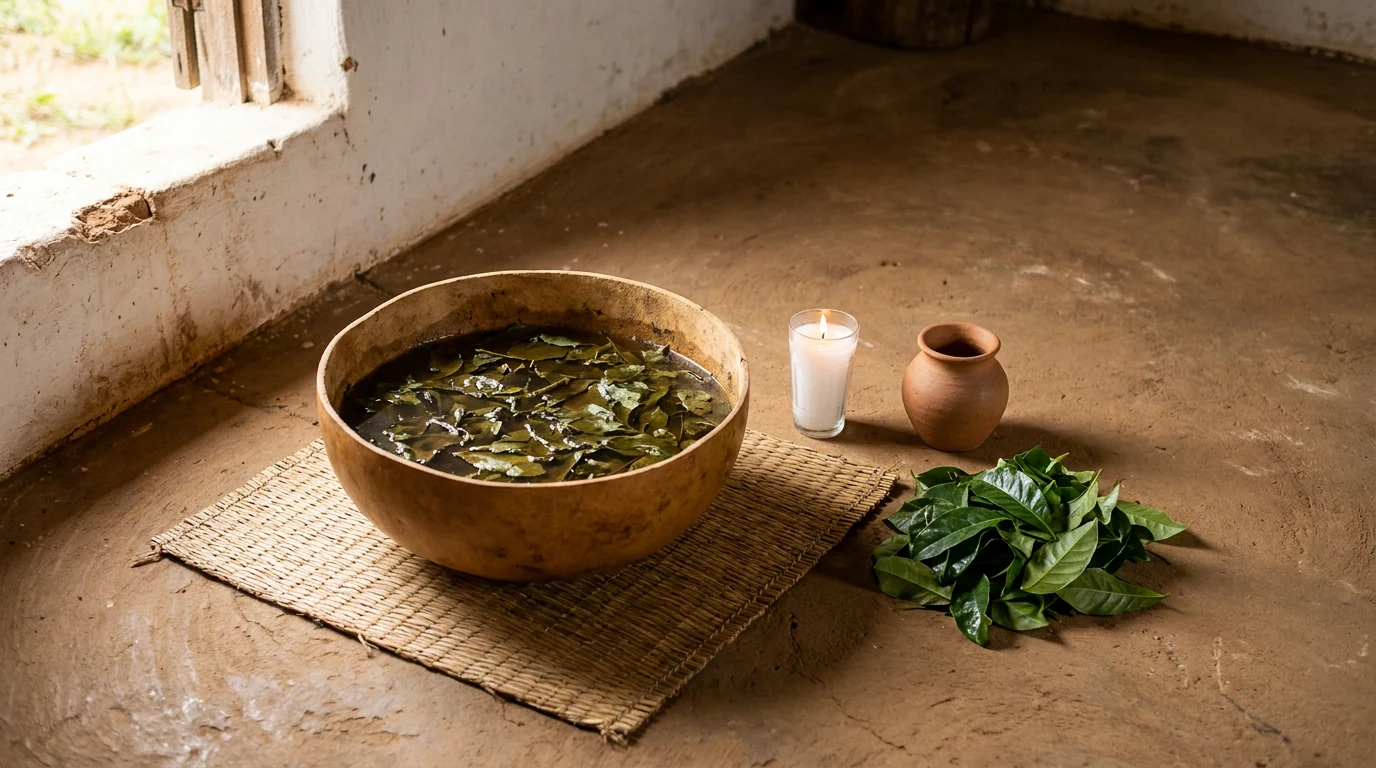
The abô (àgbo, in Yoruba) is the water of the leaves. Various fresh herbs macerated cold inside the water, left to rest, and then strained. It is this liquid that the house uses in the ritual bath, in the washing of the settlements, and in the obrigações.
This guide shows who prepares it, why the leaf does not go to the fire, and what separates the abô from the amaci and the house bath.
What is the abô in Candomblé
In the houses of the Ketu nation, the abô crosses the entire ritual life, from initiation to the last obrigação.
The research by Pedro Freire Botelho collects the formulation of José Flávio Pessoa de Barros. There, the àgbo is the most important of the vegetable mixtures of the worship of the orixás (orishas), and the link between the world of the orixás and that of men. Within Candomblé, the leaf is not an accessory. It is the matter that carries the axé.
Who rules the leaf
The owner of the leaf is Ossaim (Osanyin), also written as Ossain, Ossanha, or Òsányìn depending on the house and the nation. No ceremony is performed without him, because he is the one who holds the secret of the vegetable. The proverb that summarizes this appears in three independent records:
Kó sí ewé, kó sí Òrìsà. Without leaf there is no orixá.
In the Candomblé of the Angola nation, the same regency belongs to Katendê, the inquice of the leaves and of science, one of the inquices of the Candomblé of Angola. More about the orixá in who is Ossaim.
Who prepares the abô
The position has a name: babalossaim, or olosanyin, the priest of the herbs. Botelho records, based on Roger Bastide, that this priesthood does not involve trance: his function is to gather the leaf and care for the removal rite.
When the house does not have an olosanyin, the function is fulfilled by the babalorixá or the ialorixá themselves, and this is not delegated to another filho de santo. Each zelador has their own way of doing it.
Hence comes the honest limit of this article. It explains what abô is, it does not teach how to make it. The composition is knowledge of the position, and the ofó that awakens the leaf is not learned from internet texts.
Why the leaf of the abô does not go into the fire
The most detailed field description of this preparation is in the thesis of Luiz Fernando da Silva Anastácio, defended at USP in 2023. He observed the Sasányìn rite:
- The gathered leaves rest on the mat.
- They are washed and return to the igbá, the gourd.
- The branches and withered leaves are removed with the hands.
- Exu (Eshu) is greeted, the candle is lit, and the chants of Ossaim begin.
- The leaves are rubbed against each other inside the water, like someone scrubbing clothes to wash, and the movement does not stop as long as the chants last.
- The preparation settles for a few hours, is strained, and only then is it served.
In some houses, the babalorixá still opens an obi, chews it, and sprinkles it over the leaves before releasing them into the water.
There is no fire in any stage. What is wanted is the green blood of the leaf, extracted by friction. The Ilê Oxalá (Obatala) Segbo says it without beating around the bush: the herbs of the abô are macerated in pure or rain water, and they are not boiled.
In herbal bath there are three legitimate techniques, each for a type of material: cold maceration for fresh leaf, infusion in hot water for dry leaf, and decoction, the boiling, for bark, seed, and vine. Hence the confusion. Whoever boils did not make a mistake in technique: they are making a herbal bath at home, which is something else.
Abô, amaci and herbal bath: what separates the three
| Abô | Amaci | House ritual bath | |
|---|---|---|---|
| What is it | water of macerated leaves, with the foundation of the house | the same leaf water applied to the head of the initiate | cleaning bath that the person prepares for themselves |
| Where it is applied | body, bead necklace, dishes, consecrated foundation (assentamento), floor of the barracão | head, the ori | body, from the neck down |
| Who conducts | olosanyin or the leader | house leader, with resguardo (seclusion) | the person themselves |
| Does it alone | no | no | yes |
| Preparation | cold maceration | maceration in the water of the roncó quartinhas | maceration, infusion or decoction |
The point that almost every text gets wrong: abô and amaci are not two liquids of different natures. They are two destinations of the same leaf water. Botelho defines amaci as the liquid of leaves macerated in the water of the quartinhas of the roncó, to bathe the heads of the initiates.
Therefore, amaci requires a leader. The head has its own treatment, and the reason is in what is the ori and in what is amaci.
Abô washes what is not human
A good part of a house's abô never touches human skin. The USP thesis records that the strained liquid serves to wash sacred objects and for bathing. An Angola house details the list: alguidares, dishes, bead necklaces, ritual tools, items of the igbás, orixá clothes, and even the floor of the barracão.
There is abô that is not consumed, and it is the largest part. Washing assentamento with abô is a routine.
- Old abô is not used. The leaf loses its liturgical function and the liquid sours.
- What remains has a destination. It goes to the ojubô of Ossaim and then is given as a ritual offering (despacho) in the river or in the woods.
The leaves of the abô and its orixás
The composition is assembled in pairs of opposition, and the opposition is not just hot against cold: it is also male against female. A terreiro source describes the àgbo as a combination in four leaves or multiples of four, with the quantity varying from house to house.
The survey by Bianca Purcino, in two terreiros of Candomblé in southern Bahia, supports this with examples. The white gameleira, irokò, is a hot leaf and of the male sex, indicated for baths of the children of Exu and of Oxalá. The akòkó is a male plant consecrated to Xangô (Shango). The temperature scale in detail is in hot and cold herbs.
The table below is the record of those two terreiros, not a national rule. Leaf per orixá varies from house to house.
| Leaf | House name | Registered use | Orixá |
|---|---|---|---|
| Peregum | Dracaena fragrans | protection, sacudimento | Ogum (Ogun) |
| Oxalá rug | ewé bàbá | body cleansing | Oxalá |
| Basil | awó erédé | smoke cleansing (defumação), cleansing | Oxum (Oshun) and Oxalá |
| Quioiô | Ocimum gratissimum | sacudimento, smoke cleansing (defumação) | Omolu (Omulu) and Oxóssi (Oshosi) |
| White aroeira | ájobi fumfum | head obrigação, ritual bath | Exu and Iansã (Oya) |
| Akòkó | Newbouldia laevis | prosperity ritual bath | Xangô |
| Mariwô | ìgi ôpè | house protection | Ogum, Omolu, Oxaguiã |
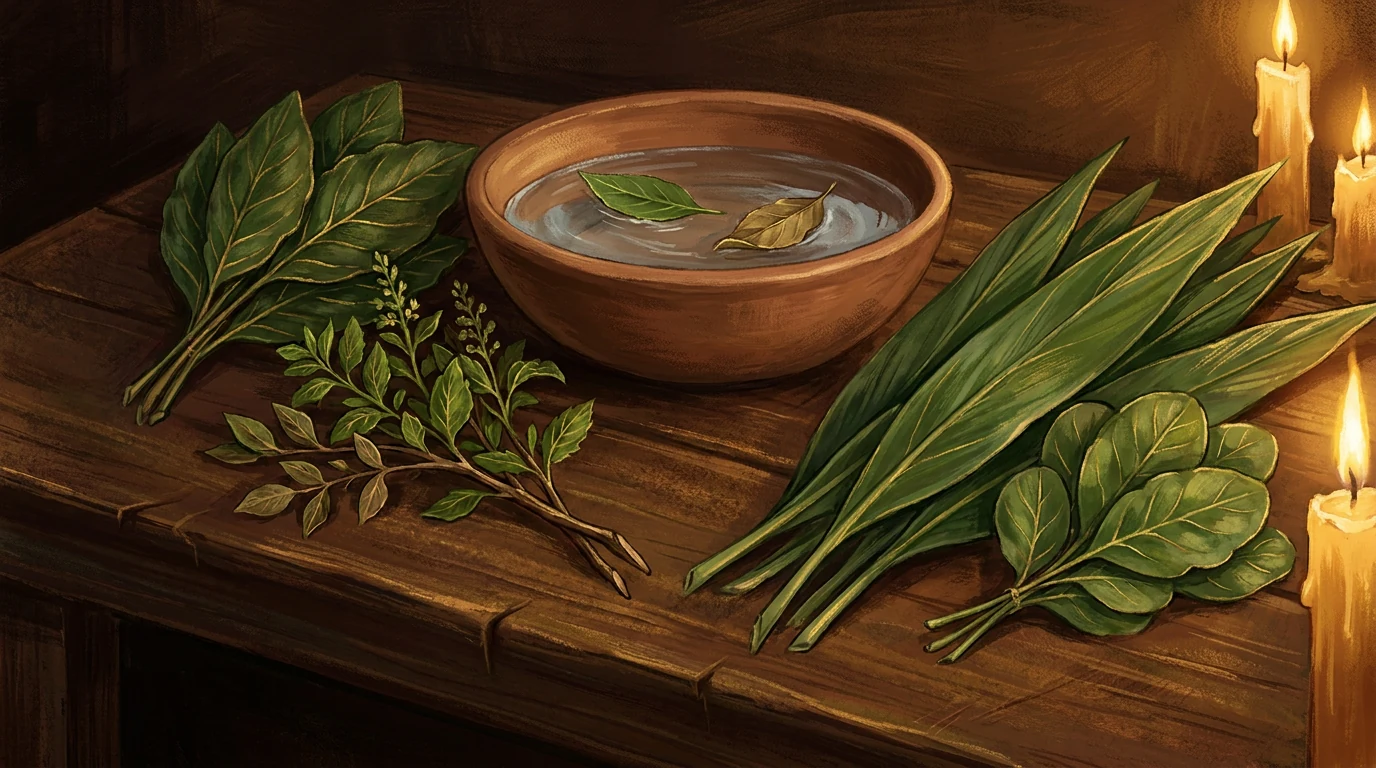
Three of these already have a post on the blog: peregum, Oxalá rug and basil. If you still do not know whose head you have, start with the orixá test.
Drinking the abô: what the sources say and the real risk
There are houses that drink. Two independent terreiro sources record the practice. One describes the àgbo also serving as a drink and medicine. The other records the custom of drinking the ritual bath when the person arrived at the house after consuming alcohol.
The caveat comes attached. The UNILA survey in terreiros of Foz do Iguaçu points to rue and dumb cane among the most cited species in the researched houses. Both are toxic if ingested.
- The dumb cane is among the main causes of poisoning in Brazil. The symptoms range from edema and mucosal irritation to asphyxiation, and the 0 to 4 years age group is the most affected.
- The rue has recorded abortifacient activity, with embryotoxic and teratogenic effects from the aqueous extract of the leaves.
Abô is a ritual bath. Where the tradition of drinking exists, it is a decision of the house, with the leaf chosen by the house. Pregnant women, children and people undergoing treatment do not improvise.
Frequently asked questions
What is the difference between abô and amaci?
Amaci is the leaf water applied to the head of the initiate, in a rite conducted by the house. Abô is the broad use of the same water: ritual bath on the body, washing of bead necklaces, dishes, and assentamentos. Same liquid, different purposes.
Can you do abô at home?
No, not the abô de fundamento. It is prepared by the olosanyin or the leader, with the leaf and the ofó of that terreiro. Alone, a person can do a herbal bath for cleansing, which does not replace the abô or the amaci.
Can you drink the abô?
There are houses that drink it, in specific situations, and this is recorded in terreiro research. But two of the most common leaves in the researched terreiros are toxic if ingested. Ingestion only with guidance from the leader, never by an internet recipe.
How long does the abô last?
A short time, and old abô is not used: the macerated leaf loses its liturgical function and the liquid sours. What remains goes to the ojubó of Ossaim and is ritually delivered (despachado) in the river or in the woods.
Where to buy the herbs and the material for abô
At Joia Mística Laroyê you find what the practice requires:
- Fresh and dry herbs by bunch or by orixá
- Clay quartinhas and alguidares in various sizes
- White candles in stick and seven day types
- White cloth and mat for preparation
- Obi and orobô for the opening rite
Stop by the shop, at Rua Benedito Zingari, 460, Bela Vista, in Extrema-MG, or message on WhatsApp with delivery to all of Brazil.
References
- Pedro Freire Botelho: Ewé Awo, the secret of the leaves in the Candomblé of Bahia, 2011
- Luiz Fernando da Silva Anastácio: the thesis on the Sasányìn rite, USP, 2023
- Bianca Purcino: the ethnobotanical survey in terreiros of Bahia, UFSB, 2022
- Correa and others: liturgical plants in terreiros of Foz do Iguaçu, 2025
- Silva and Takemura: intoxication by comigo-ninguém-pode, UFBA, 2006



