Everyone knows Saint Anthony as the matchmaker saint, the one to whom young women ask for a good partner. But, in many terreiros in Bahia, behind the statue of the Franciscan friar lives another force: Ogum, the warrior orixá of iron and of paths. The same saint who helps in love is, in Bahian syncretism, the guardian who cuts demands and opens roads.
In this article, you will understand who Saint Anthony was, who Ogum is, why the two were associated in Bahia, how this changes from region to region, and why syncretism was never the same as saying that a saint and an orixá are the same thing.
Who was Saint Anthony
Saint Anthony was born in Lisbon, around 1195, and died in Padua, Italy, on June 13, 1231. He entered the Order of Friars Minor, the Franciscans, as a young man, and became known as one of the greatest preachers of the Church. For this reason, he is called both Saint Anthony of Lisbon and Saint Anthony of Padua.
In Brazil, he became the matchmaker saint. The fame comes from popular devotion: young women ask for a good marriage, turn the statue upside down, or hide the Baby Jesus from the saint's arms until the prayer request is fulfilled. He is also the patron of lost causes and lost objects, invoked by those looking for what disappeared.
His feast day, on June 13, opens the cycle of the June saints, followed by Saint John and Saint Peter. It is one of the most beloved dates in the Brazilian popular calendar.
Who is Ogum
On the Afro-Brazilian side is Ogum, the orixá of war, iron, and paths. He is the one who forges weapons and tools, who opens the roads and cuts the demands, removing the obstacles from the lives of his children. Where there is a fight to be faced head-on, there is the strength of the warrior. If you want to know the orixá in depth, see the guide on who is Ogum.
Technical sheet of Ogum: Colors: dark blue and navy blue in Ketu Candomblé, with green in many houses; red in Umbanda | Day: Tuesday | Element: iron | Greeting: “Ogunhê!”
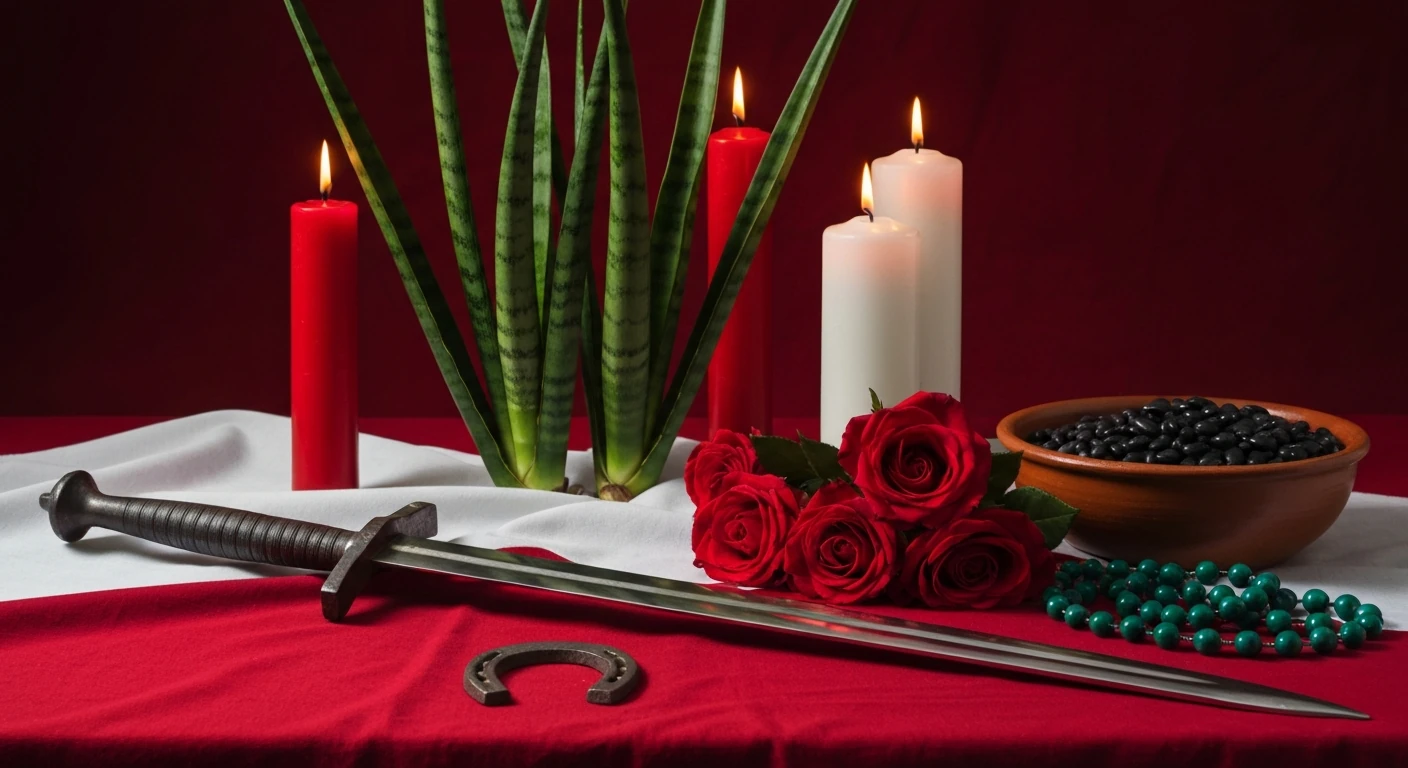
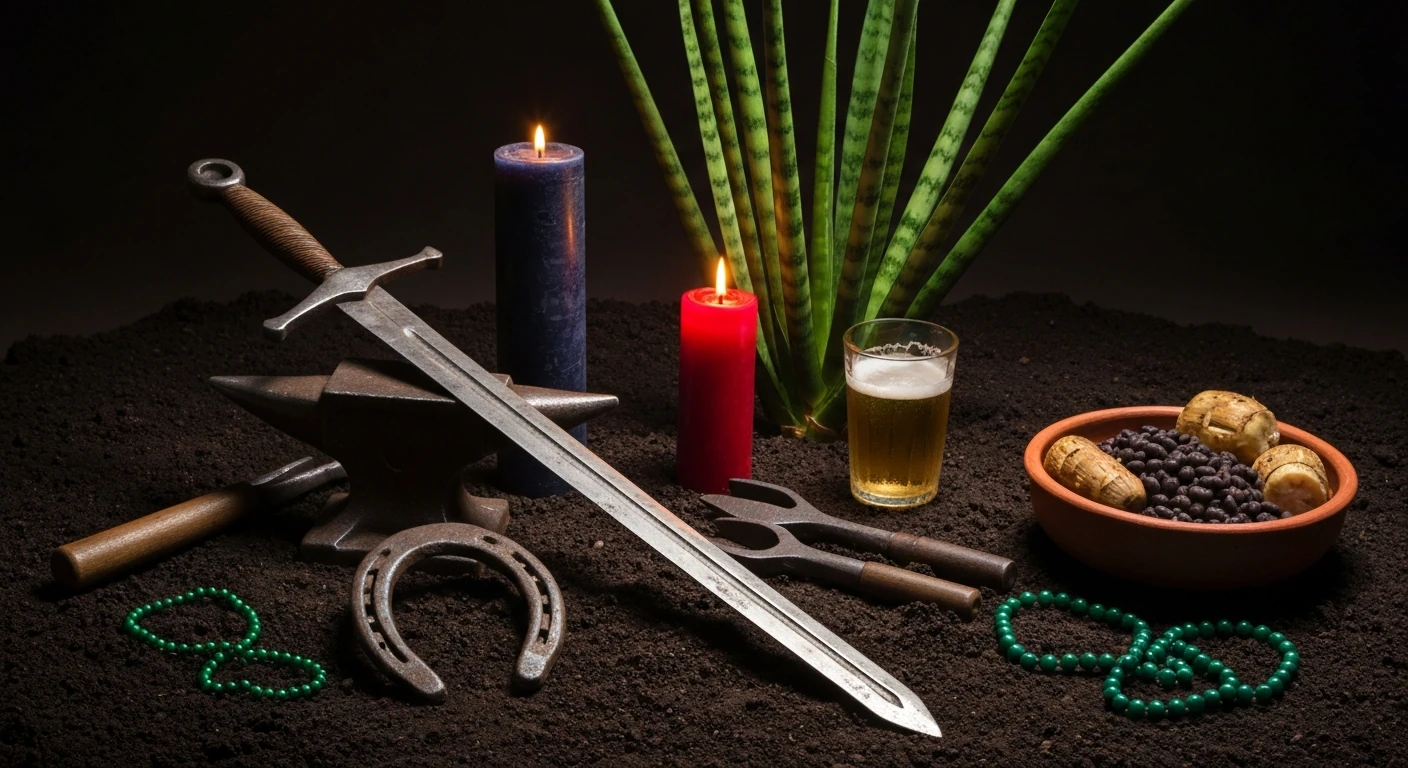
His symbols are the pieces of iron: the sword, the spear, the machete, and the anvil. The best known votive food is feijoada, served in abundance in honor of the warrior who works. To prepare a tribute with respect, it is worth seeing our guide on offering for Ogum.
It is worth remembering that Ogum acts differently in each tradition. In Candomblé, he is an orixá with a consecrated foundation (assentamento), leaves, and specific chants, worshiped within the foundation of each nation. In Umbanda, he works mainly as a line of vibration, with spirit guides that descend to cut demands and provide firmeza. In Umbanda Sagrada, by Rubens Saraceni, “Ogum is the Orixá of the Law”; the Tenda de Umbanda Caboclo Tupinambá e Vó Catarina (TUCTVC), in São José dos Campos, summarizes Ogum as “Law, Order, and Opening of Paths.”
Why Saint Anthony became Ogum in Bahia
The syncretism between Catholic saints and orixás was born as a resistance strategy. In the time of slavery, the worship of orixás was prohibited and persecuted. To continue worshiping their divinities, enslaved Africans associated each orixá with a Catholic saint, worshiping the axé behind the permitted statue.
In Bahia, the historical heart of Candomblé, Ogum was linked to Saint Anthony. Pierre Verger records: "In Bahia, Ogum was syncretized with Saint Anthony of Padua". FUCESP, the São Paulo federation, says the same: in São Paulo, Saint George; "in Bahia it is Saint Anthony". The proximity makes sense in the image: in many old representations, Saint Anthony appears as a soldier saint, in armor, a defender of the faith. This figure of strength and protection speaks with the warrior who faces the demanda with a sword in hand.
Therefore, in Bahia, June 13, the day of Saint Anthony, is also the day of Ogum. In Salvador, the newspaper A Tarde recorded in 2024 that "the day of June 13 is also dedicated to the Orixá Ogum", with the feijoada that the singer Beto Jamaica maintains at Terreiro Monzo Dandalunda. On June 13, 2022, the City of Salvador declared the terreiro Casa de Ogum, as the Okutá de Ògún is known, in Candeal, as historical heritage. The laws of April 23 and the other dates of the orixá are on Ogum's day. It is good to remember that the most widespread date of the orixá in Brazil is still April 23, linked to Saint George in the Southeast. To follow the dates of each orixá throughout the year, consult the calendar of the orixás.
The Bahian Catholic devotion also has a military trait. According to the Nautical Museum of Bahia, which operates in the Forte de Santo Antônio da Barra, the saint "was enlisted as a soldier in the Forte da Barra (1598)", became a captain in 1720 and reached infantry lieutenant-colonel in 1816; the wages went to the trustee of the Convent of São Francisco, for the saint's festivals, and the ranks were revoked on May 18, 1912. The historian Rafael Brondani dos Santos (ANPUH, 2005) records the same incorporation of the saint into the Portuguese army "in the rank of private soldier", with wages destined for worship and the festival. The festival also has the trezena, which the museum's guide defines as "a meeting of prayers dedicated to Saint Anthony, held on thirteen consecutive days, from June 1 to 13; or on thirteen consecutive Tuesdays".
Saint George, Saint Anthony, Exu (Eshu): one saint, many syncretisms
Here is the point that confuses many people, and which shows the richness of Brazilian devotion: there is not a single syncretism, there are many, which change according to the house, the nation, and the region.
- In Rio de Janeiro and in São Paulo, Ogum is syncretized with Saint George, the saint who rides and faces the dragon. It is the most famous association in the Southeast. See the guide about Saint George and Ogum.
- In Bahia, Ogum is linked to Saint Anthony, while Saint George, in this same region, is usually associated with Oxóssi (Oshosi), the hunter.
- In much of Umbanda, Saint Anthony is brought close to Exu, the orixá of paths and communication, due to the connection of both with crossroads and with the "unlocking" of life. It is worth remembering that Exu has no relation to the Christian devil.
- In Recife and part of Pernambuco, the June festivals bring Saint Anthony closer to Xangô (Shango), the orixá of justice and fire.
None of these readings is "wrong." Each terreiro keeps its own foundation, and the same saint can house different orixás depending on the tradition of the worshiper. This diversity is a mark of Afro-Brazilian faith, not a contradiction.
Syncretism is not equivalence
This is the most important and most honest point. To say Saint Anthony "is" Ogum would be oversimplifying and would disrespect both faiths. Syncretism is a historical bridge, not theological equality.
Saint Anthony continues to be Saint Anthony for the Catholic: the friar of Padua, the matchmaker, the preacher. And Ogum continues to be Ogum for the people of santo: the warrior of iron, lord of the paths, with his own foundations, leaves, and chants specific to each nação do candomblé.
What brings the two together is the history of resistance of a people who needed to hide their faith to preserve it. Recognizing this is honoring both the saint and the orixá, each within its own tradition. To better understand the differences between Afro-Brazilian traditions, see the difference between umbanda and candomblé.
Ogunhê, my father Ogum! The greeting is a request for permission from the warrior who opens the paths. To greet him is to recognize the strength that faces the demanda head-on and does not retreat before the obstacle.
Frequently asked questions
With which orixá is Saint Anthony syncretized?
It depends on the region. In Bahia, Saint Anthony is generally associated with Ogum, the warrior orixá. In much of umbanda, he is associated with Exu, the orixá of the paths. In Recife and part of Pernambuco, he appears linked to Xangô. There is no single answer: each house and region keeps its own tradition.
Why is Ogum Saint Anthony in Bahia and Saint George in Rio?
Because syncretism formed differently in each region. In Rio and São Paulo, the statue of Saint George killing the dragon was linked to Ogum. In Bahia, the soldier saint Anthony occupied that place, while Saint George, there, was associated with Oxóssi, the hunter.
Is Saint Anthony Ogum or Exu?
Both, according to tradition. In Bahian Candomblé, the connection with Ogum prevails. In Umbanda and part of the Southeast, the proximity with Exu is common, due to the connection of both with the paths and the crossroads. They are different readings, and both make sense within their houses.
What is the day of Saint Anthony and the day of Ogum?
Saint Anthony is celebrated on June 13, opening the June festivities. Ogum has the most widespread date of April 23, the day of Saint George in the Southeast, but in Bahia, June 13 is also the day of the warrior. And every Tuesday belongs to Ogum in the terreiros.
Why is Saint Anthony the matchmaker saint?
Due to popular devotion. Young women seeking marriage make promises to the saint, such as turning his statue upside down or hiding the Baby Jesus until the prayer request is fulfilled. The tradition is very linked to the June festivals, the time of weddings in Brazilian popular culture.
Where to find items for Saint Anthony and Ogum
If you have devotion to Saint Anthony or worship Ogum, at Joia Mística Laroyê you find:
- Blue, green, or red candles: to light for the warrior on a Tuesday
- Statues of Saint Anthony and of Ogum: for your altar of faith
- Iron tools (sword, spear): symbols of the warrior orixá
- Herbs and incense: such as the sword-of-saint-george, a plant linked to Ogum
- Bead necklaces and blue, green, or red beads: to compose your axé with respect
Also check out our guide about the sword-of-saint-george, the plant of Ogum. Visit our shop in Extrema, Minas Gerais or buy via WhatsApp with delivery to all of Brazil.
References
- Wikipedia: Antônio de Pádua
- Museu Náutico da Bahia: pamphlet of the Trezena of Saint Anthony of Farol da Barra (2026)
- Rafael Brondani dos Santos, ANPUH, XXIII National History Symposium (2005): Soldier Saint: militarization of Saint Anthony in 18th century Rio de Janeiro
- Pierre Verger: Orixás, Corrupio, 1981
- FUCESP: Ogum
- TUCTVC: Ogum
- Saraceni, Umbanda Sagrada: Universal Orixás
- A Tarde: feijoada of Ogum on June 13 (2024) and listing of Casa de Ogum (2022)