On April 23, red takes over the streets and the terreiros. It is the day of Saint George, the warrior saint who kills the dragon, and also the day of Ogum, the orixá of iron and battles. For a large part of Brazil, especially in Rio de Janeiro, the two are faces of the same devotion. But is Saint George really Ogum? The answer is richer than it seems, and changes depending on the region.
This article tells who Saint George was, who Ogum is, why the two were associated, how April 23 is celebrated and, mainly, why in Bahia this same saint is linked to another orixá. With respect to the two faiths that share the date.
Who was Saint George
Saint George was a Roman soldier born in Cappadocia, in modern-day Turkey, around the year 280. He was an officer in the army of Emperor Diocletian, known for persecuting Christians. When the emperor ordered everyone to renounce their faith, George refused, distributed his goods to the poor and faced death. He was tortured and beheaded on April 23 of the year 303.
The image that became famous, however, is a medieval legend: that of the knight in a red cape, mounted on a white horse, who kills the dragon and saves the princess. More than a historical fact, this scene is an allegory of the victory of good over evil and of faith over fear. It was this that made Saint George the patron of soldiers and the cavalry, and one of the most beloved saints in Brazil, where he is the official patron of the state of Rio de Janeiro.
The same honest note applies as for other popular saints: in 1969, the Church downgraded the feast to an optional memorial, due to a lack of reliable documents about his life. Popular devotion, however, never diminished.
Ogum, the warrior orixá
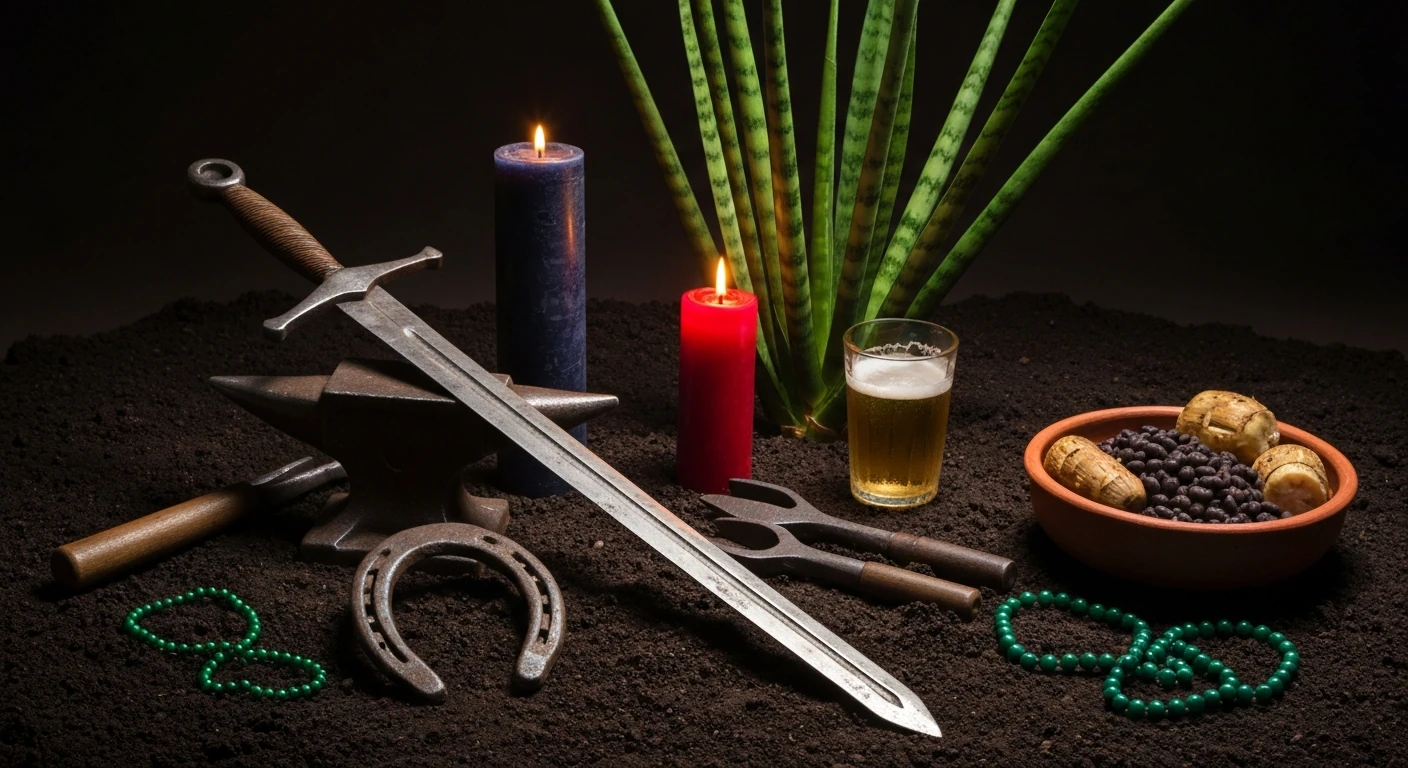
On the Afro-Brazilian side is Ogum, the orixá of war, iron, and paths. He is the one who forges weapons and tools, who opens the roads and cuts through demands, removing the obstacles from the lives of his children. His greeting is "Ogunhê!", and his symbols are pieces of iron: the sword, the spear, the machete, and the anvil.
Here we present only the essentials, because the blog already has his complete profile. To deeply learn about the mythology, colors, and offerings, it is worth reading who is Ogum. The important thing to remember is that Ogum's war is not blind violence: it is the force that opens paths and protects. It was this image of an iron warrior that found Saint George.
Why Saint George became Ogum
The meeting of the two was not by chance. Notice the similarities: both are warriors and protectors, both defeat evil with iron weapons. The spear that Saint George drives into the dragon is the same iron sword of Ogum. Both ride, both fight, both open paths where there was danger. Faced with such a similar image, the association was natural.
But it was not born from a free choice. During slavery, Africans were forbidden from worshipping their orixás. The solution was to hide Ogum behind the statue of Saint George: in the eyes of the master, they prayed to the Catholic saint; in their hearts, they greeted the orixá. Syncretism was, therefore, a strategy of resistance, and not a fusion of the two religions.
That is why syncretism is not equivalence. Saint George continues to be Saint George for the Catholic, and Ogum continues to be Ogum for the people of santo. April 23rd houses two devotions that respect each other, each with its own faith.
In Bahia, Saint George is Oxóssi
Here is the point that almost no one tells, and which is the heart of this article. The association between Saint George and Ogum applies to the Southeast, especially in Rio and in São Paulo, and for Umbanda. But it is not a universal rule.
In Bahia, in the Ketu tradition Candomblé, Saint George is linked to Oxóssi, the orixá hunter of abundance and the forests. There, the link is not war, but the mounted hunter, the arrow that guarantees sustenance. And, following this same Bahian logic, it is Saint Anthony who is usually associated with Ogum, as tradition records.
This does not mean that one region is right and the other is wrong. It means that syncretism is alive and plural: each place read the similarities in its own way, according to its history. It is the same that happens with Saint Barbara and Iansã, who in the Angola nation changes name, or with Our Lady Aparecida and Oxum, in another pair of devotions that cross. The golden rule remains valid: who defines the correspondence is the foundation of each house.
April 23: the day of Saint George and of Ogum
April 23 is a state holiday in Rio de Janeiro by Law 5.198, of 2008: "The day of April 23, Day of Saint George, is established as a state holiday." In 2023, the Supreme Federal Court ruled the law constitutional, due to the "religious and cultural relevance of the Catholic saint Saint George." It is not a national holiday, but it mobilizes the entire city, from the churches to the samba school rehearsal halls. In São Paulo, Law 14.905, of 2012, put the "Day of Ogum" on the official State calendar on the same date, without a holiday. The laws, the June 13 of Bahia and the date in 2027 are in Ogum's day.
On the Catholic side, the day has masses, novenas, and the traditional Alvorada of Saint George, with fireworks at dawn. On the side of the terreiros, there are giras, chants, and offerings to Ogum, with the color red dominating everything, from the candles to the little flags. And there is a dish that became a symbol of the date: the feijoada de São Jorge, or feijoada de Ogum, served in terreiros and centers, since beans are one of the sacred foods of the orixá. To situate the date in the cycle of celebrations, see the calendar of the orixás.
The prayer and the fame of Saint George
Few prayers are as well known in Brazil as that of Saint George. The famous "Eu andarei vestido e armado com as armas de Jorge" is recited by those seeking courage and protection, and it even echoed in popular music, in the voice of Jorge Ben Jor. It well translates the feeling that unites the saint and the orixá: the confidence of someone who feels supported by a warrior force.
The devotion to Saint George carries the fame of protecting against enemies, envy, and dangers, and of "taming the beasts" of the path. It is worth understanding this as an expression of faith and steadfastness, and not as a formula that guarantees a result. The prayer strengthens whoever prays it, gives courage to face life's battles, and renews confidence. The rest is the walk, attitude, and each person's care for their own journey.
The devotion that many today prefer to separate
A final word on a current debate. If syncretism was a tool for survival, today part of the people of santo choose to separate the saint from the orixá, affirming that Saint George is Saint George and Ogum is Ogum, each in their own tradition.
This movement is not a lack of respect to anyone. It is the recognition that Afro-Brazilian religions no longer need to hide and can assert their identity with pride. Those who celebrate both together honor the resistance of the ancestors; those who prefer to separate them honor the autonomy of their own faith. Both attitudes have their place, and both deserve respect. Spirituality, after all, is a path, and each person walks their own.
Frequently asked questions
Is Saint George Ogum?
In the syncretism of the Southeast and in Umbanda, yes, Saint George is associated with Ogum, the warrior orixá. But they are not the same deity: they are figures from different religions, linked by the common image of the iron warrior. The correspondence varies by region, and many houses today prefer to keep the saint and the orixá separate.
Why is Saint George associated with Ogum?
Because of the image of the warrior. Saint George is the knight who defeats the dragon with the spear, and Ogum is the orixá of war, iron, and the sword, who opens paths and protects. During slavery, Africans hid Ogum behind Saint George so they could worship him. It was a strategy of spiritual resistance.
Is Saint George Ogum or Oxóssi?
It depends on the region. In Rio de Janeiro, in São Paulo, and in Umbanda, Saint George is linked to Ogum. In Bahia, in Ketu Candomblé, he is associated with Oxóssi, the hunter orixá. It is not a contradiction, but rather the plurality of syncretism, which each place built in its own way.
Is April 23rd a holiday?
April 23rd, Saint George Day, is a state holiday in Rio de Janeiro by Law 5.198, of 2008, which the Supreme Federal Court ruled constitutional in 2023. It is not a national holiday, therefore it does not apply to all of Brazil. In São Paulo, the date is Ogum Day in the official State calendar, without a holiday.
What is the feijoada of Saint George?
It is the feijoada served on April 23 in terreiros, centers, and samba school rehearsal halls, in honor of Saint George and Ogum. Beans are one of the sacred foods of Ogum, which is why the dish became a symbol of the date, gathering devotion, abundance, and popular celebration.
Where to find items for Saint George and Ogum
At Joia Mística Laroyê, you find what you need to honor the warrior:
- Statues of Saint George: for your altar
- Red bead necklaces and candles: the colors of Ogum
- Swords and tools of Ogum: symbols of iron
- Snake plant (espada de São Jorge): the leaf of protection
Visit our shop in Extrema, Minas Gerais or talk to us via WhatsApp and we ship all over Brazil.
References
- Wikipedia: entry about Saint George
- Wikipedia: entry about Ogum
- Supreme Federal Court: Informativo 1105, ADI 4.092, holiday of the Day of Saint George
- Legislative Assembly of São Paulo: Law 14.905 of 2012, Day of Ogum
- CNN Brasil: report on syncretism and the celebrations of Saint George Day