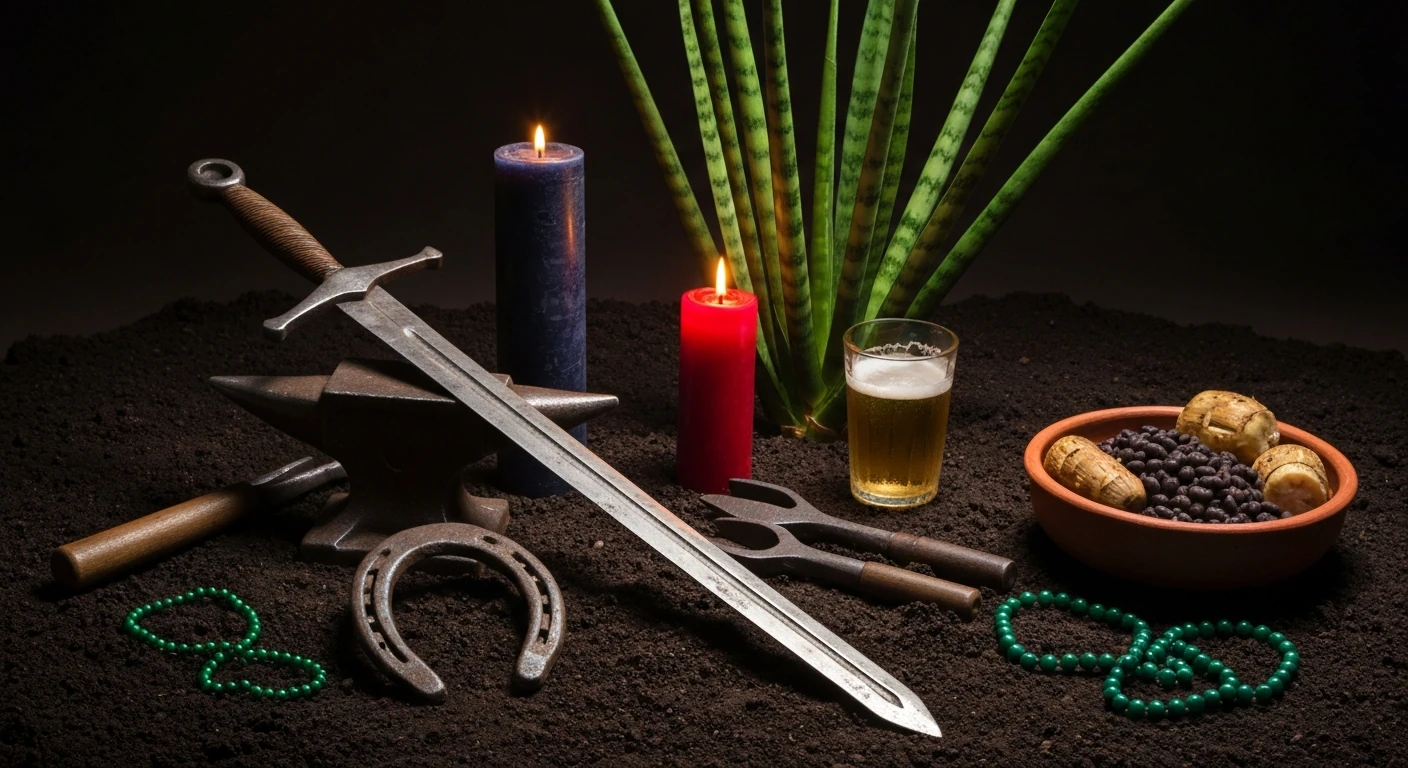
The ponto de Ogum is the sacred song of the Ogum line in the Umbanda gira: it opens the session, calls the Oguns by name, sustains the arrival, and bids farewell. In the house of Zélio de Moraes, Ogum already appears in the first opening ponto. The house book gathers 67 of his pontos. The lyrics change from terreiro to terreiro.
What is the ponto of Ogum (sacred song) and when is it sung
The ponto of Ogum is the ponto cantado (sacred song) of Ogum and the spirits of his line. Every moment of the gira has its own. In the book of the Tenda Espírita Nossa Senhora da Piedade (TENSP), Ogum enters before the section that bears his name.
- Opening: "And Ogum in every gira" and "Hail the crown of Ogum de Lei".
- Defumador (smoke cleansing blend): “Corre gira Pai Ogum” and “Quem está de ronda é São Jorge”.
- Tronqueira: "Ogum is all Malé."
- Arrival and firmeza: the first ponto (sacred song) of the Ogum section asks “Open my paths” and “Firm this gongá, Ogum.”
- Subida: "Olha Ogum vai se embora", with "Firma ponto Ogum vai se embora".
In another house, the logic is the same. In a tenda in Dourados (MS), the researcher Haroldo Medeiros records pontos for the smoke cleansing (defumação), the opening, and the arrival of the spirit guides. There are also request pontos, led according to the needs of those in the gira. Who plays and leads the singing is a matter of the curimba in Umbanda. The types of ponto in general are in pontos cantados in Umbanda.
Where to sing: opening, smoke cleansing incense blend (defumador), tronqueira, arrival, ascent | Book of the house of Zélio: 67 pontos of Ogum | Sign on the ponto riscado: sword
The pontos of Ogum at Zélio de Moraes' house
The house founded by Zélio de Moraes publishes a Livro de Pontos Cantados (Book of Sung Sacred Songs) on its website. In it, Ogum is the first line of orixá (orisha), right after the tronqueira. The index counts 67 pontos of Ogum. The book does not give an author for the pontos: the house publishes them as tradition.
Ponto 04 calls on the Oguns and then says that they work on land, in the sea, and on the sand:
“Hail Ogum Iara / Ogum Matinata / Ogum Rompe Mato / Ogum Megê”
In the other pontos, Sete Ondas, Beira Mar, Sete Espadas, Ogum de Lei, and Naruê appear. Ogum Matinata comes “sailing over the blue sea” to defend “the Southern Cross.” Who each of these Oguns is in the gira is in Ogum in Umbanda, and the orixá, in who is Ogum.
”Eu tenho sete espadas” (“I have seven swords”): the same ponto in four records
The ponto (sacred song) of the seven swords appears in four different records. It is in the book of Zélio's house and in three houses researched by Pedro Nogueira (UFJF). It is also in the booklet of the Terreiro de Umbanda Pai Maneco, in Curitiba, and in a tenda in Dourados. In TENSP, it begins like this:
“I have Seven Swords to defend me / I have Ogum in my company”
The end changes from house to house:
| Where | The verse that changes |
|---|---|
| TENSP (Zélio's house) | “I live with God and the Virgin Mary” |
| Three houses researched at UFJF | ”Ogum will descend, / In the faith of Zambi and the Virgin Mary” |
| Pai Maneco (Curitiba) | “But Ogum will descend / In the faith of Zambi and the Virgin Mary” |
| Tenda in Dourados (MS) | “Ogum is the head of the cavalry / Has seven swords with whom he defended us” |
Nogueira reads “Zambi” as Bantu influence and “Virgem Maria” as Catholic. He recalls that, because they are of oral tradition, the origins of the pontos “often cannot be proven”. The exchange is sometimes of a single word. In TENSP, the ponto that opens the Ogum section sings “Ogum, a hora é boa” (“Ogum, the hour is good”). In Pai Maneco, the same verse is “Ogum a hora é essa” (“Ogum, the hour is this”).
General, flag and patrol: why the ponto of Ogum speaks like a soldier
The ponto of Ogum uses rank, horse, and barracks. In TENSP there is “Ogum general of Umbanda”, “Lord Major Ogum” and “But he is a cavalry private”. In ponto 10, Ogum Megê goes to war mounted and wins the demanda “in the fields of Humaitá”:
“On his "horse" your Ogum went to war / With his sword / With his spear”
Ronda is another barracks word. “Beira Mar quem está de ronda é militar” (Beira Mar, whoever is on patrol is a military man), sings TENSP, and “Olha Ogum está de ronda / Miguel tá chamando” (Look, Ogum is on patrol / Miguel is calling). In Pai Maneco, the pontos of Ogum de Ronda bring Saint George patrolling and Saint Michael calling. The Núcleo Umbandista São Sebastião writes that Saint Michael is the Ogum de Lei. For the same house, the division of the Ogum falanges diverges greatly from one terreiro to another. The knightly saint of the pontos is the one in Saint George and Ogum, and his date is in Ogum day.
And Humaitá?
Humaitá is the name of a Paraguayan fortress. According to historian Francisco Doratioto, the Paraguayan War was fought around it from April 1866 to July 1868. The pontos place Humaitá in different places: “in the fields of Humaitá” and “at the tip of Humaitá” in TENSP, “in the woods of Humaitá” and “Seu Sete Ondas comes from Humaitá” in Pai Maneco.
The sources on the pontos do not explain the name. The connection with war is a possible reading. There is another piece of data: the researcher Lourival Andrade Júnior records that, during the dictatorship, many terreiro mediums belonged to the armed forces, "in most cases identified as children of Ogum".
Where do the lyrics of the pontos of Ogum come from
The lyrics arrive through the gira, through the composer, through the house's book, and through the printed collection. Diamantino Trindade, cited by Andrade Júnior, calls pontos de raiz those "brought directly by the incorporated spirits or through the intuition of the mediums". The others are created by composers, "very common in curimba festivals".
In the 1970s, pontos were already circulating in print. The collection 3,000 pontos riscados and sung in Umbanda and Candomblé was released by Editora Eco in 1974. It is the main base of the pontos that Andrade Júnior analyzed. Today, the houses publish their own. TENSP has a book; Pai Maneco has booklets by line, with "individual pontos" for each Ogum and "line pontos".
A composer's ponto (sacred song) has an owner. Pai Maneco's booklet marks the author when it exists, such as in "Composition: Reinaldo Godinho". Therefore, only pontos that the houses publish without an author or that research already cites are included here.
Ponto riscado of Ogum: the sword on the terreiro floor
In the ponto riscado, the sign of Ogum is the sword, in two studies. Andrade Júnior shows that the ponto of Caboclo Ogum das Matas has, "in addition to the traditional arrow", Ogum's sword, which he calls Obé. In Dourados, Medeiros describes a set of pontos riscados in which the sword is "representative of Ogum". Along with it goes a white and red candle, which the house links to the orixá.
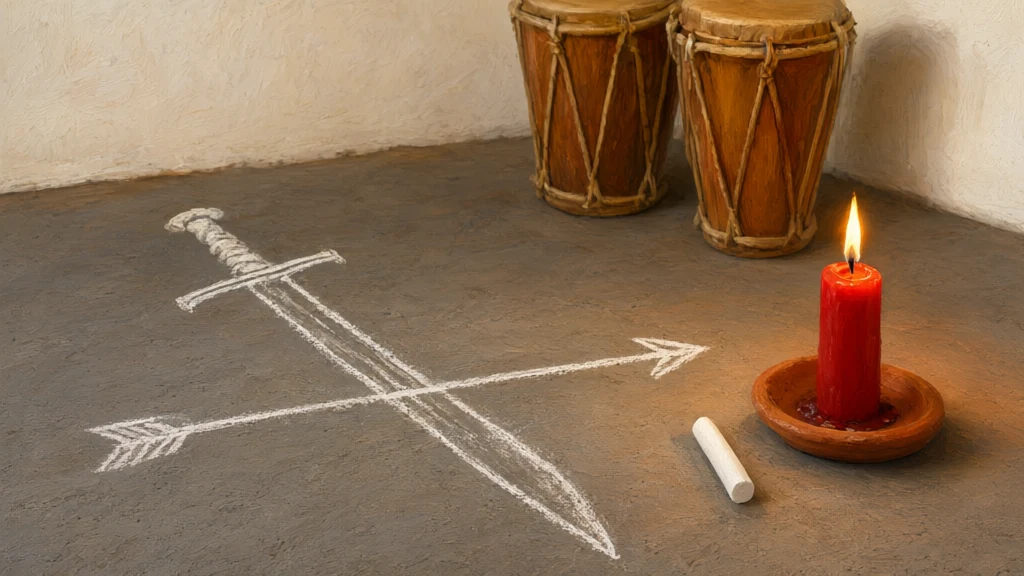
The riscado also says what the spirit asks. In Fortaleza, a pai de santo explained this to researcher Linconly Pereira: through the ponto, "you will identify the type of candle you have to light, the type of drink you have to use." Of the leaders he heard from, only two felt comfortable teaching something concrete about pontos riscados. The drawing belongs to the spirit and the house. A riscado copied from the internet is not the ponto of your terreiro. The foundation of drawing is in ponto riscado na umbanda.
The spear is in the ponto cantado; the sources do not put it in the riscado of Ogum. Whoever is going to consecrate the ponto with pemba and candle and wants to check the color the house asked for can speak with Joia Mística via WhatsApp.
Frequently asked questions
What is the most well-known ponto of Ogum?
Among the pontos with sources, the one of the seven swords, which begins with "I have Seven Swords to defend me." It is in the book of Zélio's house and in three houses researched at UFJF. It also appears in Pai Maneco and in a tent in Dourados, each with a different closing.
What did Ogum Beira Mar bring from the sea?
The ponto itself answers. In Pai Maneco's booklet, after "Seu Ogum Beira Mar / What did you bring from the sea?", comes "Coming bringing on the right arm / The rosary of Mamãe Sereia." Zélio's house has a ponto with the same first verse.
Is the ponto of Ogum in Candomblé the same as in Umbanda?
It is not the same repertoire. The book of Zélio's house is from Umbanda and sings in Portuguese. In the Bahian Candomblé described by Pierre Verger, Ogum is the first greeted after Exu (Eshu) is dispatched (despachado) and receives the cry "Ogum ieee!" A cantiga of Ogum is in Ogum Onire Alagbara.
References
- Tenda Espírita Nossa Senhora da Piedade: Book of Chanted Points
- Terreiro de Umbanda Pai Maneco: apostila de pontos de Ogum
- Pedro Antônio Pires Nogueira, UFJF: dissertação sobre caboclos e pontos em casas de umbanda
- Haroldo Paulo Camara Medeiros, UFGD: Quebra o coco e arrebenta a sapucaia
- Lourival Andrade Júnior, Mneme (UFRN): The caboclos in Afro-Brazilian religions
- Lourival Andrade Júnior, ANPUH: I worshiped the souls, Umbanda, preto-velho and slavery
- Linconly Jesus Alencar Pereira, UFC: Umbanda in Fortaleza, sung and drawn pontos
- Francisco Doratioto, Navigator (Brazilian Navy): 150 years of the Passage of Humaitá
- Núcleo Umbandista São Sebastião: Ogum line
- Pierre Verger: Orixás, Yoruba gods in Africa and the New World