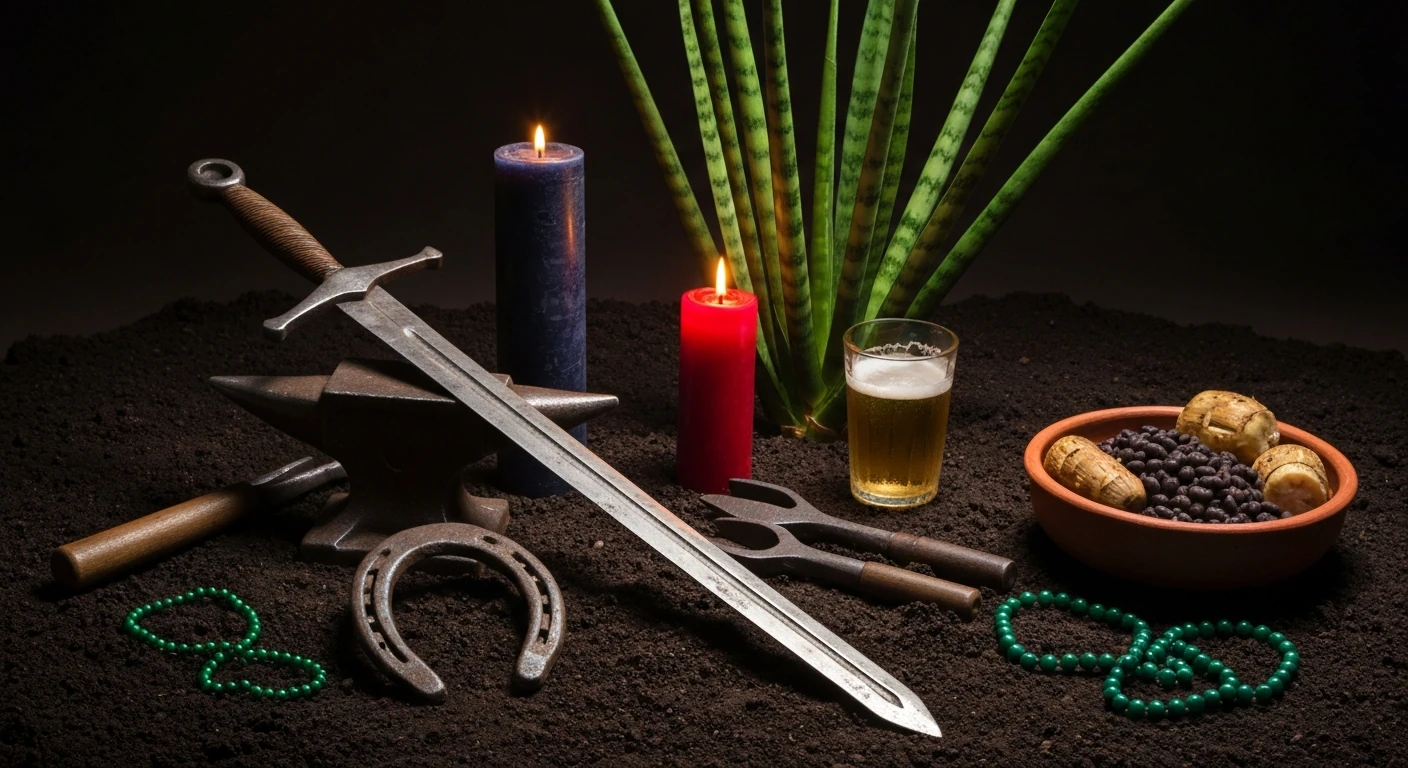
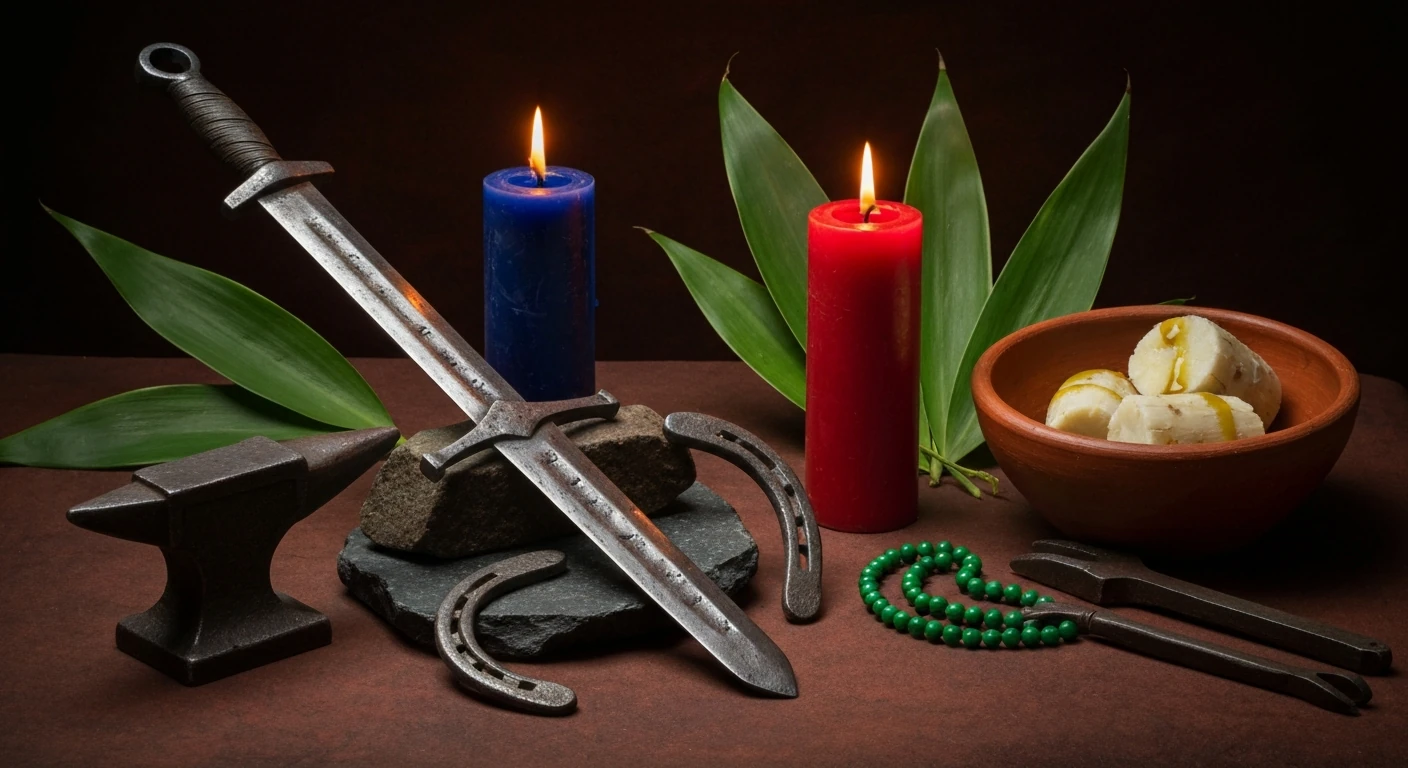
The qualities of Ogum are the many paths of a single orixá. In Bahia, Pierre Verger recorded seven names for Ogum, including Onirê, Akorô, Alagbedê, and Ogunjá. In Umbanda, the orixá gained lines, such as Beira-Mar, Megê, and Rompe Mato.
The head quality of each person is a foundation of a house of the orixás (casa de santo): it is only revealed inside, never alone.
What are the qualities of Ogum
In Candomblé, quality is the name given to each path or foundation of an orixá. The orixá is one, but manifests in qualities that express facets of the warrior: the king, the blacksmith, the one who opens roads. Anyone who wants to know the orixá before the paths can read who is Ogum.
Each quality brings its own foundation, its foods, its colors, and even a distinct temperament. An older and ancestral path requires a different treatment from a young and impetuous one. Therefore, there is no single, closed list: the qualities vary from nation to nation and from house to house.
The same happens with other orixás. The blog has already explained the paths of other great names in qualities of Xangô and qualities of Oxum, and the logic is always the same: one orixá, many paths.
Ogum is one, but walks many paths
Here lies the distinction that separates those who understood from those who only memorized names. In Candomblé, the quality is a foundation of the terreiro, revealed in the initiation of the orixá through cowrie-shell divination. It is a house secret, not an internet topic.
In Umbanda, the custom followed another path. Instead of foundation qualities, the orixá gained lines, also called falanges. Verger already noted that Ogum "is unique, but, in Ire, it is said that he is composed of seven parts".
Ogum is a single orixá. The qualities and lines are not several Oguns, but rather the many paths through which the same warrior walks.
In practice, the practitioner finds both vocabularies. A Candomblé practitioner speaks of quality, an Umbandista speaks of line, and both speak of the same Ogum. Understanding this difference avoids the most common confusion on the subject.
The main qualities of Ogum in Candomblé
In the book Orixás, from 1981, Verger writes that in Bahia Ogum receives seven names, and the most cited are "Ogum Onirê, Ogum Akorô, Ogum Alagbedê, Ogunjá, ogum Mejê, Ogum Omini, Ogum Warí". Some have explanations in the sources:
- Ogum Onirê: the name comes from the title Oníìré, "King of Ire". For Verger, Ogum took the city of Ire, put his son on the throne, and returned using the title.
- Ogum Akorô: Ogum could not wear a crown, only a diadem called àkòró. For this reason, he is hailed as Ògún Aláàkòró, writes Verger, also in Brazil and in Cuba.
- Ogunjá: Verger tells that the praises to Ògúnjajá, "Ogum eats dog", gave him the name Ògúnjá. Edison Carneiro, cited by Reginaldo Prandi, describes Ogunjá as "an Ogum who lives with Oxóssi (Oshosi) and Exu, and feeds on raw food".
- Ogum Alagbedê, Mejê, Omini and Warí: are on Verger's list, without explanation in the same passage.
- Ogum Xoroquê: is not on Verger's Bahian list; his case comes later.
This list is not exhaustive nor universal. Each root of Candomblé keeps its qualities, with its own names and details. What matters is the principle: each path is a face of the same orixá.
The paths of Ogum in Umbanda
In Umbanda, the list of Ogum lines changes with the author. In the coding of Matta and Silva, summarized by researcher Sônia Lages (UFJF), the Ogum line has seven falanges: Ogum de Lei, Yara, Megê, Rompe Mato, Malê, Beira-Mar and Matinata. The author herself warns: "But the classifications vary."
- Ogum Beira-Mar, Iara, Matinata, Rompe Mato and Megê: the house of Zélio de Moraes sings the five names in the pontos and says that "They work on the land my Pai", in the sea and on the sand.
- Ogum Rompe Mato: also appears as caboclo de Ogum in the list by Prandi, Vallado and Souza reproduced by Pedro Nogueira (UFJF), alongside Oxóssi, the theme of who is Oxóssi.
- Ogum Megê and Ogum de Ronda: in the cemetery of Vitória (ES), Umbandistas heard by Barbara Thompson say that Megê "belongs to the line of the souls" and that Ogum de Ronda "works assisting the exus".
- Ogum Sete Espadas, Sete Ondas and Naruê: are names that appear in the pontos of the house of Zélio; Naruê is also sung in the Terreiro de Umbanda Pai Maneco, in Curitiba.
Each falange, author by author, and who descends in the gira are in Ogum in Umbanda. The pontos in which these names appear are in ponto of Ogum. To know the temperament of those ruled by the orixá, it is worth reading children of Ogum.
Ogum Xoroquê: the path that touches Exu
No quality generates more doubt than Ogum Xoroquê. The firmest source is Reginaldo Prandi, in Revista USP, in 2001. He writes that those identified in the divination as children of Exu ran the risk of being seen as children of the devil. Therefore, they "ended up being initiated into another orixá, especially into Ogum Xoroquê, a quality of Ogum with deep connections to the messenger." And he adds: "Until recently, it was rare and notorious for children of Exu to be initiated into Exu."
On the same page, Prandi cites Edison Carneiro regarding the "carrego de Exu," delivered to Ogunjá. The bridge between Ogum and Exu in old Bahian Candomblé also passed through this path.
Hence comes the popular phrase that Xoroquê would be "half Exu," which no open source supports. What the sources say is the close connection with the messenger. This does not make Xoroquê a bad spirit, nor Exu the devil, as the blog explains in offering for Exu.
Ogum Xoroquê walks near Exu. Approaching Exu is not malice, it is function.
The nation, the color, and the tool of Xoroquê change from house to house, and open sources do not close these answers. Those who worship know the foundation of their own house.
Ogum beyond Ketu: Angola nation and syncretism
The qualities change names when the nation changes. In Candomblé de Angola, the energy of the orixá appears as the inquice Nkosi, which Prandi writes as "Roximucumbe," with its own liturgy and chants. In Jeje, the corresponding vodun is Gu: in Bogum, a Jeje house in Salvador, the newspaper A Tarde recorded that on January 19, Gu, "the lord of war and metallurgy (Ogum)" descends. In the Gaúcho Batuque, the warrior has a prominent place, a theme of Ogum in Batuque.
In syncretism, the orixá also gains different faces by region. In the Southeast, he is Saint George, the warrior saint, an association treated in Saint George and Ogum. In Bahia, the same Ogum is usually Saint Anthony, as shown in Saint Anthony and Ogum. The dates for each region are in Ogum day.
The color follows the tradition. In Ketu Candomblé, Prandi records beads as "dark blue or green". In Umbanda, red dominates, and Nogueira links this to syncretism, "in the red color of the mantle of Saint George for Ogun". There are Umbanda houses that follow the nation: in a terreiro he studied, "Ogun takes the dark blue".
None of this is equivalence between saint and orixá. Syncretism was a historical strategy for the worship to survive repression, not a fusion of faith.
The foundation is from the terreiro
Here is the most important point. Your quality of Ogum is not discovered on your own.
No internet test, zodiac sign, birth date, or quiz reveals a person's head quality. This is fundamento, and fundamento is revealed in the cowrie-shell divination, conducted by a babalorixá or an ialorixá, inside a house of the orixás (casa de santo). Whoever wants to understand their own path begins by looking for a serious terreiro, as the text how to know what is my orixá advises.
This article serves to know the paths and respect the richness of the tradition, never to self-initiate or fix a quality. The knowledge about qualities belongs to the terreiro, and it is there that it is transmitted, from pai and mãe de santo to child, at the right time.
Frequently asked questions
How many qualities of Ogum exist?
There is no fixed number. Verger records seven names of Ogum in Bahia: Onirê, Akorô, Alagbedê, Ogunjá, Mejê, Omini, and Warí. Other houses mention others, such as Xoroquê, and the count changes according to the nation and the terreiro. In Umbanda, the list of lines also changes from author to author.
What is the difference between quality and line of Ogum?
Quality is the term of Candomblé, a foundation revealed in the feitura de santo. Line, or falange, is the term of Umbanda, such as Beira-Mar or Rompe Mato in the list by Matta and Silva. Both speak of the same Ogum, with vocabularies from different traditions.
Who is Ogum Xoroquê?
Reginaldo Prandi describes him as "a quality of Ogum with deep connections with the messenger", Exu. Sons of Exu ended up initiated for him. He is not on Verger's list for Bahia. The idea that he would be "half Exu" has no open source, and the connection with Exu does not make him a bad spirit.
What is the most worshipped quality of Ogum?
There is no count that answers this. Onirê, linked to the title of "King of Ire", opens Verger's list in Bahia. Even so, each house has its preferences and its foundation, so the most present quality changes from terreiro to terreiro according to the root of the nation.
How to know my quality of Ogum?
Only through cowrie-shell divination (jogo de búzios), with a babalorixá or an ialorixá, inside a casa de santo. There is no test, sign, or date that reveals this. If you feel a connection with Ogum, the path is to look for a serious terreiro and let the foundation be revealed at the right time.
Where to find items for Ogum
At Joia Mística Laroyê, you find what you need to honor the warrior orixá:
- Statues and tools of Ogum: swords, spears, and the statue of the orixá in various sizes
- Candles in the colors of Ogum: dark blue, red and white
- Bead necklaces and beads: in the colors of the qualities and lines of the orixá
- Herbs of Ogum: sword-of-saint-george, guiné and peregum for baths and fumigations
- Cigars, beer and offering items: for the favor of the warrior
Visit our shop in Extrema, Minas Gerais or buy via WhatsApp with delivery to all of Brazil. See also how to prepare the offering (agrado) in offering for Ogum.
References
- Pierre Verger: Orixás, Corrupio, 1981
- Prandi, Revista USP (2001): Exu, from messenger to the devil
- Prandi, Horizontes Antropológicos (UFRGS, 1995): Deuses africanos no Brasil contemporâneo
- Lages, UFJF (2003): Exu: light and shadows
- Nogueira, dissertation (UFJF, 2014): The intra-religious dialogue in Umbanda
- Thompson, IV Seminário PGCS UFES (2019): umbanda rituals at Santo Antônio cemetery
- Tenda Espírita Nossa Senhora da Piedade: Book of Chanted Points
- Terreiro de Umbanda Pai Maneco: apostila de pontos de Ogum
- A Tarde (2023): Bogum has a cult to the vodun of the tree