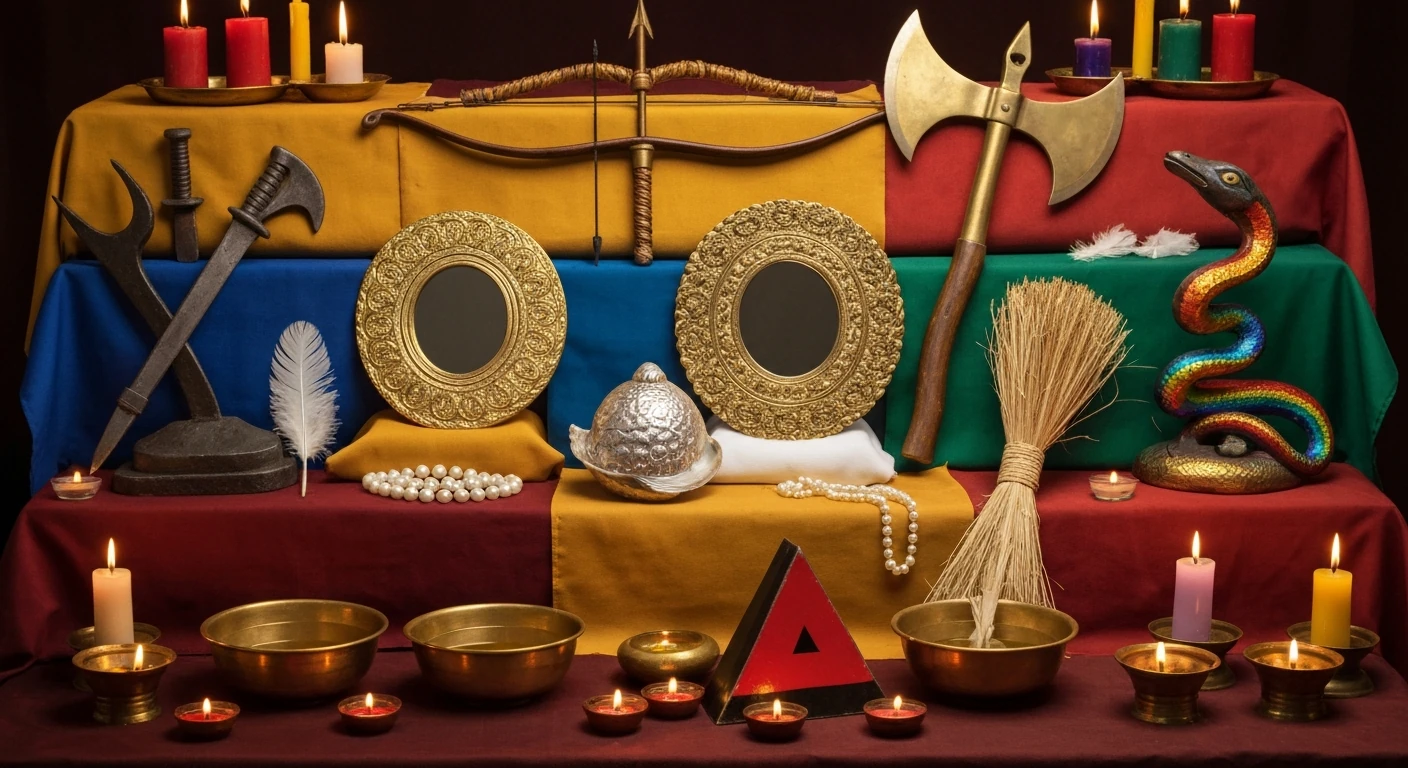
The first thing you see when the shop door opens is the pot of espada de São Jorge (Saint George's sword) resting on the frame, with leaves upright like small green blades pointed toward the sky. It has been there for years. Customers come and go, curious people enter and leave, and the plant remains on guard, silent, asking for nothing more than a little indirect light and spaced-out watering. When a leaf breaks or cracks without anyone having touched it, the people of the house of the orixás (casa de santo) take a deep breath and thank Ogum: something did not pass. The sword fulfilled its duty.
It is perhaps the most Brazilian plant that exists, even being native to West Africa. It grows in the entrance of a humble home, on a middle-class balcony, on the bakery counter, in the law office garden, and at the door of the terreiro. It crosses religion, social class, and geography. It carries on its body the name of a Catholic warrior saint and, at the same time, is a vegetal symbol of the Orixá Ogum. This text is about why it is in all these places, what it truly means, and why a ritual bath is not made with it.
The blade-plant that protects in silence
Look at the leaf of the snake plant (espada de São Jorge) without habit and try to describe it: long, upright, rigid, pointed, dark green with a golden edge, capable of cutting whoever handles it without care. There, you just described a vegetal sword. It was exactly this iconographic parallel that founded the relationship between the plant and Ogum, Orixá of iron, forging, war, and open paths.
In Yoruba cosmology, Ogum is the divine blacksmith, the one who taught humans to work with metal and clear the forest. He is the lord of the seven tools: lever, axe, shovel, hoe, pickaxe, sword, and knife. Everything that cuts, opens a path, or transforms matter through metal is under his domain. When the first Yoruba peoples looked at this elongated and rigid leaf, they saw in it a piece of the Orixá's own sword sprouting from the ground. A living blade. Vegetable iron.
The sociologist Reginaldo Prandi, in Mitologia dos Orixás (Companhia das Letras, 2001) and in Ogum: caçador, agricultor, ferreiro, trabalhador, guerreiro e rei (Pallas, 2019), recalls that Ogum is the Orixá who stands guard at the door. He is the one who opens the paths before any other sacred force manifests traditional greeting: Ogum yê! Having the sword planted near the entrance is, in the logic of the fundamento, having Ogum standing, armed, at the gate. It is not an amulet, it is not a shallow charm: it is the presence of the Orixá inscribed in plant life.
The difference in relation to a ritual bath herb like rue or guinea hen weed is important. Those act through contact: macerated, boiled, smoked, placed on the body. The espada-de-são-jorge acts through presence. It is there, and by being there, it protects. It does not need to be cut, boiled, or rubbed on the skin; its function is exercised simply by the fact that the axé of Ogum inhabits that pot, in that corner, in silence.
Colors: dark green with yellow edges | Day: Tuesday (Ogum) or April 23 (Saint George) | Element: Earth and iron | Ruling orixá (orisha): Ogum | Syncretism: Saint George
Scientific name: the confusion Sansevieria → Dracaena
Whoever tries to research the plant on gardening websites finds a small botanical labyrinth that is worth clarifying. For decades, the scientific name was Sansevieria trifasciata Prain and that is how it still appears in almost every nursery, store tag, and popular Google search. From 2017, however, phylogenetic studies of genetic sequencing demonstrated that the genus Sansevieria was actually embedded in the genus Dracaena, the same genus as the famous dragon tree of Socotra. The taxonomy was updated and the official name became Dracaena trifasciata, of the Asparagaceae family.
For practical purposes: it is the same plant. Only the badge changed. Most people in Brazil still search, sell, and buy it as sansevieria, and this spelling will remain alive for a long time. We mention the reclassification here so that no one thinks they have a plant at home different from the one in the scientific library: it is the same green blade as always, with a new name.
It is also worth noting the popular names by which the plant travels across Brazil: espada-de-são-jorge, espada-de-ogum, espada-de-santa-bárbara, lança-de-são-jorge, rabo-de-lagarto. In liturgical Yoruba, it is called Ewé Idà Òrìsà literally, "sword-leaf of the orixá".
From West Africa to Brazil
The Dracaena trifasciata is native to a wide strip of West and Central Africa, spanning from Nigeria to Congo, passing through Angola. It is not a native plant of Brazil: it arrived here within the slave trade, in the long forced displacement of African peoples to the Americas between the 16th and 19th centuries.
Records associated with studies from the Instituto Agronômico de Campinas (IAC) indicate that the plant was brought by the enslaved people themselves, who justified the possession of the seedlings to masters and slave traders with the practical claim that the leaf fibers were used to make ropes. It was a functional disguise. Behind the utilitarian use traveled the ritual meaning of the espada de Ogum (Ogum's sword leaf), a plant of protection, a religious identity smuggled in the holds.
This is a recurring pattern of the Afro-Atlantic diaspora. Entire liturgical herbs arrived in Brazil under food, textile, or medicinal justifications. The Sansevieria was an ideal candidate: it resists weeks without water, withstands unsanitary conditions, and does not die easily. The geography of its dissemination in Brazil follows the geography of the slave quarters and, later, of the quilombos, the ilês, and the terreiros.
In the African land of origin, particularly among the Yoruba people, the plant was already associated with Ògún and was used in rituals for removing the evil eye and for territorial protection. This ancestral use crossed the Atlantic practically intact. What changes in Brazil is the Catholic disguise, not the symbolic function.
The syncretism Ogum / Saint George
The relationship between Ogum and Saint George is one of the most well-known syncretisms in Brazil. To understand why it happened, it is necessary to remember the context: enslaved Africans arrived with their religious pantheon (orixás, voduns, inquices, depending on the nation), and Catholicism was imposed as the religion of the State and the master. Direct worship of the Orixás was criminalized, persecuted, and a source of punishment. The solution found not only in Brazil, but throughout the African diaspora, was to associate each Orixá with a Catholic saint with similar iconography, maintaining the worship "on the outside" Catholic and "on the inside" African.
For Ogum, the chosen saint was mostly Saint George of Cappadocia, the warrior saint of Christianity, represented on a horse, piercing a dragon with his spear. The parallel is almost millimetric: two armed warriors, two blacksmiths of the divine, two blades standing against evil. (In some regions of the North and Northeast, Ogum syncretized with Saint Anthony; the syncretism was never monolithic.)
The double date of April 23, the day of Saint George in the Catholic calendar, became a simultaneous celebration: masses in the morning, giras at night, crowds in the street, a trademark of the Brazilian religious calendar, especially in Rio de Janeiro. Reginaldo Prandi, in Segredos Guardados, recalls that syncretism was, on one hand, a survival strategy that allowed Candomblé to exist under colonization. On the other hand, today it may limit the institutional self-affirmation of Afro religions, because it keeps part of its faithful transitioning between two universes.
Today, devotees move freely. There are those who worship only Saint George in popular Catholicism. There are those who worship only Ogum in the terreiro. There is the vast majority who worship both, seeing no contradiction. The snake plant / sword-of-Saint-George is probably the most visible everyday object of this coexistence: it carries the saint in its name, the orixá in its foundation, and in the daily life of the house of whoever plants it. For a detailed report on the celebrations of April 23, it is worth reading the CNN Brasil report on Saint George Day.
Why you should NOT do a ritual bath with snake plant
Here is a point that needs to be very clear, because a lot of confusing information circulates: unlike rue, rosemary, guinea hen weed, and basil, the snake plant is not a herb for ritual baths or tea. For two reasons.
The first reason is practical and for safety. The plant contains steroidal saponins and calcium oxalate crystals. When chewed or ingested, these substances cause chemical and mechanical irritation in the mouth, throat, and stomach, causing nausea, vomiting, diarrhea, and excessive salivation. In serious cases, especially in animals and small children, they can progress to tremors, respiratory difficulties, and liver damage. There is specific veterinary literature on poisoning by Sansevieria trifasciata in dogs and cats.
The second reason is theological-traditional. Even if it were not toxic, tradition does not use it in a ritual bath. Its function is to be and protect by presence. The leaf is not an "ingredient" for preparation: it is the very vegetal wall of Ogum planted in the environment. Cutting and macerating its leaves in a ritual bath is, in the logic of the foundation, a mistake like melting the saint's sword to make tea.
Practical conclusion: those seeking a protection ritual bath have rue, rosemary, guinea hen weed, basil, and levante. Those seeking permanent protection from the environment have sword-of-saint-george in a pot. They are complementary functions, not interchangeable. To better understand the logic of herbal baths in the Afro-Brazilian foundation, see our guide on how to make a herbal bath for Oxum.
Attention pets: the plant is toxic to cats and dogs if ingested. Place it out of reach of domestic animals at a height, in a hanging pot, or in a room where the animals do not circulate.
How to care for and where to place
The sword-of-saint-george is one of the most generous plants that exist for those who care for it: it asks for little and gives back a lot. But it has its rules, and the main one is moderation in watering; the most common error is soaking it.
Traditional positions:
- Pot at the house entrance, near the main door (main protection). When there are two seedlings, tradition recommends one on each side, forming a symmetrical guard.
- Pot in commerce, especially in street shops, counters, or reception areas. Protects against envy from competitors, non-paying customers, and the "evil eye" of passersby.
- Pot in the office, for those exposed to internal disputes, corporate gossip, or high-visibility public office.
- Cut leaf under the mattress, in specific cases of nightmares or insomnia linked to spiritual disturbance. Just one leaf, wrapped in a white cloth. Replace when it withers and discard in running earth.
Basic care:
- Light: tolerates indirect sun and even low light; half-shade is ideal. Strong direct sun burns the edges.
- Water: little. Water only when the soil is dry to the touch, generally every 7 to 15 days, depending on the climate and the pot. Excess rots the root and kills the plant.
- Pot: with a drainage hole is indispensable. Well-drained substrate, with soil, sand, and small stones at the bottom.
- Propagation: by division of the clump or by leaf cutting. Reproduces easily; offering a cutting to a friend or relative is an ancient gesture of transferring protection.
Popular energetic signs:
- Leaf breaks without reason: tradition says it absorbed a targeted attack. It is not a bad sign, it is the plant fulfilling its duty. Discard the leaf in running earth.
- Wilts in a new home: energetically charged environment. Smoke cleansing (defumação) with arruda or guiné, changing the plant, or patience with renewal is recommended.
- Vigorous, sprouts a new cutting: protection in full operation, healthy environment.
- Ritual discard: compromised leaves go to running earth (garden, park, forest, riverbank), never to common trash. They are returned to nature with a brief thank you to Ogum.
Patakori Ogum! Ogum yê, my father, open the paths and hold the door.
Espada-de-são-jorge vs comigo-ninguém-pode vs arruda
The three plants coexist on the same Brazilian doorways and fulfill similar functions, but tradition distinguishes them clearly. It is worth understanding the difference before choosing.
The espada-de-são-jorge is passive and warrior protection. It does not just block: it cuts. It is a symbol of Ogum's advance, opening of paths, a blade standing upright. Its mythical image is that of the armed guard at the door.
The dumb cane is also passive protection, but it acts as a shield. It works as a wall that absorbs. When heavily charged, it may "dry out" as a sign that it has fulfilled its duty. Popular tradition usually recommends having both together: one cuts, the other shields.
The rue, in turn, is an active plant: it serves for ritual bath, smoke cleansing (defumação), and a protection branch on the body. It is consumed in the process. It does not replace the snake plant, and the snake plant does not replace the rue: one covers the environment, the other covers the person. The guinea hen weed falls into a third category: it is the energetic "surgeon," used in a strong ritual bath of spiritual cleansing (descarrego) for a serious demanda. Learn more about herbs and their functions in our herbs section.
Frequently asked questions about the snake plant
Why is it called espada de São Jorge (Saint George's sword)?
Due to the similarity of the long, pointed leaves with the sword of the Catholic warrior saint, syncretized with Ogum. The popular name was born from the iconographic parallel between the stiff leaf and the blade of the saint on horseback. In the terreiro, the same plant is called espada-de-Ogum; in Yoruba, Ewé Idà Òrìṣà.
Is the snake plant of Saint George Ogum?
Yes. It is the symbol plant of Ogum in Brazilian Afro-Brazilian religions. The syncretism with Saint George is the Catholic version of the same foundation, historically built as a survival strategy for Afro worship during colonization. Today, the dual naming coexists: snake plant of Saint George on the street, espada-de-Ogum in the ilê.
Where to place the snake plant of Saint George to provide protection?
Traditionally, at the entrance of the house or business, in a pot, near the main door. It can be inside or outside, depending on the space. If there are two seedlings, one on each side closes the guard. Feng Shui suggests the left side (dragon side), and Afro-Brazilian tradition does not contradict this indication.
What does it mean when the leaf of the snake plant breaks?
In popular tradition and Afro-Brazilian fundamento, it is a sign that the plant absorbed a targeted attack of envy, evil eye, or dense energy. It is not a bad omen: it is the function being fulfilled. Discard the broken leaf in open ground, thanking Ogum, and move forward.
Can I take a ritual bath with snake plant?
No. Tradition does not recommend it for two reasons. First, its function is passive protection in the environment, not contact on the body. Second, the plant contains saponins and calcium oxalate, being slightly toxic if ingested. For protection ritual baths, use rue, rosemary, guinea hen weed, or basil. To better understand the role of the Orixás in your home, read what the Orixás are.
Where to buy seedlings and items of Ogum
At Joia Mística Laroyê you find the items that make up the complete care with Ogum and with Saint George, ready to enter the home or the terreiro:
- Snake plant seedlings (check stock availability)
- Red and white candles of Ogum
- Statues of Ogum and of Saint George for the altar, separate or together, for those who worship both
- Miniaturized tools of Ogum (sword, horseshoe, set of seven tools)
- Ready protection ritual baths with axé by Joice Mística, for those who want to add an active ritual bath to the passive protection of the pot
- Also check out the complete page for the snake plant in our herbs section
Visit the physical store in Extrema-MG, at R. Benedito Zingari, 460. For questions, usage instructions, or consultation on what best fits your moment, talk to us via WhatsApp.
References
- CNN Brasil: report on Saint George Day and religious syncretism
- Reginaldo Prandi: Mythology of the orixás, USP, where the records of the itans of Ogum cited here come from