The myth tells, narrated by Mãe Stella de Azevedo Santos, that Oiá was the adopted daughter of the hunter Odulecê. When he died, she gathered his hunting instruments in a cloth and danced for seven days. On the seventh night, she entered the forest and left the belongings at the foot of a sacred tree. Olorum (Olodumare) was moved and gave her the power to guide the dead to the orum.
There was born the axexê, the funeral rite of Candomblé. It does not replace the wake or the burial: it happens afterward, in the terreiro, and takes care of what the death certificate does not reach.
This guide explains what the rite does, what happens with the assentamentos, who goes through it, and how each nation calls it.
What the axexê does
The anthropologist Reginaldo Prandi, supported by the work of Juana Elbein dos Santos, summarizes the rite in three purposes:
- Undo the assentamento of the ori, that which was fixed in the bori.
- Undo the links with the personal orixá and, with them, the links with the community of the terreiro.
- Send the egum off, so that it leaves the aiê and goes on to the orum.
Note that none of the three have to do with the body. The axexê deals with the ritual ties that the person built in life, and that do not undo themselves alone.
The axexê is not a party. There is chanting and there is dancing, but the atmosphere of the celebration is intentionally restrained and sad.
The rite that inverts the initiation
Each gesture of the axexê mirrors, in reverse, a gesture of the feitura.
| In the initiation | In the axexê |
|---|---|
| The head was shaved and the oxu, fixed | The oxu is removed immediately after death |
| The head was washed with amaci | The head is washed again, and this water opens the despacho |
| The ori and the orixá were settled | The settlements are undone |
| The quelê was tied around the neck | The quelê is broken |
| The bead necklaces were crossed | The bead strands are broken and gathered |
Anyone who has read about the trajectory of the iaô recognizes the entire list. It is the same sequence, read backwards.
From there comes the rule of proportion: the more years of initiation (tempo de santo), the more complex the rite. More years of initiation mean more bonds to cut.
What happens with the ori, the axé, and the assentamentos
Yoruba anthropology describes the person in spiritual units, and each one has its own destiny.
- Emi, the vital breath, returns to the principle of life and is constantly reused.
- Ori disappears, because it is unique and personal. No one inherits the destiny of another. The ibá of ori is sent off in a despacho.
- The personal orixá returns to the general orixá, of which it was a minimal part.
- Egum, the spirit with the biography and memory of the person, follows to the orum.
Regarding the objects, Prandi is direct: the sacred items of the deceased are undone, broken, and sent off in a large basket that leaves the terreiro. The bundle with the broken threads, the quelê, and the torn clothes is the carrego. The next day, before sunset, the arremate is sung.
Not every house undoes everything, and that is a valid caveat. Giselle Cossard records that the assentamentos are not always undone, and Prandi observes that the seats of founders usually stay with the terreiro. The two readings converge on one point: the jogo (divination) decides. The priest consults the oracle piece by piece.
There is also the minimum version, today the most common: the otás are sent off with a little canjica and the rest is reused.
Who undergoes axexê and how long it lasts
It is not only the senior initiate (mais velho de santo) who has ties to cut. Prandi records that even the abiã who has already done bori needs to have the ori seat ritually sent off (despachado), in a simpler ceremony.
The carrego de egum is the minimum funeral ceremony due to any initiate. The complete axexê is what is done for a person graduated in the religion, and it precedes the carrego.
Regarding the duration, the sources diverge:
| Source | Duration |
|---|---|
| Cossard, via reference entry | one, three, or six nights, plus the finalization on the next day |
| Anthropologist Fábio Lima | seven days for the elders, three for certain initiates, one for the youngest |
| National Center for Folklore and Popular Culture | from three to seven days, starting after the burial |
What everyone agrees on: the duration is proportional to the time since initiation (tempo de santo) and varies by house and by nation. There is no single number.
Many houses still repeat the rite at intervals: one month, one year, and every seven years are the most cited. Prandi attributes the repetition to the influence of Catholicism, which replaces the funeral mass on regular dates.
Regarding ogãs and ekedis, the most honest thing is to say what is known. They are confirmed people, they have ritual ties, and for that reason they also receive rito. The exact form varies by house and by position, and we do not find a reliable source to detail them.
Axexê, sirrum and mukundu: the name in each nation
Treating Candomblé as a single block erases the real difference. The funeral rite has its own name in each nation.
| Nation | Name of the rito |
|---|---|
| Ketu (Yoruba) | axexê, also written asèsè |
| Jeje (Fon) | sirrum, also written sirrun |
| Angola (Bantu) | mukundu, with ntambi as a variant |
| Mina jeje and mina nagô | tambor de choro |
There is a beautiful detail hidden in this vocabulary. In the Fon language, sirrum and zerim name the instruments that replace the atabaques in the rite. The festival drum falls silent, and another sound takes its place.
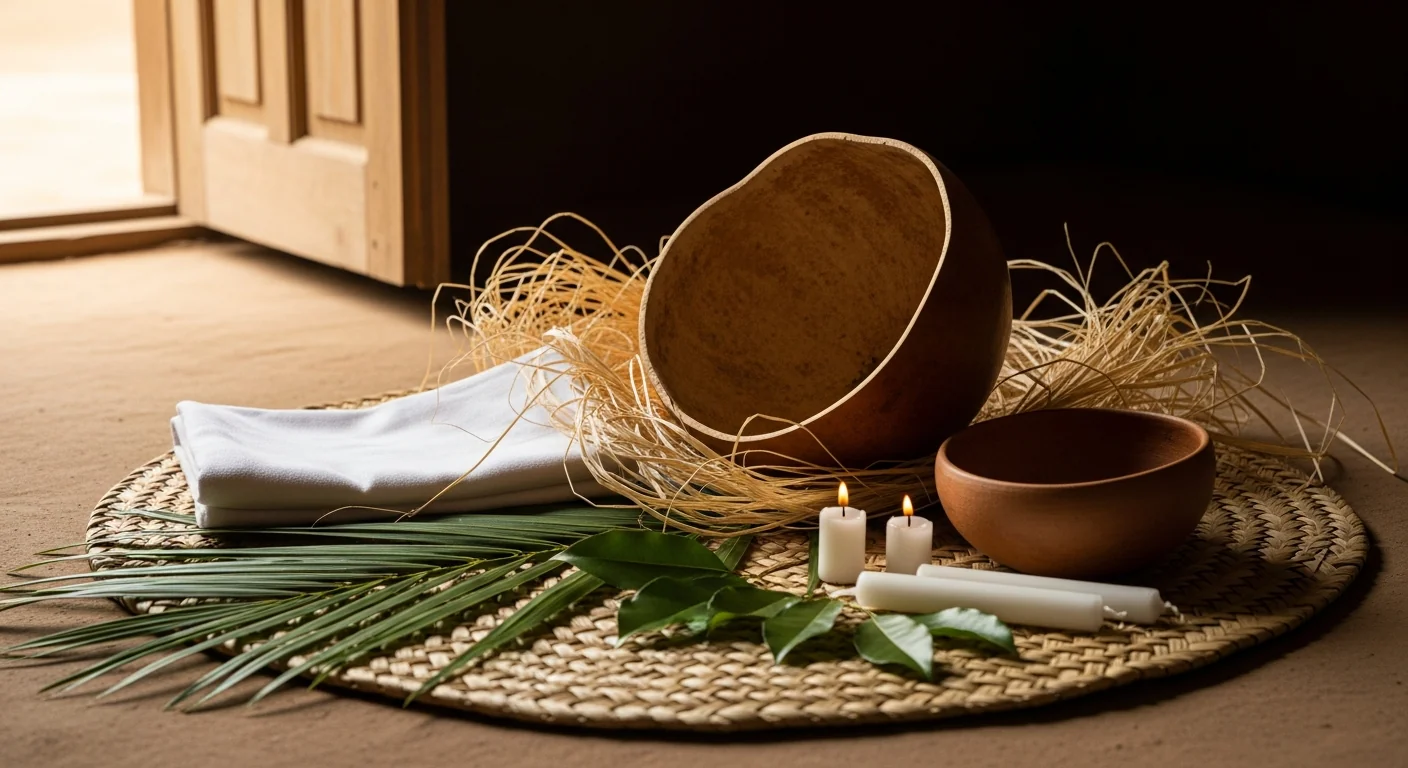
The ketu follows the same sonic logic. In place of the atabaques, a ceramic pot struck with straw fans and two gourds turned upside down in water basins enter.
One limitation worth declaring: the sources we consulted confirm the name of the rite in the angola nation, but they do not describe its liturgy. We prefer to record the gap rather than fill it with assumption.
Egum is ancestor, not haunting
Egum is the spirit of the dead: the memory, the biography, the concrete connection of that person with the community. It is not a generic spirit, it is not a backward spirit, it is not a tormented soul.
This vocabulary comes from umbanda and Kardecist Spiritism, traditions that are respectable and distinct from Candomblé. Importing it erases the Yoruba concept. Prandi calls this process the umbandização of Candomblé and describes it as a loss.
After the rite is completed, the egun becomes egungun, the honored ancestor who can return to interact with the community. In Itaparica, in Bahia, the Terreiro Omo Ilê Agbôula is the oldest house dedicated solely to the worship of babá egum. Founded in 1934, according to the opinion of IPHAN itself, it was recognized by the agency as Cultural Heritage of Brazil in 2015. The axexê follows the death of the initiate, not the calendar: therefore, Candomblé does not have All Souls' Day in the liturgy, as shown in the guide for all souls' day in umbanda.
This worship is specialized and concentrated in a few houses. It is not the routine of an orixá terreiro.
Among the orixás, the one who presides over the axexê is Iansã, to whom the conduction of the dead to the orum is attributed. Nanã (Nana Buruku), Euá, Omulu, Oxumarê, Ogum (Ogun) and, at times, Obá (Oba) also manifest. Xangô (Shango) does not participate.
The blood family, the family of santo, and the cycle that closes
The practical order usually confuses those arriving from the outside.
Immediately after death, the priests take care of the removal of the oxu. Then comes the burial, a matter for the civil family, the registry office, and the cemetery. Only after that does the terreiro organize the axexê.
In the terreiro, the rite takes place in two spaces. In a reserved area, where few enter, the objects are undone. In the barracão, the members of the house, relatives, and friends remain, and everyone dances there. The deceased is represented by an empty gourd that receives coins.
This article describes the meaning of the rite, not the procedure. The axexê is conducted by a priest with fundamento, and much of it takes place where only the fundamento enters.
Prandi ends his study with an uncomfortable observation. Most initiates end up not receiving even one day of axexê, due to cost, lack of a qualified priest, or lack of interest from the civil family. And he summarizes what is at stake: without axexê, the cycle does not close.
Frequently asked questions
How long does the axexê last?
There is no fixed number. The most cited forms are one, three, six, or seven nights, followed by the finalization on the following afternoon. The duration is proportional to the time of initiation: seven days for the older ones of santo, one day for the newer ones. Each house and each nation has its own measure.
Who can participate in the axexê?
In the barracão, the members of the terreiro, blood relatives, and friends remain, and everyone dances for the egum. The reserved area, where the objects are undone, receives only those who have the fundamento to be there. It is not social exclusion, it is a ritual division of function.
What is the carrego de egum?
It is the bundle that gathers what was undone: broken bead necklaces, the quelê, torn clothes, and broken objects. It also names the minimum funeral ceremony due to any initiate, shorter than the complete axexê. Exu (Eshu) is propitiated beforehand, because he is the one who carries the burden (carrego).
What is the difference between axexê, sirrum, and mukundu?
They are names of the funeral rite in different nations. Axexê is ketu, sirrum is jeje, and mukundu is angola, with ntambi as a variant. The purpose is close, but the liturgy, the chants, and the language change. In the houses of mina, the rite appears as tambor de choro.
Does the axexê replace the wake and the burial?
No. The wake, the burial, or the cremation follow the normal civil path, with all the death bureaucracy. The axexê comes after, in the terreiro, and deals with what the law does not deal with: the ritual bonds between the person, their orixá, and the community of santo.
Where to find liturgical use items
A reminder before everything: the axexê is not purchased. Whoever needs it must seek the terreiro itself. What the shop offers are the items of current use in religious life.
At Joia Mística Laroyê, you will find:
- White cotton cloth: for common ritual use
- White candles: in altar sizes
- Clay dishes and alguidar: pieces for daily liturgical use
- Dried and fresh herbs: for amaci and smoke cleansing (defumação)
- Bead necklaces: assembled by orixá
Visit our shop in Extrema, Minas Gerais or talk to us via WhatsApp and we ship all over Brazil.
To study the theme in depth, the reference text is Concepts of life and death in the axexê ritual, by Reginaldo Prandi, available on the USP website. The most recent academic reading is Mortuary rites in Candomblé, by Yasmin Estrela Sampaio. And the founding work continues to be The Nàgô and death, by Juana Elbein dos Santos.
References
- Reginaldo Prandi (USP): Concepts of life and death in the axexê ritual
- Yasmin Estrela Sampaio (SciELO, Mediações journal): Mortuary rites in Candomblé