



Oxumaré and Ewá are siblings in one story and husband and wife in another, and both are in the same book of myths gathered by Reginaldo Prandi. One ialorixá calls them twins, and another says they are nothing of the sort. What certainly unites them is the snake and the rainbow.
Euá, Ewá, and Yewá are spellings of the same orixá. Prandi and the theses that cite him write Euá; here it is Ewá, the most searched form. The question has several answers because itã is not a family tree: each narrative teaches one thing, and each house keeps its own.
Who are Ewá and Oxumaré, in a few lines
Ewá is the orixá of the springs and the horizon, worshipped in Ketu Candomblé and recognized as vodun in Jeje. The full profile, with family, colors, and itãs, is in who is Ewá.
Oxumaré is the orixá of the rainbow and the snake. Pierre Verger writes that he is "at the same time, male and female," and that this dual nature appears in the red and blue colors of the rainbow. For Verger, his origin is in Mahi, in ancient Daomé, "where he is called Dan." His profile is in who is Oxumaré.
Ewá: springs and horizon | Oxumaré: rainbow and snake | In common: the snake, the rainbow, the family of Nanã
Researcher Du Flor Maranhão heard the ialorixá Mãe Lúcia de Omidewá. For her, Ewá is part of the Ketu, but "she has more to do with the people of Dan, she is Fon." It is through this path, the one of the serpent, that the duo is formed in the imagination.
Are Oxumaré and Ewá siblings?
Yes, in an itã collected by Prandi in Mitologia dos orixás (2001, p. 226). There, Ewá is the daughter of Nanã and is the horizon, "the meeting of heaven and earth." She did not want to marry. She wanted to live alone, making the night fall and pulling the sun with her harpoon.
Nanã insisted on the marriage, and Ewá asked her brother for help. The rainbow hid her in the place where it ends, behind the horizon.
“And so the two siblings remained living far from their mother, there where the sky meets the earth.”
Through their mother, the two are from the family of Nanã, the same as Obaluaê and Omolu. A Ketu house, the Ilê Axé Opò Ajagunã, brings the four together as a group. According to the summary of an ethnographic video recorded there in 2021, the house calls Iewá the “sister of Oxumaré”, her “feminine version”. The columnist Djamila Ribeiro, in Folha de S.Paulo, also calls them siblings.
Are Oxumaré and Ewá married?
Also, in another itã from the same book by Prandi (p. 236). In this story, Ewá is surprised by the rainbow between the waters and falls in love. The excerpt that the researcher Naiara Paula Eugenio cites in her dissertation, defended at UERJ, says:
“And of him Euá fell madly in love. It was Oxumaré who enchanted her.”
In the version summarized by Nágila Oliveira dos Santos, she “came to marry Oxumaré, with whom she shares the secrets of the universe”. There are houses that teach the same thing. In a terreiro heard by the researcher Luciano Lima Souza, in a thesis at UESB, Oxumaré is the “husband of Euá”.
Brother on one page, husband on another. This is not a mistake by Prandi: he gathered itãs of different origins, and oral tradition coexists with versions that do not cancel each other out.
Are Ewá and Oxumaré twins?
For the ialorixá Mãe Andreia do Catimbó, yes. Heard by Maranhão in the magazine Mandrágora (2022), she says that Euá “is the twin sister of Oxumaré, daughter of Nanã”.
It is the speech of one house. No open itã that we consulted says twins. Whoever reaches this question through Google usually has heard this in the terreiro, and the honest answer is that some houses teach it this way and others do not.
”Euá is Euá”: who says they are none of that
Mãe Beata de Iemanjá, heard by Eugenio, rejects the two most repeated ideas. She does not accept that Ewá is the female side of Oxumaré and of Dan.
“Euá is Euá and Dan…”
Regarding kinship, Mãe Beata says: “it is not known if they are siblings, all are orixás who come from the Jeje”. For her, Ewá is a relative of Ibeji, of Iroko and of Oxumaré. Eugenio summarizes her position: they are “distinct orixás, but united in war and in friendship”.
The itã that Mãe Beata tells shows this alliance. Oxumaré, “who was a great man of prayer”, buys beautiful mirrors and takes them to Ewá, who dazzles the enemy army with them and avoids the war.
The reading that she rejects circulates strongly. The FUCESP federation repeats the text that Ewá “would have the same meaning as Dan or one of his halves”. Wikipedia says she is “now sister of Iansã (Oya), now sister of Oxumaré”. Neither of the two cites where they got this.
What connects the two: the snake, the rainbow and the jeje family
With source, three things bring the two orixás closer.
- The snake. In Prandi's table for Ketu Candomblé, the symbol of Ewá in the house is an iron snake. Eugenio observes that objects of Oxumaré and of Ewá sometimes get confused, because the snake “is in people's imagination as belonging to both orixás”.
- The rainbow. Oxumaré is the rainbow. For Maranhão, in some traditions Ewá is the white part of the rainbow and, in others, the red part.
- The jeje family. In Souza's thesis, the laguidibá, a disk necklace, is “from the jeje family: Omolu, Oxumaré, Euá and Nanã”. In an itã by Prandi (p. 227), Oxumaré receives Nanã's crown and becomes “the king of the jejes”.
The Fon origin carries weight. The historian Luis Nicolau Parés, cited by Montgomery and Gonzalez, records that in Bahia the serpent vodum Bessen is from the Dan family. What a vodum is and how the families are organized is in voduns in Brazil. No open source by Parés places Ewá in the Dan family. The Jeje foundation remains with the houses.
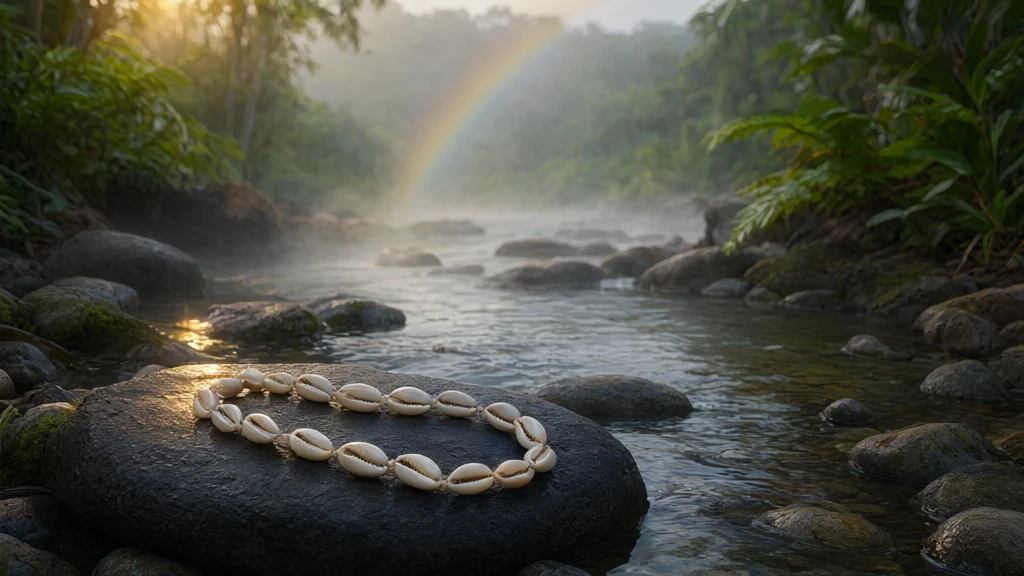
Whoever seeks a bead necklace for one of the two finds loose beads and cowrie shells at Joia Mística. The colors and the thread, however, are those indicated by the house, because they change from nation to nation.
And in the Tambor de Mina?
In the Tambor de Mina of Maranhão, the answer is different. Prandi summarizes the pantheon of the Casa das Minas, described by Sérgio Ferretti: Euá is "daughter of Azonce, also Nagô," from the Dambirá family, that of the voduns of the earth.
In a Tambor de Mina terreiro in São Paulo studied by Prandi, the table places Dangbê, which corresponds to Oxumaré, and Eowá, which corresponds to Euá, in the same family. There, Ewá is celebrated on July 16 and Dangbê on August 24, the day of Saint Bartholomew. The August date is in Saint Bartholomew and Oxumaré.
It is a fifth answer: same ritual family, another father, without marriage or twinning. Tambor de Mina is not Candomblé, and what is valid in one tradition does not automatically pass to the other.
If your doubt is about what your house teaches, the one who answers is your zelador. For questions about materials, the shop team assists via WhatsApp.
Frequently asked questions
Are Oxumaré and Ewá siblings?
In an itã collected by Reginaldo Prandi, yes: the two are children of Nanã, and Oxumaré hides Ewá where the rainbow ends. In another itã from the same book they marry. Some houses teach siblings, others husband and wife, and Mãe Beata de Iemanjá says that it is not known.
Are Ewá and Oxumaré twins?
It is the speech of the ialorixá Mãe Andreia do Catimbó, recorded by the researcher Du Flor Maranhão in 2022: Ewá would be the twin sister of Oxumaré, daughter of Nanã. No open itã consulted mentions twins, so it serves as a teaching of a house.
What is the itã of Oxumaré and Ewá?
There are two in Prandi. In the one of the horizon (p. 226), Ewá flees from marriage and her brother Oxumaré hides her behind the horizon. In the one of the rainbow (p. 236), she falls in love with him between the waters and the two marry. Mãe Beata tells a third, the one of the mirrors.
Is Ewá the feminine version of Oxumaré?
A ketu house and FUCESP read it this way, and Wikipedia speaks of her as the sister of Oxumaré. Mãe Beata de Iemanjá rejects the idea and says that Ewá is Ewá. Pierre Verger describes Oxumaré himself as male and female at the same time.
References
- Nágila Oliveira dos Santos: Orixás on the couch, with the itãs of Prandi, Revista África e Africanidades, 2010
- Naiara Paula Eugenio: A warrior face of the iabás Obá, Ewá and Oiá, dissertation, UERJ, 2014
- Reginaldo Prandi: In the footsteps of the voduns, 2005
- Reginaldo Prandi: Deuses africanos no Brasil contemporâneo, Horizontes Antropológicos, 1995
- Luciano Lima Souza: The sacred necklaces of memory, thesis, UESB, 2019
- Du Flor Maranhão: Amar e mudar as coisas no arco-íris de Euá, Mandrágora, 2022
- Vinícius Vasconcelos Castro: Dan, the rainbow serpent, Diversidade Religiosa, UFPB, 2012
- Eric J. Montgomery and Rene Gonzalez: article about Vodun, citing Parés, Revista Brasileira do Caribe, UFMA, 2019
- Gabriel Omar Alvarez: Bahia d’ Orixás, summary of the video at Ilê Axé Opò Ajagunã, 2022
- Pierre Verger: Orixás, Corrupio, 1981
- FUCESP: Ewá file
- Djamila Ribeiro: column about Ewá, Folha de S.Paulo, 2024
- Wikipedia: Ieuá entry


