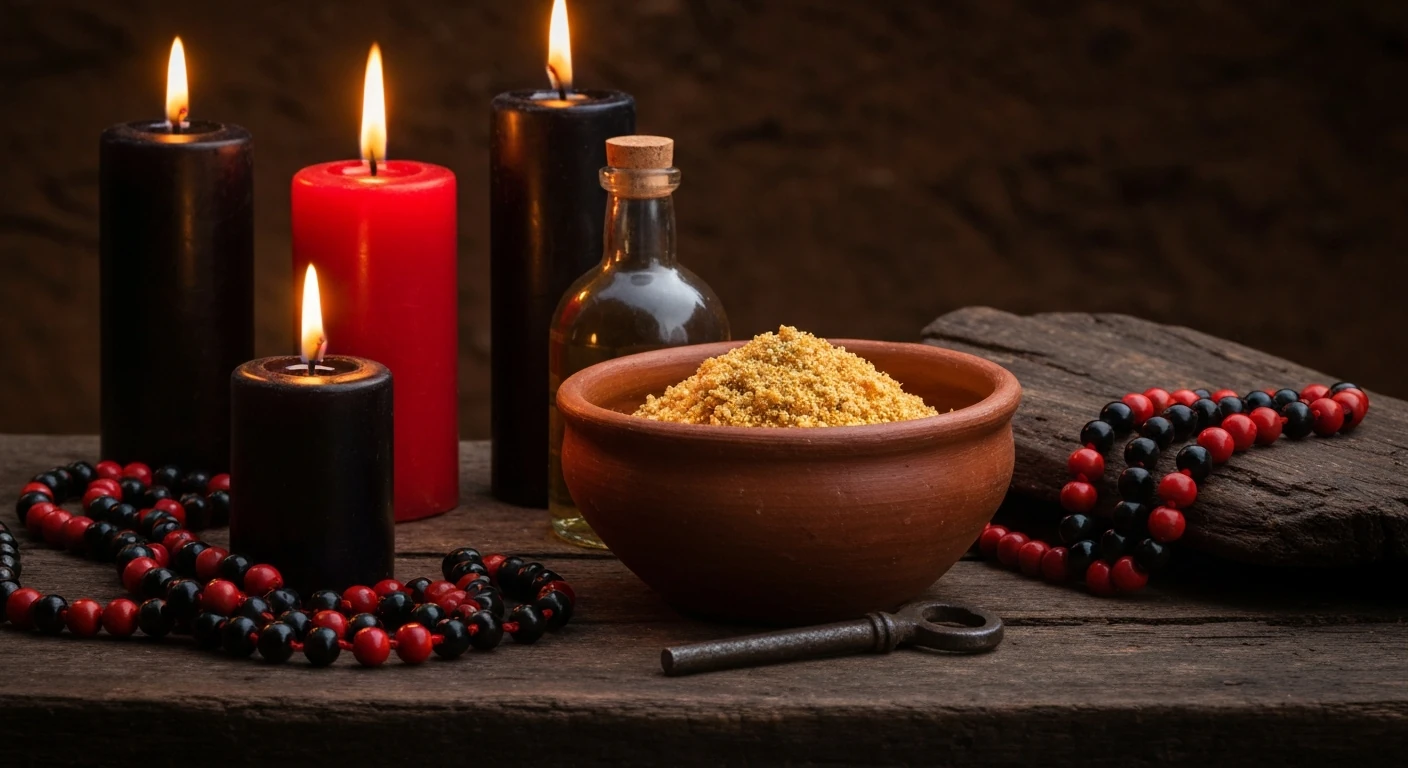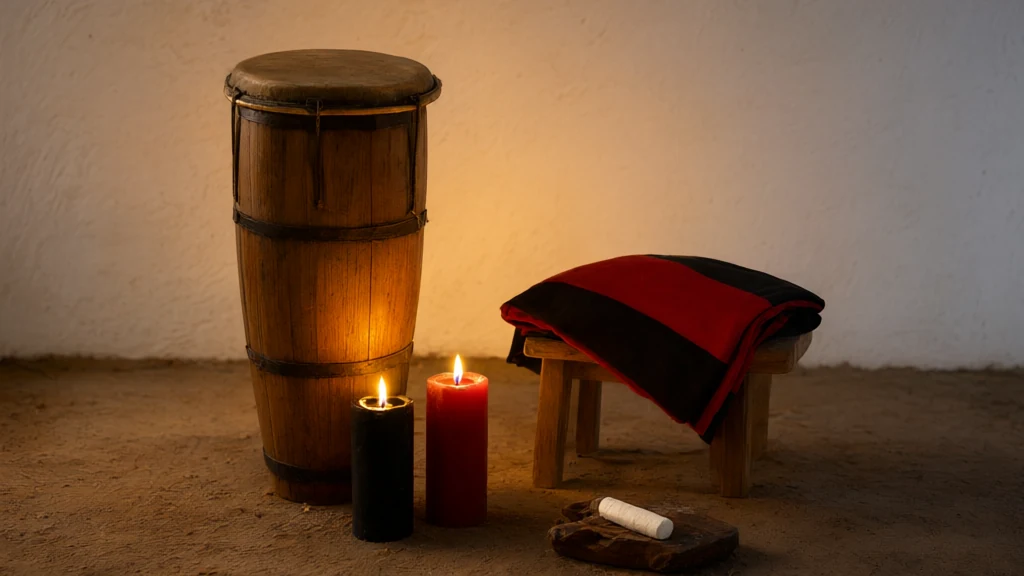
The ponto de Exu is the chant of the guardian exus in the gira of Umbanda and Quimbanda: it asks for permission, calls the spirit, firms the ritual work, and dismisses. The lyrics change from house to house, and some of the pontos have an author. Below are four pontos with sources, the moment of each, and where to read the others.
What is the ponto de Exu and when is it sung
The ponto de Exu is the ponto cantado of the Exu line, the way to call the spirit and to accompany its ritual work. Each moment of the gira has its own. The manual of the Terreiro de Umbanda Pai Maneco, in Curitiba, separates the pontos by spirit and by function.
- Opening: the Quimbanda manual of the house asks permission from Umbanda to turn to Quimbanda and, afterwards, asks permission from Exu.
- Call and greeting: each Exu has its own, with its name in the verse.
- Firmeza: in a tent in Dourados (MS), the ponto of the little church bell invokes Exu, who protects the terreiro and the ritual works.
- Subida: is the farewell chant. A ponto in the manual asks that Exu does not stumble on the path and does not mess with the neighbor.
The order and the repertoire belong to the house. Who leads the chant is a matter of the curimba in Umbanda, and the rite is in gira de quimbanda. The types of ponto in general are in pontos cantados in Umbanda.
Where it is sung: gira of Umbanda and Quimbanda | Moments: opening, call, firmeza, ritual work, demanda, subida
Which are the pontos de Exu with sources?
The open source chants to Exu are many, and here are four, all without a declared composer: the one for "Sem Exu não se faz nada", the one for Exu Tiriri, the one of the little church bell, and the one of the two heads. Each one has more than one record, with different words.
1. "Sem Exu não se faz nada"
Tá chegando à madrugada / Salve o povo de quimbanda / Sem Exu não se faz nada
The researcher Lenny de Alvarenga describes this chant as "of unknown origin" and very popular in terreiros of umbanda, of quimbanda, and in some of candomblé. In Pai Maneco, the verse is in the chant to Exu da Meia Noite. In Dourados, Haroldo Medeiros records the phrase as a chant refrain.
2. Exu Tiriri: "Toma conta e presta conta"
Exu Tiriri de Umbanda / Mora na encruzilhada / Toma conta e presta conta
It is the first of the six chants to Exu in the book of the Tenda Nossa Senhora da Piedade (TENSP), the house founded by Zélio de Moraes. The verse changes from house to house:
| Where | The verse that changes |
|---|---|
| TENSP, house of Zélio | Mora na encruzilhada |
| Collection from 1951, cited by Alvarenga | Trabalhador na encruzilhada |
| Pai Maneco, Exu Tiriri | ”Owner of the crossroads” |
Who is the spirit is in Exu Tiriri.
3. The bell of the little church, of Seu Tranca Ruas
“The bell of the little church goes belém, blem, blom / It struck midnight the rooster already crowed / Seu Tranca Ruas who is the owner of the gira”
The lyrics were already printed in 1951, in the collection Pontos cantados e riscados de umbanda, cited by Alvarenga. In Dourados, it is a ponto de firmeza, with a closing that commands to hold the gira. In Pai Maneco, it is in the Exu Tranca Ruas section of the Encruzilhada.
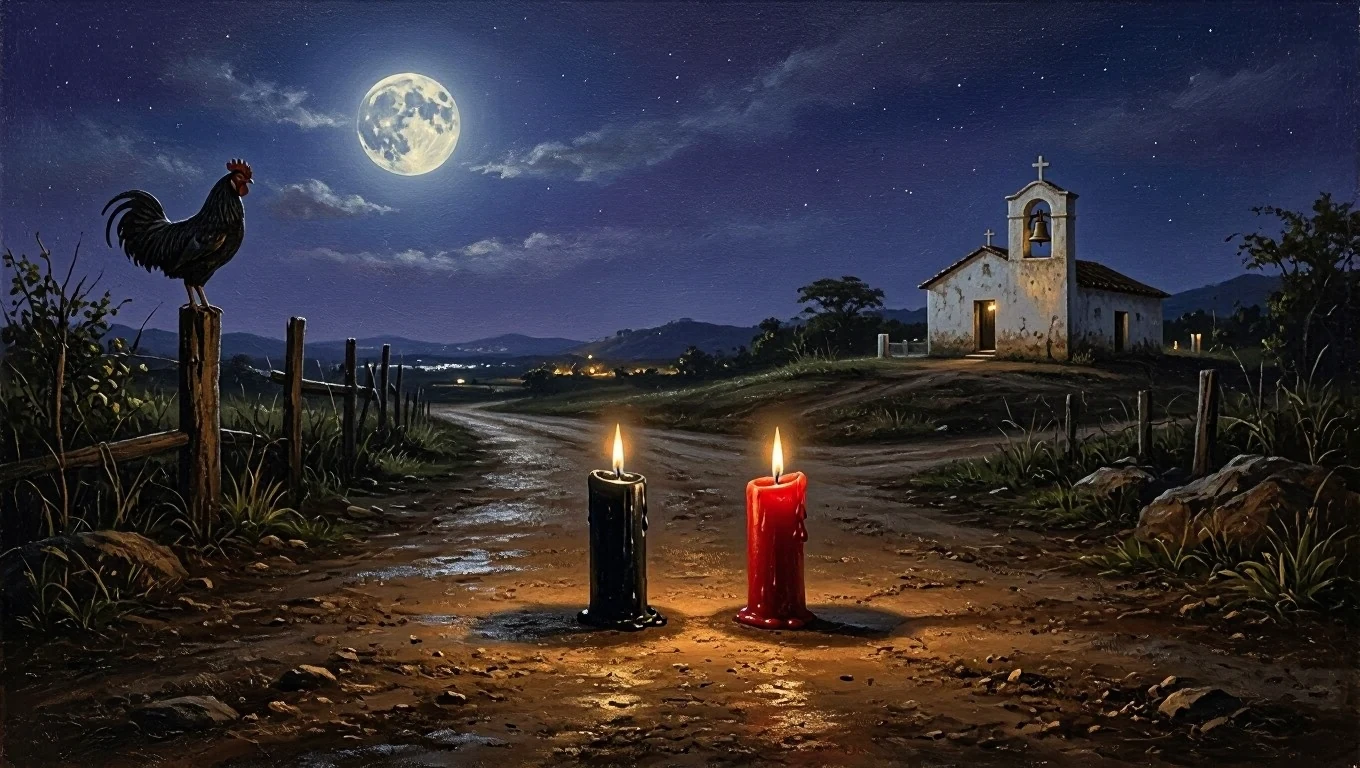
Alvarenga uses this ponto to speak of the hour of Exu. According to him, the ritual works of Exu are done at midnight and in the early morning, and not at 6h and at 18h, the hours of the Angelus. Who is he is in Exu Tranca Ruas.
4. “Exu who has two heads”
“Exu who has two heads / He gira for the children of faith”
It is ponto 04 of the TENSP. The next two verses give one head to Satan and the other to Jesus of Nazareth. Alvarenga reads the ponto as duality: in most Umbanda houses, according to him, Exu can do good or evil.
The reading is about Umbanda, and the orixá does not enter into this count. Reginaldo Prandi writes that there are no known myths of Exu that identify him with the devil. The history of this connection is in who is Exu.
What do the verses of Exu say?
The verses of Exu speak above all of what he does. An analysis gathered 221 lyrics of pontos of Exu and Pombagira, from books and records sold in religious items shops. In the pontos of Exu, the largest category was power and functions, with 31.6% of the mentions.
- Power and functions (31.6%): to work, overcome demands, watch, deliver messages, hold the gira.
- Identification and greeting (22.4%): the name of the spirit and the hail to it.
- Hierarchical relationship (15.3%): other exus, Ogum (Ogun), Saint Anthony.
- Protection (7.1%): the Exu who protects those who are connected to him.
The repertoire is large: in three books of pontos from Florianópolis, with 1,719 pontos, the group of Exu and pombagira is the largest in the chart: 335 pontos. The names of the spirits are in names of Exu.
Who does the chant to Exu belong to?
Part of the chants to Exu have an owner, and part run without a known author. Pai Maneco's booklet marks "Composition:" on 12 pontos. Most bring a composer's name, one brings "Spirit" and another brings "Public Domain" next to a name. The rest come without a mark.
Diamantino Trindade, cited by Lourival Andrade Júnior, calls the "brought directly by the incorporated spirits" root pontos. The others come from composers, "very common in curimba festivals." The mãe de santo Kátia d’Omulú, from Florianópolis, told researcher Lucas Espindola that before the spirit pulled the ponto and the ogã recorded it. Today, for her, there is a medium singing what they hear on YouTube.
Therefore, there is no list of lyrics here. The article only cites pontos without a declared author, in two or three verses. Others that appear in the search, such as "quando a saudade apertar," were not in the open sources in this research, and the lyrics are not completed from memory.
Whoever looks for the chant of an Exu can read what the house publishes in the Pai Maneco Exu booklet:
| Exu | In the booklet |
|---|---|
| Tranca Ruas | of the souls, of Embaé and of the crossroads; there is a ponto with an author |
| Tata Caveira | with Caveirinha and João Caveira; there is a sung chant with author |
| Marabô | own section; the first sung chant has an author |
| Veludo | own section; his ascent has an author |
| Mirim | separate booklet, the one at n. 27 |
The correct lyrics and melody for your gira are those of the curimba of your house. The test of which is your Exu suggests an affinity and does not change the orientation of the terreiro.
What is the difference between ponto de Exu, cantiga, and ponto riscado?
The difference between ponto de Exu and cantiga lies in the religion and in who receives the chant. In general, the ponto is from umbanda and quimbanda and calls the guardian. The cantiga is from candomblé and greets the orixá. Reginaldo Prandi, cited by Nascimento and colleagues, separates the two names and calls both "instruments of identity of the spirits".
- In candomblé: according to Roger Bastide, every ceremony begins with a tribute to Exu, the padê, for his role as messenger. The ketu chants on the site, such as Exú Ajuô Mamã, come in phonetic spelling.
- In Umbanda: Alvarenga notes that the exus come after the other spirits to work, and that the consultation is done through spirit incorporation in a medium.
The ponto riscado is the drawing made with pemba. In most cases, the spirit draws it, intones its ponto cantado, and firms the drawing with a pointer. The lines are in ponto riscado de Exu. Whoever needs to check the pemba or the candle that the house requested can speak with Joia Mística via WhatsApp. To pray to Exu instead of singing, the text is in prayer for Exu.
Frequently asked questions
What is the most well-known ponto de Exu?
Among the pontos with a source, the one for "Sem Exu não se faz nada" (Without Exu, nothing is done). Alvarenga registered it as very popular in terreiros of umbanda, quimbanda, and some of candomblé, and Medeiros calls the phrase a refrain. There is no national count.
Is there a ponto de Exu for protection or to open a path?
There are pontos that speak of this, and protection is 7.1% of the mentions in the analysis of 221 lyrics. Pai Maneco has a ritual work ponto with the cape of Seu Tranca Ruas, called a mantle of caridade, and a ponto de firmeza about opening a path. A ponto is a gira prayer, without guarantee of results.
Does the ponto de Exu serve for Pombagira?
Pombagira has her own points. Pai Maneco publishes a separate booklet, number 26, and in the analysis of the 221 lyrics, only 7 points mention the two together. Her points are in ponto de pomba gira, and who she is, in who is Pombagira. Other lines have their own article, such as ponto de Ogum and ponto de Iemanjá.
References
- TENSP: Book of Sung Chants (Pontos Cantados)
- Terreiro Pai Maneco: lyrics of the pontos, with the booklets
- Alvarenga, UCG (2006): The resignifications of Exu within umbanda
- Nascimento, Souza and Trindade (2001): Exus and Pombas-Giras in the pontos cantados
- Medeiros, UFGD (2019): Quebra o coco e arrebenta a sapucaia
- Espindola, UFSC (2024): The voice of Exu in the Umbanda of Florianópolis
- Andrade Júnior, Mouseion (2015): Pontos riscados and nominations
- Andrade Júnior, Mneme (2014): The caboclos in Afro-Brazilian religions
- Prandi, USP Journal (2001): Exu, from messenger to devil