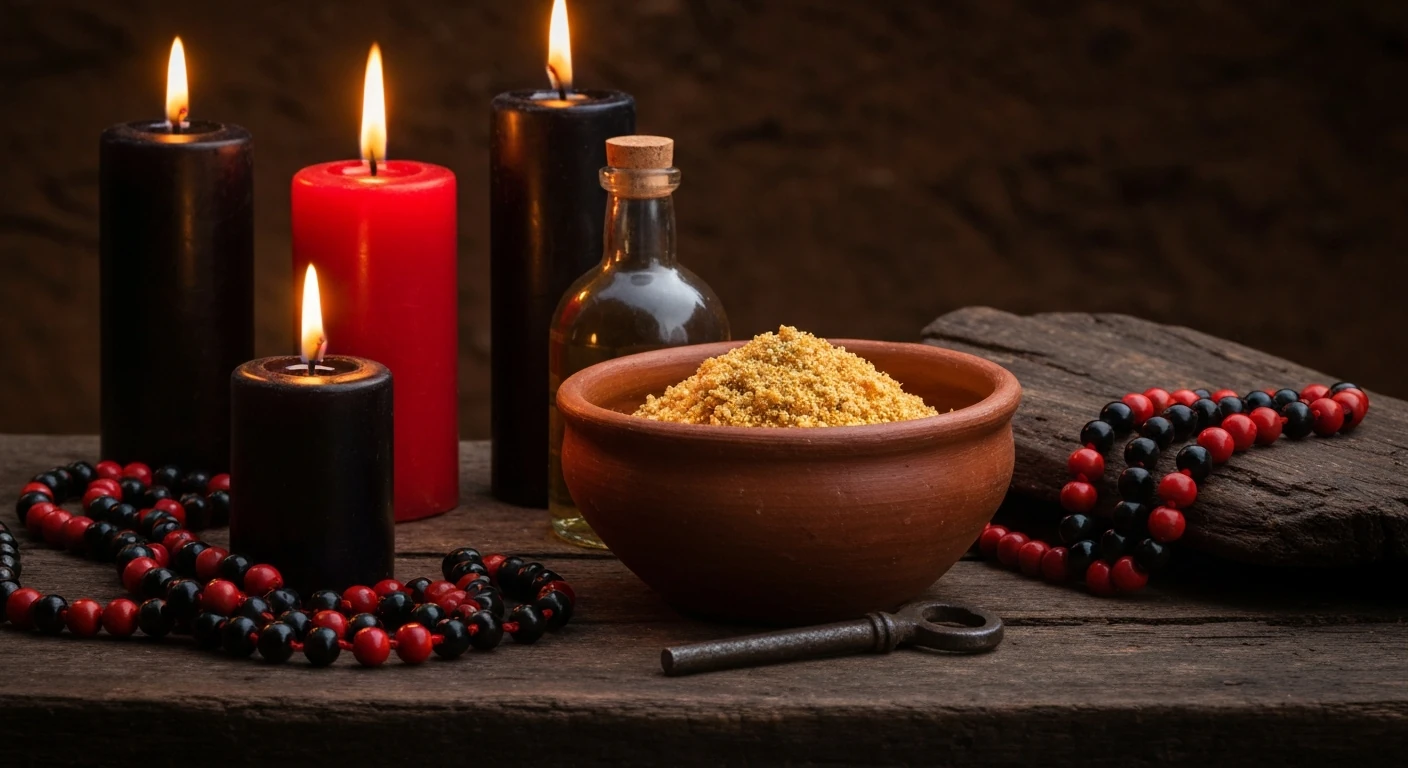
Exu Marabô is one of the most respected guardians of Umbanda and Quimbanda. Lord of paths, of crossroads, and of hidden justice, he carries a reputation of firmness, and also the weight of an old prejudice that insists on confusing him with the devil. Those who know the tradition know that this confusion is a historical error, not a truth about the spirit.
This guide presents who Exu Marabô is, his field of ritual work, the line to which he belongs, and the devotion profile with day, colors, and offerings. It also explains why the idea that "Exu is the devil" needs to be undone with respect and with foundation.
Who is Exu Marabô
Exu Marabô is a guardian exu, a spirit that acts in Umbanda and Quimbanda as a protector and worker of paths. Different from an orixá (orisha), he is understood by tradition as the spirit of someone who lived on Earth and today works on the other side, fulfilling his function within the spiritual Law.
His domain is the crossroads, the point where paths cross and decisions are made. He is asked for opening of paths, prosperity, protection against negative energies, breaking of demanda, and, above all, justice. Marabô has a reputation as a spirit who brings the truth to light and undoes deception, which is why he is sought by those who feel like victims of lies or of ritual work.
As happens with Exu Tranca Ruas, "Marabô" is not the name of a single spirit, but a title of work within the line of the Exus. Each house receives and settles its Marabô in its own way, within the living tradition of each terreiro.
Greeting: "Laroyê Exu!" It is the traditional way to greet the Exus in Umbanda and Quimbanda. One also hears "Exu Mojubá" and "Salve os Compadres".
Is Exu Marabô the devil? The answer is no
This is the most common and most unfair confusion, so it is worth saying clearly: Exu Marabô is not the devil. The association between Exu and the Christian demon is a distortion of colonial origin, not a fact of Afro-Brazilian religion.
Researcher Reginaldo Prandi shows how this happened in the study Exu, from messenger to devil. Still in the 19th century, the first European dictionaries translated the name of the orixá Exu as "devil", the devil. Catechism did the rest, superimposing the Christian figure of absolute evil over the image of the African messenger.
But Exu is not evil. He is force of movement, communication, and transformation. He is ambivalent like life, capable of opening and closing, but never the incarnation of evil. Reducing Marabô to a "bad thing" is reproducing the religious racism that still haunts Umbanda, Quimbanda, and Candomblé in Brazil. Treating the spirit with respect is part of undoing this prejudice.
Exu orixá and exu guardian: the difference that changes everything
A good part of the confusion surrounding Marabô arises from mixing two distinct planes. On one side is the Exu orixá, called Èṣù in Yoruba traditions. He is a divinity, the messenger who carries the offerings and brings the answers between men and the orixás. It is he who is discussed in the profile about who is Exu, the orixá of the paths.
On the other side are the exu guardians of Umbanda and Quimbanda, such as Marabô, Tranca Ruas, and Exu Caveira. They are not divinities, but rather spirits, spirits that work under the vibration of the Exu line. The Kardecist reading of Umbanda understands them as spirits in evolution, guardians who watch over spiritual order.
The entry about the Exu of Umbanda, which brings together authors such as Prandi and Vagner Gonçalves da Silva, helps to set this distinction. Orixá and guardian are different things, and treating both as synonyms erases the foundation of both traditions. To understand the whole of the worship, it is also worth reading what is Quimbanda.
The line and the field of ritual work of Marabô
To which orixá is Exu Marabô linked? Here honesty is required: there is no single consensus, and the answer varies according to the house and the line. There are terreiros that link Marabô to the energy of Ogum and of Xangô, the lords of war, law, and justice, which matches his profile as a just spirit. In esoteric Umbanda, the Matta and Silva table places Marabô in front of the Exus of the Oxóssi (Oshosi) vibration. The researcher Sônia Lages (UFJF), who reproduces the table, summarizes: "the Exu Marabô, for example, corresponds to the Vibration of Oxóssi and is the element of service and connection with the Caboclo Arranca-Toco". The dissertation by Pedro Nogueira (UFJF) records the same correlation in Rivas Neto, successor of Matta and Silva.
The most correct way is to present this connection as a variation of foundation, not as a closed rule. What is repeated in the houses is the field of ritual work: paths, defense, prosperity, and justice. Like every exu, Marabô also has his female pair in Pombagira, the feminine side of the Exu line. The lady who works by his side changes from terreiro to terreiro, so one should not fix a single name.
The day, the colors, and the offerings of Exu Marabô
Knowing the spirit's profile helps to worship it with respect. In most houses, it is usually like this:
Day: traditionally Friday | Colors: red and black | Drink: the marafo (cachaça) | Location: the crossroads
The day varies according to the terreiro, and there are houses that work with Marabô on Monday or Tuesday. The most cited offerings include cigars, red and black candles, farofa de dendê, coins, pepper, and strong fruits like grapes and figs, delivered at the crossroads with guidance. The drink and the cigar are ritual elements, part of the tradition, and not an invitation to consumption.
Here a central caution is needed, the same one that the tradition repeats about all Exus:
An offering is not a payment for a guaranteed result, nor a "ritual work" to harm someone. It is a gesture of respect, reciprocity, and a request, always made with the guidance of a pai or mãe de santo. Making a despacho on your own, asking for harm to third parties, goes against the foundation and the ethics of the house.
The sung chant and the greeting of Exu Marabô
In the gira, Exu Marabô is called by sung chants, the music that firms the presence and the vibration of the spirit. One of the best known chants repeats his name as a call: "Marabô ié, Marabô iá... Where is Marabô?". Each house keeps its own versions, transmitted in the axé of the community.
The greeting, like that of the entire line, is "Laroyê Exu!". Greeting Marabô is recognizing the guardian who works for order and justice, not invoking any force of evil. Whoever feels a connection with the spirit finds the right path by seeking a serious terreiro of Umbanda or Quimbanda, where the worship is learned in practice and with foundation. To know the larger structure of this worship, see the realms of quimbanda.
Frequently asked questions
Who is Exu Marabô?
Exu Marabô is a guardian exu worshipped in Umbanda and Quimbanda, lord of the paths, of the crossroads, and of justice. He works in the opening of paths, in protection, and in breaking demands. The name is a title of work within the line of Exu, and it does not refer to a single spirit.
Is Exu Marabô the devil?
No. The idea that Exu is the devil is a colonial and Christian distortion, created to demonize Afro-Brazilian religions. Exu is a force of movement and communication, not evil. Marabô is a guardian who acts for order and justice, within the spiritual Law, and treating him as a "bad thing" reinforces religious racism.
What is the day, colors, and drink of Exu Marabô?
The day most associated with Marabô is Friday, although it varies by house. The traditional colors are red and black, and the ritual drink is marafo, the cachaça. Cigar, candles, and farofa complete the devotion. Everything must be used as a ritual element, with the guidance of the terreiro.
How to make an offering for Exu Marabô?
The offering is usually delivered at the crossroads, with red and black candles, cigar, marafo, farofa, and strong fruits. The essential point is respect: an offering is not payment for a result nor ritual work against someone. Always seek the guidance of a pai or mãe de santo before consecrating any delivery.
What is the difference between Exu orixá and Exu Marabô?
The Exu orixá, or Èṣù, is a Yoruba deity, the messenger between men and the orixás in Candomblé. Exu Marabô is a guardian exu, a spirit that works in Umbanda and Quimbanda under the vibration of the Exu line. They are different planes, and one should not treat one as a synonym of the other.
Where to find items for Exu Marabô
At Joia Mística Laroyê, you find what you need to consecrate your devotion to the guardian with respect to the foundation:
- Red and black candles: the colors of consecrated foundation (assentamento) and firmeza of Marabô
- Statues of Exu: for your point of guard and devotion
- Ritual cigars and marafo: used in traditional offerings
- Bead necklaces (guias) and protection firmas: in the colors of the guardian Exus
- Patuás and defense amulets: for those seeking protection on the paths
Visit our physical store in Extrema, Minas Gerais and we ship to all of Brazil. For guidance on the correct use of each item and how to consecrate your devotion with responsibility, talk to us via WhatsApp.
References
- Reginaldo Prandi: Exu, from messenger to the devil, a study on the origin of the association of Exu with the devil
- Wikipedia: entry on the Exu of Umbanda, with references to Prandi and Vagner Gonçalves da Silva
- Lages, Clio Edições Eletrônicas (UFJF, 2003): Exu: light and shadows
- Nogueira, dissertation (UFJF, 2014): The intra-religious dialogue in Umbanda