The pontos riscados of Exu are the signature of the guardian exu: strokes made with pemba, with which the spirit identifies itself when it incorporates. They exist in umbanda and in quimbanda, and each house reads the strokes in its own way [D7, D22].
The general basis of the subject is in ponto riscado in umbanda. Here is what research says about the strokes of Exu and why the drawing is not copied.
What is the ponto riscado of Exu and what is it for
Vagner Gonçalves da Silva, from USP, defines the pontos riscados as "emblems elaborated by the Exus to identify themselves when they incorporate into their children, especially in umbanda sessions." A pai de santo heard in a USP thesis gives it a nickname: it is the "identity record" of the spirit.
The use goes beyond identification. Silva describes that the Exus draw the ponto and light candles over it to build "a center of force." An Exu heard in another USP research says that the ponto has many functions, and that the first is to communicate. In both cases, it is the word of an author or of a spirit, and not a promise of results.
Ponto riscado is a thing of the guardian. The orixá Exu, in candomblé, has other objects: the laterita, the ogó, and the iron forks, treated in symbols of Exu. The pontos riscados are, according to Lourival Andrade Júnior, "striking and indispensable in Umbanda," and also appear in gaúcha and paulista quimbanda [D7, D8].
Regarding the origin, the art historian Arthur Valle places the pontos riscados among the kongo graphic writing systems, of central African origin. In Rio, the name "pontos riscados" has been valid since at least the beginning of the 20th century.
Who draws the ponto: it depends on the house
The most common answer is that the entity is the one who draws. The Terreiro de Umbanda Cabocla Tupyara writes that the riscado is "done only by the entities". In an Afro-Gaúcho Quimbanda ceremony, researchers saw Exu himself drawing pontos with pemba.
But it is not a rule for all houses. In the Nação Livre Aruanda, an independent terreiro in Cotia (SP) studied by Ligia Nobre, the babalorixá draws most of the pontos before incorporating a spirit guide or orixá. It is an unusual house, and it shows the variation.
A spirit from the Curitiba study asks that it be recorded that the ponto should come "naturally, with the development of the medium". Who can draw is a matter for the house and its leader.
What a study of 318 pontos riscados of Exu found
The most cited study on the subject is that of Lourival Andrade Júnior, who analyzed 318 pontos riscados of Exu. They came from two houses in Itajaí (SC) and from a 1974 book, the 3000 Pontos riscados e cantados. It is a small and regional sample: the numbers below apply to it, and not to all of Brazil.
| Element | In how many of the 318 pontos | Author's reading |
|---|---|---|
| Trident | 316 | the fork appears in almost all |
| Cross | 142 | hybridization with Christianity, or the idea of death |
| Star | 27 | ”sign of evolution and wisdom” |
| Moon | 4th most frequent | fertility, irrationality, unconscious and hidden |
The trident has its own entry in tridente de Exu. Note that the right column is always the author's reading. Andrade also warns that each Exu can have more than one ponto, and that the ponto must be understood as a whole, and not stroke by stroke.
The same stroke, three readings
The fork's shape shows well why a dictionary of symbols does not work. Three houses read the straight and curved shapes in different ways:
| House or source | How the fork is read |
|---|---|
| Centro Espírita Caboclo Junco Verde (Itajaí, SC), via Andrade | curved: dominance in the Calunga (the cemetery). Straight: the crossroads. Many Exus act in both |
| Nação Livre Aruanda (Cotia, SP), via Nobre | straight for Exu Lebara. Rounded for Pombagira |
| Terreiro de Umbanda Pai Maneco (Curitiba, PR) | round: pombagira energy. Square: exu energy |
In the first house, the shape indicates the domain. In the other two, it indicates the gender of the spirit. Prandi records the rounded shape of the Pombagira on objects kept in the rooms of the candomblé Exu. No one is wrong: each house has its own reading.
Who looks at the drawing from the outside does not know which reading is valid.
Why each house has its own and the drawing is not copied
Arthur Valle writes that Afro-Brazilian religions are diverse and tradition is oral. Therefore, "it is common for the meaning of a certain iconographic element to vary from terreiro to terreiro". Only knowledge of the context in which the ponto riscado was made "can ensure its correct interpretation". Many fundamentals are not accessible to those who are not initiated.
Alice Macedo, in a USP thesis conducted in a terreiro de umbanda, reaches the same conclusion: "there is no fixed interpretive key". This conclusion is about the ritual work of umbanda in general, and not just about the ponto.
The most direct voice comes from inside a house. A spirit heard by Terreiro de Umbanda Pai Maneco, in Curitiba, said:
“It is not about following a model just because the same spirit in another, older medium draws the ponto this way or that way”
The group also records the warning that a book should not become a mold for pontos, because it would influence the mediums and lead to errors. Another quote from the study says there is "much more in a ponto riscado than the spirits will speak", as the key of the ponto.
Not even the ponto is fixed. Andrade calls the ponto the "definitive signature" of the spirit. Meanwhile, a study in Curitiba records an Exu who worked for 22 years with one ponto and changed to another upon reaching maturity. The ponto is stable within the house, in the relationship between the spirit and their medium, and does not apply to others.
In some houses it is made, seen by few and erased immediately, "so that it is not misused," tells an Exu heard by Nobre.
Why the blog does not publish the ponto of each Exu
Google shows that many people search for the ponto of a specific Exu: Caveira, Marabô, Tiriri, Capa Preta, Veludo. Here you will not find the drawing, and the reason is above: the ponto of one house is not that of another, and reproducing a ponto as a model would be teaching how to copy what the spirits themselves ask not to be copied.
What exists is the record of each Exu, without drawing: Caveira, Marabô, Tiriri, Veludo, Tranca Ruas, Capa Preta, do Lodo and Mirim. All are in Exu names.
An important note: the strong appearance of the ponto, with a trident and skull, is not a sign of "evil." An Exu heard in the Curitiba study explains that the trident and skull served to "scare," in the sense of imposing respect. There was no saint to syncretize with the Left. Andrade says the same about the scary names given to the Exus. It is protection of the house. For background, see who is Exu.
If you want to understand your ponto, it comes from your house and your leader. The pemba can be found in the shop, and Joice helps check the material via WhatsApp. Which pemba your house uses to set the ponto is told by your pai or your mãe de santo.
Frequently asked questions
What does the star mean in the ponto riscado of Exu?
In the study of 318 pontos, Andrade reads the star as a "sign of evolution and wisdom." It is the reading of one author about two houses of Santa Catarina and a book. Other houses read it differently, and the correct meaning is that of your house.
What does the cross mean in Exu's ponto?
She appears in 142 of the 318 pontos studied. Andrade offers two readings: the hybridization with Catholic Christianity and the idea of death associated with Exu. Neither counts as a rule outside of the sample.
Who can draw the ponto de Exu?
It depends on the house. In several, the one who draws is the spirit, upon incorporating [D4, D9]. In others, it is the babalorixá before incorporating. The rule belongs to the terreiro and the leader.
Can I draw an Exu's ponto riscado (sacred sigil) at home?
The blog does not teach how to draw pontos riscados. The spirits heard in Curitiba ask that the ponto come with the development of the medium, without inventing pontos, and that no book model be followed. Seek your house.
Is pemba the same thing as chalk?
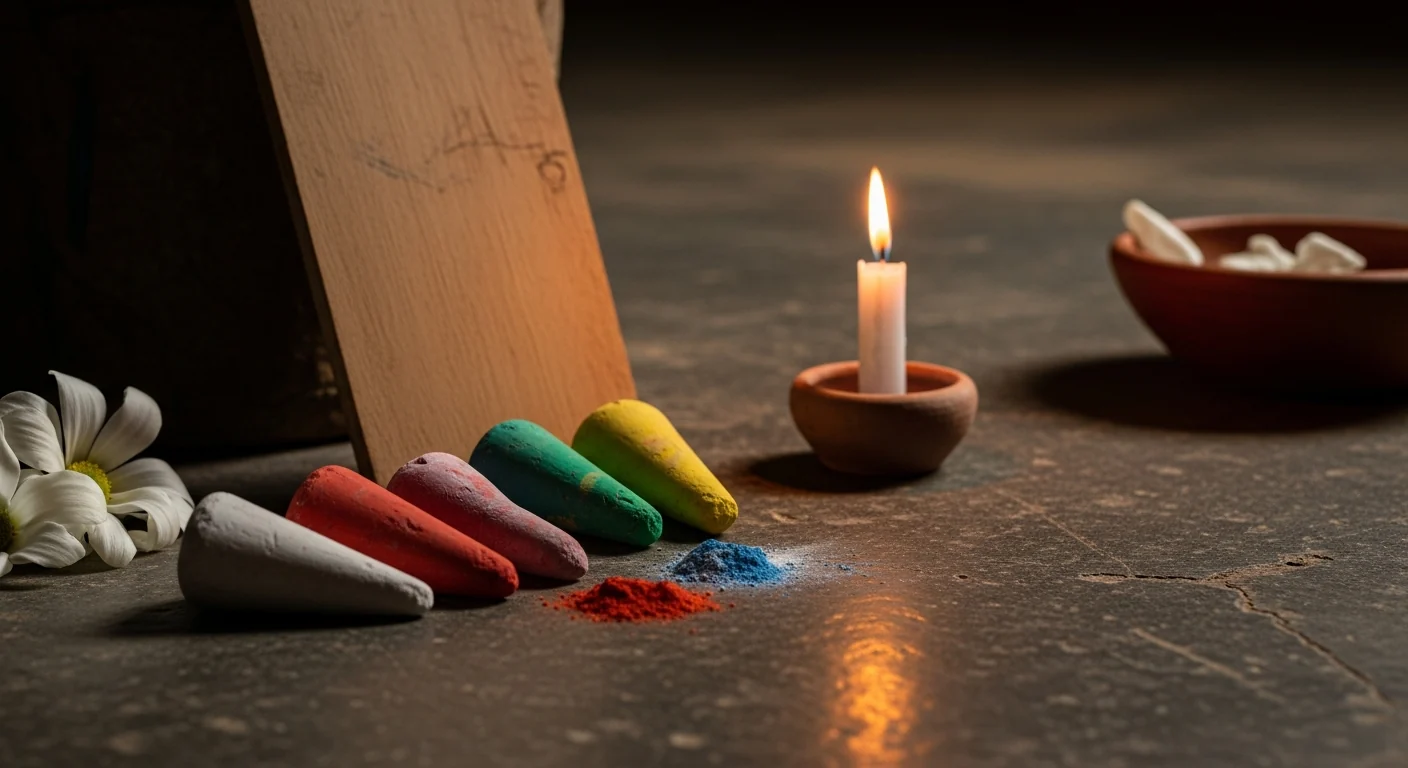
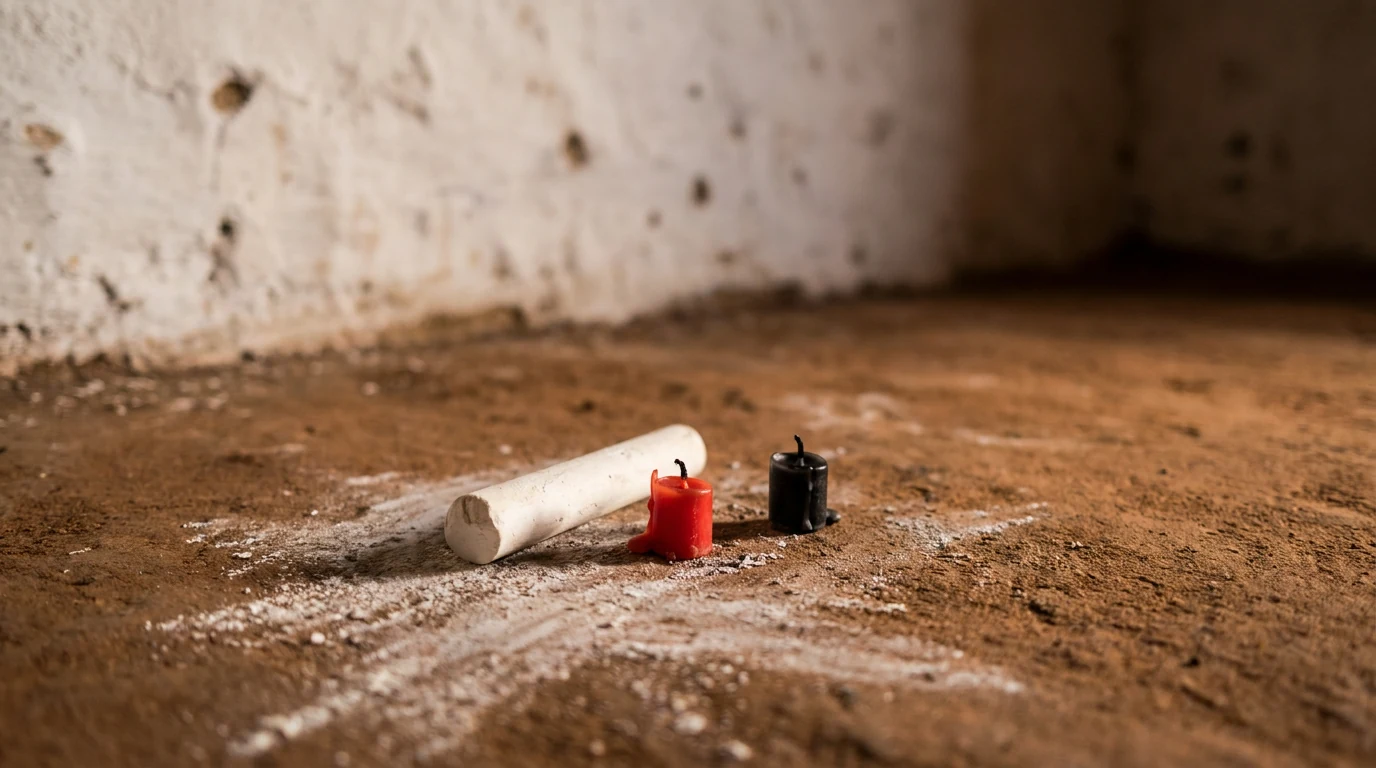
Pemba is the chalk used to draw the ponto. Camargo, in an article from UNESP, reads pemba as a reference to the world of the dead, and the white color as the bones of the ancestors. It is the author's reading.
References
- Vagner Gonçalves da Silva: Exu do Brasil, Revista de Antropologia, 2012
- Lourival Andrade Júnior: Pontos riscados and nominations, Exu in discussion, Mouseion, 2015
- Arthur Valle: Pontos riscados, spiritual invocation, naming, geometric thinking, Anais do CBHA, 2019
- Ligia Velloso Nobre: terra-chão in movement, ponto riscado, art, ritual, thesis, USP, 2019
- Alice Costa Macedo: Crossroads of interpretation in Umbanda, thesis, USP, 2015
- Eduardo Regis and Sônia Lages: The initiation ceremony in Afro-Gaúcha Quimbanda, Revista Calundu, 2024
- Hertz Wendell de Camargo: Dikenga Dia Kongo, ancestralities of Umbanda in Curitiba, Patrimônio e Memória, 2023
- Reginaldo Prandi: Pombagira and the Unconfessed Faces of Brazil, 1996
- Terreiro de Umbanda Pai Maneco: Interviews about pontos riscados made with spirits
- Terreiro de Umbanda Cabocla Tupyara: Marking, drawing, and singing pontos, 2025