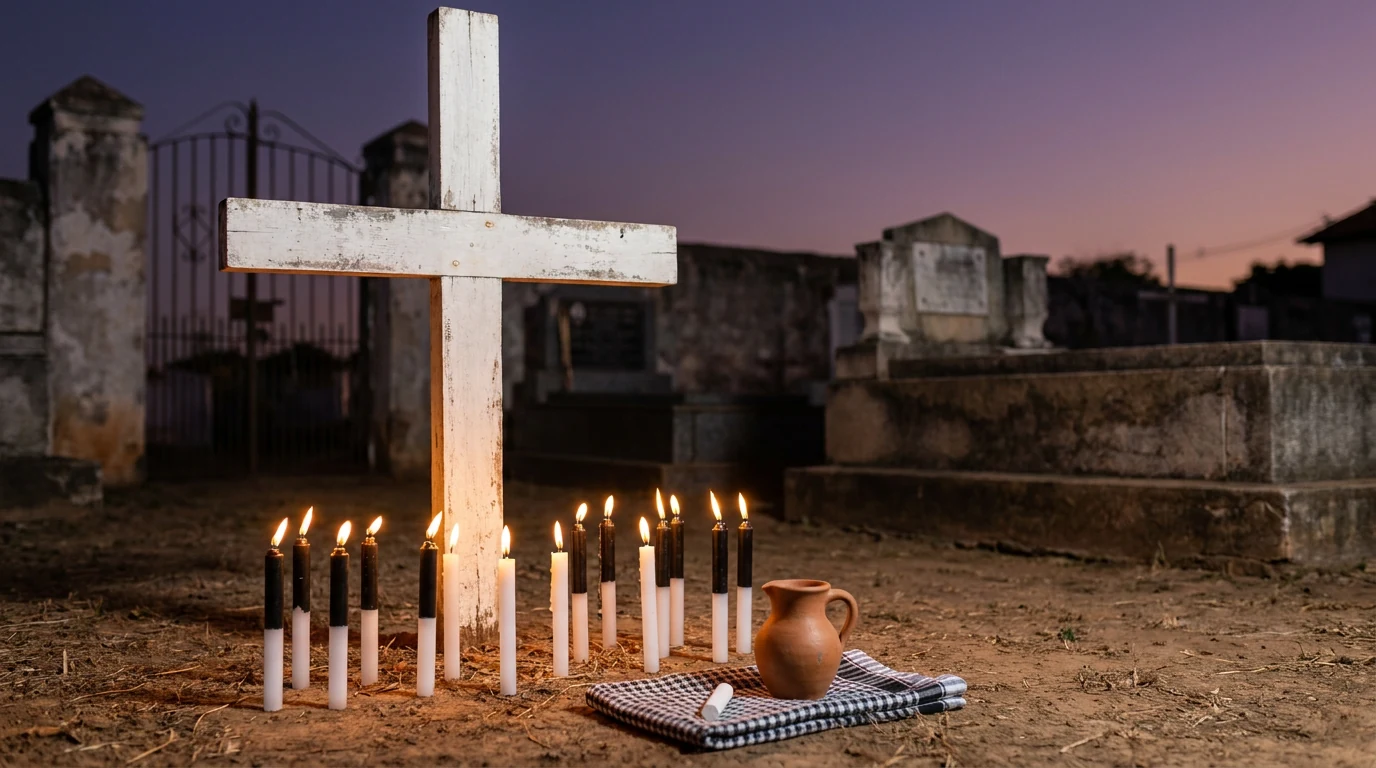
Tatá Caveira, which research writes as Tata Caveira, is an Exu of the Caveiras spiritual legion (falange), worshipped in Umbanda and Quimbanda. The first Umbanda books place him among the Exus who work under the orders of Omolu, the lord of the cemeteries. He works in the calunga, the cemetery. And his name crosses with Exu Caveira and João Caveira.
Spiritual legion (falange): Caveiras | Orixá of the line: Omolu or Obaluaê, depending on the house | Territory: calunga and gatekeeper of the cemetery | Sung greeting: Laroyê, Exu Tata Caveira | Color and day: those of the house
Who is Tatá Caveira?
Tatá Caveira is the name of a falange, a group of spirits that work under the same name. It is not just one person. Researcher Lourival Andrade Junior, from UFRN, counts the caveiras among the most active groups in the giras of umbanda: Exu Caveira, Exu Tata Caveira, Exu João Caveira, and Exu Caveirinha. The São Paulo federation FUCESP puts the same names, with 7 Caveiras, in a single falange.
The name speaks of the place where he works. Vagner Gonçalves da Silva, from USP, shows that most of the names of Exu in umbanda refer to points of passage. Many speak of the "intercession between the world of the living and the dead," such as cemeteries, catacombs, and caveiras. The Caveira of the name is the address.
Tata, Tatá, or Táta?
All three spellings appear. "Tata" is the one used in research and by FUCESP. A terreiro in Curitiba writes "Tata" and "Tatá" in the same booklet of sung chants. A bill in Porto Alegre used "Táta".
In the candomblé of nação angola, tata is a quimbundo word that means father. It becomes a title for a priest, as in tata Katuvanjesi. No source says that the name of the Exu comes from there. This connection remains as an interpretation.
This Exu is a guardian who manifests in the terreiro. The orixá Exu of candomblé has its own worship, and the difference lies in who Exu is.
To which orixá does Tatá Caveira belong?
In most sources, Tatá Caveira comes in the line of Omolu, also called Obaluaê. Reginaldo Prandi summarizes the table of the first umbanda books. In it, Tata Caveira is the most well-known name of the Exus who work "under the orders of the orixá Omulu, the lord of the cemeteries." FUCESP says that the falange of the caveiras is "submissive" to Obaluaê. And a sung chant from the Terreiro de Umbanda Pai Maneco, in Curitiba, sings "Saravá Rei Omolu" before calling "Exu Tatá Caveira."
In a house in Ribeirão Preto studied by USP, the leader says that the cemetery exu is from the line of Omolu. There, he is sought in ritual work for healing and health. This line connection can vary from terreiro to terreiro, Andrade Junior recalls. The orixá has an article in Omolu in Umbanda, and the entire line in Line of the Souls in Umbanda.
Atotô is a greeting for the orixá, not for Exu. FUCESP records "Atotô Obaluaê!" for Obaluaê. For Tatá Caveira, the chant from Curitiba sings "Laroyê Exu Tata Caveira".
Are Tatá Caveira and Exu Caveira the same?
They are different names for the same falange, and in the gira the names get mixed up. FUCESP lists Exu Caveira, João Caveira, and Tata Caveira side by side, without putting one above the other. Wikipedia, citing a devotional book, says that the two have a similar ritual. For it, Tata Caveira "works in the seven fields of faith", and Exu Caveira stays in the calunga. It is the most repeated difference on the internet, and its basis is weak.
The sung chants show how the names go together. In Pai Maneco's handout, the verse "Iron gate, wooden padlock" opens a chant for Tata Caveira. The same verse opens a chant for João Caveira, in which "who rules the cemetery" is João. A chant published in 1974 with the title "Exu Tata Caveira" sings "I am Caveira" in one verse and "I am João Caveira" in the other. And a bill in Porto Alegre says that João Caveira can come through the falange of Exu Caveira, of "Táta Caveira" or of Omulu.
| Name | What the sources say |
|---|---|
| Tatá Caveira | most well-known name of the Exus of Omolu in the first books; head of the falange for a house of Quimbanda |
| Exu Caveira | name of the cemetery falange, with an article in Exu Caveira |
| João Caveira | guards the cemetery gate in a house in Ribeirão Preto |
Who leads the falange depends on the house. A Quimbanda house calls Tatá Caveira the "head-of-falange" on its website. FUCESP puts everyone on the same line. In your house, what the leader teaches is what counts.
Where Tatá Caveira works: the calunga and the gate
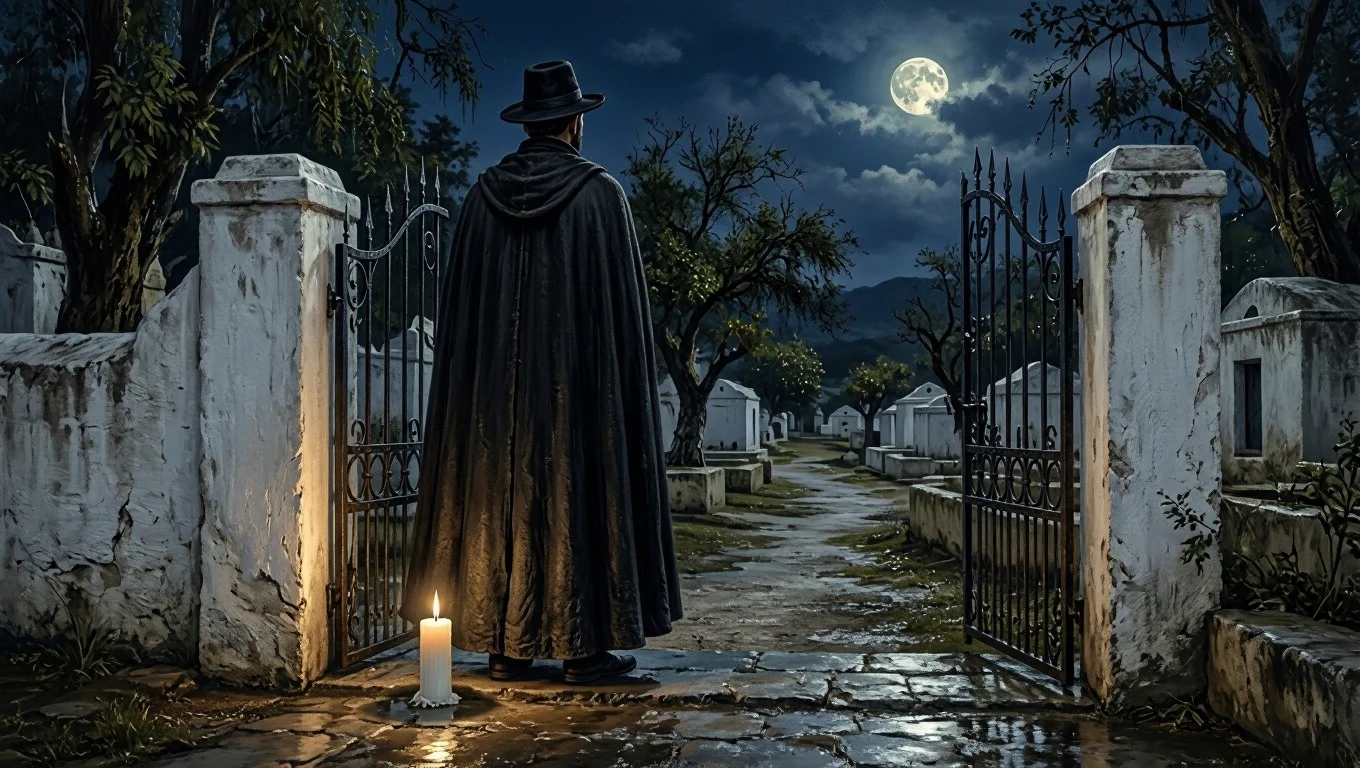
Tatá Caveira works in the calunga, the cemetery, and the sung chants place him at the gate. A sung chant by Pai Maneco describes the silence of the Calunga and "a noise at the gate" when he passes. Why so many cemetery guardians carry the surname "of the Souls" is in Exu das Almas.
For Umbandistas, the spirits occupy "the gate, the graves, the walls, the cross," writes Andrade Junior. That is why those who go to the cemetery ask for permission before entering, even to visit. In the researcher's phrase, "the owners need to allow entry and stay." The cross has an article in cruzeiro das almas.
What to offer and which candle to light
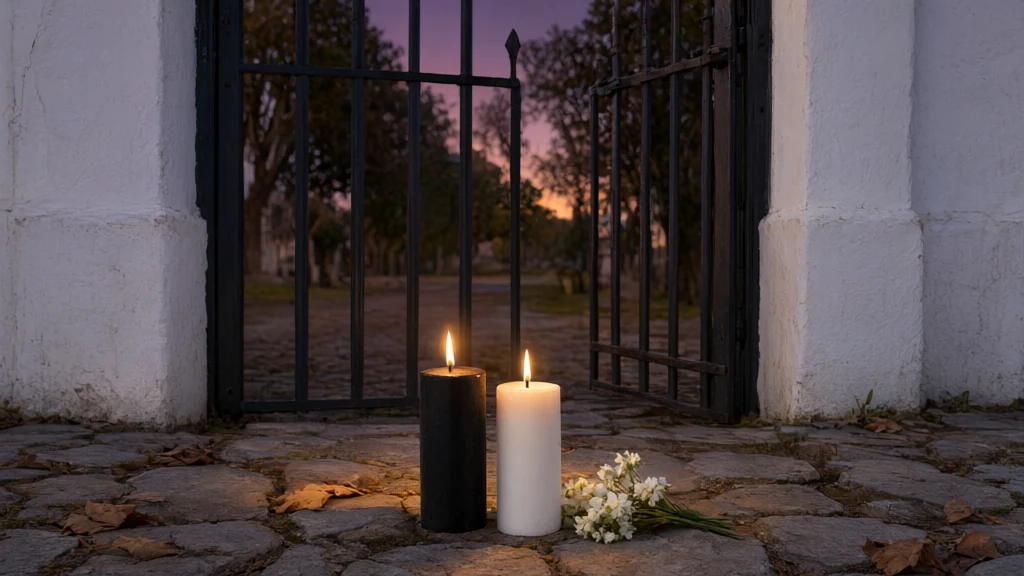
There is no record of a specific offering for Tatá Caveira. For the orixá of the line, FUCESP cites white and black candles, preferably delivered at the cemetery cross. The black candle and the white candle are in the Joia Mística shop, in Extrema, Minas Gerais. Those who want to light one from afar have the virtual candle of Exu Tatá Caveira. If your house requested another color, check with us via WhatsApp before buying. What is based for the falange is in what Exu Caveira likes.
Is the legend of Proculo that of Tatá Caveira?
The legend of Proculo circulates as the life of Tatá Caveira, and the name Proculo was already next to him in the first Umbanda books. On a Quimbanda house website, he would have been born in 670 A.D. and lived in Egypt. He would have died burned with his companions, and from there would come the 49 exus of the Caveira line.
The name has an origin that the legend does not tell. Prandi records that the first authors of Umbanda gave each Exu a name of a devil from the Christian imagination. On the table he summarizes, next to Exu Tata Caveira, appears, in parentheses, "Proculo". The dates and places of the history have no source.
The legend helps to understand what is told in the terreiro, but it is devotion, not biography. How Exu became a synonym for the devil is in religious racism. The other guardians are in Exu names.
How the house treats Tatá Caveira
Who says if a person works with Tatá Caveira is the terreiro, by spirit incorporation and by the word of the leader. The test what is your Exu returns Exu Caveira, the falange, and not Tatá Caveira. It serves as a self-knowledge game.
His sung chants exist in books, but they belong to the house and the spirit. Why they are not copied is in Exu sung chants. Firmeza and assentamento stay with those who have preparation, as shown in Exu assentamento.
Frequently asked questions
What is the color of Tatá Caveira?
No research records a specific color for Tatá Caveira. FUCESP cites white and black candles for Obaluaê, the orixá of the line. The correct color is the one your terreiro uses for the Caveiras falange.
What is the greeting of Tatá Caveira?
In a terreiro in Curitiba, the sung chant sings "Laroiê Exu Tata Caveira", the greeting of the Exu people with his name. "Atotô" is the greeting of Obaluaê, the orixá to whom the falange is linked. Many houses write Laroyê, which is the same word.
Is Tatá Caveira evil?
No. The fame comes from the first Umbanda books, which gave each Exu a name of a European devil. For Umbandistas, the cemetery spirits occupy the gate, the graves, and the cross, a place of passage between the living and the dead. A serious house does not use his name to harm anyone.
Is Tatá Caveira from Umbanda or Quimbanda?
Both. Andrade Junior records the caveiras in Umbanda giras, and there are Quimbanda houses that worship him and tell his life story. The difference between the two religions lies in what is Quimbanda.
References
- Reginaldo Prandi, USP Magazine (2001): Exu, from messenger to the devil
- Lourival Andrade Junior, Diálogos (2021): the cemetery as a sacred space
- Vagner Gonçalves da Silva, Anthropology Magazine (2012): Exu of Brazil
- Alice Costa Macedo, USP (2015): thesis on Umbanda
- Renato Botão, UNESP (2007): Candomblé Angola-Congo
- FUCESP: Obaluaê
- Pai Maneco terreiro: Exu points
- Wikipedia: Exu Caveira
- Porto Alegre Chamber: PLL 484/2021