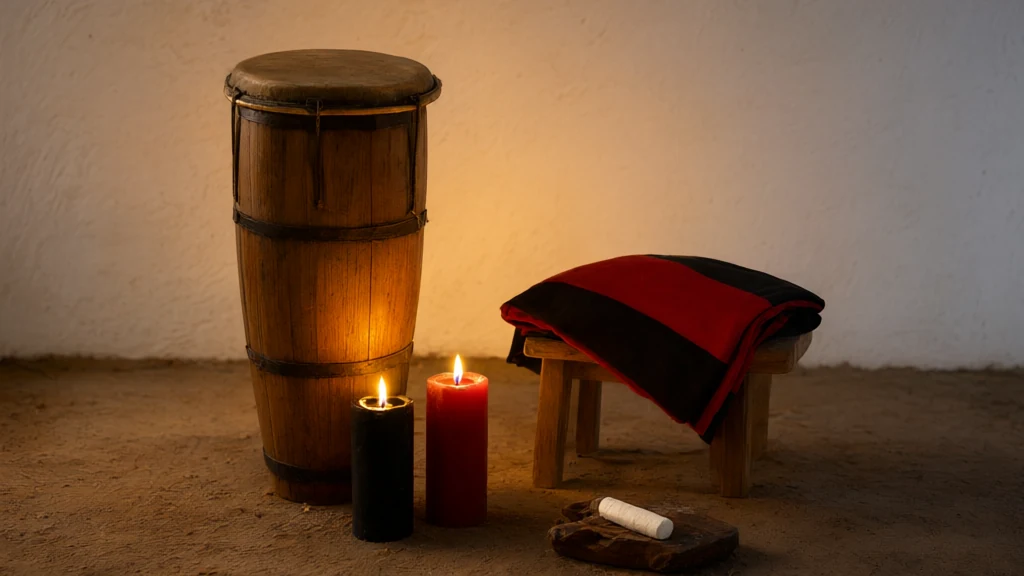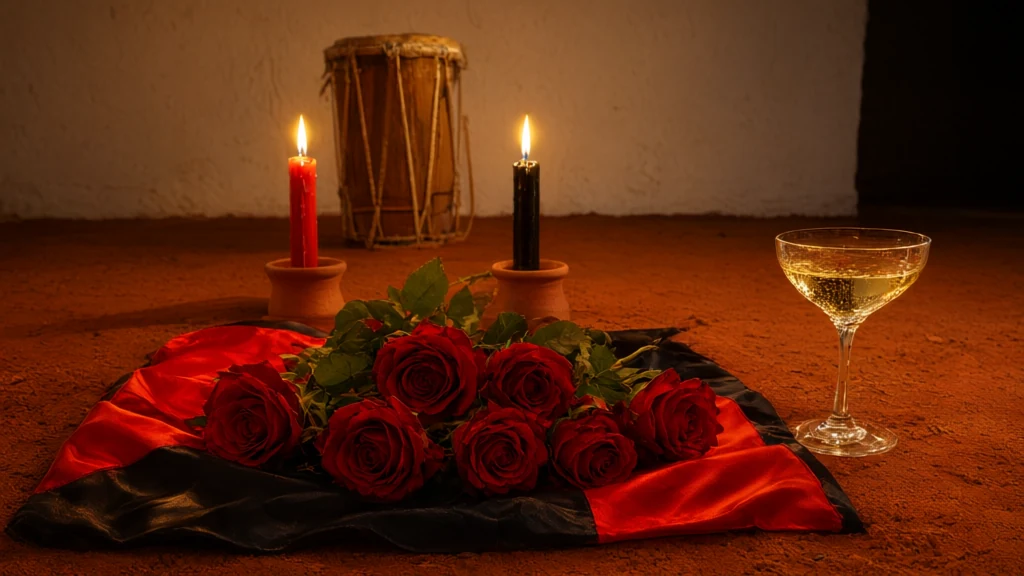
The pombagira chant is the song of the left-side gira that announces the arrival of the Pombagira, calls each spiritual legion (falange) by name, and bids farewell at the end. In Umbanda and Quimbanda, the curimba leads the chant to the sound of the atabaque. The lyrics change from house to house. Below, four chants with sources and the moment for each one.
What is the ponto of pomba gira and when is it sung?
The ponto of pomba gira is the ponto cantado of the Pombagira line, the way to call the entidade and to accompany her ritual work. Nilza Lagos remembers that "Ponto is also prayer, because through them one is instructed."
Each moment of the gira has its own. The "Pomba Gira" booklet from Terreiro de Umbanda Pai Maneco separates the pontos into three blocks: the individual ones, one per falange, the line pontos, and the subida ones.
- Arrival: the "Arreda homem que aí vem mulher" generally announces the arrival of the pombagiras, according to Lagos. Reginaldo Prandi records another, sung when she arrives incorporated.
- Call of the falange: Maria Padilha, Menina, Maria Mulambo, and Rainha have pontos with their names on the back.
- Line pontos: serve for everyone and speak of Pombagira in general.
- Subida: is the farewell. In the Pai Maneco pontos, she says goodbye and leaves, and the medium remains.
The order and the repertoire belong to the house. Whoever leads the chant is in curimba na umbanda, and the rite, in gira de quimbanda. Whoever is the entidade is in quem é Pombagira.
Where it is sung: gira de umbanda and de quimbanda | Moments: arrival, call, line, ritual work, subida | Greeting in the ponto: "Laroyê, é mojibá"
Which Pombagira pontos have source records?
Four Pombagira pontos appear in two or three independent sources, without a declared composer. Here are only short excerpts.
1. "Arreda homem que aí vem mulher"
“Move aside man, a woman is coming / She is the Pombagira / The woman of great faith”
It is the first line point of Pai Maneco. Nilza Lagos, from the Methodist University of São Paulo, gave the verse to the title of her dissertation: the point “generally announces the arrival of the women (Pombagiras)” and marks their entry onto the ritual stage. The verse is also in a book from Florianópolis studied by Lucas Espindola, from UFSC, with another continuation.
2. “In red and black”
The point opens with “In red and black” and closes like this:
“She is a beautiful girl / Oh, spinning, spinning, spinning there”
Prandi writes that this point is sung for Pombagira “when she arrives incorporated”. In Pai Maneco, it is the second line point. In Florianópolis, Espindola found it in more than one book, with “dressed at night” in the second verse.
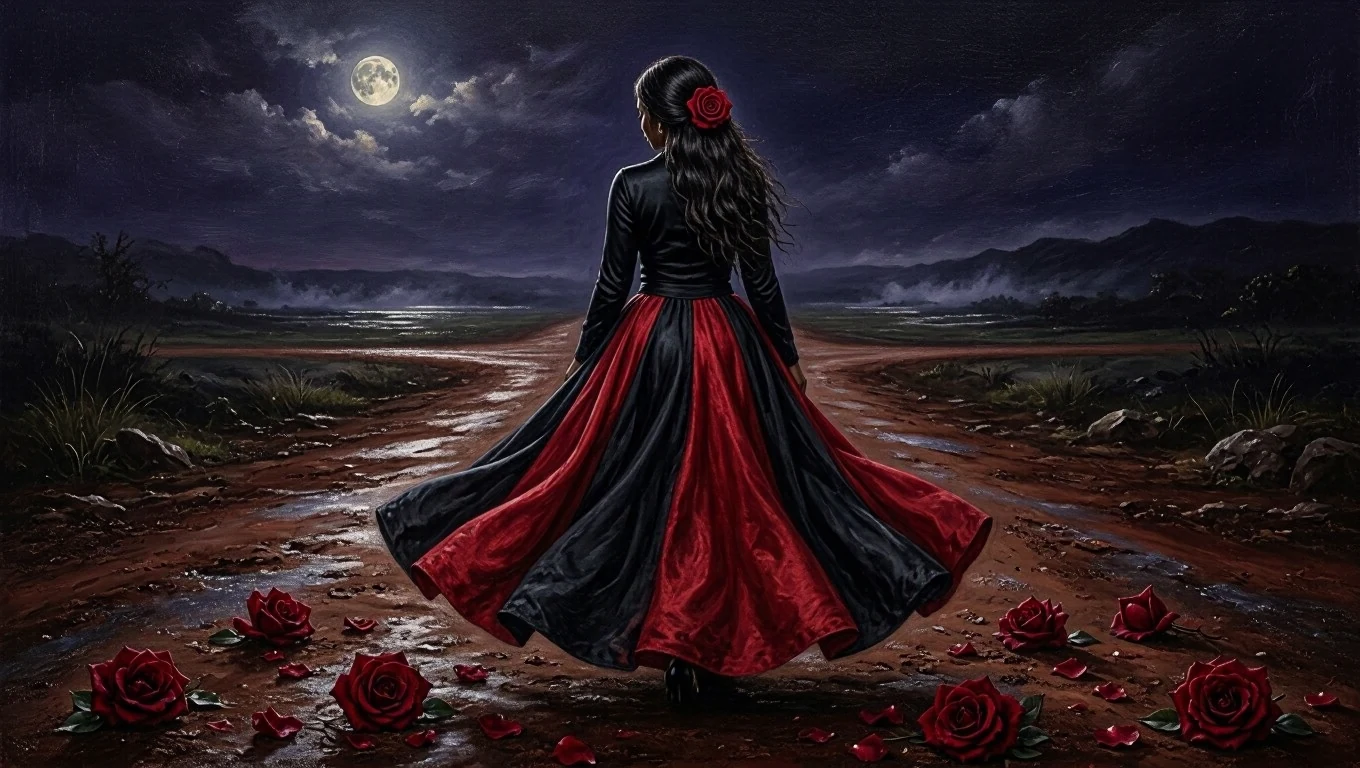
3. Pombagira Menina: “Look at what a beautiful girl”
“Look at what a beautiful girl / Look at what a beautiful girl / It is Pombagira Menina”
Adriano Nascimento, Lídio de Souza and Zeidi Trindade use it as an example of the points that describe her appearance. The lyrics come from books and records from religious items shops. In Pai Maneco, the version says “What a beautiful girl” and ends with the Menina “Leaning on the window”. Who she is can be found in Pombagira Menina.
4. “Exu made a house”
“Exu made a house / With seven doors / With seven windows”
The point continues: Exu does not need a house, and it is Pombagira who will live in it. It is among the line points of Pombagira of Pai Maneco and in two books from Florianópolis, there with the title of Exu. In the research of the 221 lyrics, only 7 points mention the two together. In them, she appears as a companion, “woman (not wife) of the Exus”.
What do the verses of the sung chant say about Pombagira?
The verses of the pomba gira sung chant speak of a beautiful girl who gira, in a skirt, in pink, at the crossroads, and with laughter. In the Pombagira sung chants analyzed by Nascimento and colleagues, appearance and power tie: 30.23% of mentions each.
- The girl and the skirt. The statue brings girl, beautiful, lovely girl, and a flowing skirt. In a sung chant by Pai Maneco, water runs and a flower is born on the hem of her skirt.
- The ritual work. The functions the verses give her: to work, to command the dawn, to overcome demands, to carry mandinga to the bottom of the sea, to cut the entanglement, and to watch. The instruments are scissors, a silver fork, and a steel pointer. A line sung chant saves the scissors that cut all entanglement.
- The rose. Prandi records open red roses, "never buds," among her gifts. In a sung chant collected by Ana Laura Brito and Nara Takaki, she is the rose that bloomed under a pile of thorns, and it is asked that she opens the paths. The flower itself is in pink of Oxum, Iemanjá, and Pombagira.
- The crossroads and the laughter. The Queen lets out a laugh when she arrives at the crossroads, and Maria Mulambo comes laughing through the crossroads. Prandi speaks of "uproarious laughs."
There are verses that repeat the stereotype of the dangerous woman, such as those of the seven husbands. Brito and Takaki read the sung chants as a counter-narrative to these stigmas. For Lagos, the Arreda is a precursor that gives voice to women in the gira. What is taken to her is in offering for Pombagira.
Whose is the pomba gira sung chant?
The sung chant of pomba gira does not have a single owner: some come from oral tradition, without an author, and others have a composer. Diamantino Trindade, cited by Andrade Júnior, calls the first ones root sung chants, "brought directly by the incorporated entities." The others are "very common in curimba festivals." For Brito and Takaki, they are oral chants, "hardly with known authorship."
The notebook of Pai Maneco marks "Composition:" on five sung chants, among them the one of Pombagira Cigana; the rest come without a mark. For this reason, there is no list of lyrics here, but rather where the house publishes those of each spiritual legion (falange):
| spiritual legion (falange) | In Pai Maneco's booklet | On the blog |
|---|---|---|
| Maria Padilha | four sections, among them the one of the Crossroads, with the "dói, dói" sung chant | Maria Padilha |
| Maria Mulambo | own section and the one of Calunga | Maria Mulambo |
| Cigana | own section; the sung chant has a composer | Pombagira Cigana |
| Sete Saias | two sung chants | Pombagira Sete Saias |
| Maria Quitéria, Rosa Caveira, Dama da Noite | own sections | pombagira names |
The right lyrics and melody for your gira are those of your house's curimba. The test of which is your Exu or Pombagira suggests an affinity and does not change the orientation of the terreiro.
What is the difference between a chant to Pombagira, a chant to Exu, and a ponto riscado?
The difference between a pombagira chant and an Exu chant lies in whom the verse calls: she has her own chants, and few mention both. In the analysis of the 221 lyrics, only 7 speak of both together. In three books from Florianópolis, with 1,719 chants, Exu and Pombagira form a single group of 335 chants, the largest in the chart. The chants of the exus are in ponto de Exu.
- In Candomblé: Prandi writes that Pombagira originates in Quimbanda and is worshipped in most terreiros of Umbanda and in a large part of those of Candomblé. In Congo and Angola Candomblés, one of the names of Exu is Bombogirá, "from which Pombagira is certainly a corruption." The sung chant of the house of pombo plays with the name, sometimes Pombogira, sometimes Pombagira.
- In Umbanda: Prandi calls the flame "a woman-Exu, as she herself likes to be called," and says that the pontos are "instruments of identity for the spirits."
The ponto riscado is the drawing made with pemba. In most cases, the entidade draws the ponto riscado, intones their ponto cantado, and firms the drawing with a pointer. For Brito and Takaki, the riscado comes from the strength of the pemba, and the cantado "operates in the strength of the efó," the power of the word. The foundation is in ponto riscado in Umbanda. Whoever needs to check the red and black candle or the pemba that the house requested can speak with Joia Mística via WhatsApp.
Frequently asked questions
What is the sung chant (ponto cantado) for Pombagira's ascent?
Every house has its own. Pai Maneco's booklet brings four points of ascent. In one of them, she says goodbye, takes her leave, and leaves; in another, the crossroads and then the calunga call, she goes, and the medium remains. The exact lyrics are those of the curimba of your house.
Is there a Pombagira point for love binding (amarração) or to attract someone?
A point is a gira prayer, not a recipe. Lagos reminds us that, through the point, the house provides doctrine. The points with sources speak of arrival, ritual work, and farewell, and the blog does not publish points that promise to bind someone. Guidance must be requested from the house.
What is the most well-known Pombagira point?
There is no national count. Among the points with sources, "Arreda homem que aí vem mulher" has three independent records. Lagos calls it a very significant point, which announces their arrival.
References
- Terreiro Pai Maneco: Pomba Gira points booklet
- Prandi (1996): Pombagira and the unconfessed faces of Brazil
- Prandi, Esboços (2010): Coração de Pombagira
- Nascimento, Souza and Trindade, Psicologia em Estudo (2001): Exus and Pombas-Giras in the sung chants
- Lagos, UMESP (2007): Arreda homem que aí vem mulher
- Espindola, UFSC (2024): The voice of Exu in the Umbanda of Florianópolis
- Brito and Takaki, Sede de Ler (2025): Between words and points
- Andrade Júnior, Mneme (2014): The caboclos in Afro-Brazilian religions
- Andrade Júnior, Mouseion (2015): Pontos riscados and nominations